
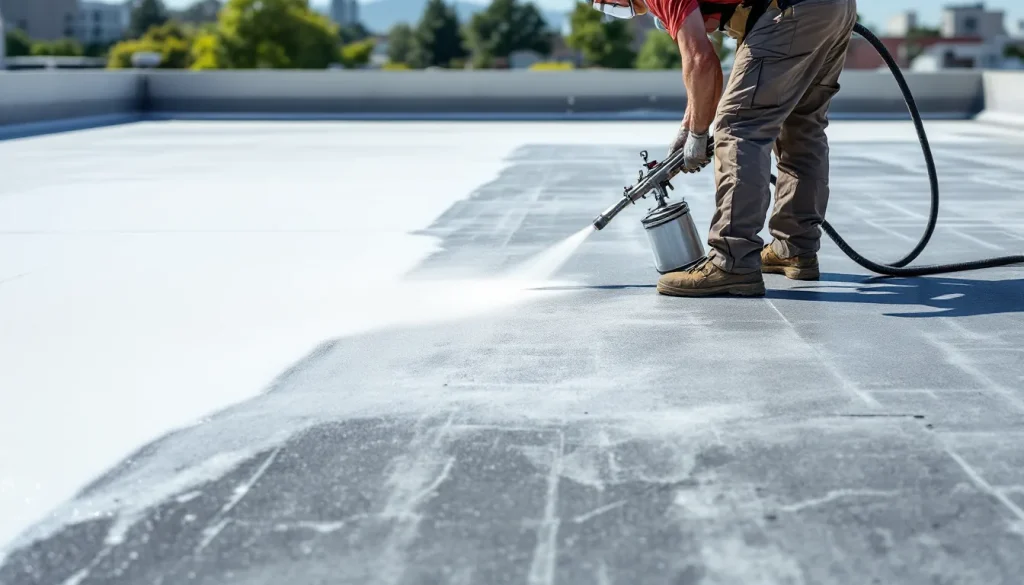
Commercial roof restoration through fluid-applied coating is the most oversold and underdocumented work in the commercial roofing industry. A silicone or acrylic coating sprayed over a 14 year old TPO (see our TPO vs. PVC choice guide) can extend useful life 10 to 15 years for $2 to $5 per square foot, which beats a $7 to $22 per square foot replacement on paper. The catch is that coating only works when the underlying roof passes specific structural and moisture tests. Coatings sprayed over wet insulation, failed seams, or rotted deck don’t restore anything. They hide problems for 18 months and then peel off in sheets while the building keeps leaking.
This guide walks through when coating (see our commercial roof restoration cost 2026) restoration is the right call, when it’s a paint-over scam, the difference between silicone, acrylic, and urethane systems, and the brand-specific products (GACO, Henry, APOC, Conklin, GAF, Karnak) that contractors actually install in 2026.
What restoration coating actually is and what it isn’t
A restoration (see our roof coating types and cost) coating is a fluid-applied membrane sprayed or rolled onto an existing roof to create a new, monolithic waterproofing surface. It bonds to the underlying membrane (TPO, EPDM, modified bitumen, BUR, metal, or concrete), seals seams and flashings under the same surface, and reflects solar heat. A properly installed coating system on a sound substrate functions as a new roof with a new manufacturer warranty for the term of the coating.
What it isn’t: a fix for a failed roof. Coatings do not replace wet insulation. They do not strengthen rotted deck. They do not re-bond delaminated seams except for hairline reseals where the substrate is otherwise sound. If your TPO is at year 22 and walking on it crackles like potato chips, coating it is throwing $30,000 into the void. The membrane has lost the plasticizers that keep it flexible, and the coating will bond to a brittle layer that’s about to fragment underneath.
This is the central conversation a competent commercial coating contractor (see our finding commercial roofers guide) will have with you on the first visit. The ones who skip it and quote a coating job for any roof, any condition, are the ones whose installs you find peeling on YouTube three years later.
Silicone, acrylic, and urethane: what coats what
The coating chemistry determines what substrate it bonds to, how it handles ponding water, and how long it lasts. The three primary categories below cover roughly 90% of commercial restoration work in the U.S. in 2026.
Silicone coatings are the workhorse for restoration over single-ply membranes (TPO, EPDM, PVC), modified bitumen, and metal. They handle ponding water indefinitely without breaking down, which is the single biggest advantage on flat roofs with chronic low spots. Cost (see our commercial roof repair costs) is $2.50 to $5 per square foot installed. Industry leaders: GACO Western GacoFlex S2000 (the 100% silicone single-coat workhorse, 20 year warranty available), Henry 887 Tropi-Cool (silicone with reflective white finish, ASTM D6694 compliant), APOC 247 Tropi-Cool (similar profile, slightly lower cost). Silicone’s downside: it attracts dirt and stains over time, reducing reflectivity, and recoats need either a recoat primer or full surface prep because nothing else bonds well to cured silicone.
Acrylic coatings are water-based, lower-cost ($2 to $3.50 per square foot installed), and best on roofs with good drainage. They don’t handle standing water well, breaking down after 48 to 72 hours of constant immersion. Acrylics are easier to apply, easier to recoat (acrylic bonds to acrylic indefinitely), and cheaper for tight budgets. Karnak Spray-Lon acrylic and Conklin Rapid Roof III are the brands most likely to be on a contractor’s truck. GAF Topcoat fluid-applied acrylic shows up frequently on restoration jobs over modified bitumen.
Urethane and polyurethane coatings are the high-end option, used most often as part of a multi-coat system (urethane base coat for adhesion plus silicone topcoat for ponding water resistance) or solo on metal roofs and high-foot-traffic decks. Cost is $4 to $7 per square foot installed. They cure to a tougher film than silicone or acrylic, which matters on roofs that get walked on regularly for equipment service. The downside is shorter recoat window and more sensitivity to humidity at install time.
The acrylic-on-flat-roof tradeoff is the same as for elastomeric roof coating on residential applications, where ponding kills the system faster than UV ever does. The same principles drive the silicone-vs-acrylic call on commercial flat roofs.
The pre-install audit that determines whether coating works
A serious coating contractor runs the same audit on every job before pricing. Skipping any of these steps is the most reliable sign you’re being sold a coating that will fail.
Moisture survey. Infrared, nuclear, or capacitance gauge to identify wet insulation. Anything over 10% wet by area should be cut out and replaced before coating. Coating over wet insulation traps moisture, accelerates deck corrosion, and causes coating blistering as trapped water vaporizes in summer heat.
Adhesion test. A small test patch (typically 4 ft by 4 ft) of the proposed coating system is applied to a representative section. After 24 to 72 hours of cure, a pull test verifies bond strength to the existing membrane. ASTM D903 or D4541 numbers should be on the audit report. Without a pull test, you’re betting on the contractor’s word that the coating will bond. With aged TPO and weathered EPDM, that bet loses more often than it wins.
Membrane condition assessment. Walk-through documentation of seam condition, flashings, drains, penetrations, and ponding areas. Anything failed gets repaired (proper membrane repair, not coating-as-repair) before the coating system is applied, and the cost of those repairs by failure mode varies with the membrane and the damage. The 22 points covered in our companion piece on the commercial inspection schedule are roughly the audit checklist a serious coating contractor will follow.
Substrate compatibility. Not every coating bonds to every membrane. PVC is famously difficult for some silicones. KEE membranes (like Sika Sarnafil) need specific primers. EPDM needs cleaning to remove EPDM-specific surface oils. Get the manufacturer’s documented compatibility chart for your specific membrane.
Restoration vs. recover vs. full replacement: the economics
For most commercial buildings, the three options at year 15 to 18 of roof life look like this on cost per square foot installed. Restoration coating: $2.50 to $5, extends life 10 to 15 years if substrate is sound. Recover (overlay): $4 to $7, installs a cover board and new membrane over the existing roof, full new system warranty, life 20 to 25 years. Full tear-off and replace: $7 to $22 depending on membrane type, insulation R-value, and accessories, life 25 to 30 years.
The math that determines which one is right depends on three inputs: how much useful life remains in the existing roof if nothing is done, what the building owner’s hold period is, and whether tax treatment makes a difference (restoration coatings are typically expensed as repair under IRS Section 162 for the year, while replacement is capitalized and depreciated over 39 years for commercial buildings unless qualifying improvement property treatment applies, which is a CPA conversation, not a roofer conversation).
The hold-period question matters more than most owners realize. If you’re selling in 24 months, a $40,000 coating that extends life through the next owner’s first 10 years probably beats a $180,000 replacement that won’t be amortized into your sale price. If you’re holding for 20 years, the coating math gets thinner because you’ll be back at year 12 deciding whether to recoat or tear off anyway.
What good coating installation actually looks like
A correctly installed silicone restoration on a 30,000 sq ft commercial roof takes 4 to 7 days with a crew of 4 to 6, weather permitting. The sequence: power wash the entire roof at 3,000 to 4,000 psi, repair all flagged defects (seam reinforcement, drain flashing, penetration flashing), prime metal flashings and any low-bonding areas, apply reinforcing mesh over all seams and details, install base coat at manufacturer-specified thickness (typically 20 to 30 wet mils), allow cure, install topcoat to bring total system to spec (60 to 90 dry mils total for silicone). Each step has manufacturer warranty implications.
If the proposal you’re reviewing skips power washing, skips seam reinforcement, or combines base and topcoat in a single-pass application, the warranty math doesn’t work. Manufacturer warranties (Carlisle, GAF, GACO, Conklin) require documented adherence to their spec, including the dry mil thickness measured during install. The contractor should be using a wet film gauge and documenting readings every 1,000 sq ft. Without that documentation, the warranty claim at year 8 gets denied for “non-conforming installation,” which is a conversation no facility (see our industrial repair guide) manager wants to have.
The companion conversation around flat roof coating restoration for residential and small commercial uses the same chemistry and same installation principles at smaller scale. Our flat roof repair cost piece covers the membrane repairs that should happen before any coating goes down.
The bait-and-switch tactics to watch for
Restoration coating attracts a specific kind of contractor: low overhead, big claims, no manufacturer authorization, and proposals that always include a “limited-time discount” pressure tactic. The patterns below are the most common.
Unauthorized installer. Quoting a GACO or GAF system but not being on the manufacturer’s authorized installer list. The coating will go on. The 15 year warranty will not be issued by the manufacturer because the installer wasn’t qualified. You get a contractor warranty (worth what the contractor’s business is worth in year 8, which is often nothing). Verify authorization by calling the manufacturer directly with the contractor’s name, not the manufacturer name on the proposal.
Wrong dry mil thickness. The proposal says “GACO S2000 silicone restoration” but doesn’t specify the dry mil thickness. Manufacturer warranties require specific thickness (typically 60 to 80 dry mils for silicone). A contractor cutting cost will install at 30 to 40 dry mils. The roof looks white and smooth for 2 years. It starts failing in year 4.
Coating-over-failed-substrate. The contractor walks the roof for 15 minutes, never does a moisture survey, and proposes coating over visible seam failures and ponding areas without repair. This is the work that creates the viral peeling-roof videos. The roof leaks within a year, and the warranty is voided because the substrate failed.
“Lifetime warranty.” No coating manufacturer issues a true lifetime warranty on commercial restoration. Common terms are 10, 15, or 20 years from the manufacturer with specific exclusions (ponding water on acrylic, traffic damage, biological growth). Anyone marketing “lifetime coating” is using contractor-warranty language that means “until our business closes.”
The questions in our questions to ask a roofing contractor piece translate directly to coating contractors. The most useful one: ask for two recent customer references on roofs older than 5 years since coating installation. Anyone unwilling or unable to provide them is selling a product they haven’t owned the consequences of yet.
When coating is genuinely the right answer
For all the warning above, restoration coating on the right roof at the right time is one of the most economically rational moves a commercial owner can make. The profile that fits: a 12 to 16 year old single-ply (TPO, EPDM) or modified bitumen roof, less than 10% wet insulation by survey, sound deck, drains functioning, no widespread seam failure, hold period of 5+ years. On that roof, a $90,000 silicone restoration buys you 12 to 15 years of additional useful life for less than half the cost of replacement and triggers tax treatment that often makes it a write-off in the current year.
The conversation with your CPA and your contractor should happen together. The coating that’s a great idea for your asset is a different conversation than the coating that’s a great idea for your tax position. Both should pencil before the deposit check goes out.
Recoat cycles and the long-term economics
Silicone and acrylic coating systems don’t restore permanently. A 20 mil silicone topcoat installed in 2026 will likely need a recoat between year 10 and year 15, with the timing driven by UV exposure, ponding water duration, and surface soiling. The recoat cost is meaningfully lower than the original restoration (typically $1.50 to $3 per sq ft) because the substrate prep is lighter: power wash, light primer if needed, single topcoat application.
This is the long-term economics that makes coating restoration compelling for owners on extended holds. The first restoration buys 10 to 15 years at $3.50 per sq ft average. The recoat buys another 10 to 15 years at $2.25 per sq ft. Over a 25 to 30 year period, the cumulative cost is comparable to a single full replacement, but the cash outlay is spread across multiple budget cycles rather than concentrated in one year. For owners with capital constraints, this matters as much as the gross dollar comparison.
Our piece on flat roof lifespan covers the underlying expectations for each membrane type, which sets the realistic context for when coating extends life vs. when it’s just deferring an inevitable replacement.
Reflectivity, energy savings, and the cool-roof premium
One legitimate selling point for white silicone and white acrylic coatings is the cool-roof energy savings. A bright white reflective coating reflects 80%+ of solar radiation, compared to maybe 5% to 15% for an aged dark membrane. On a building with significant cooling load (single-story big-box, manufacturing, warehouses with conditioned air), the cooling-cost reduction can be 10% to 25% of summer HVAC spend. For owners in hot climates (Texas, Arizona, Florida, southern California), this can translate to thousands per year on a mid-size building.
The numbers don’t pencil for every building. Heating-dominated climates (northern Minnesota, Maine) see net-zero or slightly negative energy effect from reflective coatings because winter heating gains from dark roofs are reduced by the same reflectivity that helps in summer. Run the climate-specific math, ideally with a building-energy modeler, before counting energy savings as the justification.
The DOE’s Cool Roof Rating Council (CRRC) publishes initial and aged solar reflectance values for major coating products. Most silicone restorations meet ENERGY STAR cool roof thresholds when fresh. The aged values (after 3 years of soiling) typically drop substantially, which is why dirty silicone roofs that haven’t been cleaned in a decade perform much worse than the spec sheet suggests. Periodic cleaning preserves both reflectivity and warranty compliance.