
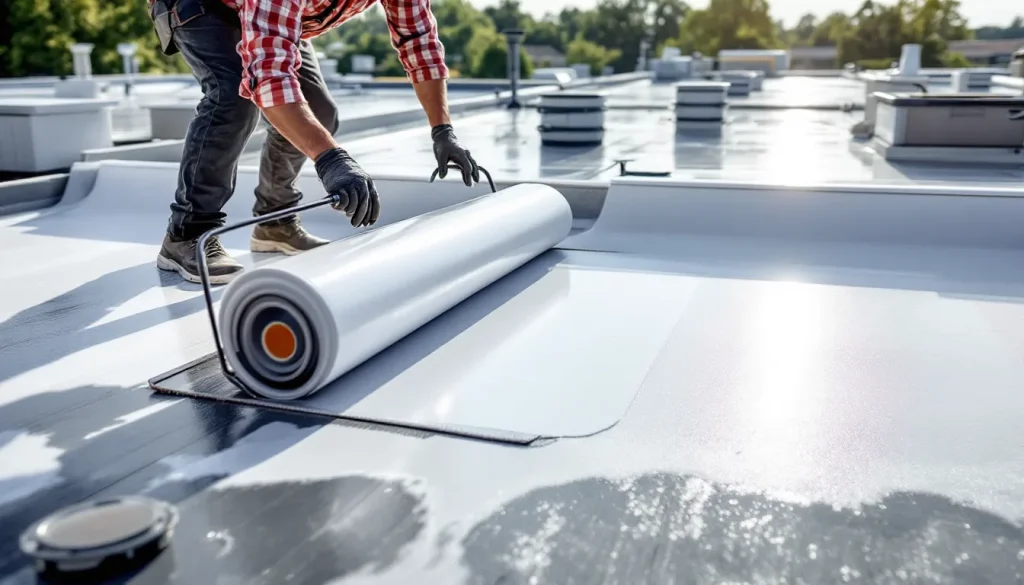
A flat roof coating (see our commercial roof restoration cost) in 2026 runs $2 to $5 per square foot installed and extends the life of a sound existing membrane by 10 to 15 years. The three chemistries are silicone (best for ponding water, $3 to $5 per sq ft, 15-year warranty available), acrylic (cheapest, $2 to $3.50 per sq ft, 10-year warranty, no ponding tolerance), and polyurethane (most durable on foot-traffic roofs, $3.50 to $5.50 per sq ft, 15-year warranty). The real product brands are GACO Western GacoFlex S2000 and S20 silicones, Henry 887 Tropi-Cool silicone, APOC Tropi-Cool 247 acrylic, Conklin Rapid Roof III silicone, Karnak Spray-Lon acrylic, and Mule-Hide and Tremco polyurethane systems. Coatings are a restoration play on a roof that still has structural integrity, not a band-aid for a roof at end of life.
The short version
- Silicone is the only chemistry with manufacturer endorsement for ponding water tolerance. GACO S2000, Henry 887, Conklin Rapid Roof III are the leading systems.
- Acrylic is the cheapest at $2 to $3.50 installed but cannot tolerate ponding and weathers faster. APOC Tropi-Cool and Karnak Spray-Lon are typical.
- Polyurethane is the most durable underfoot. Best on roofs with rooftop equipment and frequent service traffic. $3.50 to $5.50 installed.
- A coating restoration carries a 10 to 15 year manufacturer warranty (separate from any remaining membrane warranty) and is often re-coatable to extend life further.
- The substrate has to be sound. Coating over wet insulation, failed seams, or a brittle end-of-life membrane is throwing money at a roof that needs replacement.
- Adhesion testing and proper prep (pressure wash, prime, mesh seams and penetrations) drive 80 percent of long-term performance.
Short answer: what a coating actually is
A flat roof coating (see our roof coating types and cost) is a liquid-applied elastomeric membrane that bonds to an existing roof substrate, cures into a monolithic waterproof film, and extends the service life of the roof underneath. Coatings are typically applied at 20 to 40 dry mils total thickness in two or three coats, with a reinforcing fabric or mesh embedded at all seams, penetrations, and high-stress areas.
The coating is not a replacement for the membrane underneath. It is a top layer that takes the UV beating, sheds water, and waterproofs the seams and penetrations that would otherwise leak. A coating extends the life of a 15-year-old TPO or EPDM membrane by another 10 to 15 years for roughly half the cost of a full tear-off and replacement.
Coatings are also used on metal roofs, modified bitumen, BUR, and even some aged shingle roofs. The chemistry and prep change for each substrate but the principle is the same.
Silicone: the ponding-tolerant default
Silicone roof coatings are the only category with explicit manufacturer endorsement for standing water tolerance. The silicone polymer is chemically inert and does not degrade in water the way urethane, acrylic, or asphalt-based coatings do. GACO Western GacoFlex S2000 and S20, Henry 887 Tropi-Cool, and Conklin Rapid Roof III all carry warranties that cover ponding water, typically 10 to 15 years.
GACO Western GacoFlex S2000. Single-coat silicone, 20 to 30 mils total thickness, applied direct over sound TPO/EPDM/BUR/metal substrate. 50-year manufacturer cited as a target life (with periodic recoats), 12 to 50-year warranty depending on system thickness and contractor program. White or tan. Cost $3 to $5 per sq ft installed.
Henry 887 Tropi-Cool. Pure silicone, similar use case to GACO S2000. White only. 15-year warranty available with the Henry Pro Premier program. Cost $3 to $5 per sq ft installed.
Conklin Rapid Roof III. Direct-applied silicone, dealer network model. 18 to 21 dry mils typical. Cost $3.50 to $5.50 per sq ft installed (Conklin pricing is consistently on the higher end because of the dealer markup, but the system carries strong warranty terms).
Silicone’s trade-off is that it bonds well to itself and to most properly prepared substrates but not to anything except more silicone for top-coat. A future re-coat or replacement on a silicone-coated roof requires either another silicone coat or full mechanical removal of the silicone layer. Plan for that before you commit. See elastomeric roof coating for the broader category context.
Acrylic: cheapest, no ponding tolerance
Acrylic roof coatings are water-based elastomerics, applied in two or three coats at 20 to 25 mils total thickness. They are the cheapest option, easiest to apply, and easy to recoat. They are not ponding-tolerant.
APOC Tropi-Cool 247. White acrylic elastomeric. 10-year manufacturer warranty when installed per spec. Cost $2 to $3 per sq ft installed. Common on residential flat additions and small commercial work.
Karnak Spray-Lon 229AR. Acrylic, white or tan. Common on metal roof restoration as well as flat. 10-year warranty. Cost $2 to $3 per sq ft installed.
GAF Topcoat / Polyglass acrylic. Manufacturer-affiliated acrylic systems, often used as a recoat-only product on existing GAF or Polyglass roofs. 10 to 15-year warranty when part of a system.
The acrylic trade-off is straightforward. The product is cheap and easy to apply but it cannot sit in standing water. Once the coating absorbs water (a few weeks of ponding), it softens, blisters, and peels. On a roof that drains properly with no ponding, acrylic is a solid value choice. On a roof with any ponding, it is the wrong call.
Polyurethane: durability for traffic
Polyurethane coatings are the most durable category underfoot. They handle rooftop foot traffic, HVAC service, and impact without cracking the way silicone or acrylic do. They are the right choice on roofs with rooftop equipment, service walkways, or any chronic traffic.
Mule-Hide Polyurethane systems. Single-component or two-component polyurethane, 20 to 30 mils total thickness, 15 to 20-year warranty. Cost $3.50 to $5 per sq ft installed.
Tremco AlphaGuard. Two-component polyurethane on a base coat plus top coat system. Used on premium commercial restoration. 15 to 20-year warranty. Cost $4 to $5.50 per sq ft installed.
Soprema ALSAN RS. Liquid-applied PMMA / polyurethane hybrid. Used on penetration-heavy and detail-heavy roofs because of its fast-cure properties. Premium-priced at $5 to $7 per sq ft for full-roof application.
Polyurethane handles ponding better than acrylic but worse than silicone. The category trade-off is durability and traffic tolerance vs. cost.
Cost breakdown: what you actually pay for
A coating restoration price quote breaks down roughly as follows for a 5,000 square foot commercial roof:
| Line item | Typical cost | What it includes |
|---|---|---|
| Pressure wash and clean | $0.10 to $0.20 per sq ft | 3,000 to 4,000 PSI clean, debris removal, biological growth removal |
| Primer (if required) | $0.25 to $0.50 per sq ft | Bonding primer per manufacturer spec, sometimes optional on silicone over TPO |
| Seam, penetration, and detail prep | $0.30 to $0.80 per sq ft | Reinforcing mesh or fabric embedded in coating at all seams, drains, curbs, penetrations |
| Coating material (silicone) | $0.80 to $1.40 per sq ft | 20 to 30 dry mils silicone, one or two coats |
| Coating material (acrylic) | $0.40 to $0.70 per sq ft | 20 to 25 dry mils acrylic, two or three coats |
| Coating material (polyurethane) | $0.80 to $1.40 per sq ft | 20 to 30 dry mils polyurethane, two coats |
| Labor | $0.80 to $1.50 per sq ft | Roller, spray, or squeegee application |
| Warranty registration and inspection | $0.05 to $0.15 per sq ft | Manufacturer inspection if 15-year or NDL warranty |
| Total installed | $2 to $5 per sq ft | Depending on chemistry and warranty length |
When a coating is the right call vs replacement
A coating restoration is the right answer when:
The membrane has 5 or more years of structural life left. The membrane itself is not failed. The seams may be tired, UV degradation is visible, but the underlying material is intact. Coating extends life on a sound substrate.
The insulation is dry. A moisture survey (infrared scan or capacitance meter) confirms no wet insulation under the membrane. Coating over wet insulation traps the moisture and accelerates deck rot.
The roof drains adequately. No chronic ponding (or you are choosing silicone and willing to accept ponding-tolerant coverage).
The seams are not actively leaking. Active leaks need patch or seam repair before any coating. Coating does not glue failed seams back together.
A coating is the wrong call when the membrane is brittle, the insulation is wet across more than 10 percent of the area, the deck is structurally compromised, or the roof is approaching the end of its service life. At that point you are stalling a teardown for one or two seasons at coating cost, then doing the teardown anyway. See flat roof replacement cost for the full replace path.
The prep stage is where 80 percent of failures start
Coating failures rarely come from the coating itself. They come from the substrate prep. The most common prep failures:
Inadequate cleaning. Skipping the pressure wash, or using too low a pressure (under 2,500 PSI), leaves dirt, oils, biological growth, and old coating residue on the surface. Adhesion fails within months.
Skipping the primer when one is required. Silicone over EPDM almost always requires a primer (GacoFlex E-5320 or equivalent). Acrylic over weathered metal requires a rust-inhibitive primer. Skipping it is the most expensive corner cut in the coating business.
Failed adhesion test. Every coating manufacturer recommends an adhesion test patch before full application. Apply a 2-by-2-foot test patch, cure 48 hours, then attempt to peel. If it peels cleanly, the prep is wrong. The test is $50 of material and 30 minutes of time, and it prevents $20,000 mistakes.
Seam and penetration prep skipped. All seams, drains, scuppers, vents, curbs, and penetrations need a reinforcing polyester mesh or fabric embedded in the coating. Manufacturers spec this explicitly. Skipping it means seam-stress cracking within 2 to 5 years.
Cool roof and energy savings
White coatings reflect 80 to 85 percent of incident solar radiation, compared with 5 to 15 percent for an aged black EPDM or weathered TPO. The reflective coating drops rooftop surface temperatures by 50 to 80 degrees Fahrenheit on a summer day, which reduces HVAC cooling load by 10 to 20 percent on a building with rooftop HVAC.
For commercial property owners in hot climates, the HVAC savings alone can amortize the coating cost in 4 to 8 years. ENERGY STAR labels the qualified products and the Cool Roof Rating Council (CRRC) publishes the reflectance data. Most utility companies in hot climates offer rebates of $0.10 to $0.50 per square foot for cool-roof coating installs.
The cool-roof effect also extends the membrane underneath. Lower membrane temperatures mean slower plasticizer migration on PVC, slower oxidation on TPO, slower thermal cycling on all systems. The coating protects the membrane both from UV and from heat.
Re-coating: extending the extension
One of the strongest selling points for silicone is the re-coat path. At year 12 to 15, when the warranty expires, the silicone can be inspected, cleaned, and re-coated with a fresh 20 to 30 mil layer for $2 to $3.50 per sq ft. Each recoat resets the warranty clock. A well-maintained silicone roof can extend through multiple recoat cycles, with the total system life pushing past 40 years on a sound substrate.
Acrylic can also be re-coated but it requires more aggressive surface prep because acrylic chalks over time and the chalk layer interferes with adhesion. Polyurethane re-coat is straightforward with a polyurethane top coat.
The math on a 15-year recoat plan vs. a tear-off is usually favorable. Two recoats at $3 per sq ft over 30 years = $6 per sq ft. Tear-off and replace = $8 to $14 per sq ft. The recoat path wins on cost as long as the substrate stays sound.
Warranty structures
Coating warranties come in three flavors:
Material-only warranty. 10 to 15 years. Covers the coating material if it fails to perform. Does not cover labor for repair or replacement. Cheapest tier, often the default on small commercial and residential work.
Material plus labor warranty. 10 to 15 years. Covers material and labor for repairs. Requires manufacturer-certified contractor installation and a post-installation inspection. Typical premium of $0.20 to $0.40 per sq ft over material-only.
NDL (No Dollar Limit) warranty. 15 to 20 years. Covers all warranted defects with no cap on repair cost. Requires certified contractor, full system spec compliance, and pre/post-installation manufacturer inspection. Adds $0.30 to $0.60 per sq ft. Standard on commercial work with significant deferred-replacement value.
The NDL warranty is worth the premium on any roof with significant deferred-replacement risk. For a 50,000 sq ft commercial building, the cost differential is $15,000 to $30,000 against a potential repair exposure of $200,000-plus. The math favors NDL.
Where coatings are oversold
Three sales pitches to ignore:
“It will fix your leak.” No. A coating goes over a sound roof. Active leaks have to be located and patched first. A coating over a leak just traps the water and accelerates deck rot.
“It will eliminate ponding.” Silicone tolerates ponding. It does not eliminate it. The water still sits there. If your real problem is ponding, the fix is tapered insulation or added drainage. See ponding water flat roof.
“It is as good as a new roof.” It is a restoration of an existing roof. The deck, insulation, and underlying membrane are still as old as they were before the coating. A 25-year-old EPDM with a fresh silicone coat is a 25-year-old EPDM with a fresh silicone coat, not a new roof.
For roof condition assessment before any coating decision, see commercial roof restoration.
Substrate-specific notes
| Substrate | Coating options | Notes |
|---|---|---|
| Aged TPO | Silicone (best), polyurethane | Primer often required on TPO over 7 years old. Adhesion testing essential. |
| Aged EPDM | Silicone (best with E-5320 primer), acrylic on smooth EPDM | EPDM always needs primer. Black EPDM benefits most from white coating reflectance. |
| Aged PVC | Silicone (with PVC primer), polyurethane | PVC is the trickiest substrate. Plasticizer migration affects adhesion. Test extensively. |
| Modified bitumen | Silicone, acrylic, polyurethane | Granule surface needs flat-coat to fill granules before topcoat. See modified bitumen roof. |
| Built-up (BUR) | Acrylic (with primer), silicone (with primer) | Gravel surface requires partial gravel removal or full asphalt emulsion fill coat. |
| Metal (R-panel, standing seam) | Silicone, acrylic with rust primer | Rust treatment is essential. See metal-roof restoration systems. |
| Spray foam (SPF) | Silicone (standard), polyurethane | SPF roofs require recoat every 10 to 15 years as standard maintenance. |
How to vet a coating contractor
The questions to ask:
Are you certified by the coating manufacturer? GACO Pro, Henry Pro Premier, Conklin Authorized, Mule-Hide Certified, Karnak Certified. Manufacturer certification gates the warranty length. Non-certified installers cap out at 5 to 10-year warranties regardless of system.
Will you do an adhesion test patch? If the answer is no, find another contractor. Adhesion testing is industry standard.
Will you do a moisture survey before coating? Infrared scan or capacitance meter. Coating over wet insulation is malpractice.
What is the spec for seams, penetrations, and curbs? The answer should reference manufacturer detail drawings. Vague answers (we will detail it) signal an installer who is improvising.
What is the warranty type and length? Material-only vs material-plus-labor vs NDL. Length 10, 15, or 20 years. The variance is real and worth pricing both options.
For broader contractor vetting, see questions to ask roofing contractor.
FAQs
How much does flat roof coating cost?
$2 to $5 per square foot installed depending on chemistry and warranty length. Acrylic at the low end, silicone in the middle, polyurethane and NDL warranties at the high end.
How long does a flat roof coating last?
10 to 15 years for the initial warranty. Silicone can be re-coated indefinitely, pushing total system life past 30 to 40 years. Acrylic and polyurethane can also be re-coated but require more aggressive prep on each cycle.
Is silicone or acrylic better?
Silicone is better if you have any ponding water or want a longer warranty. Acrylic is better if you want the cheapest functional restoration on a draining roof. Polyurethane wins on heavy-traffic roofs.
Can a roof coating fix a leak?
No. Coating goes over a sound roof. Active leaks need to be located and patched (or the failed section replaced) before coating.
Does coating qualify for energy rebates?
White coatings rated by the Cool Roof Rating Council usually qualify for utility rebates of $0.10 to $0.50 per square foot in hot climates. Most coatings also qualify as ENERGY STAR products.
Will coating void my membrane warranty?
It depends. Some membrane manufacturers (GAF EverGuard, Carlisle SynTec) allow factory-approved coating systems without warranty void. Others void the membrane warranty if any coating is applied. Check before you commit.
How long does coating installation take?
Two to five days for a typical 5,000 to 10,000 square foot roof, depending on weather and number of coats. The dry time between coats is the longest single factor.
Bottom line
A flat roof coating is a 10 to 15-year extension of a sound existing roof, not a band-aid for a roof at end of life. Silicone (GACO S2000, Henry 887, Conklin Rapid Roof III) handles ponding and re-coats easily. Acrylic (APOC, Karnak) is the cheapest and works on draining roofs. Polyurethane (Mule-Hide, Tremco) handles foot traffic best. The prep stage (pressure wash, primer, adhesion test, seam reinforcing) drives 80 percent of long-term performance. Vet the contractor’s manufacturer certification, demand the adhesion test, and price the NDL warranty before committing. For context on the underlying roof systems, see flat roof types 2026, flat roof materials compared, and flat roof lifespan.
Related reading: all roofing guides | flat roof types 2026 | flat roof materials compared | flat roof lifespan | flat roof replacement cost | flat roof repair cost | ponding water flat roof | elastomeric roof coating | commercial roof restoration | TPO vs EPDM roofing