
Last reviewed: October 2026.
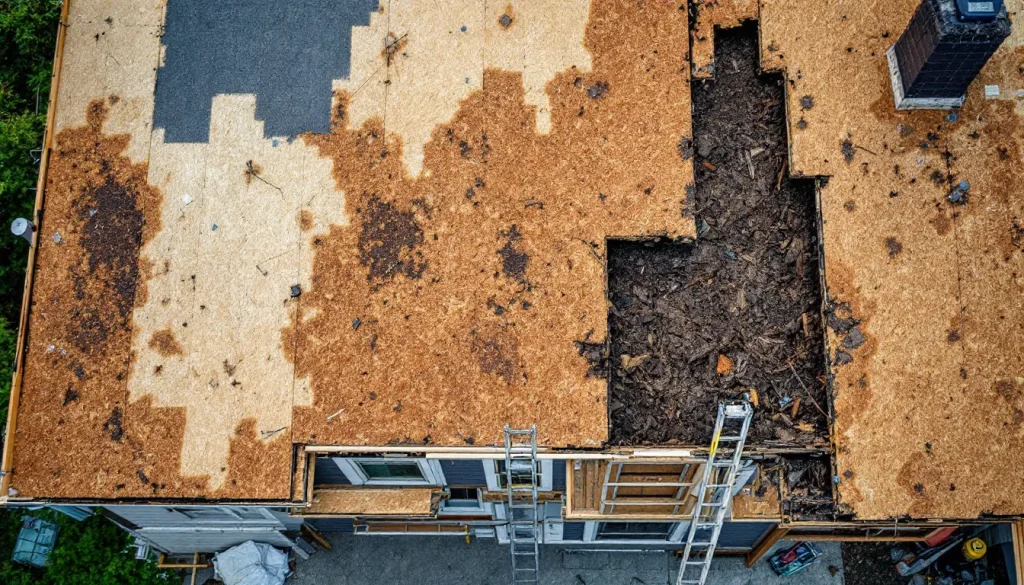
Rotted roof decking in 2026 is one of the most expensive surprises in a roof replacement project, with deck replacement adding roughly $5 to $12 per square foot of replaced area, a Roofing Brief estimate that covers material, labor and disposal. The rot usually shows up during tear off when the old shingles come off and the contractor finds soft plywood or OSB underneath. A typical 2,400 square foot roof can see $3,000 to $14,000 in unexpected decking work added mid project. Here are the warning signs you can spot before reroof, plus how to estimate the hidden damage and avoid the worst surprises.
The short version
- Decking rot adds $5 to $12 per square foot, often $3,000 to $14,000 on a typical reroof.
- The cause is almost always water plus time. A small leak that ran for 5 years rots a 50 square foot area.
- From outside, look for sagging, soft spots when walked, and stains on the underside of the eaves.
- From inside the attic, look for dark stains, soft wood under a screwdriver tip, and daylight at sheathing seams.
- OSB rots faster and more dramatically than plywood. Plywood delaminates, OSB falls apart.
- Insurance covers decking replacement when the underlying cause is a covered peril (hail, wind, fallen tree), not when the cause is age or chronic leak.
Short answer: what it costs
Roofing Brief estimates put 2026 decking replacement at $5 to $12 per square foot of replaced area, all in. The range covers regional labor differences and the choice between OSB ($1.10 to $1.60 per square foot material) and plywood ($1.60 to $2.50 per square foot material). Related: Roof decking replacement cost. The labor and disposal portion is roughly $3 to $7 per square foot regardless of material.
What that translates to. A single 4 by 8 sheet of replaced decking (32 square feet) costs $160 to $384. Replacing a partial area around chimneys, valleys, or under a leak runs $400 to $2,500. Full decking replacement on a 2,400 square foot roof runs $12,000 to $28,800. Most reroofing projects discover 5 to 15 percent of the decking needs replacement, which is the typical $1,500 to $5,000 surprise. See our roof deck repair cost guide for methods and pricing on partial work.
What roof decking actually does
Roof decking (also called roof sheathing) is the structural surface that sits on top of the rafters or trusses and supports everything above it. Underlayment, shingles, metal panels, tile, and any walking load all transfer through the decking to the framing. It is structural, not cosmetic. A rotted deck cannot be patched with caulk or a coating, no matter what an unscrupulous contractor tells you.
Modern residential roofs use either plywood (CDX grade, typically 1/2 inch or 5/8 inch thick) or oriented strand board (OSB, also typically 7/16 inch or 1/2 inch thick). Both are rated for residential roof use under IRC R803.2. Older homes (pre 1960) often use 1 inch nominal plank decking made of pine or fir, which is more rot resistant but harder to find replacement material for. See roof trusses for how the deck ties into the broader structural system.
Causes of decking rot
Decking rot has one cause with three vectors: water plus time. The water comes from a leak through the shingles or flashing (most common), from ice damming that pushes water back up under shingles (common in northern climates), or from condensation on the underside of the deck in poorly ventilated attics (less common but real). Time matters because rot is a biological process. Fungal growth needs sustained moisture above 19 percent wood moisture content for weeks or months to take hold.
A roof leak that runs for one week rarely rots the deck. The same leak running for two years almost always does. This is why catching leaks early matters more than the leak rate. A slow leak ignored for years does more damage than a major leak fixed within days.
The geography of rot tells you the cause. Rot at the eaves usually means ice damming or gutter overflow. Rot in a valley usually means a flashing failure. Rot around a chimney usually means flashing or cricket failure. Rot at the ridge usually means a ridge vent or ridge cap failure. Rot in random spots in the field usually means individual shingle failures or nail pops. Diagnosing the cause matters because if you replace the decking without fixing the cause, you will be back doing it again in 5 to 10 years.
Signs of decking rot from outside
Five outside signs of decking rot, in order of severity. First, visible sagging between rafters. Healthy decking is straight and flat. Sagging means it has lost structural integrity and is bowing under its own weight plus the shingle load above. Second, soft spots when walked. A solid deck feels firm under your weight. A rotted area feels springy, mushy, or worse, has a “pop” as fibers fail under you. Third, depressions or low spots that hold water on the shingle surface. Fourth, staining on the underside of the eaves where water has tracked along rafters before dripping out. Fifth, daylight visible from outside at the seam between sheets or boards.
Walk the roof if you can safely (see roof safety for the protocol). If you cannot, walk the perimeter and look up at the eaves with binoculars. Look for any wave or dip in the shingle surface that does not follow the framing pattern. A consistent ridge line and consistent rafter spacing tell you the framing is sound. Any deviation usually means decking has failed underneath.
Signs from inside the attic
Inside the attic is the easiest place to diagnose decking rot. With a flashlight, look at the underside of the deck (the bottom face of the plywood or OSB or planks). Five tells. First, dark brown or black water staining patterns. Healthy decking is uniform color. Stains trace water paths and tell you where the leak is. Second, mildew or fungal growth visible as fuzzy white, gray, or black patches. Third, soft wood under the tip of a screwdriver pushed firmly. Healthy decking resists penetration. Rotted decking takes the screwdriver tip easily. Fourth, daylight visible at seams between sheets. Some daylight at the ridge vent is normal. Daylight in the field is not. Fifth, sagging or warping of the underside surface, especially between rafters.
The screwdriver test is the gold standard. A flat blade screwdriver pushed perpendicular to the deck with firm thumb pressure should not penetrate more than 1/16 inch in healthy plywood or OSB. If it goes in 1/4 inch or more, that area is rotted and needs replacement. Test every 4 to 6 feet across the entire deck if you can reach it.
Symptom location to root cause map
| Rot location on roof | Most likely cause | Adjacent fix required |
|---|---|---|
| Eaves and gutter line | Ice damming or gutter overflow | Ice and water shield, gutter cleaning |
| Valley centerline | Valley flashing failure | New flashing during reroof |
| Around chimney | Chimney flashing or cricket failure | New step flashing and cricket |
| At ridge | Ridge vent or cap failure | Replace ridge cap and vent |
| Around skylight | Skylight flashing failure | Reflash or replace skylight |
| Random spots in field | Individual nail pops, shingle damage | Verify whole field condition |
| Around plumbing vent | Pipe boot failure | New pipe boot with reroof |
| Wall to roof junction | Step or counter flashing failure | New flashing during reroof |
The 4 point check during tear off
During tear off, the contractor should perform a 4 point check before laying new underlayment. Point 1: walk the entire deck while it is bare. Any soft spots, springy areas, or visible damage get marked with chalk or spray paint. Point 2: visually inspect for staining, delamination on plywood, swelling on OSB, and any obvious water damage. Point 3: probe with a screwdriver at suspect areas. Point 4: check fastener withdrawal. If you can pull nails or screws out of the decking with your fingers, the wood fibers have failed and the area needs replacement.
A reputable contractor will photograph and document any damaged decking before replacement. This documentation is important for two reasons. First, it justifies the change order you will receive. Second, if you later file an insurance claim related to the rot, the photos support the claim. Be wary of any contractor who claims extensive decking damage without producing photos.
Partial vs full deck replacement
Partial replacement is the norm. Full replacement is rare. On a typical reroof, 5 to 15 percent of the deck typically needs replacement. The contractor cuts out the damaged area to the nearest rafter on each side (so the new sheet has solid wood to nail into), drops in a new sheet of plywood or OSB cut to fit, and nails it down. Full replacement is reserved for cases where the damage exceeds 40 to 50 percent of the total deck area, where there is a structural concern about the existing deck, or where there is a code requirement for current deck thickness that the old material does not meet.
One important caveat. If the existing deck is 3/8 inch plywood (common in 1960s and 1970s construction) and the local code now requires 7/16 inch minimum, a permit pulled for the reroof may trigger a full deck upgrade requirement. Check with your local building department before signing the contract. This kind of code triggered upgrade can add $8,000 to $20,000 to a typical reroof and is the worst surprise to hit mid project.
Cost per square foot to replace
| Material | Material cost per sq ft | Labor and disposal | Total installed |
|---|---|---|---|
| OSB 7/16 inch | $1.10 to $1.60 | $3.00 to $6.50 | $4.10 to $8.10 |
| OSB 1/2 inch | $1.20 to $1.80 | $3.00 to $6.50 | $4.20 to $8.30 |
| Plywood CDX 1/2 inch | $1.60 to $2.30 | $3.00 to $6.50 | $4.60 to $8.80 |
| Plywood CDX 5/8 inch | $1.95 to $2.80 | $3.00 to $6.50 | $4.95 to $9.30 |
| Plywood CDX 3/4 inch | $2.40 to $3.40 | $3.50 to $7.00 | $5.90 to $10.40 |
| Tongue and groove plank, 1 inch | $3.50 to $6.00 | $4.00 to $8.00 | $7.50 to $14.00 |
| Full deck rip and replace, single layer | included | included | $5.50 to $9.50 per sq ft |
These figures are Roofing Brief estimates: editorial planning ranges, not quotes or survey data. Panel prices move with lumber markets and labor varies by region, so price the per-sheet change-order rate into every bid.
Decking material comparison
| Material | Typical thickness | Wet resistance | Failure mode | Best for |
|---|---|---|---|---|
| OSB (7/16 or 1/2 inch) | 7/16 to 1/2 inch | Poor, swells permanently at edges | Strand bond release, catastrophic | Budget reroofs, dry climates |
| Plywood CDX (1/2 inch) | 1/2 inch | Moderate, recoverable from short wetting | Delamination, ply by ply | Most residential reroofs |
| Plywood CDX (5/8 inch) | 5/8 inch | Moderate | Delamination | Heavier roof loads (tile, slate) |
| Marine grade plywood | 1/2 to 3/4 inch | Excellent | Minimal degradation | High humidity, repeated wet cycles |
| Tongue and groove plank | 3/4 to 1 inch | Good | Surface rot, retainable structure | Historic homes, exposed timber |
| ZIP System sheathing | 7/16 to 5/8 inch | Good with tape | Tape failure at seams | New construction |
OSB vs plywood replacement decisions
If your existing deck is OSB, replacement is straightforward. Match thickness or go thicker if code allows. OSB is cheaper but it has two known failure modes. First, OSB swells permanently when wet at edges, which is why you see swollen seams on neglected roofs. Second, OSB fails catastrophically when it rots (the strand bonds release and the panel falls apart) where plywood tends to delaminate ply by ply more slowly. For a quality reroof, plywood is the conservative choice.
If your existing deck is plywood, you can replace damaged sections with OSB to save money, but check that the local code allows mixed sheathing. Some jurisdictions require a single sheathing type per roof plane. Also note that OSB and plywood have slightly different thicknesses at the same nominal rating, which can create a noticeable bump where new meets old if the contractor does not feather the transition.
For the small number of homes still using plank decking (typically pre 1950), the conservative choice is to replace damaged planks with new dimensional lumber of the same thickness. Some contractors will overlay the entire plank deck with plywood instead, which adds about $1.50 to $2.50 per square foot but provides a smoother, more modern substrate. This is the right choice if you are also addressing significant sagging roof repair issues.
When pre reroof inspection helps
A pre reroof inspection is the single best way to avoid surprise decking costs. A contractor or independent inspector spends 1 to 2 hours on site, walks the roof, accesses the attic, performs the screwdriver test on accessible deck areas, and produces a written estimate of likely decking replacement cost. Cost runs $150 to $400. The benefit is that the bid you receive includes a more accurate decking line item, with less risk of a surprise change order mid project.
Pre reroof inspection is most valuable on homes over 25 years old, homes with a known history of leaks, homes in heavy snow climates with ice damming history, and homes that have had insurance roof claims in the past. It is less valuable on a 12 year old roof being replaced for cosmetic reasons.
For the full inspection protocol, see how to get a roof inspection and roof inspection cost.
When insurance covers decking replacement
Insurance covers decking replacement when the underlying cause is a covered peril (hail, wind, fallen tree, sudden water event) and not when the cause is age, wear and tear, or chronic leak. This is the most common decking insurance dispute. Examples that typically get covered. A tree falls and crushes a section of deck. Hail damages shingles, water gets in, decking rots, all from the same hail event. Wind tears off shingles, water gets in, decking rots over the next 6 months, all flowing from the wind event.
Examples that typically get denied. A roof reaches end of life, shingles cup and crack, water gets in over years, decking rots. A flashing was installed wrong 15 years ago, leaks slowly for a decade, decking rots. Owner notices a leak and ignores it for 3 years.
The key for getting coverage is documentation of the originating event and prompt action. If you know wind or hail damaged your roof, file the claim, get the adjuster out, get the photos taken, and act before chronic damage develops. See filing an insurance claim for roof damage and insurance adjuster roof inspection for the claim path.
DIY identification: the walk on test
If you can safely walk your roof (review roof safety first), the walk on test is the simplest DIY check. Walk slowly across the roof in a grid pattern. Pay attention to how the deck feels under your weight. A solid deck feels firm and silent. A rotted deck feels springy, makes a soft creaking sound, or in worst cases has visible deflection under your foot.
Mark suspect areas with chalk so you can revisit them. Do not jump or apply sudden loads. If a spot feels questionable, move off it immediately and do not return without a ladder spanning the questionable area to spread your weight. Falling through rotted decking is a real risk and a common cause of serious injury in roof inspection accidents.
Decision tree: fix vs replace
| Damage area | Total deck area | Recommended action |
|---|---|---|
| Under 5 percent | Any | Patch during reroof, expect $500 to $1,500 surprise |
| 5 to 15 percent | Any | Patch during reroof, expect $1,500 to $5,000 surprise |
| 15 to 40 percent | Any | Discuss full deck replacement vs partial with contractor |
| 40 percent plus | Any | Full deck replacement, budget $5 to $9 per sq ft |
| Structural sagging | Any | Engineer involvement before any work, see sagging roof repair |
| Existing deck below current code thickness | Any | Full upgrade may be required by permit, check before signing |
FAQs
How much does it cost to replace rotted roof decking?
$5 to $12 per square foot installed in 2026. A typical 5 to 15 percent decking replacement on a 2,400 square foot reroof adds $1,500 to $5,000 to the project.
Can you spot rotted decking before tear off?
Sometimes. From outside, look for sagging, soft spots, and visible dips in the shingle surface. From inside the attic, look for stains and use the screwdriver test on accessible deck areas. A pre reroof inspection at $150 to $400 is the most reliable way to estimate.
Does insurance cover decking replacement?
Yes if the cause is a covered peril such as hail, wind, or a tree event. No if the cause is age, wear, or a chronic leak that was ignored.
OSB or plywood for replacement decking?
Plywood is the conservative choice. OSB is 30 percent cheaper but fails more dramatically when it rots and swells permanently when wet at edges. Match what is already there unless you are replacing the entire deck.
What happens if I do not replace rotted decking before reroofing?
The new shingles will fail prematurely (often within 5 to 10 years) because the deck cannot hold nails properly and the underlying water damage continues. You will pay for the same area twice.
Can I patch rotted decking with epoxy or wood filler?
No. Decking is structural. Filler products are not rated for structural load. The only fix is replacement.
How fast does roof decking rot?
Months to years depending on water exposure. A slow leak ignored for 2 years rots a 20 to 50 square foot area. A major leak ignored for 5 years can rot 200 plus square feet.
Do I need to replace the whole deck if I find rot in one section?
Rarely. Most decking replacements are partial, cutting out the damaged area to the nearest rafter and dropping in new material. Full deck replacement is reserved for damage above 40 percent or code triggered upgrades.
Related reading: all roofing guides | roof sheathing | roof trusses | sagging roof repair | tear off roof cost | roof leak repair | how to fix a roof leak | signs you need a new roof | how much does a new roof cost | filing an insurance claim for roof damage