
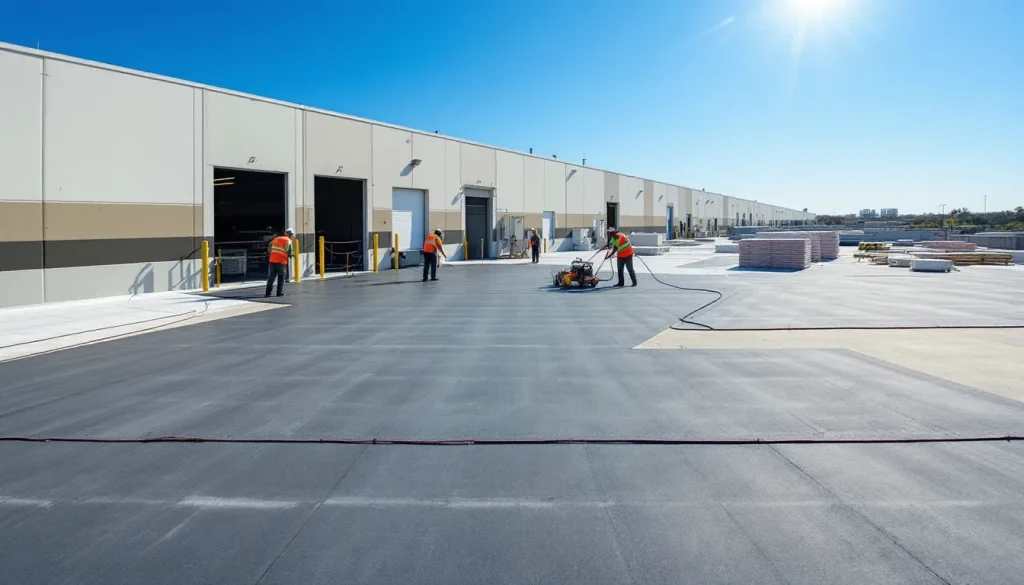
A commercial roof installation in 2026 is not a homeowner-scale project scaled up. It is a logistics exercise with a 4-to-12-week schedule, a 30-to-150-page submittal package, a crew of 8 to 30 men on the roof at peak, and a project value somewhere between $90,000 and $4 million. The membrane choice gets most of the marketing attention, but the install outcome is decided by deck verification, insulation lay sequence, fastener pattern, and the parapet detail at the edges. This guide walks the actual day-by-day project flow on a commercial install in 2026, where the money is actually spent, and which decisions the building owner controls versus which the contractor controls.
The short version
- Pre-install paperwork (architect spec, submittals, manufacturer pre-job conference) takes 4 to 8 weeks before crew enters the roof.
- Tear-off of an existing roof runs 8,000 to 15,000 square feet per day per crew. Recover (no tear-off) runs 12,000 to 25,000 square feet per day.
- ISO insulation lay, mechanically attached, runs 10,000 to 18,000 square feet per day. Fully adhered runs 6,000 to 10,000 square feet per day.
- TPO mechanically attached membrane install runs 10,000 to 15,000 square feet per day. Fully adhered TPO or PVC runs 6,000 to 9,000.
- Crew sizes scale with project: 8 to 12 men on a 50,000 square foot job, 18 to 30 men on a 200,000 square foot job.
- Manufacturer warranty registration requires the contractor to be currently certified (GAF Master Select, Carlisle Authorized, Sika Sarnafil RSB, Firestone Red Shield). No cert, no NDL warranty.
The pre-install phase nobody talks about
The crew that shows up on Monday morning is the visible part of a commercial install. The invisible part runs 4 to 8 weeks before the first roll of membrane gets cut, and it is where the project actually succeeds or fails.
The architect or owner produces a spec, usually based on a MasterFormat Division 07 section (07 54 23 for thermoplastic single-ply, 07 53 23 for EPDM, 07 55 56 for modified bitumen, 07 61 13 for standing seam). The spec defines the system, the membrane thickness, the insulation R-value, the cover board, the fastener pattern, the warranty term, and the perimeter and penetration details. A skilled contractor reads the spec and submits a detailed bid against it. A sloppy contractor reads the cover sheet and bids a number.
Once a contractor is awarded the project, the submittal package gets built. This is the document the architect and the manufacturer review before crew enters the roof. The package typically contains the membrane manufacturer’s data sheet, the insulation data sheet, the fastener spec with FM Global wind ratings, the cover board data sheet, drawings of the perimeter and penetration details, a sample of the warranty document, and proof of contractor certification with the membrane manufacturer. A 60,000 square foot project submittal package runs 60 to 120 pages. Approval cycles take 2 to 4 weeks. If the submittal misses something, the architect rejects it and the cycle restarts.
The manufacturer pre-job conference is the next gate. Carlisle, GAF, Sika Sarnafil, Firestone, Versico, and Johns Manville all require a sit-down with the contractor, the architect, and a manufacturer rep before issuing an NDL (No Dollar Limit) warranty. The rep walks through the spec, identifies anything that does not meet warranty criteria, and documents required corrections. This is also where the manufacturer confirms the contractor is currently certified at the right tier. The system overview is covered in our commercial roofing contractor guide.
Deck verification and the surprises hiding underneath
The deck under an existing roof is the single biggest source of project surprises. The bid assumes the deck is sound. The reality on a 30-year-old building is that some percentage of the deck is corroded, rotted, spalled, or de-laminated.
Steel deck (the dominant commercial deck type) corrodes from the underside, especially in buildings with high humidity or chronic roof leaks. Surface rust is cosmetic. Through-rust where the deck has lost section is a structural problem. The contractor checks deck condition during tear-off by tapping the deck with a hammer (soft spots ring hollow) and visually inspecting for daylight from below. Replacement deck typically runs $7 to $14 per square foot installed, more if the structure requires shoring during the replacement.
Concrete deck (cast-in-place or precast) is the most durable but spalls along construction joints and around drains when freeze-thaw cycling has been bad. Spalled concrete needs to be chipped back to sound material and patched with rapid-set repair mortar before insulation lay. A 5,000 square foot patch zone adds 2 to 4 days to the schedule.
Wood plank deck on older buildings (pre-1970 industrial and warehouse) rots wherever water has been chronic. Rotted plank gets replaced with new lumber matched to the original thickness, or with structural panel sheathing if the architect approves the substitution. Plank deck also requires an inter-ply gypsum or DensDeck Prime layer between the deck and the insulation to meet UL fire ratings.
Lightweight concrete deck (poured gypsum, lightweight insulating concrete) does not hold mechanical fasteners. The system has to be fully adhered, which changes the install method, the labor cost, and the schedule. If the bid was for mechanically attached on a deck that turns out to be lightweight concrete, the contractor issues a change order and the project pivots.
The tear-off, the recover, and the math on each
The tear-off decision precedes everything. The contractor either strips the existing roof to the deck and starts fresh (tear-off) or leaves the existing roof in place and installs the new system over it (recover, sometimes called overlay). 2024 IECC and most state building codes limit a building to a maximum of two roof layers, so a building already at two layers cannot recover and must tear off.
Tear-off advantages: clean inspection of the deck, full insulation R-value rebuild to current code, lighter dead load on the structure, full manufacturer warranty available. Tear-off disadvantages: 30 to 60 percent more labor cost, higher disposal cost (commercial roof debris runs $40 to $90 per ton at landfill, plus haul), and weather exposure of the deck during the project.
Recover advantages: 30 to 50 percent lower labor cost, no disposal cost, faster project schedule, deck stays protected during the install. Recover disadvantages: the existing roof’s condition is now buried under the new system, leak paths can be hidden by the recover board, and total roof dead load increases.
The honest decision rule: tear off if the existing insulation is wet (more than 25 percent moisture detected in a nuclear or infrared moisture survey), if the deck shows widespread corrosion or rot, if the existing roof is at the legal two-layer limit, or if the warranty terms require it. Recover if the existing roof is dry, the deck is sound, the building is at one layer, and the budget cannot stretch to tear-off. The detailed math is in commercial roof replacement cost.
The insulation lay, sequenced
The insulation is the most underrated part of a commercial install. Polyisocyanurate (ISO) is the dominant board, typically installed in two layers with staggered joints to eliminate thermal bridging. R-25 is the floor under 2024 IECC for most climate zones. R-30 and R-35 are typical on cold-climate specs and on owners targeting LEED or ENERGY STAR.
The lay sequence on a typical TPO mechanically attached install: bottom layer of ISO laid loose, top layer of ISO laid in staggered joints, cover board (1/2 inch Securock or DensDeck Prime) laid over the ISO, all three layers fastened through with screws and plates into the steel deck on the contractor-specified fastener pattern. Fastener density varies with wind zone, typically 5 to 12 fasteners per board on a 4-by-8-foot board.
Fully adhered systems change the sequence. The ISO and cover board get adhered to the deck with a foam adhesive (typically Carlisle FAST 100 or 200, or Firestone Insta-Stik) applied in beads on a defined spacing. The boards get walked into place and rolled. The adhesive flashes off in 10 to 30 minutes depending on temperature, after which the membrane install proceeds.
Tapered insulation deserves its own paragraph. Most flat commercial roofs are not actually flat; they slope at 1/4 inch per foot toward drains or scuppers. On a new construction with a properly sloped deck, the insulation lays flat over the slope. On a replacement where the existing deck has no slope (or has settled out of slope), tapered ISO gets installed to build the slope into the insulation. Tapered packages add $1.50 to $4.00 per square foot to the roof area requiring slope. Drainage detail is the topic of flat roof drainage design.
Membrane install: TPO, EPDM, PVC, mod-bit
The single-ply membrane install (TPO, EPDM, PVC) follows a predictable sequence. The membrane rolls (typically 10, 12, or 20 feet wide) get laid across the field with the long edge perpendicular to the prevailing wind. Each roll overlaps the prior roll by 4 to 6 inches at the side lap and 3 inches at the end lap. The seams get welded with a hot-air welder (TPO and PVC) or sealed with seam tape and seam adhesive (EPDM).
TPO and PVC welds are made with a robotic welder running 8 to 12 feet per minute on long straight runs, and with a hand welder on details, penetrations, and corners. Weld temperature is calibrated to the day’s ambient conditions and the manufacturer’s spec. A skilled crew checks weld quality every 50 to 100 feet by probing the seam with a metal seam probe; a good weld holds the probe with no separation. The relative pros and cons of TPO and EPDM are covered in TPO vs EPDM roofing.
EPDM seams used to be the failure point on EPDM systems because the seam adhesive degraded under UV. Modern EPDM seams use Carlisle Pressure-Sensitive (PS) seam tape, Firestone QuickSeam, or Versico Versi-Tape, all of which carry seam-life ratings now comparable to heat-welded TPO. The crew rolls the membrane back, cleans the seam zone with EPDM seam wash, applies the tape, rolls the membrane forward, and presses the tape with a seam roller. Done right, EPDM seams will outlast the field membrane.
Modified bitumen (mod-bit) install is fundamentally different. The base sheet gets adhered (cold-process adhesive, torch-applied, or self-adhered) to the cover board. The cap sheet gets adhered over the base sheet in a perpendicular orientation. Granulated cap sheets get a granulated-mineral surface for UV protection and fire rating. Modified bitumen lay rates run 4,000 to 8,000 square feet per day, slower than single-ply. Background is in modified bitumen roof.
Parapet, perimeter, and penetration detail
The seams in the field of the roof are not where commercial roofs fail. The failure points are the parapets, the perimeters, and the penetrations. The detail at these points is what separates a 25-year roof from a 10-year roof.
Parapet walls (low walls around the roof perimeter, typical on warehouses, big-box retail, and any urban commercial building) get flashed with a membrane wrap that runs up the wall, terminates at a termination bar or counter-flashing, and connects to the field membrane with a heat weld or seam tape. The parapet cap (the horizontal piece on top of the wall) gets sealed at every joint with manufacturer-spec sealant or a continuous cleat. The parapet detail spec is the topic of parapet wall roofing detail.
Roof drains, scuppers, and overflow drains get sealed with a fabricated membrane drain insert that bonds to the field membrane and clamps into the drain bowl. Inadequate drain detail is the single most common leak source on a commercial roof. Done right, the drain is replaceable without disturbing the field membrane. Done wrong, the drain leaks at the bowl-to-membrane junction within 3 to 5 years.
Penetrations (vent pipes, HVAC curbs, conduit risers) each get a custom-fabricated membrane flashing. Pre-fabricated boots cover round penetrations. Square penetrations get hand-cut flashing. The membrane on the penetration overlaps the field membrane and gets heat-welded or seam-taped at the junction. Penetration count drives the labor estimate on a commercial install; a building with 200 penetrations takes 30 to 50 percent longer to flash than a building with 50 penetrations on the same field area.
Crew-day math, by project size
The honest crew-day math for a TPO mechanically attached install over R-25 polyiso, including tear-off of one existing layer, parapet flashing, drain detail, and standard penetration count:
| Building size (sq ft) | Crew size | Project duration (days) | Tear-off + lay rate |
|---|---|---|---|
| 10,000 | 6 to 8 | 5 to 8 | 1,500 to 2,500 sf/day |
| 30,000 | 10 to 12 | 10 to 15 | 2,500 to 3,500 sf/day |
| 60,000 | 14 to 18 | 15 to 25 | 3,000 to 4,500 sf/day |
| 100,000 | 18 to 25 | 20 to 35 | 3,500 to 5,500 sf/day |
| 250,000 | 25 to 35 | 40 to 60 | 5,000 to 7,500 sf/day |
| 500,000 | 30 to 50 | 70 to 110 | 6,000 to 9,000 sf/day |
Weather days add 15 to 30 percent to the schedule depending on region and season. Rain stops the install. High wind (sustained above 25 mph) stops the install. Temperatures below 40 degrees F slow the install on cold-sensitive systems (adhesives, sealants, TPO welds).
Manufacturer certification and the warranty math
The 20-year and 30-year NDL (No Dollar Limit) warranties on a commercial roof are not free. They require the contractor to be currently certified by the membrane manufacturer at the right tier. The major programs:
- Carlisle Sure-Weld Authorized Applicator (base tier), Centurion Award (top tier, top 5 percent of applicators nationally)
- GAF Master Select Contractor (top commercial tier), Master Commercial Contractor (mid tier)
- Versico Versitec, VersiTrac (incentive program for repeat contractors)
- Firestone Red Shield Authorized Contractor
- Sika Sarnafil Roofing Standards Bureau (RSB) Registered Roofer
- Johns Manville Peak Advantage Contractor
Manufacturers do not issue the long-warranty system on a non-certified install. The owner can install the system without the cert, but the warranty defaults to the shorter material-only warranty, which excludes labor and workmanship. The cert is what makes the warranty terms worth the paper. Manufacturer cert verification is a screening item in questions to ask roofing contractor.
Substantial completion, punch list, and the warranty start date
The end of a commercial install is not when the crew leaves the roof. It is when substantial completion gets declared, the manufacturer inspection passes, the warranty registration gets filed, and the punch list gets closed out.
Substantial completion is a contractual definition. The roof is functionally complete, weather-tight, and the building can be occupied or used for its intended purpose. Substantial completion triggers the start of warranty terms and final payment retainage release. Most contracts require substantial completion documentation: photos of all roof areas, the as-built drawings, the manufacturer warranty certificate, and the certificate of occupancy from the local jurisdiction.
The manufacturer punch list inspection happens after substantial completion but before warranty issuance. A manufacturer rep walks the roof, identifies any details that do not meet manufacturer spec, and documents required corrections. The contractor fixes the punch list items, the rep verifies, and only then does the manufacturer issue the NDL warranty document.
Common punch list items: incomplete welds on penetration flashings, missing pitch pockets on conduit risers, gaps in the parapet termination bar, exposed insulation at edges, undersized scuppers, missing or incomplete pipe boots. None of these stop the project. All of them have to get fixed before the warranty registers.
FAQ
How long does a commercial roof install take?
A typical 50,000 square foot single-ply commercial install runs 15 to 25 working days from crew arrival to substantial completion. That excludes the 4 to 8 weeks of pre-install paperwork. Weather delays add 15 to 30 percent.
Does the building have to be vacant during the install?
Most commercial buildings can stay occupied during the install with appropriate safety planning. Hospital, school, and food-processing buildings require special protocols. The crew works above the deck, so noise and vibration are the main interior impacts.
What time of year is best for commercial install?
Spring and fall are ideal because temperatures support TPO welds and adhesive flash-off, and humidity is manageable. Summer in the Sun Belt is workable but heats the membrane to working temperatures that fatigue the crew. Winter installs are possible but cold-sensitive products require additional planning.
Can the project start before the architect approves the submittal?
No. Starting before submittal approval voids the manufacturer warranty and creates contract liability for the contractor. The submittal is the manufacturer’s required record that the system is being installed to spec.
What is the difference between a contractor warranty and a manufacturer warranty?
The contractor warranty (typically 2 to 5 years) covers workmanship: leaks at flashings, seams, penetrations attributable to install error. The manufacturer warranty (10 to 30 years NDL) covers the material and system performance. Both warranties layer on top of each other for the first contractor-warranty period.
Bottom line
A commercial roof install is a 4-to-12-week project where the membrane choice is decided in week one and the install outcome is decided by deck verification, insulation lay, fastener pattern, and detail work at parapets, drains, and penetrations. The pre-install paperwork (architect spec, contractor submittals, manufacturer pre-job conference) takes 4 to 8 weeks and is where most projects either set up for success or set up for the punch list from hell. Hire contractors who hold current manufacturer certifications at the right tier, who carry the right insurance, and who can produce references from three projects of similar size. Verify the cert with the manufacturer directly. Watch the deck inspection during tear-off and the parapet detail through install. Sign off on substantial completion only after the manufacturer punch list is closed.