
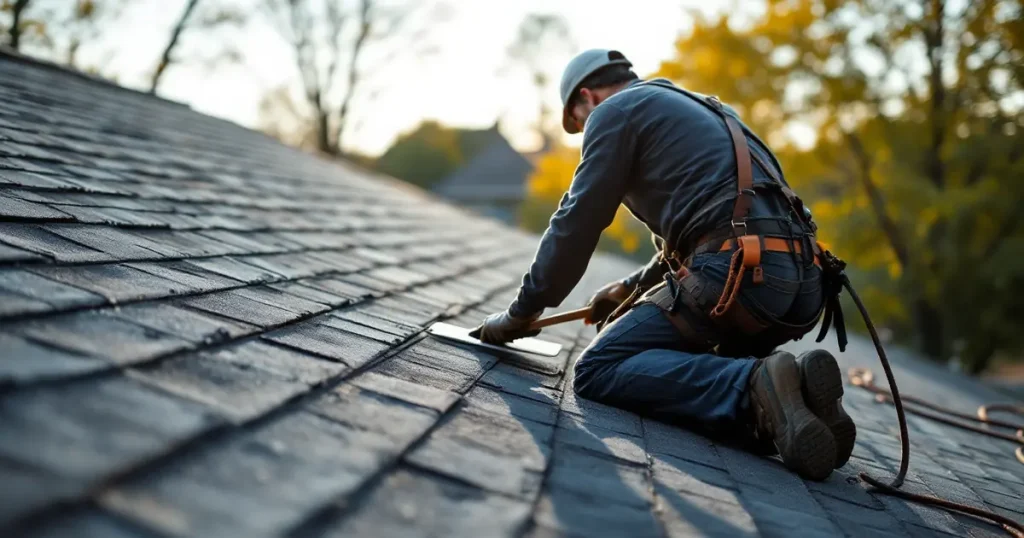
By The Roofing Brief Team | Last reviewed: November 2026
Correction, November 14, 2026: an attribution or figure in an earlier version did not match its cited source and has been corrected after a source check.
How to remove shingles without damaging them comes down to three moves: work when the shingles are cool but above 40°F, break the factory seal on the two courses above the target shingle, and pull every nail that holds it, which is its own 4 nails plus roughly 4 more from the course above that pass through its top edge. Miss those upper nails and the shingle tears at the headlap when you pull it, which is the most common way a “careful” removal goes wrong.
Shingle makers back each step. GAF’s Timberline HDZ installation instructions (4/23 edition) warn that asphalt shingles “can easily be broken in cold weather or their edges damaged in hot weather,” and GAF Technical Advisory Bulletin TAB-R-126 says any nails removed from surrounding shingles “must be replaced and the surrounding shingles must be resealed by hand.”
Key numbers at a glance
These six figures decide whether a 12 in or 13-1/4 in strip shingle comes out whole; each comes from a maker document or code text named in the Source column.
| Item | Figure | Source |
|---|---|---|
| Cold-handling threshold | Extra care below 40°F; perimeter shingles hand-sealed | Owens Corning Duration instructions, July 2026 |
| Nails in the target shingle | 4 standard, 6 in an enhanced or high-wind pattern | GAF Timberline HDZ instructions, 4/23; IRC 2021 R905.2.6 minimum of 4 per strip shingle |
| Nails from the course above that pierce it | About 4 (about 6 with six-nailing) | Roofing Brief arithmetic from GAF nail placement, shown below |
| Seal lines to break | Target shingle plus the 2 courses above it | Stephen Hazlett, Fine Homebuilding, Aug 2011 |
| Hand-seal dabs per shingle | 4 quarter-sized dabs, under 1/8 in thick | GAF Timberline HDZ instructions, 4/23 |
| Replacement nail spec | 12-gauge shank, 3/8 in head, 3/4 in into deck or through it | IRC 2021 R905.2.5; Owens Corning Duration instructions |
Which nails hold a shingle in place?
An asphalt strip shingle is held by its own row of 4 nails and also by the nails of the course above, because each new course is nailed through the top 1 to 2 inches of the course below it. On a GAF Timberline HDZ, the next course’s nails land about 3/4 in below the top edge of the shingle you want out, so that shingle cannot slide free until those nails are pulled too.
The geometry is fixed by the maker’s exposure and nail line. GAF’s 4/23 instructions place Timberline HDZ nails “approximately 6 7/8″ from bottom of shingle” on a 13-1/4 in tall shingle laid at a 5-5/8 in exposure. The GAF Royal Sovereign product information sheet lists that 3-tab at 12 in by 36 in with a 5 in exposure, and its 2004 application instructions put the nail band 5-1/4 to 6-1/2 in up from the butt.
| Shingle (maker document) | Height | Exposure | Own nails, inches above its butt | Own nails sit this far under the course above | Course-above nails, inches above this butt | Pierce this shingle? |
|---|---|---|---|---|---|---|
| GAF Timberline HDZ (instructions, 4/23) | 13-1/4 in | 5-5/8 in | 6-7/8 in | 6-7/8 minus 5-5/8 = 1-1/4 in | 5-5/8 plus 6-7/8 = 12-1/2 in | Yes, 3/4 in below the top edge |
| GAF Royal Sovereign 3-tab (sheet; 2004 instructions) | 12 in | 5 in | 5-1/4 to 6-1/2 in | 1/4 to 1-1/2 in | 10-1/4 to 11-1/2 in | Yes, 1/2 to 1-3/4 in below the top edge |
| Owens Corning Duration (cold-weather bulletin TB-10022497-A, steep-slope placement) | See bundle wrapper | 5-5/8 in | 6-1/8 in | 1/2 in | 11-3/4 in | Yes on any shingle taller than 11-3/4 in |
The table explains the seal sequence too. The target shingle’s own nails hide 1/4 to 1-1/2 in under the tab of the course above, so you unseal that course. The course-above nails hide under the tab of the course two above, so you unseal that one as well, which is why Hazlett breaks the seal on the two courses above the damaged shingle in his Fine Homebuilding repair article.
The count along the shingle follows from nail spacing. GAF’s 4-nail layout puts nails 1/2 to 2-1/2 in from each end and 11-5/8 to 14-5/8 in in from each end, so any 39-3/8 in run of the course above carries 3 to 5 nails, usually 4. With the 6-nail pattern the course-above count rises to about 6, so a removal can mean pulling 8 to 12 nails in total.
When is the best time to lift shingles?
Lift shingles when the surface is cool enough that the sealant splits cleanly but warm enough that the mat bends: in practice, above 40°F and before direct sun heats the roof. Owens Corning’s Duration instructions (July 2026) say to “use extra care in handling shingles when the temperature is below 40°F,” and Hazlett does this step before 8 a.m. in summer and only emergency repairs in winter.
| Shingle condition | What happens when you pry | Source |
|---|---|---|
| At or below 40°F | Mat is stiff; tabs crack where they bend; sealant will not reactivate, so every lifted shingle needs hand-sealing | Owens Corning TB-10022497-A; GAF instructions, 4/23 |
| Cool morning, above 40°F, roof in shade | Sealant strip tends to split cleanly; mat still flexes | Hazlett, Fine Homebuilding, 2011; Fine Homebuilding forum thread, Dec 2006 |
| Sun on a dark roof, afternoon | Sealant turns gummy and stretches; granules scuff; edges deform under a bar or a knee | GAF instructions, 4/23 (“edges damaged in hot weather”) |
| Shingle bundle or salvaged piece for reinstall | Bends without cracking once warmed | GAF storage guidance on its seasonal installation blog: store above 70°F the day before; Owens Corning: store at no more than 110°F |
A roof that faces north or sits in tree shade stays in the workable band longer than a south slope. If the morning is below 40°F, a contributor in the 2006 Fine Homebuilding thread describes warming a stubborn bond with a heat gun and slicing it with a heated blade; treat that as a last resort, because GAF’s instructions warn that excess heat damages edges.
Tools that lift shingles without tearing them
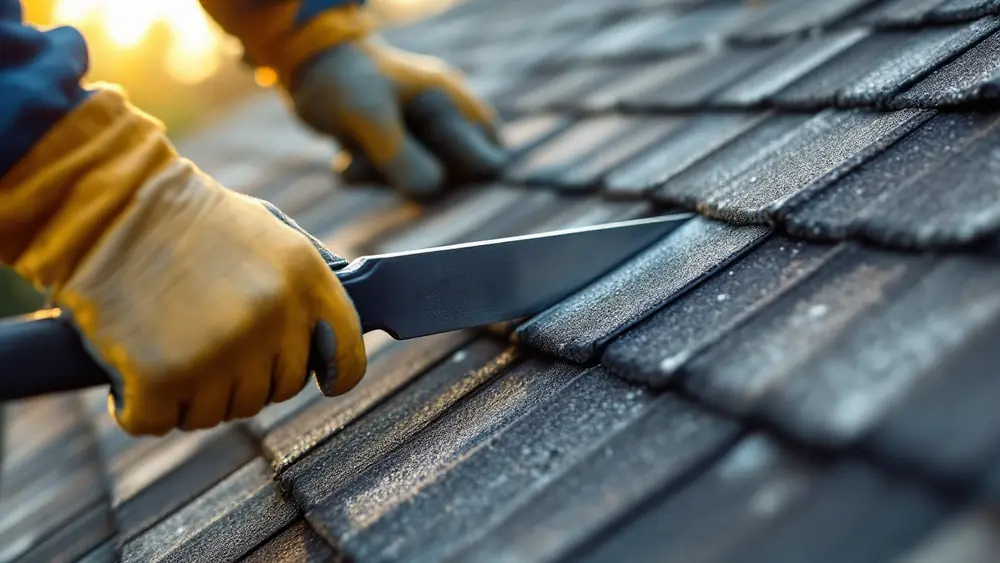
Use a thin, wide blade to break the seal and a notched bar to pull the nails; a tear-off shovel is the wrong tool for selective removal because it lifts several courses at once. Contributors in the Fine Homebuilding thread split the job the same way: a flat bar or a warmed 4 in drywall knife for the sealant, and a notched roofer’s bar for the nail heads.
| Tool | Example and size | Use it for | Damage risk | Source |
|---|---|---|---|---|
| Drywall taping knife | 4 in to 8 in steel blade | Breaking seal strips on laminated shingles | Lowest: the blade flexes instead of creasing the tab | Fine Homebuilding reader comments and forum, 2006 to 2011 |
| Flat pry bar | Stanley 55-515 Wonder Bar, listed by Stanley at 12-3/4 in long with a 1-3/4 in blade | Seal breaking and first lift of a nail head | Low if slid flat; tears tabs if levered upward | Stanley product listing |
| Notched pry bar | Estwing Pro-Claw, listed at 16-3/4 in with 2 nail slots | Hooking a nail shank under the course above and tapping it out | Medium: thicker blade can scuff the shingle above | Do it Best listing |
| Shingle ripper | Dasco Pro 640, sold as a 24 in shingle ripper | Hooking or cutting nails you cannot lift | Medium to high on brittle shingles | Walmart listing title |
| Tear-off shovel | 40 to 58 in tools such as the Bully Tools ProShingle 91110 | Full tear-off only | Destroys the shingles it lifts | Roofing Brief shovel guide |
For the full tear-off tools, see our ranking of the best roofing shovels for stripping asphalt shingles. A homeowner kit for this job is short: one flat bar, one notched bar or ripper, a hammer, a caulk gun with ASTM D4586 roof cement and a pocket of new roofing nails.
How to remove shingles without damaging them, step by step
The sequence below frees one shingle, or a short run of shingles in the same course, without tearing it or its neighbors. It assumes a walkable slope, fall protection and a dry roof, and it follows the nail map above, where the course-above nails sit 3/4 in below the target’s top edge on a GAF Timberline HDZ: unseal from the top down, then pull nails from the top down.
- Check the shingle before you start. Gently bend up a loose tab corner at the eave or rake. If it cracks or the granule surface crazes, plan to replace rather than reuse it, and expect neighbors of the same age to behave the same way. Run the test above 40°F, since cold tabs crack at any age.
- Pick the time. Start once the surface is above 40°F (the Owens Corning handling threshold) and finish before the sun softens the sealant, the timing Hazlett describes as before 8 a.m. in summer.
- Break the seal two courses up. Slide a drywall knife or flat bar under the tab of the shingle two courses above the target and work it side to side along the full 36 in to 39-3/8 in seal line. Keep the blade flat; prying upward creases the tab.
- Break the seal one course up. Repeat on the course directly above the target. On a GAF Timberline HDZ you now have about 1-1/4 in of access to the target’s own nail heads.
- Break the target’s own seal. Work the blade across the full 36 in (3-tab) or 39-3/8 in (laminated) width of the target’s tab so the shingle can drop out cleanly.
- Pull the course-above nails first. Lift the tab two courses up, find the roughly 4 nails of the course above that run through the target’s headlap, and pop each one about 1/4 in with the flat bar slid tight to the shank. Grip the raised head with the notched bar and pull it.
- Pull the target’s own nails. Lift the course directly above and remove the target’s 4 nails (6 if it was six-nailed) the same way.
- Slide the shingle out. Draw it straight down the slope. If it snags, a nail is still in; find it instead of pulling harder.
- Cut a nail you cannot lift. If a head will not rise without tearing the shingle above, hook the shank with a shingle ripper and cut or shear it flush with the deck; the new 12-gauge nail goes beside it.
- Protect the opening. If the shingle stays off overnight, cover the gap with a tarp held by sandbags or boards. GAF’s TAB-R-126 says shingles nailed through to hold a tarp “must be replaced.”
How to put the shingle back without new damage
Reinstall with new nails placed beside, not in, the old holes, then hand-seal every course you unsealed. Hazlett’s method is to nail next to each old hole and seal over it with a dab of sealant; GAF’s TAB-R-126 says removed nails must be replaced and surrounding shingles “resealed by hand” rather than left to reseal themselves.
New fasteners must meet 2021 IRC section R905.2.5: corrosion-resistant roofing nails with at least a 12-gauge shank and a 3/8 in head, long enough to go 3/4 in into the deck or through a thinner deck. R905.2.6 sets a floor of 4 fasteners per strip shingle, and the maker’s count governs where it is higher. Drive them flush; GAF’s instructions say overdriving “will damage the shingle” and raised heads “interfere with the sealing.”
| Maker document | Hand-seal pattern | Cement and limit |
|---|---|---|
| GAF Timberline HDZ instructions, 4/23 | 4 quarter-sized dabs, 1 in and 13 in in from each side, 1 in up from the bottom | Shingle tab adhesive or ASTM D4586 Type I or II, layer under 1/8 in |
| Owens Corning TB-10022497-A (cold weather) | Laminates: four 1 in dabs about 1 in from the leading edge. 3-tab: two 1 in dabs under each tab | ASTM D4586; no squeeze-out past the leading edge |
| CertainTeed Landmark chapter, Shingle Applicator’s Manual | Steep slope: 4 spots of 1 in under each corner and 12 to 13 in in from each edge | ASTM D4586 Type II |
More cement is not better. GAF warns that excess “can cause blistering of the shingles,” and Owens Corning’s bulletin repeats the blister warning. Our roofing adhesive guide covers hand-sealing products and coverage in more depth.
Worked example: materials for one shingle
The arithmetic below is a Roofing Brief estimate for removing and reinstalling one GAF Timberline HDZ shingle in a 4-nail field, using GAF’s dab pattern and Hazlett’s seal-the-old-hole method. The inputs are shown so you can rerun it for a 6-nail roof.
| Input | Count or size | Basis |
|---|---|---|
| New nails, target shingle | 4 | GAF standard pattern |
| New nails, course above | about 4 | Nail map table |
| Dabs to reseal 3 seal lines (target, +1, +2) | 3 lines x 4 dabs = 12 | GAF 4 dabs per 39-3/8 in |
| Dabs over old nail holes | 8 | Hazlett: seal over each old hole |
| Volume per dab | 1 in circle x 1/8 in = about 0.10 cu in | GAF thickness limit |
| Total cement | 20 dabs x 0.10 = about 2 cu in | Arithmetic |
| Cement in a 10.1 fl oz cartridge | 10.1 x 1.805 = about 18.2 cu in, so roughly 9 shingles per tube | 1 US fl oz = 1.805 cu in |
Can a removed shingle be reused?
A removed asphalt shingle can go back on when it comes out flat, untorn and flexible, and when it is not storm-damaged. GAF’s TAB-R-126 adds a caution for storm work: evidence of latent damage such as cracked surfacing and loosened self-seal “may not be apparent for years,” so a shingle pulled from a hail- or wind-hit slope is a poor candidate.
| If the removed shingle shows | Then | Why |
|---|---|---|
| Clean nail holes only in the area the next course covers | Reuse; nail beside the old holes and seal them | Own-nail holes sit 1/4 to 1-1/2 in under the next course’s tab |
| Nail holes torn into slots or a ripped headlap | Replace | The torn mat cannot hold a new fastener |
| A crease or crack across a tab | Replace | Hand-sealing does not close a crack in the mat |
| Nail holes from tarp nails through the exposed tab | Replace | GAF TAB-R-126: such shingles “must be replaced” |
| Granule loss at impact points | Replace | GAF TAB-R-126: granule loss “is NOT just cosmetic damage” |
| Stiff tabs that crack in the step 1 bend test | Replace, and price the slope | Same-age neighbors will crack when you lift them |
Code does not list asphalt shingles among reusable materials. 2021 IRC R908.5 permits reinstalling existing slate, clay or cement tile that is undamaged and requires flashings, edgings and vents to be replaced “where rusted, damaged or deteriorated”; reusing a sound shingle in a spot repair is a maker and workmanship question, not a code one.
Salvaging shingles to match an older roof
The best color match for a repair is a shingle salvaged from the same roof, because it has weathered with the field around it. Take it from a spot nobody sees, such as a back slope, the area under a planned addition tie-in, or a low-visibility valley edge, and put a new shingle of the same line, at the same 5 in or 5-5/8 in exposure, in that hidden spot instead.
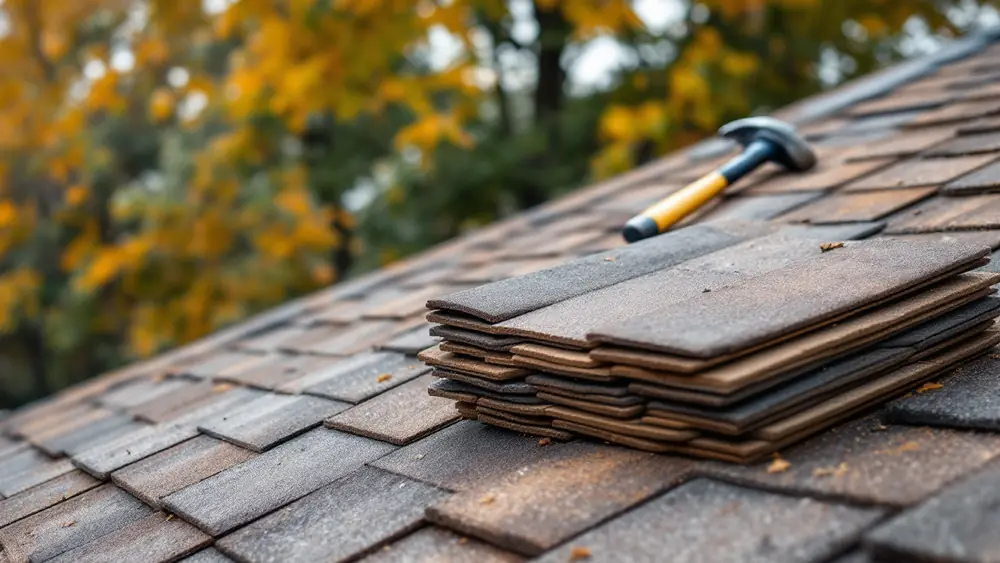
Salvage uses the same 10-step sequence, so it doubles the number of seal lines you break: 3 at the donor spot and 3 at the repair spot, or about 24 seal-line dabs plus 16 over old nail holes, roughly 40 dabs in all by the arithmetic in the worked example. Before you lift a donor shingle, read the brand and line from leftover bundle wrappers in the garage or attic; GAF Timberline HDZ, Owens Corning Duration and CertainTeed Landmark differ in exposure and nail line, so a donor from a different line will not sit flush in the course.
| Source of the patch shingle | Color match | Fit | Note |
|---|---|---|---|
| Donor shingle from a hidden slope | Closest, same weathering | Exact if same line | Doubles the lifting work |
| Leftover bundle from the original install | Same color, less weathered | Exact | GAF stores bundles above 70°F before use in cold weather |
| New bundle of the same line and color | Visible difference on an older roof | Exact if exposure matches | Check the 5 in vs 5-5/8 in exposure on the wrapper |
| Different line or maker | Usually visible | Exposure or nail line may not match | Avoid on a front slope |
For the repair-or-replace math once several shingles are involved, see the Roofing Brief shingle replacement decision guide. If the patch area is a missing shingle after a storm, start with what to do first when a roof is missing shingles.
How to remove asphalt shingles for a full tear-off
A full tear-off is the opposite job: speed matters and the shingles are scrap. Crews strip with a toothed tear-off shovel that lifts shingles and pulls nails in one stroke. A Budget Dumpster tear-off guide advises removing shingles in 2 to 3 ft sections and says 4 or 5 people can strip a roof in a day with an early start.
Family Handyman’s tear-off project (updated Oct 7, 2024) lists the total time as “a full day” and the tool list as roof jacks, a garden fork or roofing shovel, a hammer, a pry bar, a push broom, a broom magnet and a roof harness. Code then decides what goes back: 2021 IRC R908.3 defines roof replacement as removing existing layers down to the deck. Our DIY roof replacement guide covers permits, costs and when to stop.
| Goal | Selective removal | Full tear-off |
|---|---|---|
| Shingles afterward | Reused or kept intact | Scrap |
| Main tool | Drywall knife, flat bar, notched bar | Tear-off shovel or garden fork |
| Best temperature | Cool, above 40°F | Cool to mild; heat makes sealant gummy |
| Nails | Pulled one by one, about 8 per shingle | Pulled by the shovel teeth, strays swept with a magnet |
| Time | Scheduled for cool hours, before 8 a.m. in summer (Hazlett) | About a day for a 4 to 5 person crew (Budget Dumpster) |
Should you do it yourself or call a roofer?
Removing a few shingles on a low, walkable roof is a reasonable DIY job; brittle shingles, steep or high roofs, and storm-damaged slopes are where a roofer earns the fee. OSHA’s 29 CFR 1926.501(b)(13) requires fall protection for workers in residential construction 6 ft or more above a lower level; it binds employers, but the 6 ft line is a sound threshold for a homeowner too.
| If | Then |
|---|---|
| One to three shingles, one-story eave, slope you can stand on, tabs pass the step 1 bend test | DIY with the 10-step sequence and hand-sealing |
| Morning temperature stays at or below 40°F | Wait, or plan on cracking tabs and hand-sealing every lifted shingle |
| Tabs crack in the bend test, or the roof is near the end of its life | Get a roofer to price the slope, not the shingle |
| Storm damage, insurance claim open | Have the roofer or adjuster document first; GAF TAB-R-126 flags latent damage |
| Two-story eave or slope too steep to stand on | Hire it out, or use a full fall-arrest setup |
| Shingle sits at a hip or ridge | Follow the cap rules in our ridge cap installation guide |
When you call, ask the roofer three things: whether they will hand-seal the two courses above, whether they will replace every nail they pull from the course above, and whether they will match the shingle line by exposure. A roofer’s time is the main cost; the BLS OEWS May 2025 data puts the US median roofer wage at $26.65 an hour, and minimum service-call charges add to that. For other repairs that start with lifting a shingle, see how to fix nail pops on shingles, vent pipe flashing replacement and our broader guide on how to repair a damaged roof.
Frequently asked questions
How to lift shingles without damaging them?
Work when the shingles are above 40°F but not sun-heated, and slide a drywall knife or flat bar flat along the seal line instead of prying up. Break the seal on the two courses above the shingle you need, then pull the nails from the top down. Lift each tab only as far as needed to reach a nail head, and hand-seal every lifted tab afterward.
Can I remove shingles myself?
Yes, on a low, walkable roof with a few shingles to remove, most homeowners can do it with a flat bar, a notched pry bar and roof cement. Use fall protection at 6 ft or more, the OSHA line for workers. Skip DIY if the tabs crack when bent, the roof is steep or two stories high, or an insurance claim is open.
What is the fastest way to remove shingles from a roof?
For a full tear-off, the fastest method is a toothed tear-off shovel worked in 2 to 3 ft sections, which lifts shingles and pulls nails in one stroke. Budget Dumpster says a crew of 4 or 5 can strip a roof in a day. Fast methods destroy the shingles, so they suit replacement, not repairs.
How long does it take roofers to remove shingles?
A typical house tear-off takes about one day: Family Handyman lists a full day for the job, and Budget Dumpster says 4 or 5 people can strip a roof in a day with an early start. Selective removal of one shingle is shorter, but careful crews schedule it for cool morning hours, before 8 a.m. in summer in Hazlett’s practice.
How many nails do you have to pull to remove one shingle?
Usually about 8: the shingle’s own 4 nails plus about 4 from the course above, which pass through its top edge. On a GAF Timberline HDZ, those upper nails sit 12-1/2 in above the shingle’s butt, 3/4 in below its 13-1/4 in top. On a six-nailed roof the total can reach about 12.
Can you reuse shingles after removing them?
Yes, if the shingle comes out flat, flexible and untorn, with nail holes only in the area the next course covers. Nail beside the old holes, seal them, and hand-seal the tab with 4 quarter-sized dabs under 1/8 in thick, per GAF. Replace shingles with torn nail slots, creased tabs, granule loss or tarp-nail holes, which GAF says must be replaced.
Can you replace shingles without replacing the whole roof?
Yes, and GAF Technical Advisory Bulletin TAB-R-126 says it is possible to replace individual shingles, provided removed nails are replaced and surrounding shingles are resealed by hand. GAF also notes that storm damage to neighboring shingles is hard to assess, and says replacing just the damaged roof plane may be possible when damage is confined to one plane.