
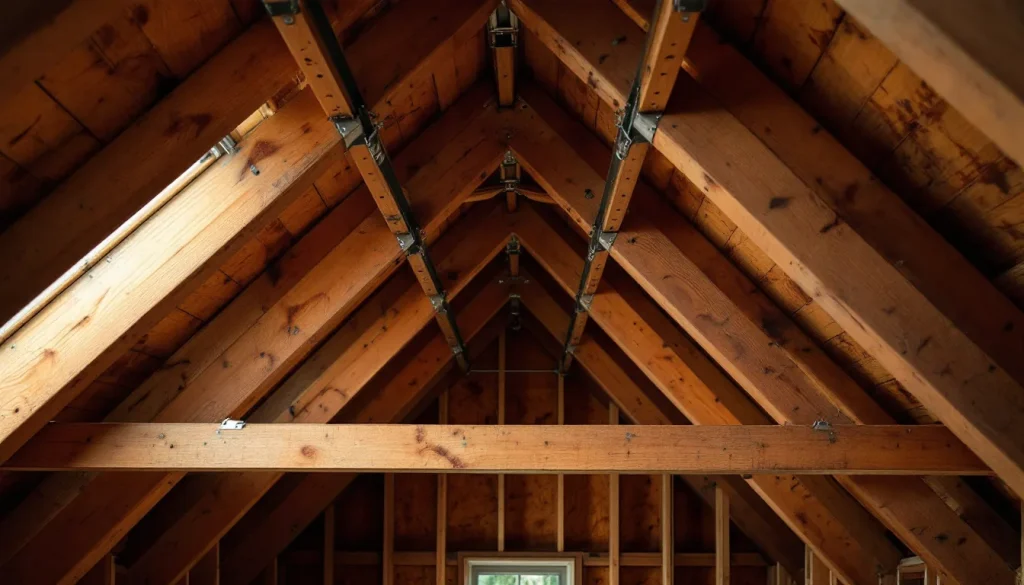
Hurricane roof straps are metal connectors that tie the roof structure to the wall framing, dramatically increasing uplift resistance during high-wind events. In Florida, the 2024 Florida Building Code Section 1626 requires hurricane straps on all new construction and major reroofs in HVHZ counties, and the Florida Existing Building Code triggers strap upgrades on any reroof that exposes more than 25 percent of the roof structure. Retrofit cost ranges from $50 to $150 per strap installed, with insurance discounts of 10 to 30 percent through Form OIR-B1-1802. The My Safe Florida Home program offers up to $10,000 in matching grants for hurricane mitigation including strap retrofit through 2027.
The short version
- Hurricane straps tie roof trusses or rafters to top wall plates, transferring uplift forces to the foundation.
- Florida Building Code Section 1626 requires straps on new HVHZ construction; the 25 percent rule triggers strap upgrades on reroofs.
- Cost: $50 to $150 per strap installed during a reroof; $200 to $400 per strap for retrofit without roof removal.
- Insurance discount: single wraps 10 to 20 percent on wind premium; double straps 20 to 30 percent through Form OIR-B1-1802.
- My Safe Florida Home program offers up to $10,000 in matching grants for hurricane mitigation.
- Use a Florida-licensed certified roofing contractor (CCC) or general contractor (CGC) and document everything with an OIR-B1-1802 inspection.
The Short Answer: Strap Types Plus Cost Plus Discounts
Hurricane straps are galvanized steel or stainless steel connectors made by Simpson Strong-Tie, USP Structural Connectors, MiTek, and a handful of code-approved manufacturers. The most common types are H1, H2.5A, H10, and H16 straps, plus various clip configurations. Each carries a load rating in pounds for uplift and lateral resistance, documented in manufacturer engineering catalogs that are accepted by Florida Building Code inspectors.
The choice between strap types depends on what your house currently has and how much retrofit work is feasible. New construction uses H10 or H16 straps at each truss-to-plate connection. Reroof retrofits typically use H2.5A clips (the most common upgrade target) or H1 wraps. Houses built before 1992 in Florida generally have minimal or no roof-to-wall connections beyond toe-nailing, which carries an uplift resistance of about 110 pounds. A single H2.5A clip raises that to 415 pounds; a double clip (one on each side of the rafter) raises it to 830 pounds.
What Hurricane Straps Actually Do: The Uplift Resistance Math
During a hurricane, the wind flowing over the roof creates suction. Bernoulli pressure differential lifts the roof upward off the walls. At 150 mph sustained wind on a typical 2,500 square foot Florida home with a 4:12 pitch, the calculated peak uplift load is approximately 60 to 80 pounds per square foot at the eaves and corners. Multiplied across the connection points, the total uplift force on a single truss can exceed 4,000 pounds.
Toe-nailing alone (the standard pre-1992 construction in Florida) provides about 110 pounds of uplift resistance per connection. That math does not work in a hurricane. Adding a single H2.5A clip brings each connection to 415 pounds. A double clip configuration brings each connection to 830 pounds. An H10 strap brings each to 990 pounds, and an H16 strap with proper anchoring carries 1,705 pounds. The transition from “house separates from walls at 110 mph” to “house survives 150 mph” runs through this math.
The Insurance Institute for Business and Home Safety (IBHS) field studies after Hurricane Michael (2018), Hurricane Ian (2022), and Hurricane Helene (2024) consistently show: homes with double-strap roof-to-wall connections and FORTIFIED designations survive Category 4 winds at materially higher rates than homes without. The wind itself does not destroy houses. The disconnect between roof, walls, and foundation does.
Single Strap, Double Strap, H-Clip
The terminology in Florida Building Code and Form OIR-B1-1802 distinguishes between specific connection types. Understanding the categories matters because insurance discounts scale with the connection strength.
| Connection Type | Uplift Capacity | OIR-B1-1802 Category | Insurance Discount Range |
|---|---|---|---|
| Toe-nail only | 110 lbs | None (minimum) | 0 percent |
| Clip (one side) | 415 lbs | Clip | 5 to 10 percent |
| Single wrap (H2.5A or H1) | 415 to 600 lbs | Single wrap | 10 to 20 percent |
| Double wrap (H2.5A on each side, or H10) | 830 to 990 lbs | Double wrap | 20 to 30 percent |
| Structural (H16 or engineered) | 1,500 lbs + | Structural | 25 to 35 percent |
The classification on Form OIR-B1-1802 is binary, not graduated. Either a connection point qualifies as a single wrap, or it does not. To qualify, the strap must wrap around the rafter or truss top chord, contact the wall top plate, and be fastened with the manufacturer-specified nails. A clip nailed to the side of the rafter without wrapping over the top chord is just a clip, not a wrap.
Hurricane Clip vs Hurricane Strap: The Distinction
The terms are used loosely in the residential market but have specific meanings in code and inspection forms. A hurricane clip is a flat or L-shaped connector fastened to the side of a rafter or truss and to the wall top plate. Common clips include the Simpson H2.5A (used as a clip in many configurations) and the Simpson H1 in side-applied mounting.
A hurricane strap is a connector that wraps over the top of the rafter or truss and ties down both sides to the wall top plate. The H1 strap installed correctly (over the rafter, fastened on both sides) is a strap. The H10 and H16 strap configurations always count as straps. A strap provides higher uplift resistance than a clip in the same connector family because the load path runs through the top of the member rather than relying on side-attachment shear strength.
For insurance purposes, only straps qualify for the “single wrap” or “double wrap” categories on Form OIR-B1-1802. Clips earn the lower “clip” discount tier.
Florida Building Code Section 1626 Requirements
The 2024 Florida Building Code, effective for permits pulled after January 1, 2026, governs HVHZ construction in Miami-Dade and Broward counties. Section 1626 requires:
- Hurricane straps or anchors at every roof-to-wall connection (rafters, trusses, and ridge beams to top plates)
- Continuous load path documentation from foundation to roof
- Strap product certification with valid Miami-Dade Notice of Acceptance (NOA)
- Installation per the NOA fastener schedule (nails, screws, and spacing)
- Inspection by certified third-party inspector or municipal inspector before roof deck installation
Outside HVHZ, Florida Building Code Chapter 23 and the wind speed map in Chapter 16 determine strap requirements. Counties with Ultimate Design Wind Speeds (V-ult) above 140 mph generally require straps on new construction. The post-Andrew code (1994 forward) progressively tightened requirements, so houses built before 1994 are the largest retrofit population.
HVHZ vs Standard Wind Zones
The wind speed map in the 2024 Florida Building Code splits Florida into wind zones from 110 mph V-ult (interior north Florida) to 180 mph V-ult (Florida Keys). HVHZ (Miami-Dade, Broward) operates at 175 mph V-ult and has its own dedicated code section with additional requirements beyond the rest of the state.
| Florida Region | Wind Zone (V-ult) | Strap Requirement on New Build |
|---|---|---|
| Miami-Dade, Broward (HVHZ) | 175 mph | Required, per Section 1626 |
| Monroe, Palm Beach | 170 mph | Required |
| Collier, Lee, Charlotte, Sarasota | 150 to 160 mph | Required |
| Pinellas, Hillsborough | 140 to 150 mph | Required |
| Orange, Osceola (Orlando metro) | 130 mph | Required |
| Duval, Alachua (North Florida) | 120 mph | Required |
The strap requirement on new construction is statewide. The retrofit triggers are tied to the reroof project scope under the Florida Existing Building Code Section R908.
Cost: New Construction vs Retrofit ($50 to $400 per Strap)
The cost of hurricane straps varies enormously based on whether the work happens during new construction, during a reroof, or as a standalone retrofit. The labor difference drives the spread.
| Installation Scenario | Cost per Strap | Notes |
|---|---|---|
| New construction (during framing) | $8 to $20 | Strap plus 5 minutes of labor; folded into framing budget |
| Reroof with full deck removal | $50 to $150 | Straps accessible during reroof; install adds 10 to 20 min per connection |
| Standalone retrofit (attic access) | $150 to $300 | Possible only from attic; labor-intensive |
| Standalone retrofit (no attic access) | $300 to $600+ | Requires soffit removal, drywall access, or interior demo |
For a typical 2,500 square foot Florida home with 25 to 30 truss-to-plate connections needing upgrade, the total retrofit cost ranges from $1,500 to $4,500 during a reroof, or $5,000 to $15,000 as a standalone project. The My Safe Florida Home grant program covers up to $10,000 of hurricane mitigation expense including strap retrofit, materially changing the homeowner economics.
Installation: Existing Home Retrofit Process
A retrofit during a reroof is straightforward: after the existing roof covering and deck are removed, the framer or roofer accesses each truss or rafter where it meets the wall top plate, installs the strap with manufacturer-specified nails or screws (typically 8d common nails or #9 Simpson Strong-Drive screws), and documents the installation for the third-party FORTIFIED inspector or municipal inspector. The work takes 10 to 20 minutes per connection.
A retrofit without removing the roof covering is harder. The strap must be installed from inside the attic, reaching the truss-plate connection by working between rafters in confined space. Many older Florida homes with low-slope roofs or blown-in insulation make this nearly impossible without removing soffits or sections of interior drywall. Most contractors recommend bundling strap retrofit with a planned reroof to avoid the labor premium.
Insurance Discount: My Safe Florida Home Program
The My Safe Florida Home program (Florida Statute 215.5586) is the state-funded hurricane mitigation grant program, administered by the Florida Department of Financial Services. Reauthorized and refunded in 2022 and 2023, the program currently offers homeowners up to $10,000 in matching grants (state funds $2 for every $1 the homeowner spends, with a maximum state contribution of $10,000) for wind mitigation improvements including:
- Hurricane straps and clips
- Sealed roof deck
- Hurricane-rated garage doors
- Impact-rated windows and doors
- Reinforced gable end bracing
The application process requires a free wind mitigation inspection through a state-approved inspector, an approved mitigation plan, and verification of completed work. Funding through 2027 is currently at $200 million per fiscal year. The program is income-tested in some application windows (lower-income homeowners receive 100 percent grants up to $10,000 in certain rounds) and uncapped in others.
Insurance Discount: By Carrier
Florida insurance carriers calculate wind premium discounts using the Office of Insurance Regulation (OIR) standardized matrix tied to Form OIR-B1-1802. The discount is mandatory under Florida Statute 627.0629, which requires every property insurer in Florida to offer mitigation discounts at minimum levels set by OIR.
| Carrier | Single Wrap Discount | Double Wrap Discount |
|---|---|---|
| Citizens Property Insurance | 14 percent | 22 percent |
| State Farm Florida | 10 to 18 percent | 18 to 28 percent |
| Universal Property and Casualty | 12 to 20 percent | 20 to 30 percent |
| Tower Hill Signature | 12 to 18 percent | 22 to 28 percent |
| Slide Insurance | 10 to 16 percent | 18 to 26 percent |
| USAA (Florida) | 15 to 22 percent | 25 to 32 percent |
Citizens publishes its discount matrix transparently. Private carriers use proprietary algorithms that fall within OIR-mandated ranges. The actual discount on your policy depends on your wind premium subcomponent, which can be 60 to 80 percent of total premium in coastal counties and 20 to 40 percent inland.
Wind Mitigation Inspection (Form OIR-B1-1802)
Form OIR-B1-1802 is the standardized wind mitigation inspection form required by Florida insurance carriers to apply discounts. The form must be completed by an authorized inspector: a Florida-licensed general contractor, building contractor, residential contractor, professional engineer, registered architect, or certified inspector who has passed the OIR-approved wind mitigation training.
Inspection costs $75 to $200 in 2026 Florida markets. The inspector physically verifies each of ten mitigation features by photographing them: roof covering, roof deck attachment, roof-to-wall connection (the strap section), roof geometry, secondary water resistance, opening protection, plus property identification fields. The completed form has a five-year validity period for most carriers.
For strap classification specifically, the inspector verifies type by physical inspection of multiple connection points (typically a minimum sample size of three per inspection). If different connections have different strap types, the form records the weakest classification. A house with 95 percent double straps but 5 percent toe-nail connections records as toe-nail. This makes retrofit completeness important.
Code Documentation: The Certificate You Need
For new construction in Florida, the strap installation is documented through the municipal building permit process. The inspector verifies installation before the roof deck goes on and signs the permit. The certificate of occupancy at completion documents the strap installation, and the original building permit number serves as the documentation reference for insurance purposes.
For retrofit work, the documentation chain is: a permit for the wind mitigation retrofit (or for the reroof if straps are bundled), inspection by the municipal inspector or third-party FORTIFIED evaluator, completion paperwork from the contractor, and a new Form OIR-B1-1802 inspection after the work is complete. Keep all of this paperwork. Insurance carriers periodically re-verify the mitigation features on policy renewal and may demand documentation 5 to 10 years after the retrofit.
Retrofit Without Roof Removal: Limited Options
Standalone strap retrofit without roof removal is possible but limited by attic access. The Florida Building Code permits attic-installed straps on retrofit projects, but the connection geometry must allow the strap to wrap over the truss top chord and fasten to the top plate. In typical 1970s and 1980s Florida tract homes with 2×4 trusses and 12 to 24 inches of attic clearance at the eaves, the work is uncomfortable but feasible.
Houses with cathedral ceilings, low-slope roofs without attic access, or insulation that fully fills the eaves are poor retrofit candidates without roof removal. For these structures, the practical path is bundling strap retrofit with the next planned reroof. Some contractors offer “permit-and-strap” packages where they pull the wind mitigation permit, install straps from inside the attic where possible, and document everything for OIR-B1-1802 reinspection.
Other Wind Mitigation Items Worth Doing
Hurricane straps are one component of the total wind mitigation picture. Form OIR-B1-1802 evaluates ten components. The other high-value items to address in coastal Florida:
- Roof covering rating (Class H asphalt or metal standing seam) – 5 to 20 percent discount
- Roof deck attachment (8d ring-shank at 6/12 spacing) – 5 to 15 percent discount
- Sealed roof deck (peel-and-stick underlayment) – 5 to 15 percent discount
- Hip roof geometry (vs gable) – 10 to 25 percent discount
- Impact-rated windows and doors – 15 to 30 percent discount
- Garage door bracing or hurricane-rated replacement – 5 to 15 percent discount
The largest single bundled improvement program is the FORTIFIED Gold designation, which packages all of these into a third-party verified upgrade. See our best roof for hurricane guide for the full FORTIFIED breakdown. For a hurricane-resistant complete system, see hurricane proof roof.
Real Florida Operator Practices
The major Florida regional roofing operators handling hurricane straps as a regular part of their work in 2026 include Kelly Roofing (Naples), Best Roofing (Fort Lauderdale), Tadlock Roofing (Tallahassee), Atlantic Roofing of South Florida (West Palm Beach), and Tropical Roofing Products distribution network operators. Several PE-backed roofing platforms operate Florida service brands as well, though hurricane mitigation expertise tends to concentrate in the long-tenured regional operators.
What separates competent operators from storm-chasers on strap work: they pull the wind mitigation retrofit permit (not just the reroof permit), they use Simpson Strong-Tie or USP connectors with current Miami-Dade NOA documentation, they schedule the third-party FORTIFIED inspector before the deck goes on, and they deliver the updated Form OIR-B1-1802 to the homeowner at project completion.
Frequently Asked Questions
Do I need hurricane straps in Florida?
If your home was built before 1994, very likely yes for insurance and code reasons. New construction since 1994 in coastal counties already has straps to current code. Retrofit during a reroof is the cheapest path.
How much does it cost to install hurricane straps?
$50 to $150 per strap during a reroof; $200 to $400 per strap as standalone retrofit. A typical 2,500 square foot home needs 25 to 30 strap upgrades, so total cost runs $1,500 to $12,000 depending on access.
What is the My Safe Florida Home program?
State-funded grant program offering up to $10,000 matching grants for hurricane mitigation including straps, sealed deck, and impact glass. Funded through 2027. Income-tested in some application rounds.
What is the difference between a hurricane clip and a hurricane strap?
A clip fastens to the side of the rafter; a strap wraps over the top of the rafter. Straps carry higher uplift loads and earn larger insurance discounts under Form OIR-B1-1802.
Will my insurance company actually give me a discount for hurricane straps?
Yes. Florida Statute 627.0629 requires every property insurer in Florida to offer wind mitigation discounts. The discount tier depends on Form OIR-B1-1802 classification: single wrap 10 to 20 percent, double wrap 20 to 30 percent on wind premium.
Can I install hurricane straps myself?
No. Florida Building Code requires the work be permitted and inspected. Permits go to Florida-licensed roofing contractors (CCC), general contractors (CGC), or building contractors (CBC). Self-installed straps will not pass Form OIR-B1-1802 inspection or qualify for insurance discount.
How long does hurricane strap installation take?
For a 2,500 square foot home during a reroof, the strap upgrade adds half a day to one full day to the project. As standalone retrofit, two to four days.
What is the 25 percent rule for reroofs?
Florida Existing Building Code Section R908 triggers strap upgrade requirements when a reroof exposes more than 25 percent of the roof structure. Most full tear-offs meet this threshold; re-covers (new shingles over existing) typically do not.