
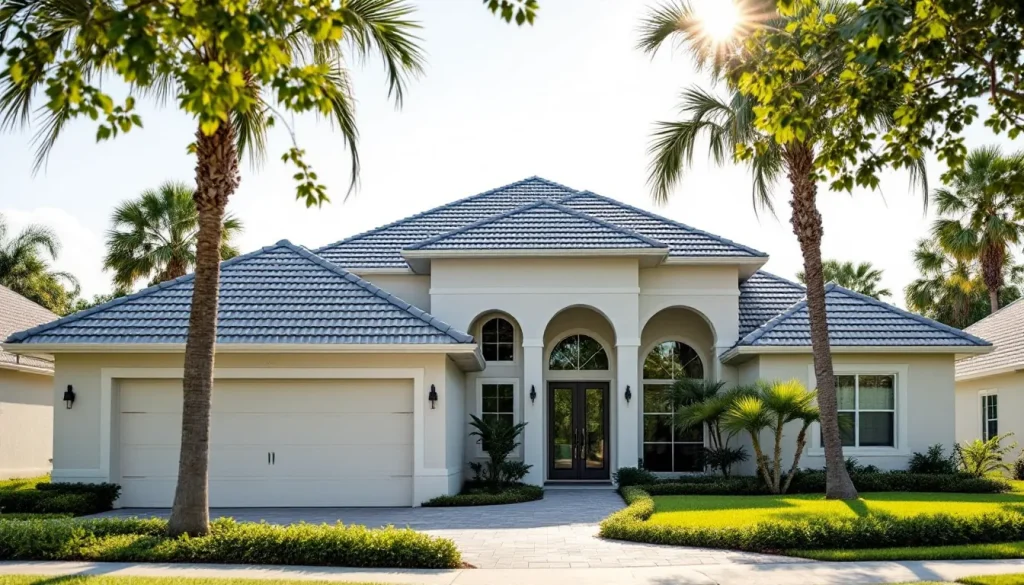
A hip roof is the four-sided sloped design where all four sides meet at the central ridge (or a peak, in a pyramid hip variant), creating a roof with no vertical end-walls. In 2026, a hip roof costs 5 to 20 percent more than a comparable gable, but the wind performance is materially better, which is why Florida, Texas, and other hurricane-zone builders specify hip almost exclusively for new construction in HVHZ counties. The insurance math alone often justifies the premium within five to eight years. Here is the complete breakdown of when hip makes sense and what the install actually entails.
The short version
- A hip roof has four sloped sides with no vertical gable end walls. The four slopes meet at hips (corner ridges) and a central ridge or peak.
- 2026 installed cost runs $6.50 to $10.50 per square foot for asphalt, $13 to $20 for standing seam metal, $11 to $20 for concrete tile.
- Wind performance is materially better than a gable: the aerodynamic shape reduces uplift, and the absence of gable end walls removes the primary failure point.
- Florida wind mitigation credits make the hip roof a financial winner in hurricane zones, often saving $400 to $1,400 annually in insurance premiums.
- Variants include simple hip, pyramid hip, cross hip, and half-hip (also called jerkinhead or clipped gable).
- Best applications: hurricane zones, snow zones with severe drift conditions, any climate where wind performance is a priority.
The Short Answer: Hip vs Gable Decision
The gable versus hip decision is the most common roof decision in residential construction, and it comes down to three factors: cost, wind performance, and architectural style.
If you are in a non-hurricane zone with a tight construction budget, a gable is usually the right answer. The 5 to 20 percent cost saving is real and the wind performance is adequate for inland conditions. If you are in a hurricane zone (Florida, Texas Gulf Coast, the Carolinas, Louisiana), a hip is almost always the right answer because the insurance savings dominate the installation premium. If the architectural style of the home demands hip (French Provincial, Italianate, certain ranch and prairie styles), the hip is required for visual integrity.
The hip roof also wins on aesthetic grounds in a number of architectural traditions. The pyramid hip is iconic in French country and Italianate construction. The simple hip with deep overhangs defines the Frank Lloyd Wright Prairie style. The cross-hip massing is core to American Foursquare residential.
Hip Roof Anatomy
The hip roof has four named structural lines that any owner should recognize.
Ridge. The horizontal line at the top of the roof, where the two long opposing slopes meet. A pyramid hip has no ridge (the slopes meet at a single peak).
Hips. The four (or more) sloping lines that run from the corners of the building up to the ridge. The hip is the structural element that gives the roof its name. Hip rafters carry significant load and are typically engineered as beams rather than as standard rafters.
Eaves. The lower edges of all four sloped sides, where the roof meets the exterior walls. Hip roof eaves wrap continuously around the entire perimeter of the building, unlike gable eaves which only run along two sides.
Valleys. Only present on cross-hip roofs, where two hip sections intersect. A simple hip has no valleys.
The continuous eave perimeter and the absence of vertical gable end walls are the geometric facts that drive everything else about the hip roof: better wind performance, higher cost, simpler ventilation strategy, and uniform appearance from any angle. For the complete roof vocabulary, see parts of a roof.
Wind Performance: Why FBC 1626 Favors Hip
The hip roof is the highest-performing residential roof geometry in wind events. The reasons are aerodynamic.
The first reason is the absence of gable end walls. The gable end is the primary failure point on a gable roof in high wind; a hip roof eliminates the failure point entirely.
The second reason is the pressure distribution across the roof surface. Wind pressure on a sloped roof is a combination of positive pressure on the windward slope and suction (uplift) on the leeward and side slopes. On a gable roof, the side slopes (which are the gable end walls) generate concentrated uplift at the gable corners and along the rake. On a hip roof, the four slopes distribute the wind pressure more evenly, and the uplift is lower at every point.
The third reason is the hip rafter as a structural element. The hip rafter ties the corner of the building to the ridge with a continuous beam, which means wind loads at the corners are carried directly to the ridge and down through the structure. On a gable roof, the corner loads have to be carried by the gable end wall back to the foundation.
Florida Building Code 1626 (the High-Velocity Hurricane Zone code) implicitly favors hip roofs through the structural prescriptive requirements for gable end reinforcement, which add significant cost to gable construction in HVHZ. Outside HVHZ but still in coastal Florida, the FBC wind provisions in Chapter 16 of FBC Residential require detailed engineering for gable ends that hip roofs do not need. The cumulative effect is that hip roofs are simpler and cheaper to engineer in any hurricane zone even though the materials cost more.
The Hurricane-Zone Insurance Discount
The economic case for hip roofs in hurricane zones is driven by insurance, not by the installation cost difference. Florida homeowner insurance carriers offer wind mitigation credits for hip roofs that can reduce annual premiums by 10 to 35 percent.
The credit is documented on the Florida Building Code wind mitigation form (often called the “OIR-B1-1802” form after the Office of Insurance Regulation form number). A licensed inspector certifies the hip-to-gable ratio of the roof, and the credit scales with the percentage of the roof that is hip. A 100 percent hip roof gets the maximum credit. A roof that is 70 percent hip and 30 percent gable gets a partial credit.
| Hip-to-gable ratio | Typical Florida wind premium credit | Annual savings on $4,000 wind premium |
|---|---|---|
| 100% hip | 20 to 35% | $800 to $1,400 |
| 90 to 99% hip | 15 to 28% | $600 to $1,120 |
| 70 to 89% hip | 10 to 22% | $400 to $880 |
| Less than 70% hip | No credit (gable rating) | $0 |
Over a 20-year roof service life, a Florida home with a 100 percent hip roof can save $16,000 to $28,000 in insurance premiums versus the same home with a gable. The hip installation premium on a 2,500 square foot home is typically $2,000 to $5,000. The payback period is 2 to 5 years, and every year after that is pure savings.
The credit structure exists in Texas, Louisiana, the Carolinas, and Alabama in various forms, though the Florida implementation is the most formal. See best roof for hurricane for the cross-state breakdown.
Cost Premium vs Gable: 5-20% Math
Hip roofs cost more than gables because of three concrete factors: more roof surface area per square foot of floor, more complex framing with hip rafters and valley elements, and slightly more material waste at the hip ridges.
| Material | Gable installed cost (2026) | Hip installed cost (2026) | Hip premium |
|---|---|---|---|
| Architectural asphalt shingles | $5.50 to $9.00 / sf | $6.50 to $10.50 / sf | +12 to 18% |
| Impact-rated asphalt | $7.50 to $11.50 / sf | $8.50 to $13.00 / sf | +10 to 15% |
| Standing seam metal | $11.00 to $18.00 / sf | $13.00 to $20.00 / sf | +10 to 18% |
| Concrete tile | $11.00 to $18.00 / sf | $13.00 to $21.00 / sf | +10 to 18% |
| Cedar shake | $13.00 to $22.00 / sf | $15.50 to $26.00 / sf | +15 to 22% |
| Slate | $22.00 to $40.00 / sf | $26.00 to $48.00 / sf | +18 to 25% |
For a 2,500 square foot home with architectural asphalt shingles, the hip premium typically runs $2,000 to $5,000. In a hurricane state with wind mitigation credits, this premium is recovered in 2 to 5 years of insurance savings. Outside hurricane states, the premium is a pure cost with no insurance offset. For broader pricing context, see how much does a new roof cost.
Variants: Simple Hip, Pyramid Hip, Cross Hip, Half-Hip
The hip roof has four primary variants, defined by the geometry of the four slopes.
Simple hip. The standard configuration. Two long slopes on the long sides of the building plus two shorter triangular slopes on the short ends, all meeting at a horizontal ridge. The simple hip is the cheapest and most common variant.
Pyramid hip. All four slopes meet at a single central peak. There is no ridge. The pyramid hip works only on square or nearly square footprints. It is the signature of French country and Italianate architecture and the standard small-pavilion roof in formal landscape architecture.
Cross hip. Two simple hips intersect at right angles, creating valleys where the two hip sections meet. The cross hip is the standard configuration for L-shaped or T-shaped homes. The valleys add leak risk relative to a simple hip.
Half-hip (jerkinhead, clipped gable). A gable with a small hip section at the peak. The half-hip is technically a gable variant rather than a hip variant, but it captures some of the wind performance benefit of a hip at lower cost. The half-hip is common on Dutch Colonial and some Tudor variants.
| Variant | Best application | Cost vs simple hip | Wind performance |
|---|---|---|---|
| Simple hip | Rectangular homes, hurricane zones | baseline | Excellent |
| Pyramid hip | Square pavilions, French country | +5 to 10% | Excellent |
| Cross hip | L-shaped or T-shaped footprints | +15 to 25% | Very good (valleys add some risk) |
| Half-hip | Dutch Colonial, Tudor accent | -10 to 15% (cheaper than full hip) | Good (partial credit available) |
Hip Roof Framing Complexity
Hip roof framing is more complex than gable framing in three specific ways.
The first complexity is the hip rafter. Hip rafters run diagonally from the corners of the building to the ridge. They are longer than common rafters (a 30-degree hip rafter is approximately 1.155 times the length of a common rafter for the same run), and they have to be sized as beams because they carry the load of all the jack rafters that frame into them.
The second complexity is the jack rafter system. The four hip slopes are framed with jack rafters of progressively shorter length running from the eave to the hip rafter at varying angles. Calculating jack rafter lengths and cuts is straightforward with modern framing software but was a craft skill in pre-software construction. The cut and span of every jack rafter is unique.
The third complexity is the framing connector requirements. Hip rafters carry concentrated loads at their connections to the ridge and to the corner of the building. In any wind zone above 90 mph design, these connections require engineered hardware (hurricane clips, beam hangers, or specialty connectors) rated for the calculated load.
The premium for hip framing labor over gable framing labor runs 15 to 30 percent depending on the framing crew. Truss-built hip roofs reduce this premium because the truss manufacturer handles the geometry, but truss hips still cost 15 to 25 percent more than equivalent gable trusses. See roof trusses for the engineering side of hip truss design.
Material Best-Pairings
Hip roofs work well with every standard residential roof material. There are no geometric incompatibilities. Material choice is driven by climate, architectural style, and budget rather than by hip geometry.
| Material | Hip suitability | Best application |
|---|---|---|
| Architectural asphalt shingles | Excellent | Mainstream residential, all climates |
| Impact-rated asphalt | Excellent | Hail belt and hurricane zones |
| Standing seam metal | Very good | Premium residential, snow country |
| Metal shingle (interlocking) | Excellent | Hip-compatible alternative to standing seam |
| Concrete tile | Excellent | Florida, California, Southwest hip homes |
| Clay tile (Spanish, Mission) | Excellent | Mediterranean and Spanish Colonial |
| Cedar shake | Good | Northeast and Pacific Northwest |
| Slate | Excellent | Historic restoration and premium custom |
The one detail worth flagging is the hip cap. The ridge and hip lines on a hip roof require special cap shingles (for asphalt) or formed ridge caps (for metal and tile). Standard architectural shingles do not include hip and ridge caps; they have to be ordered separately. The cap is typically 5 to 10 percent of the total shingle cost. See metal vs asphalt shingle roof for the material decision framework.
Snow Country Considerations
Hip roofs perform well in snow country for the same reason they perform well in wind: distributed loading and no end wall vulnerabilities. The four-sided geometry distributes snow load across the entire perimeter rather than concentrating it on two sides as a gable does.
Drift loading is the one area where hip roofs need careful design attention. Drift loads on a hip roof can concentrate at the hip rafters in certain wind conditions, and ASCE 7-22 requires that hip rafter design loads include the unbalanced drift case. For high-snow climates (40+ psf ground snow load), this typically means upsizing hip rafters by 10 to 25 percent relative to a simple uniform load calculation.
Ice damming on hip roofs is comparable to ice damming on gables. The continuous perimeter eave of a hip roof gives the dam the same conditions to form (warm attic air rising to the roof, snow melting, water refreezing at the cold eave). The mitigation strategies (ice and water shield underlayment from the eave to 24 inches inside the warm wall line, proper attic ventilation, proper attic insulation) apply identically.
Ventilation Strategy for Hip Roofs
Hip roofs are ventilated with a ridge-and-soffit system. There is no gable end available for a gable vent, so the ridge-and-soffit combination is the only practical attic ventilation strategy for a hip roof.
The continuous ridge vent runs along the top of the roof. On a simple hip with a horizontal ridge, the ridge vent is straightforward. On a pyramid hip with a single peak (no ridge), a specialty peak vent or four-sided turbine vent is required. On a cross hip with multiple ridge sections, every ridge gets a continuous ridge vent.
The soffit vent system is the air intake. The continuous perimeter eave of a hip roof gives the soffit vent system more total intake area than a gable, which can actually improve attic ventilation performance. The standard ratio of net free vent area to attic floor area is 1:300 (per IRC R806), with at least 50 percent of the vent area at the soffit and the rest at the ridge.
For the complete ventilation breakdown, see attic ventilation.
Hip + Dormers: The Architectural Option
Hip roofs can accommodate dormers, though the geometry is more complicated than dormers on a gable. The standard hip dormer is a small gable-roofed projection set into one of the four hip slopes, similar in principle to a dormer on a mansard.
The dormer geometry has to account for the hip rafter that may run through the dormer location. In practice, dormers are typically placed between hip rafters rather than crossing them. This limits dormer placement to specific locations on the roof.
An alternative is the hip-roofed dormer, where the dormer itself has a hip roof rather than a gable. The hip dormer integrates more cleanly with a hip main roof and gives a more unified architectural appearance. The cost is 15 to 25 percent higher than a gable dormer.
Cost-Benefit in Storm Zones
In hurricane and high-wind zones, the cost-benefit math for hip roofs is decisively positive over a 20-year service life.
| Item | Gable on 2,500 sf home (FL) | Hip on 2,500 sf home (FL) | Delta |
|---|---|---|---|
| Installation cost (architectural asphalt) | $17,000 | $20,000 | +$3,000 |
| Annual wind insurance premium | $4,000 | $2,800 to $3,200 | -$800 to -$1,200 |
| 20-year insurance savings | baseline | +$16,000 to $24,000 | +$16,000 to $24,000 |
| Net 20-year savings | baseline | +$13,000 to $21,000 | strongly positive |
| Hurricane damage risk (claims experience) | baseline | 30 to 50% lower claim frequency | significant |
The hip roof is one of the highest-return upgrades available in residential construction in hurricane zones. The combination of insurance savings and reduced claim frequency makes the hip a clear winner in any Florida, Texas Gulf Coast, Louisiana, or Carolinas coastal county. See best roof for hurricane for the full storm-zone analysis.
Hip in Modern 2026 Architecture
The hip roof remains relevant in modern residential architecture for three reasons.
Modern Prairie and Ranch. The Frank Lloyd Wright Prairie tradition, which dominated American residential architecture from 1900 to 1940, has had ongoing revivals. The signature deep-eaved hip with horizontal emphasis is a defining feature of the style and is still being specified in custom residential work.
Modern Mediterranean. The Florida, California, and Southwest Mediterranean style relies on a low-pitch hip with red clay or concrete tile. The hip is essential to the visual language of the style.
Modern Tropical. Caribbean and Hawaiian residential architecture uses a hip roof with deep overhangs for shade and wind resistance. The style has been adopted in coastal Florida and Texas Gulf Coast resort residential.
Production builders in hurricane zones now offer hip roof options on almost every plan, and many newer plans default to hip with gable as the upgrade option. This is a reversal from the pre-2000s default where gable was standard and hip was the upgrade.
Hip Roof Maintenance Realities
Hip roofs are slightly higher maintenance than gable roofs, but the difference is modest. The annual maintenance items include:
Inspect hip ridge caps. The hip ridge caps are exposed to wind from multiple directions and tend to lift before field shingles do. Annual inspection from the ground with binoculars is usually sufficient.
Clear continuous gutter system. The continuous perimeter eave on a hip means continuous gutters. The gutter system is twice as long as on a comparable gable (which has gutters only on two sides). Annual cleaning is essential. See gutter installation cost for replacement budgeting.
Inspect valleys (on cross-hip roofs only). The valleys at the intersections of cross-hip sections are the highest-leak-risk points on the roof. Annual inspection of valley flashing is critical.
Verify ridge vent and soffit vent function. The hip relies entirely on ridge-and-soffit ventilation, and any blockage at the soffit (often caused by attic insulation overspray) or at the ridge (often caused by debris or ice) impairs the entire attic ventilation system.
Annual maintenance budget: $200 to $500 for a single-family home with a hip roof. This is roughly 30 percent higher than a gable but materially less than a mansard.
Insurance Premium Savings: Real Numbers
The Florida wind mitigation credit structure is the most documented insurance savings opportunity for hip roofs. The credit math depends on the carrier, the location within Florida (HVHZ counties get larger absolute credits because base premiums are higher), and the certified hip-to-gable ratio on the OIR-B1-1802 form.
Working numbers from Florida carrier rate filings as of 2024 to 2026:
| Florida county tier | Typical wind premium (2,500 sf home) | 100% hip credit | Annual savings |
|---|---|---|---|
| HVHZ (Miami-Dade, Broward) | $5,500 to $9,000 | 20 to 35% | $1,100 to $3,150 |
| Coastal Florida (Palm Beach, Lee, Pinellas) | $3,500 to $5,500 | 15 to 30% | $525 to $1,650 |
| Central Florida (Orange, Hillsborough) | $2,000 to $3,500 | 12 to 25% | $240 to $875 |
| Inland Florida (Marion, Polk) | $1,200 to $2,500 | 10 to 20% | $120 to $500 |
The credit is largest in absolute dollars in HVHZ counties because base premiums are highest. The credit can fully pay for the hip installation premium within 2 to 3 years in HVHZ and within 4 to 6 years in coastal Florida. For the broader contractor selection question that drives Florida roof installation, see how to choose a roofing contractor.
FAQs
What is the main advantage of a hip roof?
Wind performance. The hip roof has no vertical gable end walls and distributes wind loads evenly across four slopes, which makes it the highest-performing residential roof geometry in high-wind events. In hurricane zones, the insurance savings typically exceed the installation premium within 5 years.
How much does a hip roof cost in 2026?
For a 2,500 square foot home with architectural asphalt shingles, expect $16,000 to $26,000 installed. Standing seam metal runs $32,500 to $50,000. Concrete tile runs $32,500 to $52,500. The hip premium over a gable runs 5 to 20 percent.
Is a hip roof better than a gable in hurricane areas?
Yes. The wind performance is materially better, the insurance discounts from Florida and other hurricane states make the hip a clear financial winner over the 20-year roof service life, and claim frequency data shows hip roofs experience significantly fewer storm-related claims.
Can I convert my existing gable roof to a hip?
Yes, but it is expensive. The conversion requires new framing for the four-sided slope structure, new sheathing on the new slopes, and complete re-roofing of the entire roof. The cost typically runs 30 to 60 percent more than a standard roof replacement. For Florida homeowners, the insurance savings can justify the conversion within 8 to 12 years.
What is the difference between a simple hip and a pyramid hip?
A simple hip has two long slopes and two short triangular slopes meeting at a horizontal ridge. A pyramid hip has four equal triangular slopes meeting at a single central peak. The pyramid only works on square footprints; the simple hip works on any rectangular footprint.
Do hip roofs need different ventilation than gable roofs?
Yes. Hip roofs cannot use gable vents because there are no gable end walls. The standard ventilation system is continuous ridge venting plus continuous soffit venting. The continuous perimeter eave of a hip roof actually gives more total soffit vent area than a comparable gable, which can improve attic ventilation performance.
How long does a hip roof last?
Service life is driven by material, not by roof style. Architectural asphalt on a hip lasts 20 to 30 years. Standing seam metal lasts 50 to 70 years. Concrete tile lasts 50 years or more. Hip roofs sometimes last slightly longer than comparable gables in hurricane zones because of reduced storm damage, but the difference is small. See how long does a roof last.
Why do builders charge more for hip roofs?
More material (10 to 15 percent more roof surface area per square foot of floor), more complex framing (hip rafters, jack rafters of varying lengths, more connector hardware), and slightly more labor for the four-slope assembly. The net cost premium runs 5 to 20 percent depending on material and complexity.