
By The Roofing Brief Team. Last reviewed: October 2026.
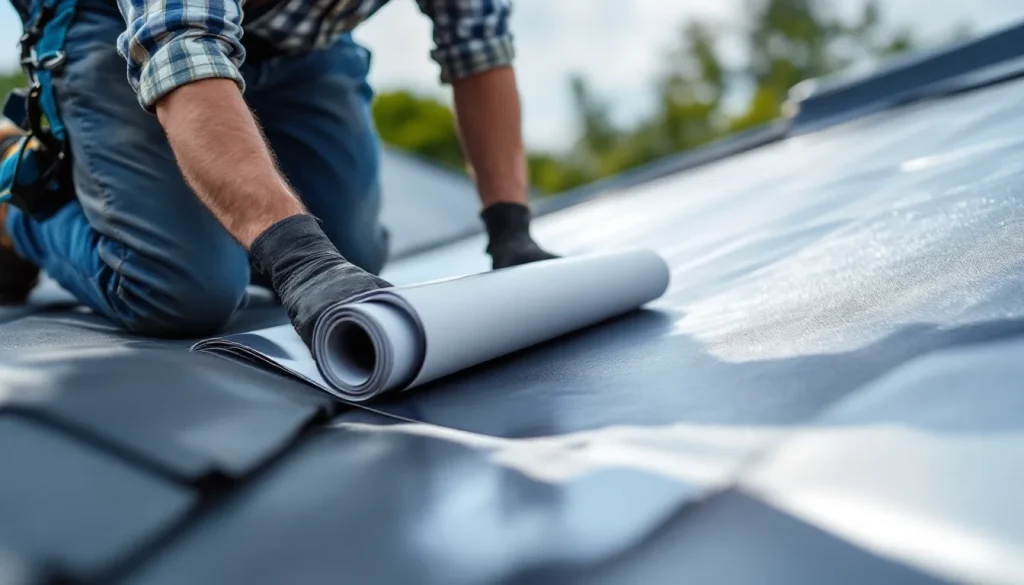
A peel and stick roof underlayment is a self-adhered rubberized asphalt or butyl membrane that bonds directly to the roof deck and seals around every nail driven through it, used in the high-risk zones where standard underlayment fails: valleys, eaves at risk of ice dams, low-slope sections under 4:12, and around chimneys, skylights, and dormers. Related: Ice dam protection membrane code. Under 2021 IRC R905.1.2, it is one of two permitted ice barriers wherever the local code’s Table R301.2 shows a history of ice damming, run from the eave to at least 24 inches inside the exterior wall line. Real product names matter here: Grace Ice and Water Shield, CertainTeed WinterGuard, GAF StormGuard, Owens Corning WeatherLock, and a handful of others define the category. The differences come down to mil thickness, surface texture, max exposure window, and price per square.
The short version
- Code requires an ice barrier from the eave to 24 in inside the exterior wall line where Table R301.2 designates a history of ice damming, and at least 36 in up the slope on roofs of 8:12 or steeper (IRC R905.1.2).
- Best installed in valleys, at eaves over ice-dam-prone zones, on low-slope sections (2:12 to 4:12), and around all penetrations.
- Published thickness: Grace Ice and Water Shield 40 mil (ESR-1677), GAF StormGuard 40 mil minimum, CertainTeed WinterGuard Granular 70 mil and WinterGuard HT 45 mil nominal (ESR-1492, January 2026).
- Two surface types: granular (WinterGuard Granular, WeatherLock G, GAF WeatherWatch) and film (Grace Ice and Water Shield, StormGuard, WinterGuard HT); high-temperature film products go under metal roof underlayment jobs.
- UV exposure limits run from 30 days (WeatherLock G) to 90 days (Grace, StormGuard), 120 days (Grace HT) and 12 months (Sharkskin Ultra SA), per each maker.
- Cost: about $40 to $112 per square (100 sq ft) for the common membranes in October 19, 2026 retail listings, and $130 for Grace Ice and Water Shield HT.
What peel and stick underlayment is
Peel and stick underlayment is a self-adhered roof membrane: one side is a rubberized asphalt or butyl-based adhesive protected by a release liner, the other side is either granular (for walkability and as a primary surface) or polymer-film (for use under finish roofing). When the release liner comes off, the adhesive bonds to a clean, dry roof deck. The defining trait, the one that separates it from any felt or synthetic, is that the membrane self-seals around every fastener driven through it; ASTM D1970, the standard IRC R905.1.1 names for self-adhering polymer-modified bitumen underlayment, tests that sealability. Drive a nail through 30-pound felt and you have an open hole. Drive a nail through a 40-mil ice and water shield and the rubberized layer closes around the shank.
That self-sealing behavior is why IRC R905.1.2 accepts it as an ice barrier in place of two layers of underlayment cemented together. When meltwater backs up under shingles at the eave, it pools above the underlayment, and a mechanically fastened felt or synthetic underlayment has open nail holes in that zone. For more on how peel-and-stick fits into the broader underlayment category, see our ice and water shield guide and the comparison with conventional products in felt vs. synthetic underlayment.
Where code requires it (IRC R905.1.2)
IRC R905.1.2 in the 2021 edition requires an ice barrier “in areas where there has been a history of ice forming along the eaves causing a backup of water as designated in Table R301.2,” so the trigger is the local jurisdiction’s entry in that table, not a temperature you calculate yourself. The rule covers asphalt shingles, metal roof shingles, mineral-surfaced roll roofing, slate and slate-type shingles, wood shingles and wood shakes; it does not list metal roof panels or tile. The barrier runs from the lowest edge of the roof to a point at least 24 inches inside the exterior wall line, and on slopes of 8:12 or steeper it must also reach at least 36 inches up the slope from the eave. Wider overhangs push the barrier further up the roof: a 24-inch overhang plus the 24-inch interior margin is 48 inches measured level, which at a 4:12 pitch is about 51 inches along the slope (48 x 1.054), so two 36-inch courses are needed.
Beyond the eave, many installers and shingle makers put peel and stick in three other places the IRC ice-barrier rule does not mandate: open valleys, around all penetrations (chimneys, skylights, plumbing stacks), and on roof sections from 2:12 up to 4:12, where IRC R905.2.2 already requires double underlayment and R905.1.1 accepts a self-adhering D1970 membrane as the alternative. For closed valleys, IRC R905.2.8.2 lets a self-adhering D1970 membrane stand in for the valley lining. The valley flashing detail guide covers the valley application in depth.
The product lineup
The table lists what each maker publishes, with the source, and retail prices per square from the listings in our best ice and water shield comparison (October 19, 2026). Blank-price rows were not in that price check.
| Product | Thickness | Surface | UV exposure limit | Price per square | Source |
|---|---|---|---|---|---|
| Grace (VYCOR) Ice and Water Shield | 40 mil | Embossed polyethylene film | Cover within 90 days | $80 to $112 | ICC-ES ESR-1677; Grace data sheet |
| Grace (VYCOR) Ice and Water Shield HT | 40 mil | Polymeric film, rated to 260°F | Up to 120 days | $130 | ESR-1677; CertainTeed HT page |
| CertainTeed WinterGuard Granular | 70 mil nominal | Fine black mineral granules | Not stated in ESR-1492 | Not in price check | ICC-ES ESR-1492, Jan 2026 |
| CertainTeed WinterGuard HT | 45 mil nominal | Plastic film | Not stated in ESR-1492 | Not in price check | ESR-1492, Jan 2026 |
| GAF StormGuard | 40 mil minimum | Film (blue patterned synthetic) | Up to 90 days | $60 to $74 | GAF StormGuard data sheet |
| GAF WeatherWatch | Not listed here | Mineral granules | Up to 60 days | $40 to $50 | GAF WeatherWatch sell sheet |
| Owens Corning WeatherLock G | Not listed on the current sheet (53 mil on OC’s 2017 sheet) | Granulated | Up to 30 days | $60 to $70 | OC Pub. 10009578-P, Nov 2025 |
| Sharkskin Ultra SA | 30 mil nominal | Polypropylene, rated -40 to 280°F | Up to 12 months | Not in price check | Sharkskin specification sheet |
Grace Ice and Water Shield is the long-running reference product; ICC-ES ESR-1677 (reissued January 2026, now held by CertainTeed) lists it at 40 mils in 36-inch rolls 36, 50, 66.7 or 75 feet long. CertainTeed WinterGuard, GAF StormGuard, and Owens Corning WeatherLock are the shingle makers’ own membranes, which can count toward each maker’s system warranty, so check the warranty terms before mixing brands. Owens Corning sells four WeatherLock versions; our review compares the WeatherLock G, Mat, Flex and Tile & Metal specs. Sharkskin Ultra SA and Grace Ice and Water Shield HT serve a different niche: high-temperature underlayment for metal and tile, rated to 280°F and 260°F respectively by their makers.
Granular vs smooth surface
The surface texture is not cosmetic. Granular-faced products (CertainTeed WinterGuard Granular, Owens Corning WeatherLock G, GAF WeatherWatch) carry a mineral topcoat and are made to go under asphalt shingles; GAF’s WeatherWatch sheet, for example, lists it for use with asphalt shingles. Film-faced products (Grace Ice and Water Shield, GAF StormGuard, CertainTeed WinterGuard HT) have a polyethylene or polymer film, and the high-temperature versions of them are what makers route to metal, slate and tile.
Picking the wrong product for the roof causes specific failures. The Grace data sheet says not to install the standard membrane under copper, COR-TEN or zinc roofing at high altitude, where roof temperatures run highest, and to check with the metal roofing maker for special requirements; Grace HT is rated to 260°F for those jobs. Under standing seam metal, the panel maker’s installation guide sets the underlayment, so match its heat rating to the membrane’s.
Peel and stick underlayment for metal roofs
IRC R905.1.2 does not require an ice barrier under metal roof panels, so peel and stick under a standing seam or exposed-fastener roof is a panel-maker or designer requirement, not a code minimum. When it is specified, use a high-temperature membrane: Grace Ice and Water Shield HT is rated to 260°F with 120 days of exposure, Sharkskin Ultra SA to 280°F with 12 months, and CertainTeed lists WinterGuard Metal (45 mils, 39-3/8 inch rolls) in ESR-1492. Copper is the exception to full adhesion: the Copper Development Association details copper pans over felt and rosin-sized building paper as a slip sheet, so the metal can move; see our copper roofing guide.
Install sequence (8 steps)
- Deck prep. ESR-1492 requires a dry deck free of dust, dirt, loose nails and other protrusions, on solid plywood or OSB. Sweep off sawdust and grit, set any proud nail heads, and replace damaged sheathing. CertainTeed’s report says no primer is required for WinterGuard; the Grace data sheet calls for Perm-A-Barrier WB Primer on wood composition sheathing only if adhesion is marginal.
- Check the temperature. ESR-1492 and ESR-1677 both require air and deck temperatures of 40°F or higher for WinterGuard and Grace Ice and Water Shield; Sharkskin rates Ultra SA for installation from 10°F and rising.
- Drip edge at the eave: follow the maker. Makers disagree on the eave lap. GAF’s Timberline HDZ instructions say to put GAF Leak Barrier on top of the non-corrosive metal drip edge along the eaves, while the Grace data sheet says to place metal drip edges over the membrane. Read the instructions for the membrane you are installing; see the drip edge detail guide.
- Snap the line and start at the low corner. Snap a chalk line at the upper edge of the ice barrier (about 51 inches up the slope for a 24-inch overhang at 4:12). ESR-1677 describes cutting Grace membrane into 10 to 15 foot lengths, rerolling loosely, peeling back 1 to 2 feet of release liner to align it, then peeling the rest and pressing it down with heavy hand pressure. A roller helps seat the membrane and push out air.
- End laps and side laps. Grace Ice and Water Shield needs at least 3-1/2 inch side laps and 6 inch end laps (ESR-1677). WinterGuard Granular and HT need 4 inch side and 6 inch end laps, and WinterGuard Sand needs 6 inches on both (ESR-1492). Always lap upper course OVER lower course so water sheds, and roll every lap.
- Valley application. ESR-1677 says to apply the membrane in valleys before the eaves, centering the sheet over the valley and working from the center outward and from the low point up. Then lap roof-field courses onto the valley strip from each side so the valley centerline carries extra layers.
- Penetrations. Around chimneys, skylights, and plumbing stacks, cut the membrane to wrap up the penetration 4 to 6 inches and bond the upturn to the vertical surface. Combine with metal step flashing per the step flashing install guide.
- Cover within the exposure window. Published limits: 30 days for WeatherLock G, 60 days for WeatherWatch, 90 days for Grace Ice and Water Shield and StormGuard, 120 days for Grace HT, and 12 months for Sharkskin Ultra SA. Past the window, the maker’s terms no longer cover UV damage, so schedule the roofing before the deadline.
Common mistakes
Most problems with self-adhered membranes come from application errors that the ICC-ES reports and maker data sheets warn against, not from the membrane itself.
- Installing on a wet or dirty deck. Both ESR-1492 and the Grace data sheet require a clean, dry deck. A layer of sawdust or a damp deck weakens the bond the day it goes down.
- Skipping the roller. Hand pressure alone leaves air pockets at laps. Roll every course and every lap.
- Wrong lap direction. Lower course laid over upper course, or end laps oriented against the shingle exposure direction, creates a water dam that pools meltwater at the seam; ESR-1677 says to install so all laps shed water, working from the low point to the high point.
- Side lap too narrow. Grace needs at least 3-1/2 inches and WinterGuard at least 4 inches on side laps; a 1-inch lap fails both.
- Missing the wall line measurement. Code says 24 inches INSIDE the exterior wall line. A common error is measuring 24 inches from the eave edge instead, leaving an unprotected zone over the wall plate where ice dams form.
- Drip edge under instead of over (or vice versa) when the product spec is opposite. GAF’s Timberline HDZ instructions put the leak barrier over the eave drip edge; the Grace data sheet puts the drip edge over the membrane.
- Exceeding the exposure window. WeatherLock G left open 60 days has doubled its 30-day limit.
- Re-using cut-off scraps for the valley. The valley needs full-width 36-inch material running continuous. Pieced-together scraps create seam after seam in the highest-water zone of the roof.
- Assuming every product needs primer, or none does. WinterGuard needs no primer per ESR-1492; Grace calls for Perm-A-Barrier WB Primer on wood composition sheathing only when adhesion is marginal.
- Installing below the rated temperature. WinterGuard and Grace Ice and Water Shield are limited to 40°F and above by their ICC-ES reports. Wait for the deck to warm or choose a product rated for lower installation temperatures; never heat the membrane with an open flame.
Cost
Material cost for the common membranes ran about $40 to $112 per square (100 sq ft) in October 19, 2026 retail listings: GAF WeatherWatch $40 to $50, Owens Corning WeatherLock G $60 to $70, GAF StormGuard $60 to $74, and Grace Ice and Water Shield $80 to $112, with Grace Ice and Water Shield HT at $130 per square, per our ice and water shield price comparison. Roll sizes differ: a Grace roll is 36 inches by 75 feet (225 sq ft) or 66.6 feet (200 sq ft), and a StormGuard or WeatherLock G roll is 200 sq ft.
The quantity math is simple. A house with 120 linear feet of eaves, a 24-inch overhang and a 4:12 pitch needs two 36-inch courses along every eave: 240 linear feet x 3 feet = 720 sq ft, or 7.2 squares. Two 20-foot valleys with a 36-inch strip add 120 sq ft (1.2 squares), for about 8.4 squares before waste. At $60 to $74 per square for StormGuard, that is roughly $504 to $622 in membrane; at $80 to $112 for Grace, about $672 to $941. Ask for installation labor as its own line item, and where the code requires an ice barrier, it is not an optional upgrade on the bid.
| If your roof is | Use | Rule or source |
|---|---|---|
| Asphalt shingles where Table R301.2 lists ice-dam history | Ice barrier from the eave to 24 in inside the wall line (36 in up the slope at 8:12 or steeper) | IRC R905.1.2 |
| Shingles at 2:12 to 4:12 | Double underlayment, or full-deck self-adhering D1970 membrane | IRC R905.2.2; R905.1.1 exception 1 |
| Below 2:12 | Not a shingle roof; ESR-1492 also limits WinterGuard to 2:12 or steeper | IRC R905.2.2; ESR-1492 section 5.6 |
| Standing seam or other metal panels | A high-temperature film membrane where the panel maker calls for one (260°F Grace HT, 280°F Sharkskin Ultra SA) | Maker data; R905.1.2 does not list metal panels |
| Copper, COR-TEN or zinc at high altitude | Not standard Grace Ice and Water Shield | Grace data sheet |
| Roof will stay open for weeks before shingles | A product with a longer UV limit (90 days to 12 months) | Maker exposure limits above |
| Install day below 40°F | Wait, or use a product rated colder (Sharkskin Ultra SA from 10°F) | ESR-1492; ESR-1677; Sharkskin spec |
| Unvented or poorly vented attic | Fix the ventilation; do not rely on full-coverage membrane | ESR-1492 section 5.8 limits WinterGuard to ventilated attics |
When to use peel and stick across the entire roof
Standard residential practice uses peel and stick only in the IRC R905.1.2 zones plus valleys and penetrations, with synthetic underlayment covering the field. Three situations come up when owners ask about going wall-to-wall with self-adhered membrane:
- Low-slope roofs from 2:12 to 4:12. IRC R905.2.2 requires double underlayment on shingle roofs in this range, and R905.1.1 exception 1 allows a self-adhering ASTM D1970 membrane installed to both makers’ instructions as the alternative.
- Hurricane and high-wind zones. The 2021 IRC adds a sealed-deck option in R905.1.1 exception 2: 4-inch-wide self-adhering D1970 strips over every deck joint with approved underlayment over the whole roof. Florida’s building code sets its own sealed-roof-deck rules, so check the current Florida edition before you choose between strips and full coverage.
- Roofs with marginal ventilation. Full coverage does not fix ventilation: ESR-1492 limits CertainTeed WinterGuard to roofs with ventilated attic spaces, so correct the attic ventilation rather than sealing the deck over the problem.
For well-ventilated, normal-slope roofs outside the ice-barrier and sealed-deck rules, the code asks for no more than standard underlayment in the field.
Compatibility with synthetic underlayment
Peel and stick at the eaves and valleys, synthetic in the field is the standard 2026 spec, and ESR-1492 section 4.3 says the field underlayment must overlap the ice barrier. If the synthetic is laid first and the ice barrier is added after, the lap direction is wrong and water can run behind the membrane. The synthetic underlayment brand comparison covers the field products that pair best with each ice barrier brand.
Frequently asked questions
Is peel and stick underlayment the same as ice and water shield?
Yes, in common usage. Ice and water shield is the most common type of peel and stick roof underlayment, and Grace Ice and Water Shield (40 mil, ESR-1677) is the product the name comes from. Some high-temperature peel and stick products, such as Grace Ice and Water Shield HT at 260°F, are aimed at metal and tile roofs, but if someone says “peel and stick” without specifying, they usually mean ice and water shield.
Can I install peel and stick over old felt?
No. The Grace data sheet says not to install the membrane directly on old roof coverings, and ESR-1492 calls for removing the existing roof covering and felts to expose the deck when reroofing. Strip to a clean, dry deck.
How long can peel and stick stay exposed before shingles go on?
It depends on the product: Owens Corning WeatherLock G up to 30 days, GAF WeatherWatch up to 60 days, Grace Ice and Water Shield and GAF StormGuard up to 90 days, Grace Ice and Water Shield HT up to 120 days, and Sharkskin Ultra SA up to 12 months, per each maker. Cover the membrane before its limit.
How thick is peel and stick roof underlayment?
Most residential membranes run 30 to 70 mils. Grace Ice and Water Shield is 40 mils (ESR-1677), GAF StormGuard is 40 mils minimum, CertainTeed WinterGuard HT is 45 mils and WinterGuard Granular 70 mils nominal (ESR-1492), and Sharkskin Ultra SA is 30 mils nominal. Thickness alone does not decide quality; check the ASTM D1970 listing and the heat rating.
Is peel and stick required under a metal roof?
Not by the IRC ice-barrier rule. R905.1.2 lists asphalt shingles, metal roof shingles, roll roofing, slate and wood, not metal roof panels. Panel makers and designers often specify a high-temperature self-adhered membrane anyway, such as Grace Ice and Water Shield HT (260°F) or Sharkskin Ultra SA (280°F).
Does peel and stick replace the need for synthetic felt?
Not for the whole roof. Use peel and stick at code-required ice barrier zones, valleys, and penetrations, and synthetic in the field, which ESR-1492 says must overlap the ice barrier. Full-coverage peel and stick is mainly a low-slope (2:12 to 4:12) or sealed-deck choice under IRC R905.1.1.
What temperature is too cold to install peel and stick?
Below 40°F for most asphalt membranes: ESR-1492 limits CertainTeed WinterGuard to air and deck temperatures above 40°F, and ESR-1677 requires 40°F or higher for Grace Ice and Water Shield. Sharkskin rates Ultra SA for installation from 10°F and rising. Never heat a membrane with a torch to force the bond.
Bottom line
Peel and stick underlayment is not a premium upgrade you can negotiate away on a reroof. Where Table R301.2 designates a history of ice damming, IRC R905.1.2 requires an ice barrier at the eaves, and peel and stick is the usual way to meet it. Pick a membrane whose surface, heat rating and exposure limit fit the roof (granular for shingles, high-temperature film for metal), install it on a clean, dry deck at 40°F or warmer, lap it 3-1/2 to 6 inches as its ICC-ES report requires, roll every seam, and run a full-width strip in every valley before shingles.