
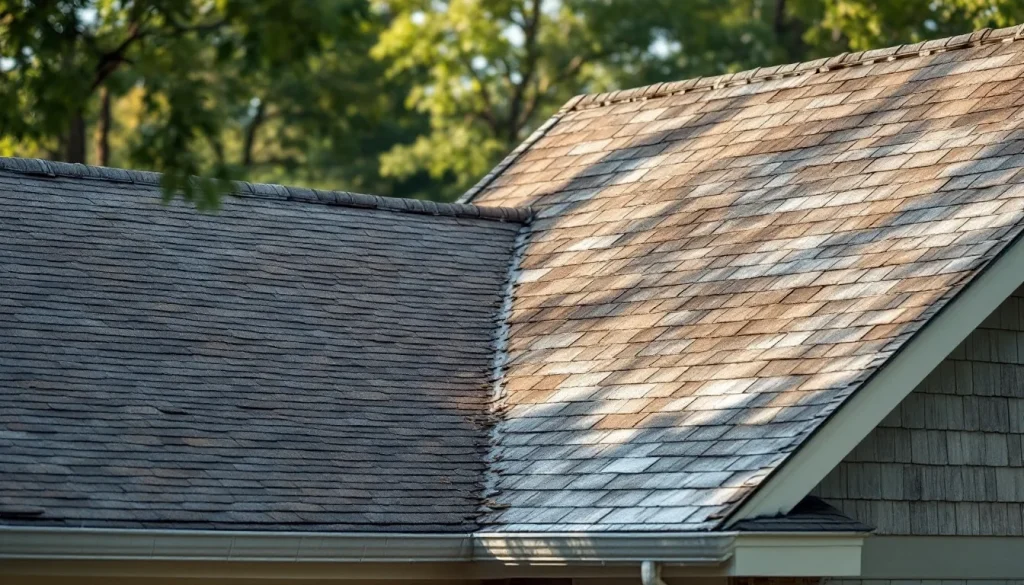
A partial roof replacement in 2026 runs $2,500 to $8,000 for one slope or section on a typical 1-to-2-story home, or roughly $400 to $1,100 per square (100 square feet) installed depending on shingle line, slope pitch, and access. It works best when storm damage is confined to one wind-facing slope, when a single section needs tear-off after localized deck rot, or when an addition has to match the existing roof. It tends to backfire when the rest of the roof is past 60% of its rated lifespan, when multiple slopes are failing, or when the homeowner is fighting an insurance carrier over shingle matching rules.
Last reviewed: August 2026.
The short version
- Budget $2,500 to $8,000 for one slope; $400 to $1,100 per square installed in 2026.
- Partial works for one-slope storm damage, isolated deck rot, or addition match-ins.
- It does not work when the roof is past 60% of its rated life or has multi-slope failures.
- Florida, Colorado, Kentucky, and Missouri have matching statutes; most other states do not.
- ACV policies pay depreciated value; RCV pays replacement only after work is completed.
- Shingle colors fade 2 to 3 years in, so even an in-production line rarely matches a 10-year-old roof.
What “partial roof replacement” actually means
The trade uses “partial” three different ways and the distinction matters when you read a contract. The narrowest version is a single-slope replacement: tear-off and reinstall on one plane of the roof, leaving the other slopes alone. The middle version is a section replacement, where a defined area (often the bottom 6 to 10 courses or a single dormer face) gets stripped and rebuilt because of localized deck rot or a flashing failure. The widest version is a “half-roof” job, common after a tornado or microburst takes the wind-facing slope of a hip or gable roof while leaving the leeward side intact.
None of these are repairs. A roof repair is patching a few shingles, a pipe boot, or a step-flashing run. A partial replacement is a tear-off down to the deck on a defined area, new underlayment, new starter, new field shingles, new ridge cap, and new flashing handoffs at every transition. The pricing reflects that: you are paying for tear-off labor, dump fees, and full materials on the affected area, just over a smaller footprint than a whole roof.
2026 cost table: one slope by size and material
A single-slope partial replacement in 2026 typically lands between $2,500 and $8,000, while a half-roof job covering two slopes can reach $17,000 to $32,000 depending on the shingle line. The table below breaks pricing down by slope size and material, from a small dormer or garage face up to a full wind-facing hip or gable slope.
| Slope size | Squares | Architectural asphalt | Designer asphalt | Synthetic slate / metal |
|---|---|---|---|---|
| Small (single dormer, garage) | 3 to 6 sq | $1,800 to $4,200 | $2,400 to $5,400 | $3,600 to $7,800 |
| Medium (one slope, 1-story ranch) | 8 to 14 sq | $3,600 to $7,500 | $4,800 to $9,800 | $7,200 to $14,500 |
| Large (one slope, 2-story or steep pitch) | 15 to 22 sq | $6,800 to $12,500 | $8,500 to $15,800 | $13,500 to $24,000 |
| Half-roof (two slopes, hip or gable face) | 20 to 30 sq | $9,000 to $17,000 | $11,500 to $21,000 | $18,000 to $32,000 |
Per-square installed pricing for partial work runs higher than a full reroof on the same house. The reason is fixed costs: mobilization, dumpster drop, permit, and crew minimums get amortized over fewer squares. A full tear-off and reroof on a 28-square house might price at $375 per square; the same crew quoting one 10-square slope on that same house will land at $550 to $700 per square because the truck still has to show up.
When partial replacement actually works
Three scenarios make sense. First, single-slope storm damage from a directional wind event: a microburst, a tornado edge, or a hailstorm that hit one face. Adjusters routinely approve partial scope when the opposing slopes show no impact spatter, no granule loss, and no creasing. Second, isolated deck rot or a flashing failure that has saturated a defined area, often around a chimney chase or under a sidewall. Once the rot is opened up, replacing the section is faster and cheaper than chasing leaks through patches. Third, an addition or dormer build-out where the new roofline ties into existing field shingles and the homeowner needs the new section to match as closely as possible.
In all three cases, the rest of the roof should have meaningful life left. As a working rule, partial makes financial sense when the existing roof has 8-plus years of expected service remaining. Below that, you are spending real money on a section that will get torn off again inside the decade.
When it does not work, and why contractors push back
A good contractor will turn down a partial job in three situations. The first is a roof past 60% of its rated lifespan: a 20-year 3-tab installed in 2010 has no business getting a $5,000 slope swap in 2026. The second is multi-slope failure, where the homeowner sees a leak on one slope but the other slopes show curled tabs, exposed mat, or granule beds in the gutters. The third is deck-wide deterioration, usually OSB delamination from chronic underlayment failure, where opening one slope reveals the same problem across the whole structure.
The math is brutal in these cases. A partial at $7,500 plus a full reroof at $18,000 three years later equals $25,500 spent where a single tear-off would have cost $19,000. The signs of a roof needing full replacement are usually visible to anyone who walks the whole structure, not just the leaking corner.
Insurance pushback and the matching question
This is where partial replacement claims get ugly. Carriers prefer partial scope because it lowers the payout, often by 40 to 60% versus a full replacement on the same loss. Homeowners want full replacement because they know the new section will not match and the unmatched roof hurts curb appeal and resale value. State law decides who wins.
Four states have explicit matching statutes that force carriers to pay for full replacement when matching materials are not reasonably available: Florida, Colorado, Kentucky, and Missouri. Florida’s framework was reshaped by HB 1503 in 2023, which narrowed the matching obligation and gave carriers more room to argue “reasonable uniform appearance” rather than perfect match. Colorado’s statute (CRS 10-4-110.4) and Kentucky’s regulation (806 KAR 12:095) are stronger from the homeowner side, requiring the carrier to repair or replace adjoining items to achieve a reasonably uniform appearance.
Most other states have no statute. In those states, the policy language controls, and most carrier forms now include “line of sight” matching language at best, with no obligation to match across roof planes that are not visible from the same vantage point. Texas, the Carolinas, and most of the Midwest fall into this bucket.
The ACV versus RCV split compounds the problem. Actual Cash Value policies pay depreciated value: a 12-year-old roof at 50% depreciation pays half the partial scope cost, and the homeowner covers the gap. Replacement Cost Value policies pay full replacement cost but only after the work is completed and invoiced, and the carrier holds back the depreciation until proof of completion is filed. Read the declarations page before you sign anything.
The shingle matching problem
Even when a carrier approves partial scope and the homeowner agrees to it, matching the new shingles to the existing roof is physically hard. Three forces work against a clean match: color fade in the first years of sun exposure, product lines that get discontinued between the original install and the repair, and lot-to-lot batch variation within a line that is still in production. Each one gets worse the older the existing roof is.
First, color fade. Asphalt granules lose pigment intensity in the first 2 to 3 years of sun exposure. A GAF Timberline HDZ in Charcoal installed in 2024 already reads lighter than a fresh bundle from the same dealer in 2026. The new slope will look obviously darker for at least a season.
Second, discontinued lines. GAF retired Timberline HD in 2020 when HDZ launched; homeowners with a 2015-era roof in HD now need their roofer to source closeout inventory or accept HDZ as the closest visual substitute. CertainTeed retired Landmark Classic colors on a rolling basis through 2022 and 2023. Owens Corning consolidated Duration colorways in 2024 and discontinued the Brownwood and Sand Dune palettes. Malarkey discontinued the Vista line in 2023.
Third, lot and batch variation. Even when the line is in production, two bundles from different mill runs can show visible color shift. Reputable suppliers stamp the lot number on every bundle wrapper and will pull from a single run if you ask, but only if the order is large enough to fill a pallet. A 10-square partial rarely qualifies. For more context on current lineup options, see the 2026 shingle brand comparison report.
Structural and detail concerns on partial jobs
The technical risk on partial replacement lives at the transitions. Where the new courses meet the old courses, the roofer has to either weave new shingles under existing tabs (rarely done well on architectural shingles, which have a non-uniform back edge) or cut a clean horizontal line and seal the joint with a starter strip and a bead of approved asphalt sealant. The latter is the only defensible method, but it leaves a visible course line on the finished roof that telegraphs as a repair from the ground.
Flashing handoffs at sidewalls, chimneys, and roof-to-wall transitions are the other failure point. If the new section ties into existing step flashing that was installed 12 years ago, the old flashing will not have a fresh underlayment lap behind it, and water can wick into the wall behind the new shingles. Best practice is to pull and reset the flashing on any wall the partial scope intersects, which the homeowner pays for separately and which most quotes do not include by default.
Waste percentages on small jobs run high. A full reroof figures 10 to 15% waste on a straightforward gable. A 10-square partial with hip cuts, valley terminations, and a sidewall handoff can hit 20 to 25% waste because the crew is making more cuts per square. Material orders should reflect that. Read more in how big a roofing square is for the underlying unit math.
Worked example: 15-square slope on a 2-story
Take a 2,400 sf two-story Colonial in suburban Ohio with a 6/12 pitch. One wind-facing slope took hail damage in a June 2026 storm and the adjuster approved partial scope. The slope measures 15 squares (1,500 sf of roof surface, not floor area).
Tear-off labor at $65 per square: $975. Dump fees, one 15-yard dumpster: $425. New 30 lb felt underlayment, 5 squares of synthetic at $22 per square installed: $110. Ice and water shield at eaves, 2 rolls: $180. Starter strip, 2 bundles: $90. Field shingles, GAF Timberline HDZ in Charcoal, 16 squares ordered for 15 squares of coverage (6.7% waste built into order), at $135 per square material: $2,160. Ridge cap, 3 bundles at $58: $174. Pipe boots, 2 at $35: $70. Drip edge, 60 linear feet at $2.40: $144. Step flashing reset on sidewall, 22 linear feet at $18: $396. Installation labor at $185 per square on 15 squares: $2,775. Permit and inspection: $185. Cleanup, magnetic sweep, tarping protection: $250.
Subtotal: $7,934. Contractor markup at 18%: $1,428. Total quoted: $9,362. If the carrier approves on RCV with a $1,000 deductible and 30% depreciation holdback on an 11-year-old roof, the first check arrives at $5,553 ($9,362 minus $1,000 minus $2,809 depreciation). The second check for $2,809 arrives after completion and submission of a final invoice. Homeowner net out-of-pocket on RCV is $1,000.
For comparison, a full reroof on the same 28-square house would price at roughly $15,200 in the same market, per current per-square replacement pricing. The partial is 62% of the full-roof cost for 54% of the roof area, which is the typical premium ratio.
Permits, code triggers, and inspection
Most jurisdictions require a roofing permit for any tear-off, partial or full. The fee usually scales with project value and runs $150 to $450. Two code triggers can change the scope mid-job. First, if the partial area exposes deck that fails inspection (delamination, rot, or insufficient nailing pattern), the inspector will require deck replacement, which adds $75 to $110 per sheet of OSB or plywood plus labor. Second, several states adopted the 2021 IRC update that requires ice and water shield extending 24 inches inside the warm wall in climate zones 5 and above; older partials that did not have this detail now have to be brought up to code on the replaced section. Get the inspector to walk the deck before the new shingles go on.
How quotes should compare on a partial job
Get three quotes minimum and force them onto the same scope. Common variances that hide real cost differences: dump fees included or extra, step flashing reset included or excluded, ridge cap product (3-tab cut versus hip-and-ridge dedicated cap, the latter costing 30 to 40% more), underlayment type (felt versus synthetic), and warranty coverage. A side-by-side comparison guide is at how to compare roof repair quotes. Be specific about the partial scope boundary in writing; “the rear slope” is not specific enough when the rear slope meets a dormer that may or may not be in scope.
FAQ
Can I do partial replacement on a roof under warranty?
Sometimes. Most manufacturer system warranties (GAF Golden Pledge, OC Platinum, CertainTeed SureStart Plus) require whole-roof installation by a certified contractor. Partial work voids the system warranty on the original section. The new section gets standard limited material warranty only, not the upgraded system coverage.
How long does a partial replacement take?
One slope on a single-story house: one day for a 3-person crew. A 15-square slope on a 2-story: one to two days. Half-roof on a complex gable with multiple penetrations: two to three days. Weather delays add to all of these.
Will my homeowners insurance rate go up after a partial claim?
Usually yes. A roof claim of any size typically adds one chargeable event to the policy and raises premiums 8 to 20% at renewal. Multiple roof claims inside 3 years trigger non-renewal in most states. The math on filing a small partial claim versus paying out-of-pocket depends on the claim size relative to the deductible and the rate increase. Run the numbers before filing.
Can I match the existing shingle color exactly?
Almost never on a roof older than 3 years. The best result comes from sourcing the same line and color from the manufacturer, accepting a slight tonal difference, and placing the new section on a slope that is not visible from the primary street view. If the line is discontinued, ask the supplier for the closest color in the current lineup and request a physical sample to hold against the existing roof.
What if the contractor finds more damage once they open the roof?
Get a change-order clause in the contract that specifies a per-sheet OSB price and a per-linear-foot rot replacement price, both itemized before work starts. Without that, the contractor can quote whatever they want mid-job and the homeowner has no bargaining position. Reasonable 2026 rates: OSB sheet replacement $95 to $140 installed, rotted rafter sister-in $185 to $260 per linear foot.
Bottom line
Partial roof replacement makes financial sense when the damage is confined, the rest of the roof has real life left, and the homeowner is realistic about color match. It costs $2,500 to $8,000 for a typical single slope, prices higher per square than a full reroof because fixed costs do not scale down, and runs into matching disputes with carriers in most states. Florida, Colorado, Kentucky, and Missouri have matching statutes; everywhere else, the policy language and the carrier adjuster decide. Before signing a partial scope, get the whole roof inspected, get three quotes on identical scope, get a change-order clause in writing, and read the policy declarations to confirm ACV or RCV treatment. If the existing roof is past 60% of its life or showing multi-slope wear, spend the extra money once on a full tear-off rather than twice on a partial now and a full replacement inside the decade.