
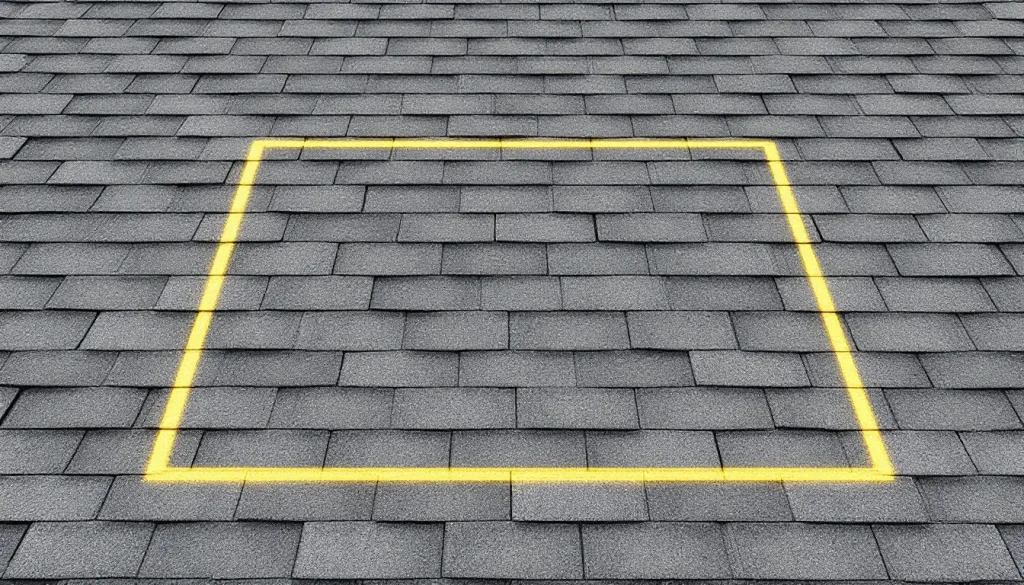
If you have ever wondered how big is a square in roofing, the answer is exactly 100 square feet, which works out to a 10 ft by 10 ft section of roof surface. The unit traces back to the early 20th century when shingle bundles, underlayment rolls, and labor pricing all converged on the same modular size. Today every shingle bundle is packaged so that 3 bundles cover one roofing square of architectural product (or 4 bundles for Class 4 impact-rated). Every underlayment roll lists coverage in squares. Every contractor quote is priced per square. Understanding the unit is the foundation of every reroof estimate, every material order, and every labor invoice in residential roofing.
The short version
- 1 roofing square = 100 square feet of roof surface = a 10 ft by 10 ft section.
- 3 bundles of architectural shingles cover 1 square; 4 bundles of Class 4 impact-rated cover 1 square.
- Average American home: 17 to 26 roofing squares depending on footprint and pitch.
- Roof square (actual sloped surface) is bigger than project square (waste-inclusive material order).
- Pros use the unit because it makes material ordering, labor estimating, and pricing comparison instant.
- Convert sq ft to squares: divide by 100. Convert squares to sq ft: multiply by 100.
Where the 100 sq ft unit came from
The roofing square was standardized in the 1900s when asphalt shingle manufacturing moved from custom-cut tar paper to factory-packaged products. Manufacturers wanted bundles small enough for one worker to carry up a ladder but large enough to minimize packaging waste. A bundle weighing 65 to 80 pounds (the architectural standard) covers roughly one-third of a 10 ft by 10 ft section. Three bundles per square stuck because it made the math trivial: count squares, multiply by 3, order bundles. Underlayment rolls were sized the same way, with most synthetic rolls at the supply house covering 5 squares (500 sq ft) per roll for fast install.
The 100 sq ft unit also made labor pricing transparent. A crew installing architectural shingles on a 6/12 roof at typical productivity covers 8 to 12 squares per day per worker. A 25 square reroof is therefore a 2 to 3 day job for a 4-person crew. Pricing per square (rather than per sq ft) makes the labor estimate intuitive. For the per-square labor math, see 2026 roofing cost report.
The 10 ft by 10 ft visual
If you stand on a roof and chalk out a 10 ft by 10 ft section, you are looking at exactly one roofing square. That section will use:
- 3 bundles (66 shingles) of architectural product like GAF Timberline HDZ, Owens Corning Duration, or CertainTeed Landmark.
- 4 bundles (88 shingles) of Class 4 impact-rated like GAF Timberline AS II or Malarkey Vista AR.
- About 21 to 22 sq ft of synthetic underlayment (1 roll covers 4 to 5 squares).
- 1 to 2 pounds of roofing nails (about 320 nails at 4 nails per shingle).
- 10 lf of starter strip and 3 lf of hip and ridge cap (allocated proportionally from the whole roof).
For the full per-square material breakdown, see new roof estimate breakdown.
Why pros use squares instead of sq ft
Three reasons. First, material ordering is built around the unit. Every bundle, every roll, every box of accessories is sized by squares. A contractor calling in a 27-square order knows exactly what shows up on the truck: 81 bundles of field shingles (plus starter, ridge cap, underlayment, ice and water shield) without doing per-bundle math.
Second, labor pricing scales linearly per square. A typical architectural reroof in the Midwest runs $300 to $500 per square installed for tear-off plus material plus labor, before regional adjustments and complexity multipliers. A homeowner comparing three quotes can divide each total by the square count to spot the outlier. For comparison methodology, see roof replacement quote guide and our roofing estimate template.
Third, the unit is recognized industry-wide. When a contractor in Texas talks to a supply house in Pennsylvania, the conversation is in squares. When an insurance adjuster writes a Xactimate estimate for a hail claim, the line items are per square. When a manufacturer publishes warranty terms (like GAF Golden Pledge requiring 4 components and 12 squares minimum), the threshold is in squares.
Bundles per square by shingle type
| Shingle type | Bundles per square | Weight per bundle | Common brands |
|---|---|---|---|
| 3-tab asphalt | 3 | 50 to 65 lbs | GAF Royal Sovereign, OC Supreme, CT XT-25, IKO Marathon |
| Architectural / dimensional | 3 | 65 to 80 lbs | GAF Timberline HDZ, OC Duration, CT Landmark, IKO Cambridge, Atlas Pinnacle |
| Class 4 impact-rated | 4 | 90 to 100 lbs | GAF Timberline AS II, OC Duration FLEX, CT Landmark IR, Malarkey Vista AR |
| Premium designer / luxury | 4 to 5 | 105 to 120 lbs | GAF Camelot II, OC Berkshire, CT Grand Manor, IKO Royal Estate |
The bundle count goes up as the shingle gets thicker. A Class 4 impact-rated bundle covers about 25 sq ft, so 4 bundles per 100 sq ft square. A premium designer like CertainTeed Grand Manor uses 5 bundles per square because each shingle is twice as thick as architectural. For more on the brand-tier landscape, see our 2026 shingle brand comparison report.
Average squares by home size
| Footprint | 4/12 pitch (low) | 6/12 pitch (avg) | 8/12 pitch (steep) | 10/12 pitch (very steep) |
|---|---|---|---|---|
| 1,200 sq ft (small ranch) | 12.6 sq | 13.4 sq | 14.4 sq | 15.6 sq |
| 1,500 sq ft | 15.8 sq | 16.8 sq | 18.0 sq | 19.5 sq |
| 2,000 sq ft (avg US home) | 21.1 sq | 22.4 sq | 24.0 sq | 26.0 sq |
| 2,500 sq ft | 26.4 sq | 28.0 sq | 30.1 sq | 32.6 sq |
| 3,000 sq ft (large family) | 31.6 sq | 33.5 sq | 36.1 sq | 39.1 sq |
| 4,000 sq ft (estate) | 42.2 sq | 44.7 sq | 48.1 sq | 52.1 sq |
These are roof squares (actual sloped surface), not project squares. The actual material order will be 10 to 15 percent higher to cover waste from cuts at valleys, hips, and rake edges. For the bundle math from these numbers, see our shingle bundle calculator and estimate shingle bundles needed.
Roof square vs project square: the distinction that trips homeowners
This is where homeowners get confused when reviewing quotes. A “roof square” is the actual measured surface area of the roof divided by 100. A 2,236 sq ft 6/12 roof is 22.36 roof squares. A “project square” is the material order including waste. The same roof might need 26 project squares to cover 22.36 roof squares because cuts at valleys and rakes waste shingle material.
Contractors sometimes quote per project square (more honest about material cost) and sometimes per roof square (looks cheaper on paper but doesn’t match the actual order). When comparing bids, ask each contractor whether their per-square price is for measured roof squares or for project squares including waste. A $400 per square quote on roof squares might be more expensive than a $370 per square quote on project squares once you do the math. See how to calculate roof square footage for the conversion.
How squares translate to cost
2026 installed pricing per square, mid-cost market:
- 3-tab asphalt: $300 to $500 per square installed.
- Architectural asphalt: $400 to $700 per square installed.
- Class 4 impact-rated: $600 to $900 per square installed.
- Premium designer: $800 to $1,200 per square installed.
- Standing seam metal: $1,200 to $1,800 per square installed.
- Natural slate: $2,500 to $4,500 per square installed.
A 22 square home in the Midwest, getting architectural shingles installed, will run $8,800 to $15,400 turnkey. The same home in coastal California will run 20 to 30 percent higher due to labor cost. Regional variation is the single biggest swing factor after material tier. For the full pricing model with regional adjustments, see 2026 roofing cost report and our average cost to replace roof guide.
Squares in insurance claim estimates
If your roof is hail-damaged or wind-damaged and you file a homeowner’s insurance claim, the adjuster will write the estimate in Xactimate software, which prices everything per square. The adjuster measures your roof (often using EagleView or Hover aerial imagery), counts the squares, and applies the per-square line items from the Xactimate price list for your ZIP code. The line items include tear-off per square, install per square, underlayment per square, ice and water shield per square, drip edge per linear foot, and so on. Understanding the square unit lets you read the estimate and challenge any obvious errors before signing the work order.
One common adjuster error: estimating the roof square count from satellite imagery without accounting for pitch. A flat satellite photo shows the footprint, not the sloped surface. A 6/12 pitch adds 12 percent to the square count vs the flat projection. If your home is 22 squares of actual roof but the adjuster wrote 20 squares from satellite, you are short 2 squares of material and labor on the claim. Ask for the adjuster’s measurement source. For the full insurance navigation guide, see our 2026 roofing insurance report.
Measuring roof squares yourself
Three methods. Ground measurement: walk the footprint of the house with a long tape, multiply length times width, apply pitch multiplier, divide by 100. Accuracy: within 5 percent if the house is a simple rectangle. Roof measurement: walk the roof with a tape (only do this on low pitches with a harness), measure each plane, multiply length times width per plane, sum, divide by 100. Accuracy: within 2 percent. Aerial report: order an EagleView, Hover, or RoofR aerial measurement for $20 to $40. Accuracy: within 1 percent and includes every linear measurement (ridges, valleys, hips, rakes, eaves).
For homeowners just sanity-checking a contractor quote, ground measurement is enough. For contractors pricing a job and ordering material, an aerial report pays for itself by eliminating same-day supply house runs. For the full measurement methodology, see how to measure a roof, our roof size calculator method, and the shingle-specific walkthrough on measuring a roof for shingles.
Metal roofing squares (same unit, different math)
Metal roofing also uses the 100 sq ft square unit, but the math is different because standing seam panels are custom-cut to roof plane length and pricing is per linear foot of panel rather than per bundle. A 100 sq ft square of standing seam might use 5 panels of 12 inch width by 20 ft length, or 10 panels of 12 inch width by 10 ft length, depending on the roof geometry. The square unit still works for material cost and labor pricing comparison. See metal roofing square calculator for the panel math.
Squares in warranty paperwork
Manufacturer warranties often reference squares as the install threshold for system warranties. GAF’s Golden Pledge warranty requires the contractor to install at least 4 GAF components (shingles, starter, hip and ridge, ridge vent or attic vent) on a roof of at least 12 squares. Owens Corning’s Platinum Protection has similar component thresholds. If your roof is under 12 squares (a small ranch or addition), you may not qualify for the highest-tier system warranty, only the shingle-only warranty. This is one reason small roof sections (additions, garages) get tacked onto whole-roof reroof contracts rather than priced standalone.
The square unit is the foundation of every conversation about roofing. Whether you are calculating bundles, comparing quotes, filing an insurance claim, or reading a warranty, the 10 ft by 10 ft section of roof surface is the unit of currency that makes the math work. For the next layer of detail on roof measurement and calculation, see our companion guides on how to calculate roof pitch and roof area vs footprint calculator.