
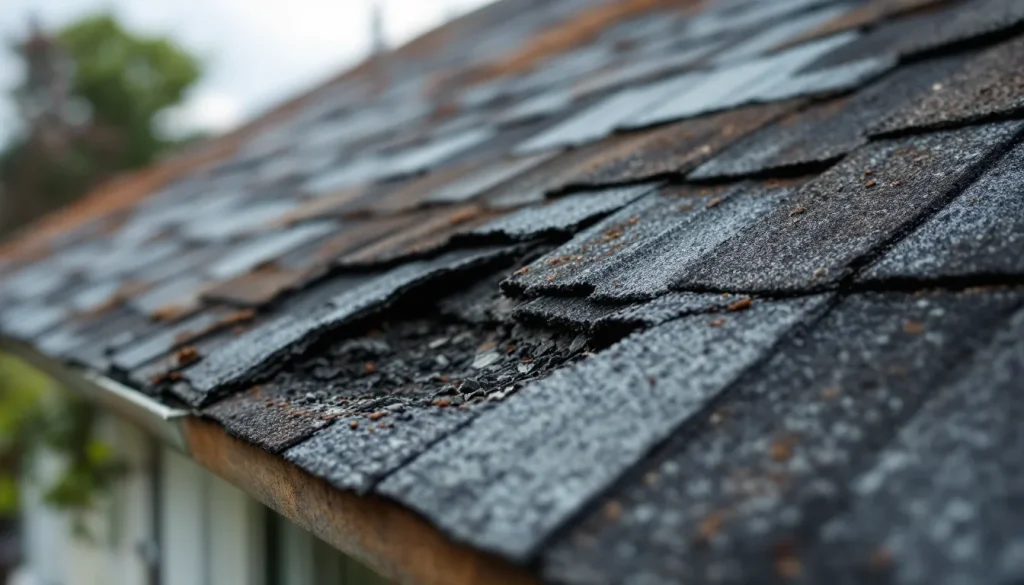
The 10 most reliable signs you need a new roof are: curling or cupping shingles, granule loss collecting in gutters, daylight visible through the attic deck, a sagging roofline, missing shingles after every storm, multiple layers of old shingles, ceiling leak stains, damaged flashing, persistent ice dams, and a roof that has simply passed its expected lifespan. If three or more of these signs you need a new roof show up at once, you are almost always past the repair window and into a full replacement decision. Dark streaks and algae growth, on the other hand, are cosmetic in most cases and do not mean your roof has failed.
The short version
- Hard structural signs (sagging roofline, attic daylight, deck rot) mean replace now, not next year.
- Granule loss in gutters plus curling shingles usually means the roof is in the last 2 to 5 years of life.
- Black streaks from Gloeocapsa magma algae are cosmetic and do not require replacement.
- An asphalt roof that has hit 80 percent of its rated lifespan is almost always cheaper to replace than to keep patching.
- Get a written inspection from a licensed roofer before you decide repair versus replace. A free 20-minute look is enough for an honest answer.
The Short Answer: 10 Signs You Need a New Roof
Here is the ranked list adjusters, home inspectors, and roofing contractors use. The top five are structural and almost always mean replacement. The bottom five can sometimes be repaired if caught early.
| # | Sign | Severity | Repair or Replace |
|---|---|---|---|
| 1 | Sagging roofline | Critical | Replace + deck repair |
| 2 | Daylight visible from attic | Critical | Replace |
| 3 | Active interior leaks staining ceiling | High | Replace if widespread |
| 4 | Multiple layers of old shingles | High | Replace (tear-off required) |
| 5 | Past expected lifespan | High | Replace |
| 6 | Curling, cupping, clawing shingles | Medium-High | Replace within 1 to 2 years |
| 7 | Granule loss in gutters | Medium | Replace within 2 to 5 years |
| 8 | Missing or lifted shingles after storms | Medium | Repair if isolated, replace if widespread |
| 9 | Damaged flashing | Medium | Repair if small, replace if rusted out |
| 10 | Dark streaks or algae growth | Cosmetic | Clean, do not replace |
Sign 1: Curling, Cupping, or Clawing Shingles
Asphalt shingles are designed to lay flat against the roof deck. When the asphalt binder dries out and the mat shrinks, the shingle edges lift. Curling happens at the corners, cupping happens at the center, and clawing is when the edges curl down and the center bows up. All three mean the same thing: the shingle has lost its weatherproofing oils and is brittle.
Once you see this on the south or west-facing slopes (the slopes that get the most UV), the rest of the roof is usually 6 to 24 months behind. A roofer can confirm by stepping on a shingle and pressing a thumbnail into it. A healthy shingle bends. A failed shingle cracks.
Why curling means replacement, not repair
Curling is rarely isolated. If one slope is curled, the whole roof has hit the same UV dose and is on the same timeline. Patching the curled section costs almost as much per square foot as replacement and buys you only 18 months. Most contractors will tell you so honestly.
Sign 2: Granule Loss in Gutters
Asphalt shingles are protected by a mineral granule layer that blocks UV and adds fire resistance. New shingles lose a handful of granules in the first rainfall. After that, shedding should be minimal. If you clean your gutters and find a half-inch layer of granules that look like coarse black sand, the shingle mat is exposed and UV is now baking the asphalt directly.
Asphalt Roofing Manufacturers Association (ARMA) data shows that significant granule loss correlates with a 70 to 80 percent reduction in remaining service life. Once you can see bare spots from the ground (look for shiny black patches on dark shingles), you are inside the replacement window.
Sign 3: Dark Streaks or Algae Growth (This Is Cosmetic)
This is the most-misdiagnosed roof issue in the United States. The black streaks running down north-facing slopes are a blue-green algae called Gloeocapsa magma. It feeds on the limestone filler in asphalt shingles. It looks awful. It does not cause leaks. It does not shorten the structural life of the roof in any measurable way.
The fix is a 50/50 sodium hypochlorite and water spray (this is what professional soft-wash companies use) for about $300 to $600. If you are choosing your next roof, look for shingles with copper granules or algae-resistant ratings, like CertainTeed StreakFighter or GAF StainGuard Plus. Algae resistance comes standard on most architectural shingles sold after 2020.
When algae IS a sign of bigger problems
Algae itself is cosmetic. But if your roof is so shaded that algae is thriving, you may also have moss. Moss holds moisture against shingles for hours after rain, and that constant moisture does shorten lifespan. Moss is the structural concern. Algae is just ugly.
Sign 4: Daylight Visible from the Attic
Go into your attic in the middle of a sunny day with the lights off. Look up at the underside of the roof deck. If you see daylight, you have either failed flashing, missing shingles, or rotted deck wood. All three are replacement-grade problems.
A pinhole of light around a vent stack is sometimes a flashing fix ($200 to $500). A long line of light along a valley or ridge means the deck is compromised and water has been getting in for months. Pull insulation back and check for dark staining on the underside of the plywood. Black or dark brown means active rot.
Sign 5: Sagging Roofline
Stand across the street and look at your ridge line. It should be perfectly straight. A dip, wave, or visible sag means one of three things: rotted roof decking, a failed rafter, or a structural truss issue. None of those are roof-only problems. All of them need a structural engineer or experienced GC, not just a roofer.
A sagging roof that is also leaking is an immediate replacement. The longer water sits in the sagged section, the more deck and framing you lose. This is the one sign on this list where waiting another season is a real risk to the house, not just to the shingles.
Sign 6: Missing or Lifted Shingles After Every Storm
One missing shingle after a 70 mph windstorm is normal. A dozen missing shingles after a typical thunderstorm is sealant failure. Shingles seal to the row below using a thermal-activated adhesive strip. When the asphalt has dried out enough, that seal fails, and even moderate gusts will lift the tabs.
Roofing contractors check this by lifting a tab by hand. If it pops up with almost no resistance, the sealant strip is dead across the whole roof. The shingles are still there for now, but the next 50 mph storm will take a lot of them. This is a replace-this-year sign.
Sign 7: Multiple Layers of Old Shingles
The International Residential Code (IRC R908.3) allows a maximum of two layers of asphalt shingles on a roof. Many municipalities limit it to one. If you have two layers and you are seeing other signs on this list, you cannot legally add a third layer. The next roof must be a full tear-off.
A tear-off adds roughly $1 to $2 per square foot to the project (about $1,500 to $3,500 on a typical 2,000 sq ft roof), but it is mandatory. You can check by lifting a shingle at the edge of the roof and counting the layers. If you cannot tell, your roofer will say so during the estimate. See our breakdown of total project costs at how much does a new roof cost.
Sign 8: Leak Stains on Ceiling
A single small stain (see our water stain ceiling diagnosis) on a bathroom ceiling can be a vent boot issue (about $250 to $450 to fix). Multiple stains, stains that grow with each rainstorm, or stains in different rooms point to a roof system failure, not a single penetration.
If you see a stain, also check:
- Whether it gets larger after rain (active leak)
- Whether it is directly below a roof penetration (vent, chimney, skylight)
- Whether the attic insulation above it is wet or compressed
- Whether nearby drywall is soft to the touch
Wet insulation that has not dried means the leak has been recurring. Mold can grow inside 48 to 72 hours per the EPA. A roof producing recurring leaks is past its functional life.
Sign 9: Damaged Flashing Around Chimneys and Vents
Flashing is the thin metal that seals the joint between the roof and any vertical surface: chimneys, skylights, walls, vent pipes. On a healthy roof, flashing is solid, sealed, and free of rust. On a failing roof, you will see:
- Rust running down from the flashing
- Visible gaps between flashing and the chimney
- Cracked or missing sealant
- Tar patches over old flashing (a previous-owner shortcut)
A skilled roofer can replace flashing without replacing the whole roof if the shingles are still healthy. But if your flashing is failing AND your shingles are curling, you have hit the natural replacement point.
Sign 10: Your Roof Is Past Its Expected Lifespan
Age alone is a valid sign. The National Roofing Contractors Association (NRCA) and most insurance carriers use these benchmarks:
| Material | Typical Lifespan | Replacement Window |
|---|---|---|
| 3-tab asphalt | 15 to 20 years | Year 15+ |
| Architectural asphalt | 20 to 30 years | Year 22+ |
| Premium designer asphalt | 30 to 50 years | Year 35+ |
| Standing seam metal | 40 to 70 years | Year 45+ |
| Concrete tile | 50 years | Year 45+ |
| Clay tile | 100+ years | Year 75+ |
| Slate | 75 to 200 years | Year 80+ |
| Wood shake | 20 to 40 years | Year 25+ |
If you do not know how old your roof is, check three places: the inspection report from when you bought the home, the building permit records at your county clerk’s office, and the underside of the roof deck where many contractors write the install date in pencil. For a full breakdown by material, see our learn library.
What’s Cosmetic vs What’s Real Damage
Insurance adjusters use this same distinction every day. Cosmetic damage does not reduce the functional life of the roof. Functional damage does. Knowing the difference saves you from being talked into a $20,000 replacement you do not need, and from skipping a $15,000 replacement you do need.
| Issue | Cosmetic | Functional |
|---|---|---|
| Black algae streaks | Yes | No |
| Faded shingle color | Yes | No |
| Small moss patches | Sometimes | If long-standing |
| Granule loss | No | Yes |
| Curling shingles | No | Yes |
| Hail dimples (no mat fracture) | Sometimes | Depends on UL 2218 rating |
| Hail bruising (mat fracture) | No | Yes |
| Lifted shingles | No | Yes |
| Daylight in attic | No | Yes (critical) |
When to Repair vs When to Replace
Use the 25/25/25 rule that most independent roofing inspectors apply:
- If less than 25 percent of the roof shows damage and the roof is less than 25 percent into its expected lifespan, repair.
- If more than 25 percent shows damage OR the roof is more than 75 percent into its expected lifespan, replace.
- If damage is between 25 and 75 percent, do the math: get a repair quote and a replacement quote and compare cost per year of remaining life.
Example: a 17-year-old architectural shingle roof with curling on the south slope and a few missing shingles. Repair quote $2,800 buys maybe 3 years of life. Replacement quote $14,500 buys 25 years. Repair: $933 per year. Replace: $580 per year. Replace wins. Run the same math on your own roof. If you are budgeting, our roof replacement cost calculator gives a quick range.
How to Verify: Get a Real Inspection
A free roof inspection from a reputable local contractor takes about 20 to 45 minutes and should produce:
- A written report with photos of every issue found
- An estimate of remaining lifespan
- A clear repair-or-replace recommendation
- Itemized pricing for both options
Avoid contractors who refuse to give you a written report, who pressure you to sign that day, or who claim damage that they cannot photograph. For how to vet a roofer properly, read how to choose a roofing contractor. If you are weighing your next roof material, our metal vs asphalt shingle roof comparison covers the long-term math.
Drone inspections vs walk-the-roof
Drone inspections are convenient but miss soft spots in the deck and subtle granule loss patterns. A drone is a fine first pass. A real inspection includes someone walking the roof and looking inside the attic. If a contractor will not go up or in, get another opinion.
What This Costs You If You Wait
A roof that is two years past replacement and starts leaking will cost you the replacement (about $9,500 to $25,000 for a typical home per HomeAdvisor 2026 data) plus interior repairs that often run $3,000 to $15,000. Insurance generally does not cover damage caused by a roof that was already failing. The National Association of Insurance Commissioners (NAIC) reports that maintenance-related denials are the second-most-common claim rejection in residential roofing.
Waiting a year on a roof showing structural signs almost never saves money. Waiting a year on a roof showing cosmetic-only signs (algae streaks, faded color) costs you nothing.
FAQs
How many missing shingles before I need a new roof?
A handful of missing shingles after a major storm is usually a repair. If you are losing shingles in every moderate storm, the sealant strips have failed roof-wide and a replacement is the better long-term move. Most contractors use a 20 to 30 percent threshold: if more than that share of the roof has lifted or missing shingles, replace.
Are black streaks on my roof a sign I need a new roof?
No. Black streaks are Gloeocapsa magma algae. They are cosmetic, do not cause leaks, and do not shorten the functional life of an asphalt roof in any meaningful way. A soft-wash cleaning ($300 to $600) handles it. Replacement is not warranted.
Can I just patch a few bad spots instead of replacing the whole roof?
You can if the damage is isolated and the rest of the roof is in good shape and within its expected lifespan. You cannot if the issues are widespread, if the shingles are curling everywhere, or if the roof is past 80 percent of its rated life. Patching a roof that is already failing is throwing good money after bad.
How do I know how old my roof is?
Three sources: the home inspection report from your purchase, the building permit records at your county clerk’s office (most municipalities require a permit for re-roofs), and the underside of the deck where many crews pencil-in the install date. If all three fail, a roofer can estimate within a 3-year window by looking at granule loss and shingle profile.
Does a sagging roof always mean replacement?
Almost always. A sag means the deck or framing is compromised, and you cannot install a new roof over a deck that is failing. Even if the sag is small, a structural inspection is mandatory before any new roof goes on. The fix typically includes deck repair, possibly rafter sistering, and a full replacement.
Should I get a second opinion if a roofer says I need a new roof?
Yes, especially if the first contractor came to your door after a storm and is pushing for a same-day signature. Storm-chasing crews target areas after hail events and overstate damage to drive volume. A second opinion from a local, established contractor with a permanent address is worth the 30 minutes.
Will my insurance pay for a new roof if it is just old?
No. Homeowners insurance covers sudden damage from a covered peril (wind, hail, fire, falling objects). It does not cover wear and tear or age-related failure. If your roof is failing because it is 25 years old, that is on you. If it is failing because of a hailstorm last month, that is a claim. For the full claim process, see our guide on filing an insurance claim for roof damage.