
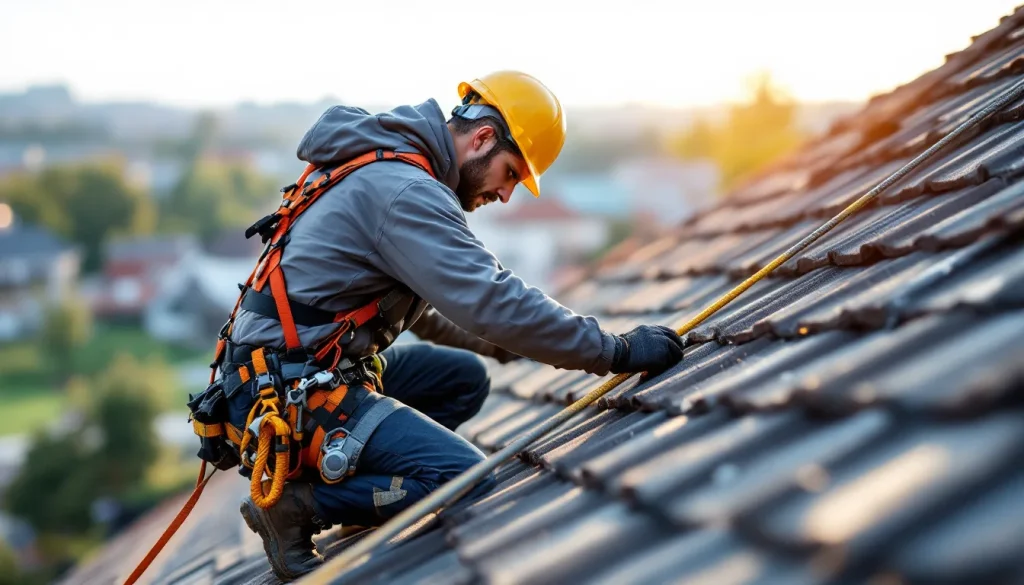
Roof safety in 2026 means following OSHA 1926.501 fall protection requirements for any work above 6 feet above ground, including residential reroofing where workers MUST be tied into either a personal fall arrest system (PFAS) per OSHA 1926.502, a guardrail system, or a safety net system. DIY homeowners working on their own roof are not regulated by OSHA, but the 6 foot rule remains the practical safety threshold because falls from 6 feet kill or seriously injure people. OSHA reports falls as the leading cause of construction fatalities (typically 35 to 40 percent of all construction deaths annually), and roofing has one of the highest fatality rates of any construction trade. Here is the complete safety guide for both pros and homeowners.
The short version
- OSHA 1926.501 requires fall protection on any work surface 6 feet or more above a lower level. This applies to all residential and commercial roofing work performed by paid workers.
- The three accepted protections are personal fall arrest systems (PFAS), guardrails, or safety nets. PFAS is the most common on residential reroofs.
- A complete PFAS includes a full body harness (ANSI Z359.11 rated), a lanyard or self retracting lifeline (ANSI Z359.14), and an anchor point capable of supporting 5,000 pounds (ANSI Z359.18).
- The 4 to 1 ladder rule: for every 4 feet of working height, the ladder base sits 1 foot out from the wall.
- OSHA fines for roof safety violations run $16,131 per serious violation in 2026, $161,323 per willful or repeat, with criminal referrals possible for fatalities.
- The leading injury patterns are falls from edge (45 percent), falls through skylights (12 percent), and ladder falls (18 percent). All three are addressable with the right equipment.
Short answer: OSHA 1926.501
OSHA 1926.501 is the controlling federal regulation for fall protection in construction, including roofing. The key requirement is in 1926.501(b)(13): “Each employee engaged in residential construction activities 6 feet or more above lower levels shall be protected by guardrail systems, safety net systems, or personal fall arrest systems.”
There is no residential exception. Prior to 2010, OSHA permitted slide guards as an alternative on residential roofing under certain conditions. That permission was withdrawn in OSHA Compliance Directive STD 03 11 002. As of 2026, every paid worker on a residential roof at 6 feet or above must be protected by one of the three named systems. Slide guards alone are not compliant.
The three systems. First, guardrail systems (rare on roofs, more common on flat commercial roofs with parapet height adequate or temporary guardrails installed). Second, safety net systems (rare, used in some industrial applications). Third, personal fall arrest systems (PFAS), which is the dominant choice on residential roofing. A PFAS consists of a body harness, a connecting device (lanyard or self retracting lifeline), and an anchor.
The 6 foot fall protection rule
6 feet is the trigger height for residential construction under OSHA. For commercial construction (steel erection, scaffolding, etc.), the trigger heights vary, but for roofing on a single family or duplex home, 6 feet is the line. The vast majority of residential eave heights are above 6 feet (a single story ranch eave is typically 8 to 10 feet, a two story eave is typically 16 to 20 feet), so the rule applies essentially everywhere.
The 6 foot height is measured from the working surface (the roof) to the lower level (typically the ground). On a low slope or flat roof, the worker is on the roof for the entire shift, so the rule applies all day. On a steep slope, the rule applies anywhere within 6 feet of the edge.
One useful exception. Workers traveling across a roof with no exposure to an unprotected edge are not required to wear PFAS for the travel portion. The moment they approach within 6 feet of an edge or a hole (skylight opening, roof opening for a vent, scuttle), they must be tied off. In practice, this is why most roofing crews tie off the entire time they are on the roof, regardless of where on the roof they are working.
Personal Fall Arrest System (PFAS)
A complete PFAS has three components: harness, connecting device, and anchor. Each must be rated for the load and inspected before each use. OSHA 1926.502 defines the performance requirements. ANSI Z359 series defines the design and testing standards that PFAS components are built to.
The harness must be a full body harness (not a body belt, which was banned for fall arrest in 1998). It must distribute fall arrest forces across the thighs, pelvis, waist, chest, and shoulders. ANSI Z359.11 is the current 2026 standard for full body harnesses. The harness has a dorsal D ring (between the shoulder blades) for fall arrest attachment, and may have side D rings for positioning. Cost runs $80 to $400 depending on quality, fit, and features.
The connecting device is either a lanyard (a fixed length tether, typically 6 feet, with a shock absorber) or a self retracting lifeline (SRL, which pays out cable and locks like a seatbelt during a fall). Lanyards are cheaper ($45 to $150) but require the anchor to be above the worker. SRLs ($200 to $800) are more flexible because they can be used with anchors at the worker’s level or above. ANSI Z359.14 covers SRL standards.
The anchor must support 5,000 pounds per worker attached, per 1926.502(d)(15). This is the single most often missed requirement on residential roofing. A nail driven into a rafter is not 5,000 pounds rated. A purpose built roof anchor (Guardian Edge Pro, Malta Dynamics A 8000, Frost King) is. Cost runs $30 to $80 per anchor. Anchors are typically installed at the ridge or upper third of the roof so that any fall keeps the worker above the eave.
Anchor types: ridge, fixed, temporary
Three categories of anchors are used on residential roofing. Each has tradeoffs.
Ridge anchors are the most common on reroofs. A bracket is screwed through the shingles or directly to the ridge framing with lag bolts into the rafters. The anchor is left in place during the project and removed before final shingle install at the ridge cap. A new ridge anchor must be installed for each project; ridge anchors are not warrantied for reuse without re inspection. Cost is $30 to $80 per anchor plus 10 to 15 minutes of installation.
Fixed (permanent) anchors are installed during new construction or as part of solar prep. They penetrate the deck and lag bolt to a rafter or truss. They remain on the roof and are flashed in with the new roofing. This is the right choice when the homeowner plans to have ongoing roof access (solar maintenance, holiday lights, etc.). Cost is $60 to $200 each installed.
Temporary tie ins use a wrap around anchor at a ridge or vehicle pull rope thrown over the ridge to a counterweight on the other side. Temporary tie ins are useful for short inspections but are not OSHA compliant for sustained roofing work. Most reputable crews do not rely on them.
ANSI Z359 harness standards
The ANSI Z359 fall protection code is a series of standards that govern the design, testing, and use of fall protection equipment. Z359.11 covers full body harnesses. Z359.14 covers self retracting devices. Z359.18 covers anchorages. Z359.13 covers personal energy absorbers and lanyards. Z359.0 covers the overall fall protection program.
The 2026 update to Z359.11 added requirements for stretch limit in the harness webbing (to control elongation during fall arrest and prevent the worker’s spinal column from compressing) and for trauma suspension straps to prevent orthostatic intolerance (passing out while hanging in the harness after a fall). Buy harnesses rated to current Z359.11 standards. Older harnesses to legacy ANSI A10.32 are not compliant for new purchases in commercial use.
Harness inspection. Before every use, check webbing for cuts, abrasion, burns, or chemical damage. Check stitching for broken threads. Check the D ring for cracks or distortion. Check buckles for proper function. Pull tested annually by a competent person. Replace any harness involved in a fall arrest event, regardless of visual condition.
Roof bracket setup with toeboards
Roof brackets (also called roof jacks) are platforms attached to the roof surface that provide a flat working surface on steep slopes. A 2×10 plank spans between brackets to create a working platform. On slopes above 6/12, brackets are essential for safe walking and material staging.
OSHA 1926.452(h) requires roof brackets to be rated for the load, secured to the framing with adequate fasteners (not just shingle nails), and spaced so the plank cannot tip. Toeboards (a vertical board at the outer edge of the platform) are required to prevent tools, materials, and feet from sliding off. The toeboard must be at least 3.5 inches high per 1926.502(j).
Roof bracket and plank setup does not by itself satisfy the fall protection requirement. Workers on brackets must still be tied into a PFAS. The brackets reduce the consequence of slips but they do not arrest a fall over the eave.
Ladder safety: 3 point contact and 4 to 1 angle
More than half of roofing related injuries involve ladders, not the roof itself. Two rules cover most of the risk.
The 4 to 1 rule. For every 4 feet of working height, the ladder base sits 1 foot out from the wall. A ladder reaching a 16 foot eave is set up with its base 4 feet from the wall. Steeper setups slide out from under the climber. Shallower setups tip backward at the top. The 4 to 1 angle (about 75 degrees) is the structural sweet spot.
The 3 point contact rule. Two hands and one foot, or two feet and one hand, are in contact with the ladder at all times. No carrying material up in your hands. Use a tool belt or hoist rope. The single most common ladder fall mechanism is a climber with both hands full reaching for a handhold that is not there.
Additional ladder safety requirements per OSHA 1926.1053. Ladder must extend 3 feet above the working surface (so the climber can transition on and off at the top without the ladder ending at foot level). Ladder feet must be on solid level ground or footed by another person. Ladder must be tied off at the top to prevent shifting. Single ladders rated under 250 pounds (Type III) are not OSHA compliant for commercial use; Type IA (300 lb) or IAA (375 lb) are required.
Steep slope considerations (above 7/12 pitch)
OSHA defines steep slope as any roof with a pitch greater than 4 in 12, but the practical jump in risk happens around 7/12 and above. At 7/12, the average person cannot stand on shingles without slipping. At 9/12, even cleated shoes lose grip. At 12/12 (45 degrees), nothing but roof brackets and ropes keep you on the roof.
On steep slope work, OSHA 1926.501(b)(11) requires PFAS, guardrail, or safety net regardless of work duration. There is no exception for “just a quick patch.” Steep slope roofing also typically requires roof brackets at frequent spacing, ropes to walk between work zones, and a buddy on the ground watching the worker.
For steep slope roof identification and planning, see roof pitch chart. If you are unsure of your roof’s pitch, drop a level on the rafter at 12 inches from a wall and measure the vertical distance to a horizontal line at 12 inches out. That vertical number over 12 is your pitch.
DIY safety limits: what you should NOT do
DIY roofing carries significant safety risk. The five things a typical DIYer should not do regardless of confidence level.
One. Do not work on a roof above 12 feet without PFAS and an anchor, period. Falls from 12 feet kill at roughly 25 percent rate per CDC data. Above 20 feet, fatality rates exceed 50 percent.
Two. Do not work on a roof above 7/12 pitch without roof brackets and PFAS. The slip mechanics change above 7/12 and no shoe gets enough traction.
Three. Do not work on a wet roof. Asphalt shingles are slippery wet. Metal is much worse. Even a light dew makes both materially more dangerous. Wait for dry conditions.
Four. Do not work alone above 10 feet. Someone on the ground who can call 911 within 30 seconds of an incident is the difference between life and death in roughly 40 percent of fall fatalities (where the victim survived the impact but died of complications).
Five. Do not work near or step on skylights or roof openings. Skylight covers are not rated for body weight in many cases. Falling through a skylight is a common pattern in roofer fatalities. Cover or barricade any opening before working near it.
Weather and safety
| Condition | Risk | Decision |
|---|---|---|
| Wet shingles | Slip and fall | Stop work, wait for dry |
| Frost or dew | Slip and fall | Stop work until evaporated |
| Lightning within 10 miles | Strike | Stop work, descend, wait 30 min after last strike |
| Wind sustained over 25 mph | Material airborne, loss of balance | Stop work, secure materials |
| Temperature above 95 F | Heat exhaustion, shingle damage from foot traffic | Hydrate, work morning hours only |
| Temperature below 40 F | Shingle brittleness, dexterity loss | Avoid asphalt work, layer up |
| Snow or ice on roof | Slip, structural unknown | Stop work, remove ice before work |
Fall protection system comparison
| System | Setup cost per worker | OSHA reference | Best for | Limitations |
|---|---|---|---|---|
| Personal fall arrest (PFAS) | $240 to $1,200 | 1926.502(d) | All residential roofing | Requires 5,000 lb anchor |
| Guardrail system | $1,500 to $6,000 per setup | 1926.502(b) | Flat commercial roofs | Impractical on steep slope |
| Safety net system | $3,000 to $12,000 | 1926.502(c) | Industrial applications | Rare on residential |
| Warning line plus monitor | $200 to $800 | 1926.502(f) (low slope only) | Low slope commercial | Not allowed on residential under 4/12 ban |
| Slide guards | $80 to $250 | Withdrawn 2010 | Not OSHA compliant alone | Cannot be sole protection |
| Controlled access zone | $50 to $300 | 1926.502(g) | Specific leading edge tasks | Requires written plan |
OSHA enforcement: fines and inspections
OSHA fine schedule effective January 2026. Serious violations: $16,131 maximum per violation. Other than serious: $16,131 per violation. Willful or repeated: $161,323 per violation. Failure to abate: $16,131 per day beyond abatement date. These are the federal maximums; states with their own OSHA plans (California, Washington, Oregon, others) may have their own fine schedules at or above federal.
OSHA enforcement on residential roofing is increasingly proactive. The 2024 Roofing National Emphasis Program targets residential roofing contractors with planned inspections. Inspections include reviewing fall protection plans, observing crew tie ins, checking ladder setup, and interviewing workers. Citations are issued on the spot. Common citations involve missing anchors, expired harnesses, workers not tied off, and ladder violations.
Criminal referrals. Fatal accidents can trigger criminal investigation under 29 USC 666(e) (willful violation causing death of a worker). Maximum penalty is 6 months imprisonment and $250,000 fine. Several contractors have served prison time in the last decade.
ANSI Z359 standards reference table
| Standard | Covers | Key 2026 requirement |
|---|---|---|
| ANSI Z359.0 | Definitions and program management | Written fall protection program required |
| ANSI Z359.1 | Personal fall protection equipment | General performance baseline |
| ANSI Z359.7 | Qualification and certification of manufacturers | Third party testing required |
| ANSI Z359.11 | Full body harnesses | Stretch limit on webbing, trauma straps |
| ANSI Z359.13 | Personal energy absorbers and lanyards | Maximum arrest force 1,800 lb |
| ANSI Z359.14 | Self retracting devices | Class 1 and 2 distinction for leading edge use |
| ANSI Z359.18 | Anchorage connectors | 5,000 lb static load capacity per worker |
| OSHA 1926.502(d)(15) | Anchorage strength | 5,000 lb per worker or 2x maximum arresting force |
Workers comp and injury statistics
| Statistic | 2024 to 2026 data | Source |
|---|---|---|
| Fall fatality share of construction deaths | 35 to 40 percent | BLS CFOI |
| Roofing fatality rate per 100,000 workers | 54 (vs construction average 13) | BLS 2024 |
| Leading fatal injury for roofers | Falls from elevation (62 percent) | OSHA |
| Average workers comp claim for roofing fall | $104,000 | NCCI |
| Permanent disability rate after roofing fall | 11 percent of survivors | NIOSH |
| Mod factor impact on annual roofing premium | Single fatal can double 3 year premium | NCCI |
The financial logic for contractors. A $300 PFAS setup per worker plus a $50 anchor per project pales next to a $16,131 citation, $104,000 claim, or a workers comp mod that doubles annual premium for 3 years. Safety is the cheapest line item in a roofing contractor P&L. For homeowners, the cost of doing it right (a $200 harness, $80 anchor, $150 lanyard) is significantly less than the cost of one ambulance ride.
The DIY safety checklist
If you are determined to DIY on your own roof, the minimum safety setup. Type IA or IAA extension ladder (300 lb or 375 lb rated). Full body harness ANSI Z359.11 ($150 to $250 quality range). 6 foot lanyard with shock absorber, ANSI Z359.13 ($60 to $120). Ridge anchor rated for 5,000 pounds, ANSI Z359.18 ($30 to $80). Soft sole shoes with good tread (not work boots, which slip on asphalt). Cell phone in pocket, someone aware you are on the roof. Stop work in any weather condition listed above. Total cost for the safety kit: $240 to $450. This is the floor. Going below this on a real roof is not safety, it is gambling.
If your roof is above 7/12 pitch, above 20 feet at the eave, or has multiple openings (skylights, dormers, complex geometry), hire a professional. The marginal savings of DIY do not justify the marginal risk. For finding qualified roofing professionals, see how to choose a roofing contractor.
FAQs
What does OSHA require for roof safety?
OSHA 1926.501 requires fall protection on any work surface 6 feet or more above a lower level. Acceptable protection is guardrail, safety net, or personal fall arrest system (PFAS). PFAS is the dominant choice on residential roofing.
Does OSHA apply to homeowners on their own roof?
No. OSHA regulates employer to employee relationships. A homeowner working alone on their own home is not regulated by OSHA. The 6 foot rule still represents the practical safety threshold because falls from that height kill people.
What is a personal fall arrest system?
A complete PFAS has three components: full body harness (ANSI Z359.11), connecting device (lanyard or self retracting lifeline, ANSI Z359.14), and anchor capable of 5,000 pounds (ANSI Z359.18).
How much does roof safety equipment cost?
$240 to $450 for a basic compliant setup: harness, lanyard, ridge anchor. Professional grade equipment runs $500 to $1,200 per worker.
What is the 4 to 1 ladder rule?
For every 4 feet of working height, the ladder base sits 1 foot out from the wall. A 16 foot reach uses a 4 foot base offset. This produces a 75 degree ladder angle.
What is the OSHA fine for a fall protection violation?
$16,131 per serious violation in 2026. $161,323 for willful or repeat. Criminal charges possible for fatalities.
Are roof slide guards OSHA compliant?
No. OSHA withdrew the slide guard exception for residential roofing in 2010 (Compliance Directive STD 03 11 002). All paid workers must use PFAS, guardrail, or safety net.
What pitch is too steep for DIY?
Above 7/12 pitch, even cleated shoes lose grip on asphalt shingles. Above 9/12, you need roof brackets and rope work. Above 7/12 is the practical DIY cutoff.
Related reading: all roofing guides | how to choose a roofing contractor | roof pitch chart | tear off roof cost | metal roof installation | how long does roof replacement take | signs you need a new roof | how much does a new roof cost | roof leak repair | how to fix a roof leak