
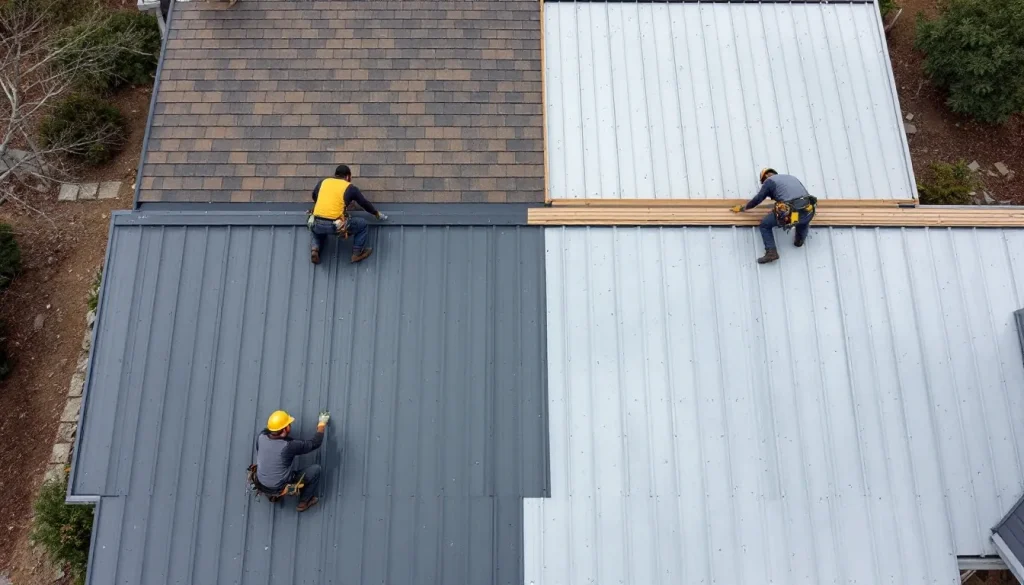
Metal roof installation in 2026 takes 4 to 7 days for a typical residential reroof and costs $10 to $25 per square foot installed, depending on profile (corrugated vs standing seam) and material (steel, aluminum, copper, zinc). The install process from tear-off to ridge cap follows a strict sequence, and the most expensive mistakes happen in steps 2 and 4, before any panel goes on the roof. Here is the complete process from site prep to final ridge cap, with the specific failure points that separate a 50-year install from a 10-year leak callback.
The short version
- A typical 2,400-square-foot residential metal reroof takes a crew of 3 to 5 installers 4 to 7 working days.
- Installed pricing runs $10 to $25 per square foot, with standing seam at the top and corrugated 26-gauge at the bottom.
- The two most common expensive mistakes happen at deck inspection (step 2) and underlayment selection (step 4).
- High-temperature synthetic underlayment is required under all metal panels, not standard 15-pound felt.
- Wind uplift ratings come from ASTM E1592 panel testing and UL 580 assembly testing, with Florida HVHZ requiring Miami-Dade NOA approval.
- Installer certification programs (MCA, MBCI, McElroy, Englert) signal training-quality and are required for full panel warranties.
The Short Answer: Install Timeline and Cost
A 2,400-square-foot residential metal reroof with a single roof plane and moderate pitch (5/12 to 7/12) takes 4 to 5 days for an experienced crew (see our metal roofing contractor finder). Multi-plane roofs with valleys, dormers, and complex flashings push to 6 to 7 days. Standing seam installs run longer than through-fastener corrugated because of the clip-setting and seaming labor. Total installed cost for the same 2,400-square-foot roof ranges from $24,000 (corrugated, 26-gauge Galvalume) to $60,000 (standing seam, 24-gauge Kynar-finished steel) to $90,000 plus for copper or zinc.
Pre-Install: Site Prep and Permit
Permitting takes 5 to 20 business days depending on jurisdiction. The permit application requires the product spec sheet, the manufacturer install manual reference, the wind uplift rating relevant to the local design wind speed, and (in HVHZ zones) the Miami-Dade NOA or Florida Product Approval number. Site prep includes dumpster delivery, plywood lift staging, ladder set, and ground tarping under the eaves to catch nails and torn underlayment. Trees within 10 feet of the eave should be trimmed back before tear-off to avoid panel damage during set.
Step 1: Tear-Off Existing Roofing
Tear-off is day one. A 3-tab asphalt shingle roof tears off at roughly 30 to 45 squares (100-square-foot units) per day per crew. Architectural shingles tear off at 25 to 35 squares per day. The old felt comes off with the shingles. Any old flashings, drip edge, ridge vent, and pipe boots are removed completely. The deck is left clean, swept, and ready for inspection. Tear-off and dump fees run $1.20 to $2.50 per square foot of roof area, included in the total installed price.
Step 2: Inspect and Replace Decking
Deck inspection is the most-rushed step on most installs, and it is where the expensive surprises hide. Every square inch of decking is walked, with the installer probing for soft spots, rot at eaves and valleys, delaminated OSB, and broken sheathing edges over rafters. Damaged sheets are marked, pulled, and replaced. Code (IRC R803) requires the deck to provide a solid, structurally sound substrate before any new roofing is installed.
Typical replacement runs 2 to 6 sheets on a healthy roof, 10 to 20 sheets on an older home with prior leaks, and 30 plus sheets on a roof that was reroofed over rot. Plan a budget contingency of $400 to $1,200 for deck replacement on any reroof of a pre-1995 home. The full sheathing breakdown is at roof sheathing, and the underlying framing details are at roof trusses.
Step 3: Install Underlayment
Underlayment selection is the second expensive mistake point. Metal panels heat up to 160 to 180 degrees Fahrenheit in summer sun, and standard 15-pound asphalt-saturated felt will release tar that bonds to the metal panel back. For metal roofs, high-temperature synthetic underlayment is the correct specification: Sharkskin Ultra SA, Titanium PSU30, Grace Ice and Water Shield HT, or equivalent rated for 240 to 260 degree continuous exposure.
Ice-and-water shield self-adhered membrane is installed at eaves (extending 24 inches inside the warm wall line, per IRC R905.1.2 in climate zones with ice damming), in valleys (full width), around all penetrations, and at low-slope transitions. Synthetic underlayment covers the remainder of the deck, with 4-inch horizontal laps and 6-inch end laps, capped fasteners 12 inches on center in the field and 6 inches at laps. The full felt vs synthetic discussion is at felt vs synthetic underlayment.
Step 4: Install Drip Edge
Drip edge installs over the underlayment at eaves and under the underlayment at rakes (or per local code interpretation). The eave drip edge directs water into the gutter and prevents capillary draw under the panel. The rake drip edge closes the gable end and seals the underlayment edge from wind-driven rain. Drip edge for metal roofs is typically a heavier-gauge formed metal piece in the same finish as the panels, with 24-gauge or 26-gauge steel preferred over the 28-gauge used for asphalt. Full detail at drip edge.
Step 5: Layout and Plan Panel Lengths
Standing seam panels are typically ordered to length, with each panel running from ridge to eave in a single piece up to 40 to 60 feet. The shop drawing or field measurement specifies each panel length plus a 1 to 2-inch overhang at the eave. Corrugated panels lap end-to-end with 6 to 12-inch overlaps and sealant tape, so they can run shorter and still cover the slope length. Layout planning includes panel-edge alignment with the eave, square-to-ridge alignment, and pre-positioning of clips or fastener lines.
Step 6: Install Eave Trim
Eave trim sits on top of the drip edge and creates the upturn that locks the panel down at the eave. For standing seam, the eave trim has a hemmed lip that the panel front edge engages. For corrugated, the eave trim is a simpler formed angle with closure strips matching the panel rib profile. Closure strips are foam or rubber profiled inserts that block wind-driven rain and insect intrusion at the eave end of each rib.
Step 7: Install First Panel (The Critical Alignment)
The first panel sets the alignment for every panel after it. The first panel is placed at one gable end, squared to the eave and the ridge using a string line or chalk line on the underlayment. A misalignment of 1/4 inch at the first panel becomes a 4-inch misalignment by the twentieth panel, with no way to recover except to pull and reset. Experienced installers spend 30 to 60 minutes on the first panel and 5 to 10 minutes on each subsequent panel.
For standing seam, the first panel is locked into the eave trim hem and the clips are set along the panel edge at the manufacturer-specified spacing (typically 24 inches on center for high-wind zones, 36 inches for standard). For corrugated, the first panel is positioned at the gable rake edge with the major rib aligned to a chalk line, and the first row of screws is driven through the major ribs into the deck or purlins.
Step 8: Continue Panels with Proper Overlap
Subsequent panels engage the previous panel at the side lap. Standing seam side laps are mechanically seamed: a portable seaming machine runs down the lap and folds the two panel edges into a locked double-lock seam. Corrugated side laps depend on the profile. R-Panel and U-Panel laps are a single rib overlap with screw-through fastening. 5V crimp laps a single V over the adjacent panel V. Standard corrugated overlaps the wavy profile by 1.5 corrugations minimum.
End laps (where a panel ends partway up the slope and another panel continues) require sealant tape (butyl tape, 1-inch wide minimum) and a 6 to 12-inch overlap secured with screws. End laps are weak points and good installers minimize them by ordering longer panels.
Step 9: Install Valleys
Valleys on metal roofs are open valleys with a formed valley metal in the same finish as the panels. The valley pan is a W-profile or V-profile formed piece, 24 inches wide minimum, installed over a full-width strip of self-adhered membrane. Panels are cut to the valley line with a 2 to 3-inch hem turned down into the valley pan, providing a wind-rain barrier. The panel-to-valley joint is closed with sealant tape under the panel edge. Full valley flashing detail at roof flashing.
Step 10: Install Flashings (Chimney, Walls, Vents)
Step flashings at sidewalls, headwall flashings at chimney uphill faces, counter-flashing into the masonry reglet at chimneys, and pipe boot flashings at plumbing and HVAC penetrations all install in this step. For metal roofs, flashings are formed sheet metal in the same gauge and finish as the panels, not the asphalt-style aluminum flashings used under shingles. EPDM or silicone pipe boots are rated for 180 to 260 degree exposure (Dektite, Master Flash). Penetration flashings have a service life of 15 to 20 years and need replacement before the panels themselves do.
Step 11: Install Ridge Cap and Closures
The ridge cap is the final piece. Standing seam ridge caps lock over the panel seams using a Z-closure or vented closure that allows attic ventilation. Corrugated ridge caps install over inside-closure strips that block the rib openings. Ridge vent options for metal roofs are continuous formed-metal ridge vents matched to the panel profile, with insect screen and weather baffle integrated. Attic ventilation requirements (1 square foot of net free area per 150 square feet of attic, or 1 to 300 with a balanced soffit-to-ridge ratio) are covered at attic ventilation.
Fastening: Through-Fastener vs Concealed Fastener
| Attribute | Through-Fastener | Concealed-Fastener (Standing Seam) |
|---|---|---|
| Fastener visibility | Visible at every screw line | Hidden under raised seams |
| Fasteners per square | 80 to 120 | 40 to 60 (clips, not panel screws) |
| Gasket replacement at year 20 | Required campaign | Not applicable |
| Thermal expansion accommodation | Limited (screws pin the panel) | Excellent (panel floats on clips) |
| Typical service life | 40 to 50 years | 50 to 70 years |
| Installed cost per sq ft | $5 to $12 | $10 to $25 |
The fastening philosophy difference is the single biggest engineering distinction between corrugated and standing seam. Standing seam clips allow the panel to expand and contract with temperature, with a 30-foot panel moving 1/4 to 3/8 inch between winter low and summer high temperatures. Through-fastened panels resist that movement, creating fastener fatigue and slot elongation at the screw holes over decades.
The Top 8 Installation Mistakes
From the install manuals published by MBCI, McElroy Metal, and Englert, plus the case studies in roofing-industry quality reports, the eight most expensive metal roof install mistakes are: (1) installing felt underlayment instead of high-temperature synthetic, (2) over-driving through-fasteners and crushing the EPDM gaskets, (3) installing flashings before the panel rather than integrated with the panel run, (4) skipping the ice-and-water shield at eaves in cold climates, (5) misaligning the first panel and accumulating skew across the field, (6) using carbon-steel screws instead of stainless or galvanized in coastal applications, (7) failing to plan attic ventilation continuity at the ridge, and (8) installing closure strips upside down or omitting them entirely.
DIY Metal Roof: Why Most Should Not Try
DIY metal roofing is possible on sheds, equipment buildings, and detached garages where the consequence of a leak is low. DIY on a residential reroof is risky for three reasons. First, panels are long, heavy, and easily damaged in transit and during set. Second, the alignment requirements compound errors, and the recovery is to pull and reset, not to fudge it. Third, the warranty terms on premium finishes (Kynar, Galvalume) require installation by a certified contractor, and DIY installation voids the substrate warranty. For homeowners committed to DIY, the corrugated 26-gauge agricultural-panel install on an outbuilding is reasonable. Residential standing seam is not.
Installer Certifications: MCA, MBCI, McElroy, Englert
Four certification programs signal trained installers. The Metal Construction Association (MCA) credentials include the Certified Installer program for commercial work. MBCI offers installer training and certification for their panel systems. McElroy Metal certifies installers on their Maxima, Medallion, and 138T panels. Englert offers installer training for their A1000 and S1300 systems. A certified installer signature is required for the panel warranty to honor coil-substrate claims, paint warranty claims, and watertight performance warranty claims. The framework for evaluating contractors generally is at how to choose a roofing contractor.
Wind Uplift Testing: UL 580 and ASTM E1592
Wind uplift performance is tested two ways. UL 580 (Tests for Uplift Resistance of Roof Assemblies) tests the complete assembly (deck, underlayment, attachment, panel) against static and oscillating uplift pressure, with Class 30, Class 60, and Class 90 rating tiers corresponding to 30, 60, and 90 pounds per square foot uplift resistance. ASTM E1592 (Standard Test Method for Structural Performance of Sheet Metal Roof and Siding Systems by Uniform Static Air Pressure Difference) tests the panel itself at incrementally increasing uplift pressures until failure, generating a documented allowable design pressure.
Florida HVHZ jurisdictions (Miami-Dade and Broward counties) require Miami-Dade NOA approval for the specific panel and attachment combination, with TAS 100, 110, 114, and 125 protocol testing. Non-HVHZ Florida uses Florida Product Approval (FPA) numbers. For hurricane-zone reroofs, the panel manufacturer typically publishes uplift test results by deck type (5/8-inch plywood vs 7/16-inch OSB), fastener type, and fastener spacing pattern. The hurricane-zone discussion expands at best roof for hurricane.
Thermal Expansion: The Hidden Engineering
Metal expands and contracts with temperature, and the dimensional change is significant across long panels. Steel expands at roughly 6.5 microinches per inch per degree Fahrenheit. A 40-foot steel panel cycling from 0 degrees Fahrenheit on a winter night to 160 degrees Fahrenheit on a summer afternoon moves 0.5 inches across its length. Aluminum expands at roughly 13 microinches per inch per degree, so a 40-foot aluminum panel moves nearly 1 inch across the same temperature range. Standing seam clips are designed to allow this movement (the panel slides on the clip while staying locked under the seam). Through-fastener corrugated panels resist movement, accumulating fatigue stress at every screw and at the panel end-laps. The engineering implication: through-fastener panels above 40 feet of run length should have an expansion joint or a transition detail at the half-way point.
Snow Retention Systems
Snow retention on metal roofs is a separate engineering decision from the panel install. Three system types dominate. Pad-style snow guards are individual cleats screwed into the panel ribs, with each pad rated for 200 to 400 pounds of snow load and pads spaced per the panel manufacturer guidance and the local ground snow load. Continuous snow rails are aluminum or steel bars clamped to the panel ribs in a continuous run across the eave, with rated capacities of 2,000 to 5,000 pounds per linear foot. Snow fences are taller, multi-row systems used in extreme-snow regions where the avalanche risk requires staged retention. Installation cost runs $0.40 to $0.80 per square foot for pad-style and $1.20 to $2.20 per square foot for continuous rail.
Color Selection and Cool-Roof Performance
Paint color affects both aesthetic and thermal performance. Light colors (white, light grey, light tan) reflect 60 to 80 percent of solar heat and qualify for ENERGY STAR cool-roof status with Solar Reflectance Index (SRI) values above 75. Mid-tone colors (medium grey, blue, green) reflect 30 to 50 percent. Dark colors (black, dark brown, hunter green) reflect 20 to 35 percent. The Kynar 500 cool-pigment formulations developed by BASF and Sherwin-Williams Coil Coatings allow dark colors with SRI values 40 to 60 percent higher than standard pigments of the same hue, narrowing the cool-roof penalty for buyers who want a dark roof. Cool-roof incentive programs in California, Florida, and Texas provide rebates of $0.10 to $0.50 per square foot for qualifying installations.
Cost Versus Asphalt: The Lifetime Math
The installed-cost gap between metal and asphalt shingles is real, but the lifetime-cost gap narrows or reverses depending on the comparison window. A 30-year architectural asphalt shingle roof installed at $5.50 per square foot will need replacement at year 22 (the typical real-world failure point versus the warranty marketing). A standing seam metal roof installed at $14 per square foot will last 50 to 60 years. Over a 50-year window, the asphalt option requires 2 to 3 reroofs ($16 to $24 per square foot cumulative). The full installed-cost comparison is at metal roof cost and the head-to-head is at metal vs asphalt shingle roof.
Warranty Stack: Substrate, Paint, Workmanship, Watertight
Four warranty layers protect a finished metal roof install. The substrate warranty covers the steel coil or Galvalume coating against perforation, with terms of 25 to 50 years from the steel mill (or panel manufacturer who buys the coil). The paint finish warranty covers color fade, chalk, and adhesion, with Kynar 500 PVDF carrying 30 to 40 year warranties from PPG, Sherwin-Williams, Akzo Nobel, or Valspar. The installer workmanship warranty covers labor defects, with terms of 2 to 10 years typical and 10 to 25 years for installers who hold manufacturer certifications. The watertight system warranty (sometimes called a no-dollar-limit warranty) is offered by some manufacturers on certified-installer projects, covering both materials and workmanship together with 20 to 30 year terms and full repair-or-replace remedy.
Penetration Detailing: Pipe Boots, Curbs, and Vents
Penetration flashings are the highest-risk leak points on a metal roof, with up to 70 percent of metal roof leaks in claim data originating at pipe boots, HVAC curbs, satellite dish mounts, and vent stacks. The correct flashing approach varies by penetration type. Plumbing vent stacks use a high-temperature EPDM or silicone pipe boot (Dektite or Master Flash) sized for the stack diameter, with the boot base sealed to the panel using butyl tape and the upper boot sleeve clamped to the stack. HVAC curbs are formed from heavy-gauge sheet metal with full hemmed edges and panel-locked counter-flashing on all four sides. Satellite dish mounts and other post-install penetrations are best handled with a curb-mount flange rather than a direct screw-through, which preserves the panel water plane.
Mid-Roof Transitions: Pitch Changes and Wall Returns
Mid-roof transitions where the pitch changes (often where a porch roof meets a main roof at a different slope) require formed transition flashings that maintain the water plane across the slope change. The transition flashing is custom-formed at the panel manufacturer or in the field shop, with a hemmed upper edge that the upper panel laps over and a hemmed lower edge that the lower panel locks into. Wall returns (where the roof meets a vertical wall in line with the eave) use a sidewall flashing with step-flashing or counter-flashing integration into the wall siding or masonry. These transitions are slow-labor details that experienced metal installers handle in 30 to 90 minutes each.
Project Sequencing on Multi-Trade Sites
On new construction, metal roof installation sequences after framing inspection, sheathing inspection (covered at roof sheathing), and prior to HVAC rough-in across the roof. The framing structure below sits at roof trusses. Penetration locations (plumbing vents, HVAC stub-outs, exhaust fans, kitchen vents) are coordinated before panels are set so that flashing details can be planned. The general contractor schedules the metal install around weather windows, with 3 to 5 consecutive dry days preferred for the panel-set portion. Underlayment can be installed in shorter windows because it tolerates light moisture, but panel installation goes faster on dry decks.
Permit and Inspection Sequence
Three inspections are typical on a residential metal reroof. The pre-construction inspection (where required) verifies the existing structure can carry the new roof load and the permit application matches the planned scope. The in-progress inspection verifies the deck condition after tear-off and before underlayment, with the inspector checking sheathing replacement quality, drip edge installation, and ice-and-water shield placement. The final inspection verifies the completed install matches the permit, with the inspector checking ridge ventilation, flashing details, and overall workmanship. Failed inspections require rework and re-inspection, typically with 5 to 10 business day intervals between attempts.
Frequently Asked Questions
How long does metal roof installation take?
4 to 7 working days for a typical 2,000 to 2,800-square-foot residential reroof. Standing seam installs run longer because of clip-setting and mechanical seaming. Complex roofs with valleys, dormers, and multiple slopes can extend to 8 to 12 days.
Can metal roofing be installed over existing shingles?
Some manufacturers approve installing metal roofing over shingles with purlins or a metal lath spacer, but the practice trades 2 to 5 hours of tear-off labor for compromised warranty terms, fastener-pullout concerns, and concealed deck damage that goes undiagnosed. The professional standard is tear-off to the deck and install over a clean substrate.
What is the minimum pitch for a metal roof?
Standing seam: 1/4 in 12 minimum for mechanically-seamed double-lock profiles, 3/12 minimum for snap-lock profiles. Corrugated through-fastener panels: 3/12 minimum with manufacturer sealant tape at all laps. The full pitch-to-material chart is at roof pitch chart.
Do I need to remove gutters before metal roof installation?
Yes, in most cases. The existing gutters are detached and either reused or replaced after the eave trim and panel are installed. New gutters are typically installed at the same time as the new roof. The eave trim flashing geometry differs between asphalt and metal, so the gutter hangers are repositioned 1 to 2 inches lower on most installs.
What underlayment goes under a metal roof?
High-temperature synthetic underlayment rated for 240 to 260 degree continuous exposure, with self-adhered ice-and-water shield at eaves (cold climates), valleys, and around penetrations. Standard 15-pound asphalt felt is not appropriate under metal because it will release tar at summer roof temperatures.
Can metal roofing be installed in winter?
Yes, with two cautions. Self-adhered membranes (ice-and-water shield, peel-and-stick underlayments) need 40 degrees Fahrenheit minimum for proper adhesion or primer pre-treatment. Panel surfaces become slippery with frost and snow, slowing labor by 30 to 50 percent. Many crews continue metal work into winter where shingle crews stop, because metal panel installation does not require warm sealant activation.
What is the warranty on metal roof installation?
The substrate (steel coil, Galvalume coating) carries a 25 to 50-year warranty depending on supplier. The paint finish (Kynar 500 PVDF) carries a 30 to 40-year color and chalk warranty. The installer typically warrants workmanship for 2 to 10 years. Watertight system warranties (offered by some manufacturers for certified installers) cover both materials and workmanship for 20 to 30 years.
How much does metal roof installation cost in 2026?
Corrugated 26-gauge Galvalume: $5 to $12 per square foot installed. Standing seam 24-gauge Kynar: $10 to $20 per square foot installed. Premium copper or zinc standing seam: $20 to $40 per square foot installed. Detailed pricing at metal roof cost and the calculator at how much does a new roof cost.
Metal roof installation in 2026 is a mature, well-documented process with clear sequencing, defined materials, and tested performance criteria. The crews that consistently deliver 50-year installs are the ones that follow the manufacturer install manuals, respect the underlayment specification, do not rush deck inspection, and align the first panel correctly. For a deeper look at the panel options themselves, the corrugated profile breakdown is at corrugated metal roofing, and the standing seam premium tier is documented at standing seam metal roof cost.