
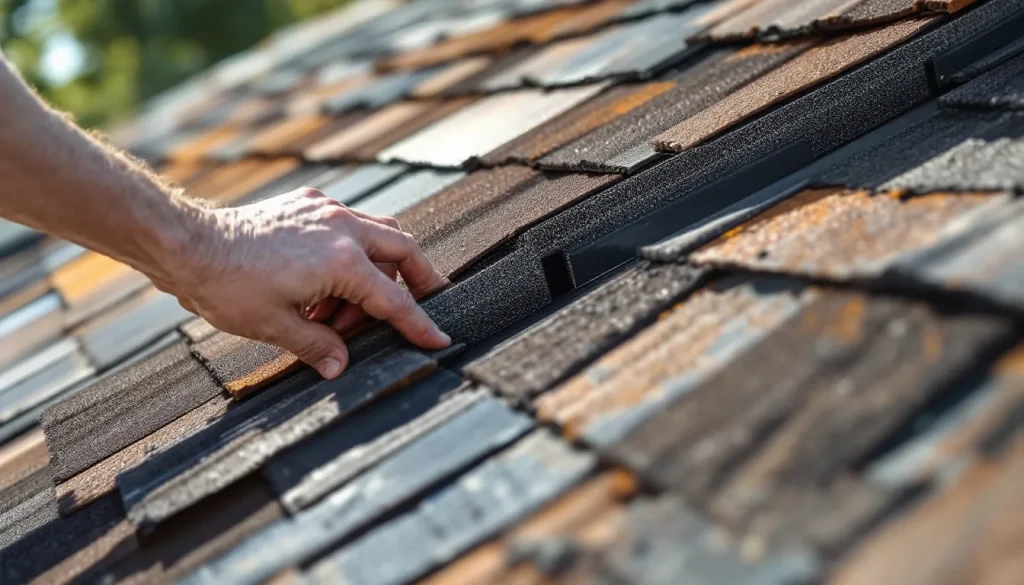
Step flashing (see our flashing on a house overview) is bent sheet metal installed one piece per shingle course where a sloped roof meets a vertical wall, chimney, or dormer side. Each piece is L-shaped: typically a 4-inch leg up the wall and a 4-inch leg onto the roof, woven into the shingle course immediately above it so water sheds onto the shingle and not behind the wall cladding. IRC R905.2.8.5 requires step flashing at all sidewall transitions; continuous strip flashing is not code-compliant for asphalt shingle roofs at sidewall conditions. This is where roughly 95% of wall-junction leaks start, almost always because the installer used continuous flashing instead of stepped, skipped the kickout at the bottom, or relied on caulk to bridge gaps the metal should have handled.
Last reviewed: August 2026.
The short version
- Standard piece size: 4 in x 4 in x 7 to 10 in long (one piece per shingle course).
- Larger 5 in x 7 in pieces are spec’d in heavy snow regions and for steep pitches over 9/12.
- Material: 26 gauge G-90 galvanized or 0.025 to 0.032 in aluminum minimum; copper 16 oz on premium.
- One piece per shingle course, woven into the course above. Never continuous strip.
- Bottom piece extends past the eave with a kickout flashing turning water into the gutter.
- Counter flashing (or siding/stucco) covers the wall leg; never rely on sealant alone.
- Top piece tucks under headwall flashing or counter flashing at the top of the run.
What step flashing is and where it goes
Step flashing handles the wall-to-roof transition where a sloped roof butts against a vertical wall. The vertical surface might be a chimney side, a dormer side, a second-story wall above a porch roof, or a section of cladding on a multi-gable home. The water problem at that junction is gravity plus capillary action: water running down the wall tries to push behind the shingles, and water running down the shingles tries to push up behind the wall cladding. Step flashing solves both at the same time by giving water a metal surface to track over, course by course.
The geometry matters. Each piece overlaps the one below by 2 to 3 inches, gets covered by the shingle above by at least 2 inches, and has its wall leg covered by counter flashing, siding, or stucco. The flashing creates a watertight shingle-style metal layer running up the wall, sealed entirely by the geometry of the lap. No sealant required between pieces. Sealant in step flashing is a maintenance item that gets replaced; the metal lap is the actual seal.
For the broader picture of where flashing lives on a roof, see what is flashing on a roof and the roof flashing guide. For chimney junctions specifically, our chimney flashing installation guide covers how step flashing pairs with counter flashing and a cricket, and low-slope roofs that end at a vertical wall use the different geometry in our parapet wall flashing detail.
Sizing chart
Standard residential asphalt shingle step flashing is 4 inches up the wall, 4 inches onto the roof, and 7 inches long along the slope. Steep pitches of 9/12 and up move to a 5-inch roof leg and 8 to 10-inch lengths, while very steep pitches and heavy snow regions use 5 in x 5 in x 10 in pieces. Cedar shake and slate step up to 5 in x 7 in x 10 in. Sizes vary by climate, pitch, and shingle type.
| Application | Wall leg | Roof leg | Length (along slope) | Gauge / thickness |
|---|---|---|---|---|
| Standard residential, 4/12 to 8/12, asphalt shingle | 4 in | 4 in | 7 in | 26 ga galvanized or 0.025 in aluminum |
| Steep pitch (9/12 to 12/12) | 4 in | 5 in | 8 in | 26 ga galvanized or 0.025 in aluminum |
| Very steep (12/12+) or heavy snow regions | 5 in | 5 in | 10 in | 24 ga galvanized or 0.032 in aluminum |
| Cedar shake / shingle roof | 5 in | 7 in | 10 in | 24 ga galvanized or copper 16 oz |
| Standing seam metal roof at sidewall | 4 in | 4 in | 10 ft continuous | 24 ga matching panel material |
| Slate roof | 5 in | 7 in | 10 in | 20 oz copper or stainless 304 |
| Tile roof | 4 in | 5 in | 10 in | 26 ga painted or 16 oz copper |
The length-along-slope number is what matters for ordering: a 5-inch exposure shingle course needs a 7-inch step flashing piece to give 2 inches of overlap on each end. A 6-inch exposure course (rare on standard architectural shingles) wants 8 to 10 inches of length per piece.
Material comparison
Galvanized steel, aluminum, copper, and stainless are the common step flashing materials, and material is the single longest-life decision on the wall junction. Because step flashing buried behind siding or counter flashing is essentially unmaintainable, spec the material that will outlast the roof: galvanized lasts 30 to 40 years, aluminum 40 to 60, and copper or stainless 80-plus. If it fails, the whole wall comes off to replace it.
| Material | Spec | Lifespan | Cost (per piece) | Best for | Watch out for |
|---|---|---|---|---|---|
| Galvanized steel | G-90, 26 ga | 30 to 40 yr | $0.50 to $0.80 | Standard residential, asphalt shingle, painted siding | White rust streaking on the wall; not for coastal |
| Aluminum | 3003-H14, 0.025 to 0.032 in | 40 to 60 yr | $0.80 to $1.20 | Coastal, standard residential, stucco siding | Avoid contact with copper, pressure-treated lumber, and concrete (galvanic / chemical reactions) |
| Painted aluminum (Kynar 500) | 0.025 to 0.032 in | 40 to 60 yr | $1.20 to $1.80 | Visible installations where color matters | Field cuts expose unpainted edges |
| Copper | 16 oz cold-rolled | 80 to 100+ yr | $3.00 to $5.00 | Premium residential, slate, cedar shake | Cost; will stain wood and stucco below; avoid contact with aluminum and galvanized |
| Lead-coated copper | 16 oz | 80 to 100+ yr | $5.00 to $7.00 | Heritage, museum work, no-staining premium | Cost; weight |
| Stainless steel | 304 (interior), 316 (coastal), 26 ga | 80+ yr | $2.50 to $4.00 | Coastal, salt-air exposure, premium | Cost; harder to bend in the field |
Pre-formed pieces from Lifetime Tool, Amerimax, and Berridge save crew time but cost 50% to 100% more per piece than bending in the field. On standard 4 x 4 x 7 in pieces, pre-formed makes sense for a single-day job (no brake on the truck). On non-standard sizes (5 x 7 or 5 x 10), field-bend with a sheet metal brake.
Install sequence (5 steps)
Install step flashing from the bottom up, one piece per shingle course. Run ice and water shield up the wall, set the kickout flashing first, then weave each shingle course with a single step flashing piece nailed once in the high corner. Cover the wall legs with counter flashing or siding, and tuck the top piece under the headwall flashing. The five steps below walk through the full sequence.
- Step 1: Prep the substrate and run ice and water shield up the wall. Strip back any siding 8 inches above the roof deck so you have access to the wall sheathing. Run a strip of ice and water shield up the wall 6 inches and onto the roof deck 24 inches. This is a backup membrane in case water ever gets past the step flashing. Install starter shingle along the eave per the manufacturer’s spec. Do not caulk the wall-to-deck joint; you want any water that does get behind the flashing to drain back out, not be trapped.
- Step 2: Install kickout flashing at the bottom. The bottom-most step flashing piece needs a kickout: a 90-degree bend at the lower edge that turns water into the gutter rather than down the wall. Without it, water runs off the bottom of the wall-roof junction and behind the wall cladding, causing the rot pattern that contractors call “the kickout cancer.” See our dedicated kickout flashing guide for the geometry. Install the kickout first; everything above it laps onto its roof leg.
- Step 3: Install the first course of shingles, then the first step flashing piece. Install the first shingle course along the eave per spec. Set the first step flashing piece on top of that course, hard up against the wall, with its bottom edge aligned with the bottom of the next shingle exposure. Nail it with one nail in the high (roof-side) corner. Never nail through the wall leg. The single nail keeps the piece from sliding but leaves the rest of the flashing free to flex with shingle movement.
- Step 4: Weave each shingle course with one step flashing piece. Install the next shingle course, sliding it under the wall leg of the step flashing but on top of the roof leg. The shingle covers the roof leg of the step flashing by at least 2 inches. Set the next step flashing piece on top of that shingle course, overlapping the previous piece by 2 inches along the slope. Continue: shingle, flashing, shingle, flashing, all the way up the wall. One piece per course. Never a continuous strip.
- Step 5: Cover wall legs with counter flashing, siding, or stucco. Once the step flashing run is complete, cover the wall legs with permanent cladding. On masonry walls (brick, stucco, stone), install counter flashing with a reglet cut into the wall and sealant in the reglet only. On wood-sided walls, the siding itself becomes the cover; leave a 1.5 in to 2 in gap between the bottom of the siding and the roof so debris doesn’t collect against the step flashing. At the top of the wall run, the last step flashing piece tucks under the headwall (apron) flashing or counter flashing at the top of the wall.
Common failure modes
Most step flashing failures come from a handful of mistakes: continuous strip instead of stepped pieces, a missing kickout at the bottom, reverse-shingled flashing, nailing through the wall leg, and relying on caulk as the primary seal. Each one lets water track behind the wall cladding, where it rots sheathing and framing before anyone ever sees a roof leak. The full list of defects is below.
- Continuous strip flashing instead of step flashing. The single most common defect. A single piece of L-flashing running the full length of the wall looks easier and faster. It fails the first time water tries to track along the wall surface, because there’s no shingle weave breaking the path. Continuous strip flashing at sidewalls is a code violation under IRC R905.2.8.5 for asphalt shingles.
- No kickout at the bottom. Without a kickout, water runs off the bottom of the wall-to-roof junction and behind the siding. The result is rotted sheathing and framing inside the wall, usually 1 to 3 ft above the floor. Often invisible until drywall comes off.
- Reverse-shingled flashing. Installer puts each step flashing piece on top of the shingle in its course rather than under the shingle above. Water tracks behind the wall leg and into the wall.
- Nailing through the wall leg. Pinning the wall leg of the flashing voids the lap movement and creates a leak path at every nail.
- Caulk as primary seal. Sealant between the wall leg and the wall cladding is a backup, not a seal. Caulk fails in 7 to 10 years. If the geometry of the metal isn’t watertight without caulk, the install is wrong.
- Step flashing buried under stucco with no counter flashing. Stucco shrinks and cracks at every metal-to-stucco transition. Without counter flashing in a reglet cut into the stucco, the crack becomes a leak path.
- Galvanic corrosion (aluminum step flashing under copper counter flashing, or copper step flashing on galvanized wall flashing). Mixing metals in direct contact in a wet environment accelerates corrosion of the less-noble metal.
- Step flashing reused on a reroof. The metal is age-hardened, has nail holes in the wrong places for the new shingle exposure, and is often bent out of shape. Spec new flashing on every reroof.
- Skipping ice and water shield behind the flashing in cold climates. Ice dams push water back up the wall behind shingles. Without ice and water shield on the deck and up the wall, the step flashing isn’t enough.
- Bottom flashing piece too short (no kickout, no gutter integration). Even with a kickout, the bottom piece needs to extend past the eave by enough to reach into the gutter. Cut short, it dumps water on the fascia.
Most of these failure modes show up as wall stains in the room behind the affected wall, not as roof leaks. By the time the homeowner notices, the framing inside the wall is rotted. The fix is described in our roof flashing repair guide; the prevention is correct install up front.
Cost
Step flashing material is cheap; the cost driver is labor and access. Material runs about $35 to $75 per side of a chimney or dormer, typically 10 to 15 pieces. A new install during a full reroof is included in the per-square shingle price, while a retrofit that cuts back and resets siding runs $400 to $1,200 per wall. Repairing one failed run on a chimney costs $300 to $800. Typical residential numbers in 2026 break down as follows.
- Step flashing material: $35 to $75 per side of a chimney or dormer (typically 10 to 15 pieces).
- Labor for new install during a full reroof: included in the per-square shingle price.
- Labor for retrofit step flashing on an existing roof (siding cut back, flashing replaced, siding reset): $400 to $1,200 per wall.
- Repair of one failed step flashing run on a chimney: $300 to $800.
- Full reroof + step flashing replacement on a typical chimney (4 sides): $600 to $1,500 in materials and labor allocation.
The cost-to-fail ratio is what makes this detail worth spending on. A $40 material cost protects $5,000 to $20,000 in wall framing, sheathing, and finish work. For the broader leak-source diagnosis, see our roof leak repair and how to fix a roof leak guides, and the drip edge installation detail for the eave termination that pairs with the bottom piece. The roof vent pipe boot is another common leak point worth checking on the same roof.
Code references and certifications
IRC R905.2.8.5 is the controlling code section for step flashing at sidewall transitions on asphalt shingle roofs. The 2024 IRC update tightened the language to explicitly prohibit continuous flashing at sidewall conditions and to require kickout flashing at the bottom termination. ASTM A653 is the spec for galvanized step flashing (G-90 minimum). ASTM B209 is the spec for aluminum sheet (3003 or 5052 alloy). NRCA Roofing Manual: Steep-Slope Roofing details the residential step flashing standard. Most major manufacturer warranties (GAF, Owens Corning, CertainTeed, IKO) explicitly require step flashing at sidewalls or void the warranty.
Frequently asked questions
What size step flashing should I use?
Standard residential asphalt shingle: 4 inches up the wall, 4 inches on the roof, 7 inches long along the slope. Steep pitches (9/12+) or heavy snow regions: 5 in x 5 in x 10 in. Cedar shake and slate: 5 in x 7 in x 10 in. Always size so one piece overlaps the next by at least 2 inches.
Can I use one continuous piece instead of stepped pieces?
No. Continuous flashing at sidewalls is prohibited under IRC R905.2.8.5 for asphalt shingles. One piece per shingle course is required. Continuous flashing fails the first time water tries to track laterally along the wall.
Do I need a kickout flashing at the bottom of the step flashing run?
Yes. Without a kickout, water running off the bottom of the wall-to-roof junction goes behind the siding and rots the framing. The kickout turns that water into the gutter instead. IRC requires it; most major manufacturer warranties require it; and field experience absolutely requires it.
What material should I use for step flashing?
Standard residential: 26 gauge G-90 galvanized steel or 0.025 to 0.032 in aluminum. Coastal: aluminum or 316 stainless to avoid corrosion. Premium / slate / cedar shake: 16 oz copper or 304 stainless. Never use steel and copper in contact.
How long does step flashing last?
Galvanized: 30 to 40 years. Aluminum: 40 to 60 years. Copper: 80 to 100+ years. Stainless 304/316: 80+ years. The roof shingles will typically reach end of life before properly installed step flashing in any of those materials.
Can I replace step flashing without removing the siding?
Almost never. The wall leg of step flashing tucks behind the siding by design; to replace it, the siding above the flashing run has to come off. The exception is rare cases where the original installer left a counter flashing detail with a removable reglet cover, but that’s not standard residential practice.
Bottom line
Step flashing is the cheapest wall-junction insurance available. The material costs less than $1 per piece. The install adds 30 to 60 minutes per wall during a reroof. The protected wall framing is worth tens of thousands of dollars. Spec it correctly: stepped, not continuous; one piece per shingle course; kickout at the bottom; counter flashing or siding cover at the top; ice and water shield behind the flashing on the deck. Do that on every wall transition and the wall-junction leak pattern that drives most home insurance roof claims essentially disappears.