
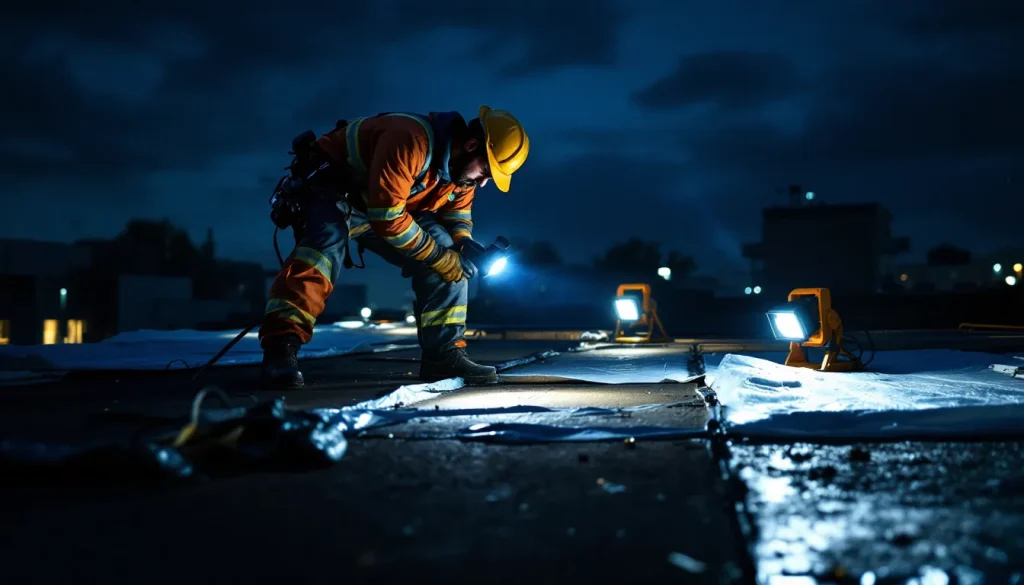
A 24/7 commercial roofing service call in 2026 typically runs $400 to $1,500 in mobilization fees plus $250 to $450 per hour for after-hours labor (for the full data set, see our the 2026 Roofing Contractor Industry Report), with most temporary repairs landing in the $1,200 to $5,000 total range before the permanent repair gets scheduled. The economics work out for the contractor because emergency rates carry premium margins; the economics work out for the building owner because a $3,000 emergency tarp at midnight prevents $50,000 to $300,000 in interior damage by sunrise. This guide breaks down what emergency service actually costs, when to call, what to expect on response time, what counts as a permanent fix versus a temporary patch, and the insurance documentation rules that determine whether your carrier reimburses the call.
The short version
- Emergency mobilization fees run $400 to $1,500 just to get a crew to your building after hours.
- After-hours labor runs $250 to $450 per hour, double-time-and-a-half rates on holidays.
- Common temporary patches: Top Coat tarping, Polyglass Stick-and-Stay, GAF EverGuard Seam Tape Emergency, MULE-HIDE Patch & Caulk.
- Realistic response time: 45 minutes to 4 hours depending on contractor distance, traffic, and crew availability.
- Insurance documentation rules: photos within 48 hours, named-peril notation, ASCE 7-22 wind pressure analysis if claiming wind damage.
- Build the emergency vendor relationship before the emergency: existing service contracts get priority over walk-up calls.
When to call: the decision triggers
Not every roof leak is an emergency (see our emergency commercial roofing services overview), and the contractor knows it. Calling a 24/7 line for a slow drip in a back storage room at 2 AM gets the call queued behind genuine emergencies and may get an awkward response from the dispatcher. The triggers that justify the after-hours call:
Active water entry above critical occupancy. Water dripping into a server room, an operating theater, a kitchen line during service hours, a pharmacy compounding area, a class-A office floor with tenants present. The cost of even an hour of continued water entry exceeds any reasonable emergency response cost.
Active water entry above sensitive inventory. Water entering a warehouse zone with high-value or moisture-sensitive product (electronics, pharmaceuticals, paper goods, textiles, food). Inventory loss compounds quickly; a $300 patch at 11 PM saves $40,000 in damaged goods by morning.
Catastrophic membrane failure during a storm (for the full data set, see our the 2026 Severe Weather Roof Damage Report). A section of TPO blown back, a parapet cap blown off exposing the wall flashing, a hail strike that punctured the membrane in multiple locations, a tree limb that punched through the membrane and deck. The membrane is open and continued precipitation will flood the building.
Structural deck exposure. The roof system has been physically removed by wind, fire, vehicle impact, or vandalism, leaving deck or interior exposed to weather.
Active fire-suppression water above an occupied building. A fire on a building with an automatic suppression system has dumped water into the roof system. The system requires immediate drainage and weather protection.
What does NOT justify an after-hours call: a slow leak that has been ongoing for days or weeks, a drip in a vacant building, a known maintenance item that has been deferred, a leak that can be contained with a bucket until normal business hours. Save the emergency budget for actual emergencies.
Mobilization fees and after-hours labor rates
The fee structure for emergency commercial response in 2026 has three components: mobilization fee, hourly labor rate, and materials at cost plus markup.
Mobilization fee covers the contractor’s cost to dispatch a crew, send a service truck loaded with emergency materials, and absorb the schedule disruption of pulling crew off other work or off-shift. Typical 2026 ranges:
- Same-day business-hours service call: $250 to $500 mobilization
- After-hours (evening, before midnight): $400 to $900 mobilization
- Overnight (midnight to 6 AM): $700 to $1,500 mobilization
- Holiday or weekend overnight: $1,000 to $2,500 mobilization
Hourly labor rate is the per-man rate for the crew on site. Business hours commercial service typically bills $90 to $150 per hour per man. After-hours rates jump significantly:
- Evening (5 PM to midnight): $180 to $320 per hour per man
- Overnight: $250 to $400 per hour per man
- Holiday or weekend overnight: $350 to $500 per hour per man
Most emergency calls run 2 to 5 hours from arrival to crew-leaving. A 3-hour overnight call with a 2-man crew at $300 per hour per man comes to $1,800 in labor plus the $1,000 mobilization plus $400 to $1,200 in materials, totaling $3,200 to $4,000. The number is real and the building owner who balks at it does not understand the alternative.
Materials at cost plus markup covers the temporary patch materials, the tarping, the ballast bags, and any roof penetration repairs done at the call. Typical commercial markup is 30 to 60 percent over wholesale, which is standard across the trade.
Common temporary patches and what they actually do
The emergency call almost never produces a permanent repair. The goal at 2 AM is to stop water entry until daylight, until the storm passes, or until the permanent repair can be scheduled with the right materials. The temporary patches in the crew’s truck:
Tarping (Top Coat, generic poly tarps, Visqueen, EPDM scrap). The fastest emergency response is a heavy poly tarp or scrap EPDM membrane laid over the failure zone and ballasted with sandbags, lumber, or concrete blocks. Tarping does not bond to the existing membrane; it relies on weight to stay in place. Effective for 24 to 72 hours in moderate weather; less reliable in sustained high wind.
Polyglass Stick-and-Stay self-adhered patch. A peel-and-stick modified bitumen sheet that bonds to most existing membrane systems. Effective for 30 to 90 days as a temporary patch; the manufacturer does not warrant it as a permanent repair. Application in cold weather requires a torch warm-up of the substrate.
GAF EverGuard Seam Tape Emergency. Self-adhered TPO-compatible tape that can be used to re-seal a failed TPO seam or to patch a small puncture in TPO. Works at temperatures down to 25 degrees F.
MULE-HIDE Patch & Caulk and similar single-component sealants. Sausage-pack mastics used for around-penetration leaks and small punctures. Easy to apply, modest durability, and visible if applied carelessly. Acceptable as a temporary fix on EPDM, TPO, modified bitumen, or built-up roofs.
Liquid-applied emergency mastic (Karnak, Henry, Geocel). Trowel-applied or brush-applied sealant designed for emergency patching of any membrane system. The crew applies a coat over a fabric reinforcement at the failure zone. Works on dry or damp substrates but not on standing water.
The temporary patch buys time for the permanent repair. The permanent repair requires the right system materials, the dry substrate, the warranty-compliant detail. None of those conditions hold at midnight in a thunderstorm. The repair framework for the permanent fix is in commercial roof repair guide.
Response-time math, region by region
Realistic response time depends on the contractor’s service area, the time of day, and the crew availability:
- Dense urban market with an existing service contract: 45 minutes to 2 hours
- Dense urban market without a service contract (walk-up call): 2 to 6 hours
- Suburban market with service contract: 1 to 3 hours
- Suburban market walk-up call: 3 to 8 hours
- Rural market with service contract: 2 to 6 hours
- Rural market walk-up call: 6 to 24 hours, sometimes not until next business day
The math says: build the emergency relationship before the emergency. Contractors with active service contracts give priority dispatch to those clients. Walk-up calls (the building owner who has no relationship with any roofer until the leak starts) get last priority. The cost of a basic annual service contract is $500 to $2,500 per building on a small-to-mid commercial property; the value of priority dispatch in an emergency is greater than that. Service contract details are in commercial roof inspection schedule.
What the crew actually does on site
The emergency response sequence, walked through:
The dispatcher takes the call, gathers building address, contact name and number, brief description of the failure, and dispatches the closest available service crew. The crew loads the service truck with a tarp pack, ballast bags, two or three temporary patch products, a seam roller, a hand welder, a battery-powered impact driver, and any building-specific membrane sample if known.
On arrival, the crew assesses the failure zone first, the surrounding roof second, and the immediate cause if identifiable. Photos at this stage are critical: the failure zone before the patch, the surrounding membrane, any visible debris (wind-deposited, hail, tree limbs, etc.), and the interior water entry path if accessible. These photos drive the insurance claim later.
The crew selects the temporary patch product based on substrate, weather conditions, and expected duration before permanent repair. Tarp-and-ballast for large open areas. Stick-and-stay or self-adhered tape for small to mid punctures. Liquid-applied mastic for irregular failures or penetration leaks.
The crew applies the patch, photographs the completed temporary repair, walks the surrounding roof for additional failures (storms often produce multiple failures), and clears any obstructed drains or scuppers. The crew documents arrival time, work performed, materials used, departure time, and any conditions requiring follow-up.
The crew leaves, and a service report goes to the building owner within 24 hours along with photo documentation and recommendations for the permanent repair. The permanent repair is scheduled separately, usually within 5 to 30 days depending on extent and weather.
Insurance documentation rules that determine reimbursement
The emergency call cost is often reimbursable through the building’s property insurance, but only if the documentation is right. The rules in 2026:
Photos within 48 hours. Most commercial property policies require the insured to document the loss with photographs within 48 hours of discovery. The emergency crew’s photos satisfy this requirement if delivered to the insurance carrier within the window.
Named-peril notation. The service report should identify the cause of the failure if known: wind, hail, mechanical impact, vandalism, fire-suppression water. The named peril determines coverage; a wear-and-tear failure is typically not covered, while a wind or hail failure typically is.
ASCE 7-22 wind pressure analysis if claiming wind damage. Significant wind-damage claims require the contractor’s engineer or a third-party engineer to produce an ASCE 7-22 wind pressure analysis showing that the storm’s measured wind speeds exceeded the membrane’s uplift rating in the affected zone. NOAA storm data, local airport METAR reports, and weather service archives provide the wind data.
Hail strike documentation if claiming hail damage. Hail damage requires demonstrating that hail actually fell at the building location with stone size sufficient to damage the membrane. NOAA Storm Prediction Center archives, insurance industry hail databases (CoreLogic, ImpactGenie), and witness statements support the claim.
Contractor invoice with separated mobilization, labor, materials. Insurance carriers require itemized invoices for emergency claims. A lump-sum invoice for $4,500 will get pushed back; a detailed invoice showing $1,000 mobilization, $2,800 labor (4 men at 3 hours at $235 per hour per man including premium), $700 materials gets approved.
The full filing process for property insurance roof claims is in filing an insurance claim for roof damage.
Comparison table: emergency costs vs damage prevented
| Scenario | Emergency call cost | Damage prevented | Net savings |
|---|---|---|---|
| 5-foot membrane tear over class-A office at 11 PM | $2,500-$4,000 | $30,000-$120,000 ceiling tile, drywall, carpet, furniture | $26,000-$118,000 |
| Parapet cap blown off over restaurant kitchen during dinner | $1,800-$3,500 | $8,000-$50,000 inventory and equipment | $4,500-$48,000 |
| Hail puncture series over electronics warehouse overnight | $3,000-$6,000 | $50,000-$500,000 inventory | $44,000-$497,000 |
| Tree limb impact over manufacturing line midnight Sunday | $2,500-$5,000 | $20,000-$150,000 line equipment plus downtime | $15,000-$148,000 |
| Active leak over pharmacy compounding area during off-shift | $2,000-$4,000 | $15,000-$80,000 regulated inventory | $11,000-$78,000 |
Building the emergency relationship before the emergency
The best emergency call is the one to a contractor who already knows your building. Building the relationship requires:
Annual inspection and service contract. A formal inspection two times per year (spring and fall) with a service contract that includes priority dispatch in emergencies. The inspection identifies developing issues before they become emergencies. The service contract documents the existing system, the membrane type, the warranty terms, and the access points.
Up-to-date building information at the contractor. Building address, after-hours contact name and number, alarm system contact, access protocols (key holder, lockbox, security guard), interior leak-path information. The contractor should have a file on your building before the first emergency call.
Pre-positioned access keys or lockbox codes. An emergency response delayed by 90 minutes waiting for the building manager to drive to the site and open the roof access door is 90 minutes of additional water damage. Pre-arrange access protocols.
Documentation of the warranty manufacturer and system. If the roof is under a manufacturer warranty, the contractor doing the emergency patch should know which manufacturer to coordinate with for the permanent repair. Some manufacturers will not honor warranty terms if a non-certified contractor performs the permanent repair, so the emergency patch needs to be temporary in fact.
The relationship and the workflow are part of the larger commercial vendor selection process. Background in commercial roofing contractor guide and on storm-specific response in commercial roof storm damage.
What to ask the contractor before the emergency
Vetting an emergency vendor before the emergency is critical because the vetting at midnight is impossible. The questions:
Do you have a 24/7 dispatch line? What is the realistic response time to my address at 2 AM? Do you carry a TPO/EPDM/PVC service truck or do you have to stage materials? What is your mobilization fee and after-hours labor rate? Do you offer a service contract that includes priority dispatch? Can you provide proof of insurance and a current certificate showing my project as additional insured? Can you produce photos and a service report within 24 hours of an emergency call? Do you have a relationship with my membrane manufacturer for warranty coordination on the permanent repair?
The contractor who gives clear, specific answers and produces documentation on request is the right emergency vendor. The contractor who hedges, declines to commit to specifics, or pushes back on documentation is the wrong vendor. Pick the vendor in normal business hours; the emergency is too late.
FAQ
Does my service contract include emergency response?
Read the contract. Many basic inspection-and-maintenance contracts do not include emergency response or include only “best effort” emergency response without guaranteed dispatch. Premium service contracts include guaranteed 4-hour or 2-hour response with priority dispatch. Verify before the emergency.
Can the contractor file the insurance claim for me?
Some can, most prefer not to. The building owner is the insured and is the right party to file the claim. The contractor provides the documentation (invoice, photos, service report) that the insured needs to support the filing. A few specialty firms offer claims advocacy services for a percentage of the recovery.
What if the patch fails after the crew leaves?
A temporary patch is exactly that. It is expected to hold for 24 hours to 90 days depending on product and conditions. If it fails before the permanent repair, call the contractor back. Most reputable contractors will return on a callback without re-charging the mobilization fee.
Can I tarp it myself to save the call?
Only if you are licensed, insured, OSHA-trained on roof access, equipped with fall protection, and confident in your assessment of the failure. For most building owners, the right answer is no. Falls from commercial roofs are the leading cause of construction fatalities. The $3,000 emergency call is cheaper than a workers’ comp claim or an OSHA fine.
What if the contractor refuses to come out?
Some 24/7 lines are advertised but staffed only by an answering service that takes a message and dispatches in the morning. Vet the dispatcher before the emergency by calling the line and asking pointed questions. A real 24/7 service answers live, takes specific information, and confirms dispatch.
Bottom line
A 24/7 commercial roofing service call in 2026 runs $1,200 to $5,000 in most scenarios and prevents $5,000 to $500,000 in damage depending on what is below the failure zone. The economics work for everyone when the call is genuinely needed. Build the emergency vendor relationship before the emergency with a service contract, pre-positioned access, and up-to-date building information at the contractor. When the failure happens, call, document, and let the crew install a temporary patch that buys time for the permanent repair. File the insurance claim with detailed photos, named-peril notation, and an itemized invoice. The emergency call is a tool, not a disaster.