
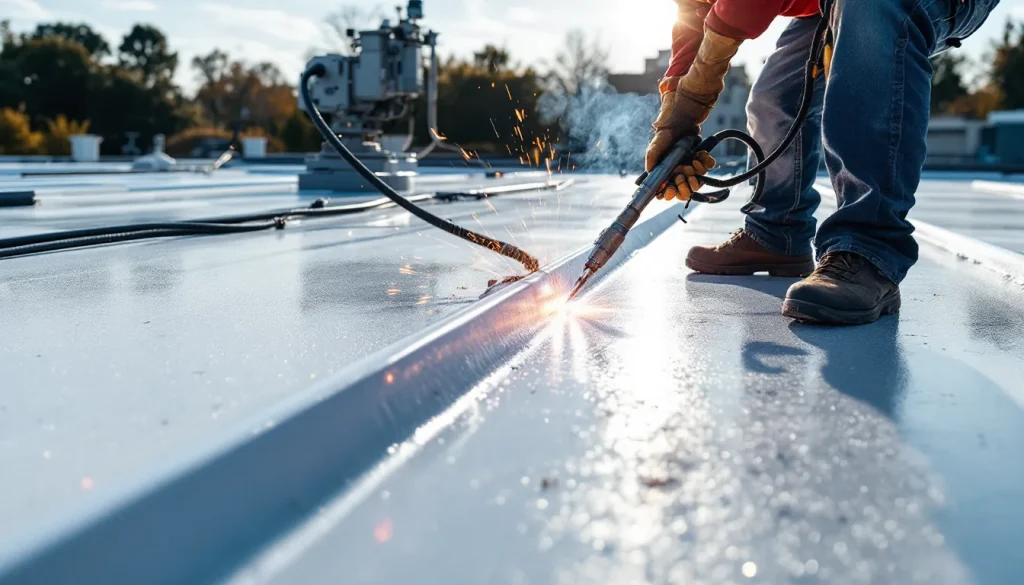
Commercial roof repair (see our commercial roof repair costs by type) in 2026 lives in a wide pricing band that catches building owners off guard. A single tear smaller than two square feet runs $300 to $1,200 on a TPO or EPDM membrane when the deck underneath is dry and the crew can hot-air weld a patch in an afternoon. A 25 square foot section with wet insulation underneath, a failed seam running 60 linear feet, and a drain that needs new flashing? You can be at $8,000 to $12,000 before the truck leaves the parking lot. The job description on the proposal looks similar. The price doesn’t, because labor hours and tear-out scope are where commercial repairs actually live.
This guide breaks repair (see our warehouse roof repair methods) pricing by repair type, walks through how a competent crew diagnoses what they’re looking at on a commercial flat roof repair, and gives you the repair-versus-replace math at the ages and conditions where the call is genuinely close. The honest answer at year 18 on a 60-mil mechanically attached TPO with three patches already on it is usually different than at year 8 on the same system. We’ll show you why.
Commercial roof repair cost by repair type in 2026
Commercial repair pricing breaks down by what the crew actually has to do. The categories below are roughly how a competent project manager scopes a job, and they match how most reroof contractors organize their estimating spreadsheets.
Small membrane patch, under 2 sq ft: $300 to $1,200. A single puncture from a dropped tool or a small mechanical tear gets cleaned, primed (on EPDM) or directly heat-welded (on TPO/PVC), and patched with matching membrane. Most of the cost is the trip charge and minimum labor call, not materials. Same-roof repairs at $300 to $500 typically happen as part of a service-contract visit where the crew is already on site.
Large membrane patch, 3 to 25 sq ft: $1,500 to $5,000. The scope crosses into proper isolation: cutting out the failed section, inspecting the cover board and insulation underneath for moisture, replacing what’s wet, and welding in a properly sized patch with a 6 inch overlap on all four sides. If the insulation tested wet on a moisture probe, you add tear-out and new ISO at $1.50 to $2.00 per square foot. That insulation replacement is where large patches start running over their initial estimate.
Seam reseal, 50 to 200 linear feet: $1,800 to $7,500. Seam failures show up as fishmouths, lifted edges, or thin spots where the original heat weld didn’t bond properly. Reseal work requires cleaning the seam zone, applying a cover strip of new membrane 6 inches wide over the failed area, and welding both sides. Pricing scales with linear footage and how many seams cross penetrations or curbs. Anything over 200 linear feet on a single roof usually signals a systemic problem (poor original install or end-of-life membrane) and the conversation should shift toward overlay or replacement.
Drain flashing repair: $400 to $1,800. The drain bowl gets a new lead or membrane flashing, the clamping ring is reset with new bolts, and the strainer is replaced if it’s corroded. If the deck around the drain has rotted (common with chronic ponding), you add deck repair at $300 to $800 per drain. Drains are the single most common source of interior leaks on a commercial flat roof, and most facility managers learn this after the third tenant complaint from the office directly below one.
Curb and penetration flashing: $500 to $2,500 per penetration. HVAC curbs, plumbing vents, gas lines, conduit penetrations, and equipment supports all need their membrane flashings rebuilt when they fail. A full curb flashing rebuild involves cutting back the failed membrane, installing new uncured EPDM or molded TPO corners, and re-welding to the field membrane. Multiple penetrations on the same roof get priced together with a slight bulk discount. See our breakdown of roof flashing and roof flashing repair for the residential equivalents.
Full membrane overlay (cover board plus new membrane): $4 to $7 per square foot. When repairs cross a threshold (we’ll get to it below), an overlay installs a layer of recovery board (Securock, DensDeck, or HD ISO) over the existing roof followed by a new mechanically attached or fully adhered membrane. The original roof stays in place as a substrate. Pricing depends on cover board choice, membrane thickness, and whether a vapor barrier is needed.
How a competent crew diagnoses commercial leaks
The leak you see inside the building is rarely directly below the leak in the membrane. Water travels along the deck flutes (on metal decks) or along the underside of the cover board until it finds an interior penetration: a conduit, a screw, a deck seam. By the time it shows up as a ceiling tile stain, it has migrated 20 to 80 feet from the entry point. This is why “just patch where it’s wet” almost never solves a commercial leak. Active water intrusion during a storm is a case for 24/7 emergency commercial roof repair, with a permanent fix scheduled once the roof is dry.
Real diagnosis on a low-slope commercial roof involves three steps. First, a visual walk: the crew looks at the membrane in the suspected area for visible defects, checks the nearest penetrations, and inspects the drain pans. Second, a moisture survey if the leak is recurring: infrared (best after sunset when wet insulation holds heat longer than dry), nuclear gauge, or capacitance meter. Third, a flood test on isolated sections if the leak source still isn’t clear.
Smaller shops will skip the moisture survey on jobs under $5,000 and patch the most likely entry point. That’s fine on a one-off leak. If you’re paying for the third repair in 18 months and nobody has done a real moisture survey, you’re paying for guesses, and the cumulative invoice has probably already exceeded what a survey would have cost. A reputable commercial roofer will recommend the survey unprompted when they see repeat repair history. Read our piece on questions to ask a roofing contractor for the diagnostic ones that separate professionals from estimators.
Repair versus replace: the decision tree
The standard rule of thumb is that when annual repair costs exceed 2% of replacement cost for three years running, replacement wins on pure dollars. That rule is fine for a first pass and useless for the actual decision, which depends on roof age, percentage of wet insulation, warranty status, and tax treatment.
Here’s how a sober facility manager actually thinks about it. Under 10 years old: repair almost always wins. The membrane has 10 to 15 years of useful life left, and you’re protecting the manufacturer warranty by using authorized repair methods and authorized installers. Voiding the warranty by using a handyman to “save money” on a $1,500 patch can cost you $80,000 in lost warranty coverage when a larger failure happens at year 14. 10 to 15 years old: case by case. Get a moisture survey. If less than 10% of the insulation is wet and the membrane shows no widespread seam failure, repair. If 15% to 25% is wet or multiple seams are failing, start pricing an overlay. 15 to 20 years old: overlay or full tear-off becomes the rational call for any failure beyond a small patch. Repair money on a 17 year old TPO is increasingly thrown at a problem that’s going to recur next season somewhere else.
Over 20 years old: full replacement, unless the building is going to be demolished or sold within 24 months. The membrane is at or past end of life. Patching is buying weeks, not years. Our guide to flat roof lifespan walks through how the different membrane types actually age, which is the foundation of any honest repair-vs-replace conversation.
The hidden costs that turn a repair into a project
Three line items show up on commercial repair invoices that surprise owners who haven’t done one before. Wet insulation replacement. A 12 sq ft patch with 8 sq ft of wet ISO underneath isn’t a 12 sq ft repair. The crew has to cut back to dry insulation, which usually doubles the affected area. Budget 25% to 40% over the visible-damage size when the survey shows moisture.
Tapered insulation around drains. If the drain repair includes resetting tapered ISO to reestablish slope, you’re at $600 to $1,500 in additional materials per drain. Crews who skip this step end up with ponding right back where it started, which is one of the fastest ways to turn an $1,800 drain flashing repair into a $4,500 callback six months later.
Crane or rigging access. Materials that have to come up by crane (large rolls of membrane, full insulation pallets) add $400 to $1,200 for a half-day crane rental. Roofs with no parapet access or no rooftop elevator, common on warehouse (see our industrial roof repair specifics guide) buildings, force this cost almost every time. Skilled crews coordinate crane time across multiple buildings in a portfolio to spread the cost.
Material differences that change repair tactics
The membrane on the roof dictates how repairs work. TPO: hot-air welded patches, fast, clean, no chemical primers, sensitive to temperature (below 40°F slows welding throughput dramatically). EPDM: seam tape and primer or splice cement, slower than TPO in good weather, more forgiving in cold weather, and easier to spot-fix without specialized equipment. PVC: similar to TPO but welds at slightly different parameters, and crews trained on TPO sometimes overheat PVC seams. Make sure your repair contractor has actually installed the membrane type they’re repairing. Modified bitumen: torch-applied or cold-adhered patches, fire watch required for torch work, longer cure times. See our modified bitumen roof piece for the maintenance characteristics. Built-up roof (BUR, gravel ballast): the most labor-intensive to repair because the gravel has to be cleared, the underlying felts cut and replaced, and new flood coat installed.
One detail that matters: your repair crew should be matching membrane manufacturer and thickness, not just material type. A patch of off-brand 45-mil EPDM on a 60-mil Versico roof technically works but may void the manufacturer warranty on the surrounding membrane.
Insurance, ponding water, and acts of God
Commercial property insurance covers sudden, accidental damage. It does not cover wear, gradual deterioration, or maintenance failures. Hail damage from a documented storm is covered. The same damage discovered six months after the storm, with no claim filed at the time, is almost always denied as “not timely reported.” Roof inspections within 48 to 72 hours of major weather events are the single best way to preserve insurance recovery on commercial policies. Read our guide to filing an insurance claim for roof damage for the documentation chain that holds up under adjuster review.
Ponding water is the exclusion that catches commercial owners off guard. Most policies exclude damage from water that pools for more than 48 hours, on the theory that it’s a design or maintenance problem, not a peril. If your roof has chronic ponding and a section eventually fails, your carrier may treat the underlying water exposure as the proximate cause and deny the claim. The same documentation habit pays off after wind and hail damage, when the claim hinges on proving the roof was sound before the event. This is one reason competent commercial roofers will document drain function and tapered insulation condition every visit.
What a good commercial repair proposal looks like
A serious proposal for commercial repair work shows you four things. One: a written scope of work that names the specific repair locations (by drawing markup or photo), the membrane type and thickness being installed, and the manufacturer of any patch materials. “Repair leaks in the southeast quadrant” is not a scope. Two: a unit-price schedule that says what the cost is per square foot of additional wet insulation if found, per linear foot of additional seam, and per drain if more drains need flashing. This protects you and the contractor from change-order surprise. Three: the contractor’s manufacturer certification for the membrane being repaired, especially if your roof is under a No Dollar Limit warranty (we cover this in our commercial roof warranty guide). Four: a workmanship warranty on the repair itself, typically 1 to 5 years.
The roofing estimate template and roofing contract template we publish for residential work translate directly to commercial. The categories are the same. The numbers are bigger.
Timing the repair against the seasons
Commercial repair work isn’t season-agnostic. TPO and PVC hot-air welding slows below 40°F and stops being reliable below 25°F. EPDM splice cement has a working temperature range that excludes most of January and February in northern climates. Modified bitumen torch work is forbidden in many jurisdictions during dry-vegetation periods (fire watch and permits required). Cold-applied systems extend the season but at higher material cost.
The practical implication: leaks that emerge in December often get a temporary patch (typically a self-adhered membrane patch over the suspect area) followed by a proper repair in April. The temporary patch can run $400 to $1,200 and is essentially a bridge cost. Owners who insist on a permanent repair in mid-winter typically pay 30% to 60% more for crews working in heated tents and end up with a repair whose weld quality is questionable. The better play is usually to budget for the temporary now and the permanent in spring.
Commercial roofs reward owners who treat them as managed assets and punish owners who treat them as ignored infrastructure. The repair invoice you avoid in year 8 by not doing an inspection often shows up as a six-figure tear-off in year 14. Build a relationship with a competent commercial roofer, get on a real inspection schedule (our companion piece on the commercial inspection schedule covers this), and price-shop the work, not the relationship. The roofs that outlive their projected service life by 5 to 10 years are almost always on buildings where the owner did this. The roofs that fail at year 14 instead of year 22 are almost always on buildings where the owner didn’t.