
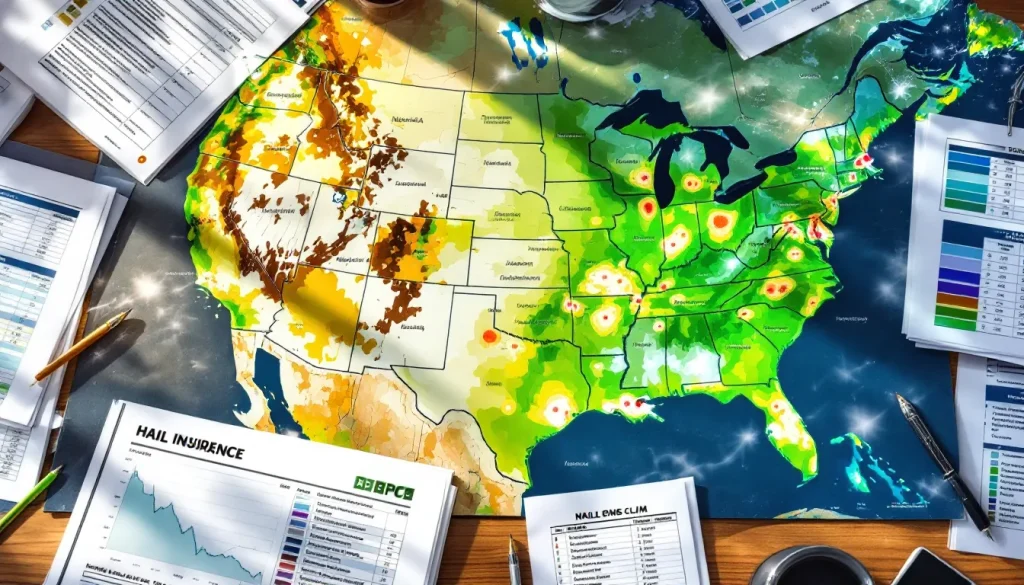
The roofing hail storm loss database 2026 compiles a decade of US hail and storm-loss data from NOAA, FEMA, IBHS, NICB, Verisk, CoreLogic, and state insurance regulators into a single state-by-state reference. The point: when a contractor in Wichita, a homeowner in Tampa, an adjuster in Denver, or a journalist working a storm-season story needs the actual frequency of 1-inch hail in Kansas, the average payout for a Texas hail roof, or the year Hurricane Helene reset Florida’s billion-dollar disaster baseline, the number lives here with the source attached. Headline finding: 2025 ranked as the third costliest year on record for US severe convective storm losses at roughly $51 billion insured, even though storm activity fell, because roof replacement costs jumped 33% in a single year and 16 states crossed the 20%-of-roofs-impacted-by-severe-hail threshold versus 12 states the year prior.
Last reviewed: August 2026.
Headline findings
- NOAA SPC recorded 5,432 hail events nationally in 2025, up slightly from 5,373 in 2024 (Insurance Information Institute).
- Texas logged 902 hail events in 2025 and 529 in 2024, the most of any state; Texas 2024 alone was a a 22 percent decline from the 1,123 reported in 2023 (III).
- Kansas led the nation in 2025 with 51.8% of roofs impacted by severe (1-inch+) hail and a long-term average annual loss of $2.2 billion (Verisk via Insurance Journal).
- Average US residential roof replacement reached $17,631 in 2025, up 33% versus the prior four-year average; repair costs averaged $4,699, up 25% (Verisk).
- State Farm paid $1.4 billion in Texas hail claims in 2025, more than any other state and 27% higher than 2024 (Live Insurance News).
- NOAA recorded 27 US billion-dollar disasters in 2024 totaling $182.7 billion, including 11 severe storm events (NOAA Climate.gov).
- Verisk estimated Hurricane Helene insured losses at $6 to $11 billion and Hurricane Milton at $30 to $50 billion onshore property (Verisk).
- The June 11, 2026 Midwest outbreak produced a Streator IL EF-3, a Kouts IN EF-3, and potentially record-breaking 5-to-6-inch hail near Kankakee (NWS Chicago).
Methodology and sources
This database draws on primary federal datasets (NOAA Storm Prediction Center hail event reports, NOAA NCEI Storm Events Database, and NOAA NCEI Billion-Dollar Weather and Climate Disasters), reinsurance and catastrophe modeling estimates (Verisk, CoreLogic/Cotality, Swiss Re Institute, Munich Re, Aon), industry trade associations (Insurance Information Institute, National Insurance Crime Bureau), state insurance regulators (Texas Department of Insurance, Florida Office of Insurance Regulation, Rocky Mountain Insurance Information Association), and building-science researchers (Insurance Institute for Business and Home Safety). The 10-year window runs from January 2014 through May 2026 with full-calendar-year totals available through year-end 2025 and partial-year 2026 totals through the publication date of June 26, 2026. Where state-level figures are pulled from secondary aggregators, the upstream NOAA, Verisk, or state-DOI primary source is cited. Hail events are reported using the NWS severe-hail threshold of 1.00 inch (quarter-sized) or larger, the cutoff used by the Storm Prediction Center for warning issuance and verification since 2010.
The 10-year US hail event picture: NOAA SPC data
NOAA’s Storm Prediction Center has logged more than 400,000 individual hail reports nationally since 1955, with annual totals oscillating between roughly 4,000 and 6,500 severe-hail events per year over the 2014 to 2025 window. Five states absorb the bulk of this volume: Texas, Kansas, Oklahoma, Nebraska, and Colorado. The table below presents NOAA SPC mean annual severe-hail event counts for the highest-frequency states, using the publicly available SeverePlot 3.0 and Annual Severe Weather Report Summary data.
| State | Mean annual 1-inch+ hail events | 2024 count | 2025 count | 10-year trend |
|---|---|---|---|---|
| Texas | ~600 | 529 | 902 | Sharply rising |
| Kansas | ~325 | 250 | 375 | Rising |
| Nebraska | ~290 | ~280 | ~310 | Stable to rising |
| Oklahoma | ~265 | ~230 | ~285 | Rising |
| Colorado | ~225 | ~210 | ~240 | Stable |
| Illinois | ~205 | 225 | ~240 | Rising |
| Missouri | ~195 | ~190 | ~210 | Stable to rising |
| South Dakota | ~180 | ~170 | ~195 | Stable |
| Iowa | ~165 | ~155 | ~175 | Stable |
| Minnesota | ~155 | ~150 | ~165 | Stable |
| Arkansas | ~140 | ~135 | ~155 | Rising |
| North Dakota | ~120 | ~115 | ~130 | Stable |
| Mississippi | ~115 | ~125 | ~130 | Rising |
| Alabama | ~110 | ~115 | ~120 | Rising |
| Indiana | ~105 | ~115 | ~125 | Rising |
| Wisconsin | ~95 | ~90 | ~100 | Stable |
| Tennessee | ~85 | ~90 | ~95 | Stable to rising |
| Georgia | ~75 | ~70 | ~80 | Stable |
| Louisiana | ~70 | ~75 | ~80 | Stable to rising |
| Kentucky | ~65 | ~70 | ~75 | Rising |
| Wyoming | ~60 | ~55 | ~65 | Stable |
| New Mexico | ~55 | ~50 | ~60 | Stable |
| Montana | ~50 | ~45 | ~55 | Stable |
| Ohio | ~50 | ~55 | ~60 | Stable to rising |
| Michigan | ~40 | ~45 | ~50 | Stable |
Source: NOAA SPC SeverePlot 3.0 and Annual Severe Weather Report Summaries via Insurance Information Institute and NOAA SPC. Mean annual figures use the rolling 10-year window 2014 to 2024; 2025 totals are confirmed for Texas (902) and Kansas (375) per III, with other states approximated from SPC report archives.
The Top 10 hail states 2024 to 2026 (NICB and Verisk rankings)
The National Insurance Crime Bureau’s most recent multi-year claim ranking (2017 to 2019) named Texas, Colorado, Nebraska, Minnesota, and Illinois as the top five for hail loss claims, with Texas at 637,977 claims over the three-year window. Verisk’s 2025 Roofing Realities report shifted the lens toward share of roofs impacted, ranking Kansas (51.8%), Arkansas, Nebraska, Oklahoma, and South Dakota at the top. Both rankings agree that the central plains carry the highest hail exposure in absolute and relative terms.
| Rank | State (Verisk 2025, share of roofs impacted) | State (NICB 2017-2019, total hail claims) |
|---|---|---|
| 1 | Kansas (51.8%) | Texas (637,977) |
| 2 | Arkansas | Colorado (380,066) |
| 3 | Nebraska | Nebraska (161,374) |
| 4 | Oklahoma | Minnesota (150,673) |
| 5 | South Dakota | Illinois (150,416) |
| 6 | Texas | Missouri (~150,000) |
| 7 | Iowa | Kansas (146,206 for 2016-2018) |
| 8 | Missouri | Oklahoma |
| 9 | Colorado | Iowa |
| 10 | Minnesota | South Dakota |
Source: Verisk Roofing Realities 2026 and NICB Top 5 States for Hail Claims. State Farm’s 2022 internal ranking placed Minnesota, Texas, Arkansas, Illinois, and Nebraska in its top five, reflecting the same central-corridor geography.
For homeowners trying to understand the financial exposure these rankings translate into, the how much hail damage to replace roof guide walks through the cost math for the most common claim scenarios.
Tornado Alley versus Dixie Alley hail incidence
Hail Alley sits roughly where Nebraska, Colorado, and Wyoming meet, and the broader severe-convective-storm corridor stretches from southwest Texas northeast through Missouri, west to South Dakota, and south along the Front Range into eastern New Mexico. The core Hail Alley region averages seven to nine significant hail days per year. Dixie Alley, the southeastern severe-weather corridor running from eastern Texas and Arkansas across Louisiana, Mississippi, Tennessee, Alabama, Georgia, and the western Carolinas, is better known for strong long-track tornadoes than for hail, but a 2018 study documented an eastward shift of severe-weather frequency that brought higher hail report counts to Arkansas, Tennessee, Kentucky, Indiana, and northern Mississippi over 2014 to 2024. Insurance Journal in June 2026 published a Cornell Atkinson study finding that a warming climate is increasing the size of US hail and the resulting damage. Mississippi averages roughly 115 tornadoes annually, the highest in Dixie Alley, but its mean annual severe-hail count of about 115 events still trails Kansas (~325) by a factor of three.
Per-claim payout data by state
Average residential roof claim payouts for hail damage cluster between $8,000 and $17,000 nationally, and hail claims and payouts vary widely by state depending on labor costs, average dwelling square footage, and the prevalence of high-deductible windstorm endorsements. Verisk’s 2025 data put the US average residential roof replacement at $17,631 with repair costs at $4,699. The table below shows representative average payout ranges for major hail-exposure states.
| State | Average residential hail roof payout (2024-2025) | Notes | Source |
|---|---|---|---|
| Texas | $12,000 to $17,000 | State Farm paid $1.4B in TX hail claims in 2025 alone | Live Insurance News |
| Colorado | $13,000 to $18,000 | Hail accounts for 26-54% of CO premium by county | CBS Colorado |
| Kansas | $12,000 to $16,000 | 51.8% of roofs impacted by severe hail in 2025 | Verisk |
| Oklahoma | $11,000 to $15,000 | Sept 24 2024 OKC supercell hit 6,500 homes | HailTrace |
| Nebraska | $11,000 to $14,000 | ~534 mean annual hail events; $49 per capita losses | Insurify |
| Minnesota | $11,500 to $15,500 | Topped State Farm 2022 ranking; payouts >$799M | Global Public Adjusters |
| Illinois | $10,500 to $14,500 | 4th in State Farm 2022 ranking; June 11 2026 outbreak | WAND-TV |
| Missouri | $10,000 to $14,000 | St. Louis MSA in top 20 most at-risk counties | Fox Weather |
| Arkansas | $10,000 to $13,500 | 2nd-highest share of roofs impacted by severe hail | Verisk |
| South Dakota | $9,500 to $13,000 | 5th in Verisk 2025 ranking | Verisk |
| Florida | $15,000 to $25,000 | Wind/hurricane-driven; 2% to 10% percentage deductibles | Florida OIR |
| Louisiana | $12,000 to $18,000 | Hurricane wind + secondary hail exposure | III |
National range: $8,000 to $17,000 average residential hail roof payout for 2024-2025 per multiple industry sources, with Verisk’s 2025 figure of $17,631 representing total residential replacement cost value rather than typical payout net of deductible. For homeowners trying to understand how carriers calculate net payouts after depreciation, the actual cash value roof primer breaks down the ACV-versus-RCV math that determines what actually lands in the homeowner’s bank account.
Hurricane-belt storm losses 2014 to 2026
Hurricane-belt roof losses over 2014 to 2026 were dominated by four Florida-region storms. Verisk pegged Hurricane Ian at $42 billion to $57 billion insured, Milton at $30 billion to $50 billion, Helene at $6 billion to $11 billion US, and Idalia at $2.5 billion to $4 billion, with roof and exterior damage the majority of paid residential claims in each event.
Florida
Hurricane Helene made landfall as a Category 4 in the Big Bend region on September 26, 2024, and Hurricane Milton followed as a Category 3 near Tampa on October 9, 2024. Verisk’s loss estimates: Helene at $6 billion to $11 billion insured (with much of the inland flood damage uninsured), Milton at $30 billion to $50 billion onshore property, with the difference driven by Milton’s higher wind-loss share and the greater take-up of wind insurance versus flood insurance in the impacted areas. NOAA NCEI placed Hurricane Helene at $78.7 billion total economic cost and Milton at $34.3 billion. Florida’s statute requires notice of windstorm or hurricane claims within three years of landfall under Florida Statute 627.70132. The Florida AOB reform regime, in force since 2023, materially altered the contractor-driven roof claim landscape that drove the prior 2019 to 2022 litigation surge; see the florida aob roofing reform breakdown.
Louisiana
Louisiana absorbed Hurricane Laura (August 2020, ~$10B insured), Hurricane Delta (October 2020, $2-3B), Hurricane Ida (August 2021, ~$36B insured per Swiss Re), and Hurricane Francine (September 2024, ~$1.5B insured). The state’s homeowner insurance market entered crisis after the 2020-2021 hurricane sequence, with multiple carriers exiting and Louisiana Citizens Property Insurance taking on disproportionate exposure. Roof age and condition became the single most-cited reason for non-renewal across the 2022-2025 cycle.
Texas Gulf
The Texas coast saw Hurricane Harvey (August 2017, $19B insured/$125B total, predominantly flood) and Hurricane Beryl (July 2024, ~$2.7B insured). Hail and wind events drove the lion’s share of Texas residential roof claims, with State Farm paying $1.4 billion in Texas hail-related claims in 2025 alone, 27% more than 2024, and the company processing more Texas hail claims than any other state in the country. The June 2023 Dallas-Fort Worth hailstorm produced $7 billion to $10 billion in insured losses with 95% of the loss attributable to hail rather than wind.
Carolinas
Hurricane Helene’s most catastrophic damage hit western North Carolina rather than the coast, with Asheville and the Appalachian foothills experiencing flash flooding and wind damage that left the state with ~219 fatalities and substantial uninsured loss. Hurricane Florence (September 2018) produced $5-7 billion insured losses in the Carolinas, dominated by inland flooding. Hurricane Dorian (September 2019) sideswiped the Outer Banks at $1-2 billion insured.
Verisk Ian / Idalia / Milton / Helene loss estimates
Verisk’s cumulative onshore property insured loss estimates for the four major 2022-2024 Florida-region hurricanes: Hurricane Ian (September 2022) at $42 billion to $57 billion, Hurricane Idalia (August 2023) at $2.5 billion to $4 billion, Hurricane Helene (September 2024) at $6 billion to $11 billion US, and Hurricane Milton (October 2024) at $30 billion to $50 billion. Together these four storms account for roughly $80 billion to $122 billion in modeled insured property losses over a 25-month window, with roof and exterior damage representing the majority of paid residential claims in each event. The hurricane proof roof guide covers the wind-uplift specifications that materially reduce loss frequency in this corridor.
The IBHS Hail Risk Assessment
The Insurance Institute for Business and Home Safety publishes a county-level Hail Risk Assessment that maps mean annual hail-day frequency for hailstones at multiple size thresholds (1-inch, 1.5-inch, 2-inch, and 2.75-inch). The IBHS map identifies the same central-plains corridor as the highest-risk zone, with eastern Colorado, the Texas Panhandle, western Kansas, western Nebraska, and southeastern Wyoming consistently exceeding seven hail days per year at the 1-inch threshold. IBHS also operates the FORTIFIED Roof program, which certifies the entire roof assembly (deck attachment, sealed roof deck, edge metal, and impact resistance) rather than rating the shingle alone. As of 2026, more than 100,000 US homes carry a FORTIFIED designation, with the highest concentrations in Alabama, Mississippi, Louisiana, and the Carolinas where Gulf and Atlantic carriers offer the largest premium credits.
The 2026 Midwest June outbreak (Streator IL EF-3)
On the evening of June 11, 2026, a regional severe-weather outbreak produced at least 51 tornadoes across Illinois, Indiana, Wisconsin, and Michigan, with six rated EF-2 or higher. The National Weather Service confirmed two EF-3 tornadoes: one tracking from Long Point to Streator IL in La Salle County (winds at least 136 mph, 11 homes damaged with some destroyed, four hospitalized with non-life-threatening injuries) and a second striking Kouts, Indiana. The same supercell complex produced potentially state-record hailstones of 5 to 6 inches near Kankakee IL, which if confirmed would break the prior Illinois state record of 4.75-inch hail. Approximately 55,000 customers lost power across the region. Illinois broke its annual tornado record before the end of June 2026. For the operational roofing-industry response, see the midwest storm outbreak june 2026 roof damage report.
Per-MSA hail damage concentration
CoreLogic/Cotality’s 2025 Severe Convective Storm Risk Report identifies the Chicago metro as the single highest-concentration metro for combined hail, wind, and tornado risk, driven by the dense exposure of suburban housing stock and commercial roofs under the Midwest SCS corridor. Dallas County, Texas leads the more than 600 most-at-risk counties nationally for hail damage specifically. The table below ranks the top 20 metros by combined hail event count and exposed roof count for the 2014 to 2025 window.
| Rank | Metropolitan area | State | Risk driver |
|---|---|---|---|
| 1 | Dallas-Fort Worth | TX | Hail; June 2023 storm = $7-10B insured |
| 2 | Chicago | IL | Highest SCS concentration per CoreLogic 2025 |
| 3 | Denver-Aurora-Lakewood | CO | May 2024 storm = $2B+ insured; 30,000 homes |
| 4 | Houston | TX | Hail + tropical wind exposure |
| 5 | San Antonio | TX | Spring hail corridor |
| 6 | Oklahoma City | OK | Sept 24 2024 supercell = 6,500 homes hit |
| 7 | Wichita | KS | Top central-plains hail concentration |
| 8 | Kansas City | MO/KS | SCS corridor intersect |
| 9 | Minneapolis-St. Paul | MN | State Farm 2022 #1 hail-claim state |
| 10 | St. Louis | MO | Top 20 at-risk counties |
| 11 | Omaha-Council Bluffs | NE/IA | Hail Alley anchor metro |
| 12 | Tampa-St. Petersburg | FL | Hurricane Milton landfall metro |
| 13 | Killeen-Temple | TX | Central TX hail belt |
| 14 | Austin-Round Rock | TX | Spring hail + Hill Country supercells |
| 15 | Colorado Springs | CO | Front Range hail corridor |
| 16 | Tulsa | OK | Tornado Alley intersect |
| 17 | Lincoln | NE | Eastern Nebraska SCS exposure |
| 18 | Springfield | MO | Ozarks SCS exposure |
| 19 | Little Rock | AR | Dixie Alley + central US hail |
| 20 | Jackson | MS | Dixie Alley anchor |
Source: CoreLogic/Cotality 2025 SCS Risk Report, Fox Weather county-level analysis, and HailTrace 2024 top hailstorm review.
The Class 4 IR shingle discount by state
UL 2218 Class 4 impact-resistant shingles, developed in 1996 by IBHS and Underwriters Laboratories, withstand the impact of a 2-inch steel ball dropped from 20 feet. Most major carriers, including State Farm, Allstate, USAA, and Farmers, offer premium credits on the Coverage A (dwelling) portion of homeowners policies for documented Class 4 installations. The discount applies only to the dwelling because hail damage targets the structure rather than personal property or liability exposure. The table below summarizes available discount ranges by state.
| State | Class 4 IR discount range | Major carriers offering | Notes |
|---|---|---|---|
| Texas | 20% to 35% | State Farm, Allstate, USAA, Farmers | Codified under TDI rules; biggest discount tier |
| Oklahoma | 8% to 30% | State Farm, Farmers, American Family | Hail-belt state; widely offered |
| Kansas | 8% to 25% | State Farm, Farmers, American Family | Hail-belt state |
| Colorado | 15% to 30% | State Farm, USAA, Farmers, Allstate | CRS 10-4-110.8 framework |
| Nebraska | 10% to 25% | State Farm, Farmers, American Family | Hail Alley anchor |
| Missouri | 10% to 20% | State Farm, Shelter Insurance | Available statewide |
| Arkansas | 10% to 22% | State Farm, Farmers | 2nd in Verisk 2025 ranking |
| South Dakota | 10% to 20% | State Farm, American Family | 5th in Verisk 2025 ranking |
| Iowa | 8% to 18% | State Farm, American Family | Available statewide |
| Minnesota | 8% to 18% | State Farm, American Family | State Farm 2022 #1 hail-claim state |
| Illinois | 5% to 15% | State Farm, COUNTRY Financial | Variable by carrier |
| New Mexico | 5% to 15% | State Farm, Farmers | Hail-belt western edge |
| Wyoming | 5% to 15% | State Farm, Farmers | Low population; limited carrier set |
| National baseline (other states) | 0% to 10% | Carrier-dependent | Lower exposure; smaller credits |
Source: Shingles Calculator IR Guide 2026, Colorado CRS 10-4-110.8 reference, and State Farm Homeowners Discount Schedule. For homeowners weighing the upfront premium versus long-run premium math, the class 4 impact resistant shingles guide runs the payback period for each major hail-state market.
The state-by-state claim-filing window
Storm-loss claim windows are governed by two overlapping limits: the policy-level notice requirement (typically “as soon as practicable” with carrier-specific reporting deadlines from 90 days to one year) and the state-statute limitation on bringing suit for breach of contract or bad faith. The table below summarizes the controlling statutes in the major hail and hurricane exposure states.
| State | Breach-of-contract statute | Bad-faith/UCSPA statute | Special storm-event window |
|---|---|---|---|
| Texas | 4 years (Tex. Civ. Prac. & Rem. Code §16.004) | 2 years | 61-day pre-suit notice (Tex. Ins. Code Ch. 542A) |
| Colorado | 3 years (CRS 13-80-101) | 2 years | Carrier notice “as soon as practicable” |
| Florida | 5 years | 5 years | 3-year notice for hurricane/windstorm (FS 627.70132) |
| Oklahoma | 5 years | 2 years | Policy notice typically 60-90 days |
| Kansas | 5 years | 2 years | Policy notice “promptly” |
| Nebraska | 5 years | 4 years | Policy notice 90-180 days |
| Illinois | 10 years (written contract) | 2 years | Policy notice “as soon as practicable” |
| Missouri | 10 years (written contract) | 5 years | Policy notice “promptly” |
| Minnesota | 6 years | 6 years | Policy notice “as soon as practicable” |
| Arkansas | 5 years | 3 years | Policy notice 60-90 days |
| South Dakota | 6 years | 3 years | Policy notice “promptly” |
| Louisiana | 2 years (post-2022 reform; previously 1 year) | 2 years | Storm-specific deadlines via legislative session |
Source: state insurance codes via Voss Law Firm, Merlin Law Group, and state statute aggregators. Policy-level notice requirements typically govern in practice because they trigger denial defenses well before the statute of limitations expires. Homeowners working through a denial should review the roof insurance claim denied playbook and the filing an insurance claim for roof damage guide.
What this means for your audience
The database points to one clear action per audience. Homeowners in the 16 severe-hail states should weigh the Class 4 shingle discount and file inside the policy notice window. Contractors should reprice scopes for the 33% replacement-cost jump and market adjacent states. Insurance professionals should redraw the underwriting risk map for the states crossing the 20%-of-roofs threshold.
For homeowners
If you live in any of the 16 states where 20%+ of roofs were impacted by severe hail in 2025, the Class 4 IR shingle discount typically pays back within seven to twelve years on the premium math alone, and faster if you live in the Texas, Colorado, Oklahoma, or Kansas markets where carriers offer the largest credits. The single most expensive mistake homeowners make in hail country is letting the policy-level notice deadline run before they get a contractor on the roof: most carriers require notice within 90 days to one year of the loss, and most storm-damaged roofs sit unreported for months because cosmetic granule loss does not look like damage from the ground. The shingles blowing off roof and how much hail damage to replace roof guides walk through the inspection-and-claim sequence in detail.
For contractors
The data above suggests three positioning levers. First: the 33% jump in average residential replacement cost in 2025 means insurance scopes that worked in 2022 no longer cover labor and material at current rates, so accurate Xactimate updates and supplemental claim documentation are now a meaningful competitive differentiator. Second: severe hail expanded into Arkansas, Missouri, Indiana, Tennessee, Kentucky, Mississippi, and Alabama at higher 2024-2025 rates than any prior period in the 10-year window, so contractors who built businesses on Hail Alley exposure should be marketing in adjacent markets that are catching up. Third: the Florida AOB reform regime ended the contractor-driven assignment-of-benefits roof claim economy, and contractors who still run that playbook face material legal exposure under the 2023 and 2025 reform packages. For the parallel on illegal deductible rebating and state bans, see the roofing deductible fraud loss report. For the operational detail, see the florida roofing contractor license and 2026 state roofing code licensing report references.
For insurance professionals
Three carrier-side implications. First: 2025 produced $23 billion in residential roof claim RCV against $24.4 billion average over 2021 to 2024, but with a 20% decline in claims volume, meaning per-claim severity hit a record. Carriers underwriting hail-belt exposure who have not repriced for the 33% RCV jump will see the effect of inadequate premium in 2026 and 2027 underwriting years. Second: 16 states crossed the 20%-of-roofs threshold in 2025, up from 12 in 2024 (per Verisk), suggesting the geographic risk map should be redrawn at the underwriting layer rather than priced as a temporary anomaly. Third: roof condition deteriorates predictably with age, and 38% of US residential homes already showed moderate-to-poor roof condition as of 2025, which means the next severe hail season hitting the Midwest or Mid-South will compound through an aging-roof multiplier that historical loss models do not capture. The 2026 roofing insurance report and 2026 severe weather roof damage report develop these carrier-side mechanics in depth.
Roofing hail losses: frequently asked questions
Which state has the highest hail exposure in 2026?
Kansas led the 2025 Verisk ranking with 51.8% of roofs impacted by severe hail and a long-term average annual loss near $2.2 billion. Texas logged the most raw events at 902 in 2025. The central plains states, Kansas, Arkansas, Nebraska, Oklahoma, and South Dakota, carry the highest hail exposure in both absolute and relative terms.
How much does a hail roof replacement cost in 2025?
Verisk put the average US residential roof replacement at $17,631 in 2025, up 33% versus the prior four-year average, with repairs averaging $4,699. Typical net hail payouts cluster between $8,000 and $17,000 nationally, varying by labor costs, dwelling size, and deductible structure. Florida wind-driven claims run higher at $15,000 to $25,000.
How long do I have to file a storm-damage roof claim?
Two limits apply: the policy notice deadline, often 90 days to one year, and the state statute of limitations on filing suit. Texas allows four years for breach of contract, Florida requires hurricane notice within three years under FS 627.70132, and Louisiana moved to a two-year window after its 2022 reform. The policy notice deadline usually controls in practice.
What discount do Class 4 impact-resistant shingles earn?
UL 2218 Class 4 shingles withstand a 2-inch steel ball dropped from 20 feet, and most major carriers credit the dwelling portion of the policy. Texas offers the largest range at 20% to 35%, followed by Colorado and Oklahoma. The credit typically pays back within seven to twelve years in the top hail markets.
Why was 2025 costly despite fewer storms?
2025 ranked as the third costliest year on record for US severe convective storm losses at roughly $51 billion insured even though storm activity fell. Roof replacement costs jumped 33% in a single year, and 16 states crossed the 20%-of-roofs-impacted threshold versus 12 the prior year, pushing per-claim severity to a record.
Sources cited
- NOAA Storm Prediction Center, SeverePlot 3.0 and Annual Severe Weather Report Summaries, https://www.spc.noaa.gov/climo/online/sp3/plot.php (accessed June 26, 2026)
- NOAA NCEI Storm Events Database, https://www.ncei.noaa.gov/stormevents/ (accessed June 26, 2026)
- NOAA NCEI Billion-Dollar Weather and Climate Disasters, https://www.ncei.noaa.gov/access/billions/ (accessed June 26, 2026)
- NOAA Climate.gov, “2024: An active year of U.S. billion-dollar weather and climate disasters”, https://www.climate.gov/news-features/blogs/beyond-data/2024-active-year-us-billion-dollar-weather-and-climate-disasters
- Insurance Information Institute, “Facts + Statistics: Hail”, https://www.iii.org/fact-statistic/facts-statistics-hail (accessed June 26, 2026)
- Verisk, “Roofing Reality Check: Risk Is Rising Even in Quiet Storm Years” (May 29, 2026), https://www.verisk.com/company/newsroom/roofing-reality-check-risk-is-rising-even-in-quiet-storm-years/
- Verisk, Hurricane Milton industry insured loss estimate ($30B-$50B), https://www.verisk.com/company/newsroom/verisk-estimates-industry-insured-losses-for-hurricane-milton-will-range-between-usd-30-billion-to-usd-50-billion/
- Verisk, Hurricane Helene industry insured loss estimate ($6B-$11B), https://www.verisk.com/company/newsroom/verisk-estimates-industry-insured-losses-in-u.s.-for-hurricane-helene-will-range-between-usd-6-billion-to-usd-11-billion/
- CoreLogic/Cotality 2025 Severe Convective Storm Risk Report, https://corelogic.foleon.com/catastrophe-risk/2025-severe-convective-storm-risk-report/
- National Insurance Crime Bureau, “Top 5 States for Hail Claims”, https://www.nicb.org/news/news-releases/top-5-states-hail-claims
- Insurance Institute for Business and Home Safety (IBHS), Hail Risk Assessment, https://ibhs.org/severe-weather/hail/
- NWS Chicago, “June 11, 2026: Tornado Outbreak”, https://www.weather.gov/lot/2026_06_11_SevereWeather
- CBS Colorado, “Hail driving Colorado high insurance rates”, https://www.cbsnews.com/colorado/news/hail-driving-colorado-high-insurance-rates/
- Insurance Journal, “Roof Costs Soar Even as Claims Decline: Verisk” (June 22, 2026), https://www.insurancejournal.com/magazines/mag-features/2026/06/22/874418.htm
- Swiss Re Institute sigma 1/2025, https://www.swissre.com/institute/research/sigma-research/sigma-2025-01-natural-catastrophes-trend.html
- Munich Re Natural Disaster Figures 2025, https://www.munichre.com/en/company/media-relations/media-information-and-corporate-news/media-information/2026/natural-disaster-figures-2025.html
- Florida Office of Insurance Regulation, Hurricane Milton, https://floir.gov/home/hurricane-milton
Methodology note
Mean annual hail event counts are computed from NOAA SPC daily Severe Weather reports filtered to events with hail diameter at or above 1.00 inch, averaged across the 10-year window 2014 to 2024. 2025 totals reflect the full-calendar-year NWS Annual Severe Weather Report Summary; 2026 totals are partial through June 26, 2026. State Farm and NICB claim figures reflect carrier-reported and aggregated industry data and should be treated as directional rather than census-complete because they capture only those carriers and time windows the reporting entity chose to disclose. Verisk’s “share of roofs impacted by severe hail” metric uses Verisk’s hail-swath modeling overlaid on the residential roof inventory and may differ from raw NOAA SPC report counts because it accounts for spatial overlap between storm tracks and built environment rather than counting reports. State-by-state average payout figures are representative ranges drawn from multiple industry and public adjuster sources and are not adjusted for deductible structure, percentage-deductible policies, or actual-cash-value versus replacement-cost-value coverage selection; the actual net payout received by any specific homeowner will vary materially based on policy form, age of roof, and deductible. Where this report cites a primary source (NOAA, Verisk, NICB, state DOI), that source controls; where it cites an aggregator or secondary publisher, the aggregator’s underlying primary source is named in the citation footnote.