
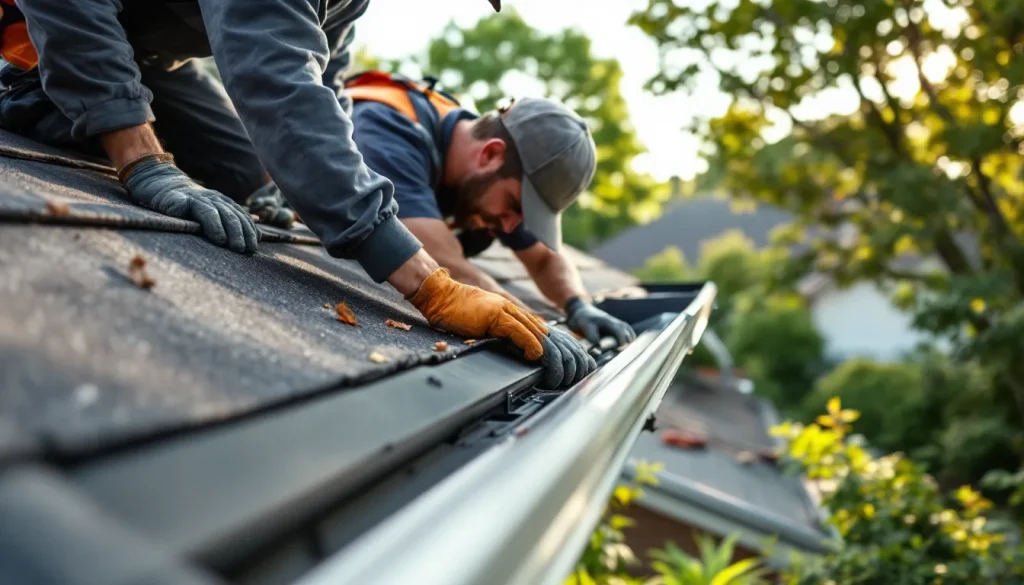
Gutter installation cost (see our rain gutter cost and options) in 2026 ranges from $4 to $15 per linear foot installed, putting a typical 200-linear-foot home install between $800 and $3,000. The 4x cost spread depends on material (aluminum vs copper vs vinyl), gutter style (K-style vs half-round), one-piece versus sectional construction, downspout count, and regional labor rates. The most common 2026 install (5-inch one-piece aluminum K-style with 3 downspouts on a 2,000-square-foot home) runs $1,200 to $2,000 fully installed. Premium copper on the same house runs $5,000 to $9,000. The math below breaks out cost per linear foot, material decisions, installation labor, and ROI on gutter guards, plus when DIY actually makes sense.
The short version
- Aluminum one-piece: $5 to $9 per linear foot installed. The 80% case.
- Copper: $20 to $40 per linear foot installed. The premium case.
- Vinyl: $3 to $6 per linear foot. The budget case; lasts 10 to 15 years vs 30+ for aluminum.
- One-piece beats sectional on every measure except DIY-ability. One-piece requires a truck-mounted roll former.
- Downspouts cost $35 to $80 each in materials, plus install labor. Plan one downspout per 30 to 40 linear feet.
- Gutter guards (LeafGuard, Gutter Helmet, mesh inserts) add $7 to $30 per linear foot and pay back in 3 to 8 years.
The short answer: cost per linear foot
Gutter pricing is almost always quoted per linear foot installed, which bundles material, labor, downspouts (sometimes), and minor flashing work. The table below is built from 2026 RSMeans data, NAHB regional cost reports, and contractor pricing in the top 50 metro markets.
| Material | Material cost/lf | Installed cost/lf | Typical lifespan | 200 lf install total |
|---|---|---|---|---|
| Vinyl | $1.50-3.00 | $3-6 | 10-15 years | $600-1,200 |
| Aluminum (sectional) | $2.00-3.50 | $4-7 | 20-30 years | $800-1,400 |
| Aluminum (one-piece) | $3.00-5.00 | $5-9 | 25-35 years | $1,000-1,800 |
| Steel (galvanized) | $3.50-6.00 | $6-12 | 20-30 years | $1,200-2,400 |
| Steel (galvalume) | $5.00-8.00 | $9-14 | 30-40 years | $1,800-2,800 |
| Copper | $12.00-22.00 | $20-40 | 50-100 years | $4,000-8,000 |
| Zinc | $15.00-25.00 | $22-45 | 60-100 years | $4,400-9,000 |
Note: “200 linear feet” is roughly the gutter run on a 2,000-square-foot single-story home with simple rooflines. Two-story or complex-roofline houses can have 250 to 400 linear feet.
Aluminum gutters (most common, $5 to $9 per linear foot)
Aluminum is the default residential gutter material in 2026, accounting for roughly 70% of all new installs. The reasons are practical: aluminum doesn’t rust, holds paint and powder coating, comes in 25+ colors, and works well with roll-formed one-piece installation. The downside is dent susceptibility (a falling branch dents aluminum where it would bounce off steel) and color fade on premium dark finishes.
Aluminum gauge selection
- .025 gauge (cheap/builder grade): $4 to $6 per linear foot. Dents easily. Often used on production housing. Realistic life under 20 years in hail zones.
- .027 gauge (standard contractor grade): $5 to $7 per linear foot. The middle of the market. 25 to 30 year life.
- .032 gauge (premium): $6 to $9 per linear foot. Resists denting and warping. 30 to 35 year life. Worth the upgrade in hail zones (TX, OK, KS, CO).
Color and finish
Standard mill-finish aluminum is the cheapest option. Baked-on Kynar-coated colors (white, brown, bronze, black, and 20+ designer colors) add $0.50 to $1.50 per linear foot but extend functional life and don’t chalk or fade as quickly.
Copper gutters (premium, $20 to $40 per linear foot)
Copper is the premium residential gutter material, used on architecturally significant homes, historic restorations, and high-end new builds. Cost is 4x to 5x aluminum, but lifespan is 2x to 3x and the patina aesthetic is genuinely unmatched.
Why copper costs so much
- Raw material cost: copper traded at $4.50 to $5.50 per pound through 2025-2026. A 6-inch K-style copper gutter weighs about 1.0 pound per linear foot.
- Specialized fabrication: copper gutters are typically hand-soldered at joints. Few crews are trained on this.
- Heavy-gauge requirement: most copper is installed at 16 oz or 20 oz (.0216 or .0270 inch), thicker than aluminum.
- Lower labor pool: copper gutter crews are 10% to 20% of the total install workforce, so labor commands premium rates.
When copper actually makes sense
- Historic preservation districts requiring copper
- Premium homes where the architectural premium is part of the build
- Owners with 50+ year time horizons on the property
- Houses with copper-detailed flashing, finials, or roofing where matching the system makes sense
Steel gutters (industrial use, $6 to $14 per linear foot)
Steel gutters split into two markets. Galvanized steel ($6 to $12 per linear foot installed) is durable and dent-resistant but rusts at any breach in the zinc coating. Galvalume (zinc-aluminum coated steel, $9 to $14 per linear foot) is more rust-resistant and is the steel grade typically specified on commercial buildings and standing seam metal roof homes for color match.
Steel is heavier than aluminum (about 2x), which makes it harder to install but also more dent-resistant. In high-hail markets, steel gutters can outlast aluminum by 5 to 10 years. The tradeoff is more fastener stress on the fascia and more weight on the hangers.
Vinyl gutters (budget, $3 to $6 per linear foot, shortest life)
Vinyl gutters are the budget option: sold by big-box stores in 10-foot sections, snap-together connectors, and a DIY-friendly install process. Materials cost is $1.50 to $3 per linear foot, total installed cost $3 to $6 per linear foot.
What you give up
- Lifespan: 10 to 15 years vs 25 to 35 for aluminum. UV embrittles vinyl over time.
- Cold weather brittleness: vinyl cracks in deep freezes. Not recommended above the 40th parallel.
- Sectional only: no one-piece option. Every joint is a future leak risk.
- Limited color: white and brown are the standard offerings; no factory paint options.
- Resale value: appraisers and inspectors flag vinyl as a downgrade on otherwise-quality homes.
Vinyl makes sense for rental properties, outbuildings, and DIY budget projects. For owner-occupied homes, the 10-year life gap means you’ll install gutters 2 to 3 times in the life of the house instead of once.
K-style vs half-round gutters
K-style and half-round are the two dominant residential gutter profiles. K-style accounts for 85%+ of U.S. residential installs. Half-round is more common on historic, European-style, and architecturally specified homes.
| Feature | K-style | Half-round |
|---|---|---|
| Profile | Flat back, decorative front | Semicircular cross-section |
| Water capacity (5-inch) | ~7,200 sq ft drainage | ~5,600 sq ft drainage |
| Self-cleaning | Decent (debris catches in inner curve) | Excellent (smooth radius) |
| Cost premium | Baseline | +30% to +60% |
| Material availability | All materials | Mostly copper and aluminum |
| Visual style | Modern, transitional | Historic, traditional, European |
For most homes, K-style is the right answer. Half-round is worth specifying on historic properties, copper installations, and houses where the architectural detail is part of the aesthetic plan.
One-piece vs sectional (and why one-piece matters)
One-piece gutters are formed on-site from a single coil of aluminum or steel using a truck-mounted roll former. The gutter has no seam along its entire length (typically up to 60 to 80 feet per run). Sectional gutters are pre-cut in 10-foot sections and connected with mechanical joints sealed with caulk.
Why one-piece wins
- Fewer leak points. Sectional gutters leak at joints. One-piece only leaks at corners and downspout outlets.
- Faster install. A 2-person crew can install a typical one-piece system in 4 to 6 hours. Sectional takes 8 to 12.
- Better appearance. No visible joints along the run.
- Custom-length runs. The gutter is sized exactly to the run, no joining of cut pieces.
- Longer life. Sealant joints fail in 5 to 10 years. One-piece doesn’t have them.
When sectional still makes sense
- DIY install (you can’t transport a roll former to your driveway)
- Very small jobs (under 40 linear feet)
- Vinyl-only specifications
- Repair or extension of existing sectional systems
Downspout sizing and count
Downspouts are sized to drain the gutter capacity. Undersized or undercount downspouts cause overflow, which sends water back under the roof drip edge and into the fascia.
Sizing guidance
| Roof area drained | Gutter size | Downspout size | Downspouts per run |
|---|---|---|---|
| Up to 500 sq ft | 5-inch K-style | 2×3 inch | 1 per 35 lf |
| 500-1,200 sq ft | 5-inch K-style | 3×4 inch | 1 per 40 lf |
| 1,200-2,400 sq ft | 6-inch K-style | 3×4 inch | 1 per 40 lf |
| 2,400+ sq ft | 6-inch or 7-inch | 4×5 inch round | 1 per 30 lf |
Downspouts cost $35 to $80 each in materials and $30 to $60 each in install labor. A typical 200-linear-foot install gets 5 to 7 downspouts. Underspec’d downspouts are one of the most common 2026 install defects.
Gutter guards: LeafGuard, Gutter Helmet, mesh inserts
Gutter guards have become the fastest-growing product category in residential gutters since 2020. The promise is simple: install guards once and never clean gutters again. The reality is more nuanced. Premium guards (LeafGuard, Gutter Helmet, Leaf Filter) work well on most debris. Cheap mesh inserts can clog with fine pine needles and oak tassels.
| Guard type | Cost installed (per lf) | Effectiveness | Maintenance |
|---|---|---|---|
| Mesh insert (DIY drop-in) | $1-3 | Fair | Annual clean |
| Micromesh stainless (Leaf Filter, etc.) | $8-22 | Very good | Annual rinse |
| Reverse curve (Gutter Helmet, Gutterglove) | $10-25 | Good | Annual inspect |
| Integrated hood (LeafGuard one-piece) | $15-30 | Very good | Minimal |
| Foam insert | $1-3 | Poor (degrades fast) | Replace in 2-3 yrs |
Gutter guard ROI math
Premium guard installation typically costs $1,500 to $5,000 on a 200-linear-foot home. Annual gutter cleaning runs $200 to $600. Payback is 3 to 8 years, assuming you would otherwise hire out cleaning. If you DIY clean for free, payback can stretch to 15+ years and isn’t worth it on pure cost.
The non-cost case for guards is protection. A clogged gutter causes water to back up under the drip edge, into the fascia, and eventually into the attic. Repair cost for fascia and soffit rot runs $2,000 to $8,000. One avoided rot event pays for the guard system.
Labor cost vs materials cost split
On a typical 2026 aluminum one-piece install, labor is roughly 60% of total cost and materials are 40%. For copper, labor drops to 30% to 40% because the material itself is so expensive. For vinyl DIY, labor is essentially zero and materials are 100%.
| Project type | Material % | Labor % |
|---|---|---|
| Vinyl DIY | 100% | 0% |
| Vinyl pro install | 40-50% | 50-60% |
| Aluminum one-piece | 40% | 60% |
| Steel | 45% | 55% |
| Copper | 60-70% | 30-40% |
| Gutter guards (added to existing) | 30% | 70% |
Regional cost variation
Gutter installation costs vary 30% to 50% by region in 2026, driven primarily by labor markets. RSMeans 2025 data and contractor surveys put the regional spread at:
| Region | Cost index (US avg = 1.00) | Aluminum one-piece per lf |
|---|---|---|
| San Francisco Bay Area | 1.45 | $8-12 |
| NYC / Boston metro | 1.35 | $7-11 |
| LA / Seattle metro | 1.25 | $7-10 |
| Chicago / Denver / Atlanta | 1.05 | $6-9 |
| Texas metros (DFW, Houston, Austin) | 0.95 | $5-8 |
| Southeast (Charlotte, Raleigh, Nashville) | 0.90 | $5-8 |
| Midwest small metros | 0.85 | $5-7 |
| Rural areas | 0.80 | $4-7 |
Removal of old gutters (typical $1 to $3 per linear foot)
Removing existing gutters before a new install typically runs $1 to $3 per linear foot, or $200 to $600 on a 200-linear-foot job, one of the line items covered in our gutter replacement cost breakdown. Most contractors bundle removal into the install quote rather than charging separately. Confirm this in writing before signing.
What’s usually NOT bundled: disposal of the old gutter material (typically $50 to $150 dump fee), fascia repair if rot is found during removal ($15 to $40 per linear foot of replacement fascia), and drip edge replacement if missing or damaged ($1 to $3 per linear foot). Budget a $300 to $800 contingency for these.
Replacement schedule by material
| Material | Realistic lifespan | Typical replacement trigger |
|---|---|---|
| Vinyl | 10-15 years | UV embrittlement, joint failures |
| Aluminum (.025) | 15-20 years | Hail dents, color fade, sealant failure at corners |
| Aluminum (.032) | 25-35 years | Same as above but later |
| Steel (galvanized) | 20-30 years | Rust at scratches and fasteners |
| Galvalume steel | 30-40 years | Coating failure at fastener penetrations |
| Copper | 50-100 years | Functional failure rare; aesthetic replacement only |
DIY gutter installation (when it’s reasonable)
DIY gutter install is reasonable in three scenarios:
- Vinyl sectional on a single-story home. Big-box stores sell complete kits for $400 to $800 on a 200-linear-foot job. Tools needed: hacksaw, drill, level, ladder. Skill required: moderate. Time: full weekend.
- Replacing damaged downspouts on an existing aluminum system. Most home centers stock matching components. Tools needed: tin snips, drill, sealant. Time: 2 hours per downspout.
- Mesh gutter guard install on existing gutters. Tools needed: gloves, scissors. Time: 4 to 6 hours for a typical home.
When NOT to DIY
- One-piece aluminum or steel (requires truck-mounted roll former)
- Two-story or complex-roofline homes (ladder safety risk)
- Copper or zinc (specialty soldering and fabrication)
- Any installation under existing gutter guards or solar panels
Hidden costs to watch for in a gutter quote
Gutter quotes vary widely in what they include. Two contractors quoting “$1,500 for 200 linear feet” can mean very different things when broken out. The line items below are the ones most commonly bundled or unbundled, and each is worth confirming in writing before signing.
| Line item | Typical cost | Often bundled? |
|---|---|---|
| Removal of existing gutters | $1-3/lf | Sometimes |
| Disposal of old material | $50-150 flat | Rarely separate |
| New drip edge install | $1-3/lf | Often missing from quote |
| Fascia repair (if rot found) | $15-40/lf | Always extra |
| Soffit repair (if rot found) | $10-30/lf | Always extra |
| Hidden hangers vs spike-and-ferrule | $0.50-1.00/lf upgrade | Specify in contract |
| Splash blocks at downspouts | $15-30 each | Often included |
| Underground drain tie-in | $100-300 per downspout | Always extra |
| Permits (where required) | $50-200 | Sometimes |
| Warranty registration | $0 | Should be included |
The hidden hanger spec is worth flagging. Hidden hangers (a hooked aluminum bracket inside the gutter) hold dramatically better than the old spike-and-ferrule system. Most quality installers default to hidden hangers in 2026, but cheap quotes sometimes still use spikes. The cost difference is small ($0.50 to $1.00 per linear foot) and the holding power is 2x to 3x better.
Hanger spacing and pitch
Gutters need adequate hanger spacing and proper drainage pitch to function correctly. NRCA and most manufacturers specify:
- Hanger spacing: every 24 inches in standard climates, every 16 inches in snow zones.
- Drainage pitch: 1/4 inch per 10 feet of run, dropping toward the downspout.
- End caps: sealed with NP1 or matching polyurethane sealant, not silicone.
- Outlet sizing: 3×4 outlet hole, not the cheaper 2×3 hole, on K-style 5-inch and larger.
Improper pitch is the #1 install defect: gutters that look horizontal don’t drain, and standing water shortens material life and breeds mosquitoes. A quick test: pour a gallon of water into the gutter at the high end. It should reach the downspout within 30 seconds.
Heated gutter systems for ice prevention
Heated gutter cables (also called gutter heat tape) prevent ice from forming inside gutters and downspouts during winter. They’re an active solution to ice dams, used in climates where passive ventilation alone isn’t enough.
Heated gutter cost and tradeoffs
- Self-regulating heat cable: $3 to $7 per linear foot material, $5 to $12 per linear foot installed.
- Operating cost: $40 to $120 per winter at typical northern utility rates.
- Lifespan: 5 to 10 years before cable replacement.
- Cautions: heat tape is a band-aid solution. The proper fix is attic insulation and balanced attic ventilation.
Heated gutters make sense for homes with chronic ice dam problems and architectural complications that prevent proper ventilation. For most homes, the insulation-and-ventilation fix delivers better long-term results.
Underground drainage and water management
Gutters move water off the roof. What happens after that matters too. Water dumped at the foundation drives most basement moisture problems. Good water management routes downspout discharge at least 4 to 6 feet from the foundation, ideally into a drainage system.
Options ranked by cost
- Splash block ($15 to $30): a concrete or plastic block at the downspout base. Disperses water 2 to 3 feet. Minimal solution.
- Flexible extension ($10 to $30): corrugated black tubing extending 6 to 10 feet from the downspout. Easy DIY.
- Rigid extension ($30 to $60): PVC pipe routed to a daylight point. Better aesthetics.
- Pop-up emitter ($60 to $150): buried PVC to a lawn-level discharge that opens with water flow.
- French drain tie-in ($300 to $1,500): downspout connects to a perforated pipe in a gravel trench. Best long-term solution.
- Dry well ($800 to $3,000): underground gravel chamber that absorbs the discharge.
Gutter cleaning costs and DIY math
The annual cleaning cost is the single biggest recurring expense in gutter ownership. Hiring a pro twice a year on a typical home runs $300 to $600 annually. DIY cleaning runs $0 to $30 in supplies (ladder rental, scoop, gloves) and 2 to 4 hours of labor per cleaning.
| Approach | 10-year cleaning cost | Trade-off |
|---|---|---|
| DIY 2x/year | $0-300 | Time + ladder safety risk |
| Pro 2x/year | $3,000-6,000 | No time, no risk |
| Premium guards installed | $1,500-5,000 once + minimal cleaning | Upfront cost |
| Mesh guard DIY install | $200-800 once + annual rinse | Cheaper guards = more maintenance |
The math favors guards for homeowners who would otherwise hire out cleaning. For DIY-capable homeowners on simple single-story homes, the guards are a quality-of-life upgrade more than a financial one.
Gutter maintenance schedule
Once installed, gutters need cleaning 2 to 6 times per year depending on tree exposure. Skipped cleaning causes the failures listed below, all of which cost more than the cleaning itself.
- Overflow at the eave: water gets behind fascia, rots wood. Repair $2,000 to $8,000.
- Sag from debris weight: gutter pulls away from fascia. Repair $300 to $1,500.
- Ice dam formation: clogged gutters trap ice. Damages shingles, soffits, attic.
- Mosquito breeding: standing water in clogged gutters.
- Foundation water damage: overflow soaks foundation, drives basement water issues.
The seasonal cleaning calendar is in our roof maintenance schedule guide. The short version: 2x per year minimum (spring and fall), 3x to 4x in heavy pine or oak exposure.
Frequently asked questions
How much does it cost to install gutters on a typical house?
A typical 2,000-square-foot single-story home (200 linear feet of gutter, 5 downspouts) runs $1,000 to $1,800 fully installed in aluminum one-piece. Two-story homes typically run $1,500 to $3,000. Premium materials (copper) push the same project to $5,000 to $9,000.
Are one-piece gutters worth the extra cost?
Yes for any owner-occupied home. The cost premium over sectional is $1 to $2 per linear foot. The lifespan gain is 5 to 10 years and the leak-rate drop is dramatic. One-piece is the right answer in virtually every pro install scenario.
What size gutters do I need?
5-inch K-style is standard for most U.S. homes. 6-inch is recommended if your roof drains more than 1,200 square feet to a single gutter run, or if you live in a high-rainfall area (Pacific Northwest, Gulf Coast). 7-inch is rare and reserved for very large homes or commercial use.
Do gutter guards actually work?
Premium guards (LeafGuard, Gutter Helmet, micromesh stainless) work well on most debris. Cheap mesh inserts can clog with fine debris (pine needles, oak tassels) and need annual cleaning anyway. Foam inserts degrade fast and aren’t recommended. If you’re paying for guards, pay for premium.
Can I install gutters myself?
Vinyl sectional gutters on a single-story home are a reasonable DIY job. Anything else (one-piece aluminum, copper, two-story installs) belongs with a pro. The one-piece roll former alone is a $30,000+ piece of equipment, which is why it’s a pro-install product.
How long do aluminum gutters last?
Builder-grade .025 aluminum lasts 15 to 20 years. Standard .027 lasts 25 to 30 years. Premium .032 lasts 30 to 35 years. The main failure modes are hail dents, sealant failure at corners, and color fade on dark Kynar finishes.
What gauge of aluminum should I specify?
For standard residential, .027 gauge aluminum is the contractor default and handles most weather conditions. In hail zones (TX, OK, KS, CO, NE), upgrade to .032 gauge for $1 to $2 more per linear foot. The .032 gauge resists dents from hail and falling debris substantially better, and the upgrade pays for itself in avoided repairs over 25 to 30 years. Cheap .025 builder-grade aluminum is the most common source of premature gutter failure and should be avoided on owner-occupied homes.
How many downspouts do I need?
Plan one downspout per 30 to 40 linear feet of gutter run, sized to the roof area drained. A 200-linear-foot home typically needs 5 to 7 downspouts. Undersized or undercounted downspouts are the most common install defect: water that can’t drain fast enough backs up under the drip edge and damages the fascia. If the existing system overflows during heavy rain, the fix is usually adding a downspout or upsizing existing ones, not replacing the entire gutter.
What’s the cheapest gutter option that doesn’t compromise quality?
Standard-gauge (.027) aluminum one-piece in a mid-grade Kynar finish. Runs $5 to $7 per linear foot installed. Lasts 25 to 30 years. Beats vinyl on every dimension except upfront cost.