
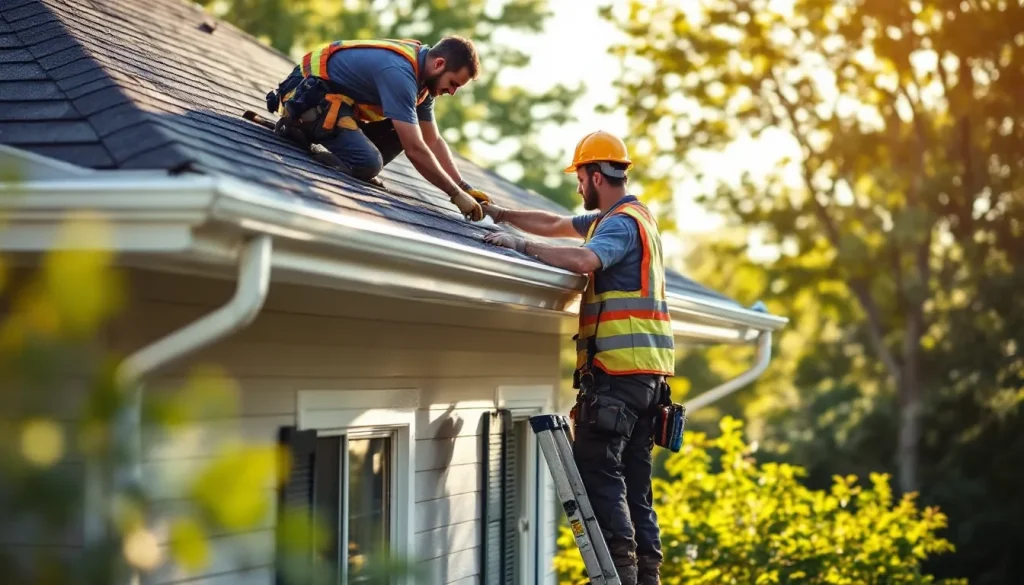
Gutter installation in 2026 is a 4 to 8 hour job for a typical 200-linear-foot residential home, costing $800 to $3,000 fully installed depending on material and gutter style, with one-piece aluminum K-style running about $7 to $13 per linear foot installed and one-piece copper running $25 to $45 per linear foot installed. The process from measurement to hangers to downspout placement determines whether the system lasts 20 years or fails in 5. Most homeowners do not realize that the failure mode is almost never the gutter material itself: it is the slope, the hanger spacing, or the downspout sizing. NAHB cost data 2025 and RSMeans 2025 both put proper gutter installation at the low-cost end of exterior projects, but the median callback rate within 24 months runs 8 to 12 percent for crews who skip the inspection step. Here is the complete process plus the 6 mistakes that cause early failure.
The short version
- A 200-LF gutter installation takes 4 to 8 hours and costs $800 to $3,000 in 2026, depending on material (aluminum cheapest, copper most expensive) and whether it is one-piece or sectional construction.
- Slope must be 1/4 inch per 10 feet toward downspouts. Get this wrong and the gutter will pool, freeze, or sag inside two seasons.
- Hangers belong every 24 inches in mild climates and every 16 inches in snow and ice zones. Most early failures trace back to skipping this rule.
- A 5-inch K-style aluminum gutter with a 2×3 downspout handles roof areas up to about 600 square feet. Above that, move to 6-inch gutter with 3×4 downspouts.
- The six most common install mistakes are reverse slope, hanger spacing, undersized downspouts, missing end caps, water dumped at the foundation, and overdriven nails through the fascia.
- Pull a permit only when your municipality requires one (rare); always check that the installer carries general liability and workers comp before any ladder hits your siding.
The Short Answer: Process Steps + Day-Of Timeline
A professional 2-person gutter crew handles a standard 1,800 to 2,400 square foot single-family home in a single visit. The sequence almost never changes: measurement walk, demolition of old gutters (if applicable), fascia inspection, slope marking, hanger installation, gutter run, downspout connection, and water test. The biggest variable is the fascia condition. If the fascia board is rotten under existing gutters (more common than most homeowners expect), the project either pauses for fascia repair or the new gutter goes onto a marginal substrate that will fail in 3 to 5 years.
Here is a typical day-of timeline for a 200-linear-foot install with one-piece aluminum gutters:
| Step | Time | Crew | Notes |
|---|---|---|---|
| Arrival, walk-through, ladder setup | 20-30 min | 2 | Confirm downspout exits and fascia condition |
| Tear-off of existing gutters | 45-90 min | 2 | Skip if new construction |
| Fascia inspection and prep | 20-40 min | 1 | Patch rot, prime exposed wood |
| Slope marking and chalk lines | 30 min | 1 | 1/4 inch drop per 10 feet of run |
| On-site gutter rolling (one-piece) | 60-90 min | 1 | Roll-forming truck stays on driveway |
| Hanger and gutter install | 2-3 hr | 2 | 16 to 24 inch hanger spacing |
| Downspout install | 45-75 min | 2 | Includes outlet cutting and elbow runs |
| Cleanup and water test | 30-45 min | 2 | Hose test for slope verification |
If the home requires more than 280 linear feet or has a complex roofline with multiple downspout runs, expect a second day. Two-story installs add about 25 percent labor time due to ladder repositioning and walk-board safety setup.
Pre-Install: Inspection and Measurement
Every professional gutter installation starts with a measurement walk-through, not a phone quote. The crew measures each fascia run with a 100-foot tape, identifies the downspout drop points, and inspects the fascia and soffit for rot, paint failure, or pest damage. This step takes 15 to 30 minutes and uncovers about 30 percent of the surprises that derail a project: nail-pull damage from the old gutters, soft fascia behind the gutter back, blocked soffit vents, or a roofline that has settled out of level.
The inspector should also note the roof pitch and the square footage of each roof plane that drains into a given gutter run. This determines the gutter and downspout sizing, which the NRCA installation manual ties to a calculated runoff volume. A 1,200 square foot roof plane in a 6-inch-per-hour rainfall zone (most of the Gulf Coast and the southeast in storm season) generates enough volume to overwhelm a 5-inch K-style gutter, which is why coastal Florida code and many contractors default to 6-inch gutter with 3×4 downspouts regardless of nominal roof size.
The measurement walk also flags the fascia situation. See our companion piece on fascia board for the full repair-versus-replace decision framework. If 10 percent or more of the fascia is soft or rotten, the gutter project becomes a fascia-and-gutter project, and the price jumps 40 to 80 percent.
Material Choice: Aluminum vs Copper vs Steel vs Vinyl
Material drives both the upfront cost and the lifespan. Aluminum is the workhorse: 80 to 85 percent of residential gutters installed in the U.S. in 2025 were aluminum. Copper is the premium choice on architectural homes and historic restorations. Galvanized steel is regional, mostly in the upper Midwest and Northeast where ice load matters. Vinyl is the budget DIY choice and is rarely worth the discount.
| Material | Cost/LF Installed (2026) | Lifespan | Maintenance | Best For |
|---|---|---|---|---|
| Aluminum (.027″ or .032″) | $7-$13 | 20-25 years | Low | Most homes |
| Aluminum (.040″ heavy gauge) | $9-$15 | 25-30 years | Low | Snow zones, longer runs |
| Galvanized steel | $10-$18 | 20-25 years | Medium (rust) | Ice load regions |
| Copper | $25-$45 | 50-100 years | Very low (patina) | Architectural, historic |
| Vinyl | $3-$7 | 10-15 years | High (UV brittle) | DIY, low-priority sides of home |
| Zinc | $22-$35 | 50+ years | Very low | European-style architecture |
Aluminum thickness matters more than most homeowners realize. The .027 inch gauge is the builder-grade default. The .032 inch gauge costs about 10 percent more and resists ladder-dent damage and ice load far better. The .040 inch heavy gauge is the upgrade most worth paying for, especially in any climate where ice can sit in the gutter for weeks. See gutter installation cost for a full breakdown by material and home size.
One-Piece (Continuous) vs Sectional Construction
One-piece gutters, also called continuous gutters, are rolled on-site from coil stock by a portable roll-forming machine mounted in the installer’s truck. The machine produces a single continuous length of gutter for each fascia run, with seams only at corners and downspout outlets. Sectional gutters come in 10-foot pre-formed pieces that are joined with sealant or slip connectors every 10 feet along the run.
One-piece is the modern standard for a reason. The fewer joints in a gutter system, the fewer leak points. A typical 200-linear-foot home has 8 to 12 joints with sectional construction and 2 to 4 corner joints with one-piece. Each joint is a future failure: sealant ages out at the 8 to 12 year mark, and slip connectors corrode where dissimilar metals contact. Industry data from GAF installer surveys puts the leak callback rate on sectional gutters at roughly 3x the rate on one-piece gutters within the first 10 years.
| Factor | One-piece (continuous) | Sectional |
|---|---|---|
| Joints per 100 LF | 0-2 (corners only) | 10 (every 10 feet) |
| Cost/LF installed | $7-$13 aluminum | $4-$8 aluminum |
| Leak callback rate (10 yr) | ~5% | ~15% |
| DIY friendly | No (requires truck-mounted machine) | Yes |
| Custom lengths | Yes (any length) | 10-foot increments only |
| Repair | Harder (must remove full run) | Easier (swap one section) |
The sectional gutter still has a place. It is the only practical option for a homeowner doing the install themselves, and it is the right choice when only one elevation of the home needs new gutters and the rest of the run is fine. For a full replacement, one-piece is almost always the better long-term value.
K-Style vs Half-Round Profile
K-style is the rectangular profile with a decorative front lip that mimics crown molding. It has been the dominant U.S. residential profile since the 1960s. Half-round is the traditional rounded profile common on pre-1950 homes and high-end architectural restorations. The choice is part aesthetics, part capacity, and once the profile is set you still pick a gutter color to match your trim.
A 5-inch K-style gutter holds roughly 1.2 gallons per linear foot. A 5-inch half-round holds about 0.97 gallons per linear foot. The K-style carries more water in the same nominal size, which is why most builders default to it. Half-round costs about 25 to 40 percent more for the same material in the same length because the manufacturing is more labor-intensive and the hanger system is specialized (most half-round needs interior hidden brackets or external strap hangers).
Half-round in copper, installed with strap hangers on a slate or cedar shingle roof, is one of the longest-lived assemblies in residential construction. Plan on 75 to 100 years before any meaningful work is needed. K-style aluminum is the right answer for almost every other home.
Sizing the Gutters: 5-inch vs 6-inch
The default residential size is 5-inch K-style. The upgrade size is 6-inch K-style. The 6-inch gutter carries about 40 percent more water than the 5-inch and pairs with a 3×4 downspout (versus the 2×3 standard on the 5-inch). For most single-story homes with simple gable rooflines, 5-inch handles the volume. For two-story homes, complex rooflines, or any home in a heavy-rain region, 6-inch is the right call.
| Gutter size | Max roof drainage area (4 in/hr storm) | Pairs with downspout | Cost premium over 5-inch |
|---|---|---|---|
| 5-inch K-style | ~600 sq ft per downspout | 2×3 | Baseline |
| 6-inch K-style | ~1,200 sq ft per downspout | 3×4 | 20-35% |
| 7-inch K-style | ~2,000 sq ft per downspout | 4×5 or round | 50-80% |
Roof drainage area is calculated per downspout, not per gutter run. A 1,000 square foot roof plane with one downspout sits at the limit of a 5-inch gutter in a moderate-rain zone. The same roof plane with two downspouts splits that volume and runs comfortably on a 5-inch gutter. This is why the right answer for borderline homes is often a 5-inch gutter with an extra downspout rather than the upsize to 6-inch.
Downspout Spacing and Sizing
The IRC and most local plumbing codes use the same drainage area rule: one downspout per 600 square feet of roof drainage area for a 2×3 downspout, or one per 1,200 square feet for a 3×4 downspout. In practice, most builders default to one downspout per 30 to 40 linear feet of gutter regardless of roof area, which often overshoots the code requirement and adds resilience.
Downspout placement should follow three rules. First, downspouts go at the low end of every gutter slope run, never at the high end. Second, downspouts go at outside corners rather than mid-run when possible, so they tie cleanly into the building corner trim. Third, every downspout exits at least 4 to 6 feet from the foundation, either by extension pipe, underground PVC routing to a daylight discharge, or a French drain. Water dumped within 2 feet of the foundation is the single biggest cause of basement seepage and foundation cracking in homes with otherwise functional gutters.
Step 1: Remove Old Gutters (When Applicable)
Tear-off is the first physical step. For sectional aluminum gutters, the crew unscrews the hangers or pulls the spike-and-ferrule fasteners, then lifts each 10-foot section down. For one-piece gutters, the crew cuts at the corners and lowers full runs to the ground. Disposal usually rides along to a metal recycler, where the aluminum scrap value (around $0.50 to $0.80 per pound in 2025) offsets a small portion of the labor.
Tear-off exposes the fascia for the first time in 20-plus years. Expect to find one of three conditions: the fascia is sound and just needs paint touch-up at the old fastener holes, the fascia has localized rot at one or two corners (patchable), or the fascia is widely rotten and needs partial or full replacement. The walk-through quote should include a contingency line for fascia work, typically $150 to $400 for spot repairs.
Step 2: Mark Slope (1/4″ per 10 Feet to Downspouts)
Slope is the most-skipped step in amateur installs and one of the clearest signs of a bad gutter install, since it is the single biggest determinant of whether the gutter actually drains. The standard is 1/4 inch of drop per 10 feet of run, sloping toward the downspout. On a 40-foot fascia run with a downspout at one end, that means the high end of the gutter sits 1 inch higher on the fascia than the low end. On a center-downspout layout (one downspout in the middle of the run with the gutter sloping from both ends), the high points are at the outer corners and the low point is in the center.
Professional crews snap a chalk line from the high point to the downspout using a level or laser to verify the drop. The chalk line marks the top edge of the gutter on the fascia. Hangers and the gutter then align to the chalk line. Skipping the chalk line and eyeballing the slope produces gutters that visually look “level” but actually run uphill in the middle, pooling water and accelerating corrosion.
Step 3: Install Hangers (16-inch Spacing for Ice/Snow Zones)
Hangers are the structural backbone of the gutter. The modern standard is the hidden hanger: a curved aluminum or steel bracket that hooks over the front lip of the gutter and screws into the fascia from inside the gutter. Hidden hangers replaced the older spike-and-ferrule system (a long nail driven through the gutter and into the fascia, with a hollow tube spacer) because spikes work loose over time and pull through softened fascia.
Hanger spacing depends on the climate. The default is 24 inches on center. In ice and snow zones (USDA hardiness zones 5 and colder, or anywhere ice dams form), tighten to 16 inches on center. The closer spacing distributes ice load across more fascia attachment points and prevents the gutter from sagging or pulling free during a freeze cycle. Each hanger should be screwed into solid wood with a #10 or #12 stainless or coated screw at least 2 inches long. Hitting only the fascia trim board (often 3/4-inch thick) without grabbing the rafter tail or a backer is a common shortcut that fails within a few years.
Step 4: Run Gutter Sections (or Roll On-Site for One-Piece)
For one-piece installs, the truck-mounted roll-former produces each gutter run to exact length, including the miter cuts at corners. The fresh-rolled gutter is lifted to the fascia (usually by two people working off ladders or a walkboard), seated into the hangers, and the front lip is clipped down. Outside corners and inside corners are joined with prefabricated miter pieces that are sealed with butyl-based gutter sealant. Polyurethane sealant works too, but butyl stays flexible longer in temperature swings and outlasts silicone in UV exposure.
For sectional installs, each 10-foot section is hung first, then the joints are connected with slip connectors or fastened with rivets and sealed with butyl. The end of each run gets an end cap, crimped and sealed. The outlet (where the downspout will connect) is cut into the bottom of the gutter with a downspout outlet punch or aviation snips, sized to match the downspout (2×3 or 3×4 rectangular).
Step 5: Seal Joints + Install End Caps
Sealant work is where most leaks originate. The right approach is to bed every joint in a 1/4-inch bead of butyl gutter sealant, mechanically fasten the joint with rivets or screws, then apply a second bead on top to bridge the seam. Tooling the sealant smooth with a wet finger or plastic tool helps it bond and resist UV. The wrong approach (sealing only the top surface without mechanical fastening) leaves the joint to flex against the sealant in every thermal cycle, which delaminates the seal in 3 to 5 years.
End caps deserve the same attention. The end cap is crimped over the open end of the gutter, riveted in 4 to 6 places, and fully sealed inside and out. Water that finds its way past a poorly sealed end cap drips behind the gutter onto the fascia, which is exactly what gutters are supposed to prevent.
Step 6: Connect Downspouts + Direct Away from Foundation
The downspout drops from the gutter outlet to grade in a series of three pieces: the outlet drop (a short section connecting to the outlet), the offset elbows (typically two 75-degree elbows that bring the downspout flush to the wall), and the vertical run secured to the wall every 8 to 10 feet with downspout straps. At grade, the downspout connects to an extension that carries water 4 to 6 feet from the foundation, an underground PVC drain line, or a splash block at minimum.
The most common error here is dumping the downspout discharge directly onto a splash block within 2 feet of the foundation. Splash blocks help, but they do not stop water from saturating the soil within 4 feet of the foundation, where it can find its way to the basement or crawl space. In any climate with significant rainfall, a downspout extension or buried drain line is worth the extra $40 to $150 per downspout.
The 6 Most Common Install Mistakes
Eight to twelve percent of new gutter installs generate a callback within 24 months. Most callbacks trace back to one of six mistakes:
| Mistake | What Goes Wrong | Visible Symptom |
|---|---|---|
| Wrong or zero slope | Water pools in low spots, accelerates corrosion, overflows during storms | Standing water in gutter after rain stops |
| Hanger spacing too wide | Gutter sags in the middle, ice load pulls hangers | Visible dip in gutter midspan, pulled hangers |
| Undersized downspouts | Outlet cannot accept full storm flow, gutter backs up and overflows the front | Front-of-gutter overflow during heavy rain |
| Missing or poorly sealed end caps | Water drips behind gutter onto fascia, rotting it from behind | Streaks on fascia, paint peeling under gutter ends |
| Foundation discharge too close | Water saturates soil at foundation, causes seepage and settling | Wet basement walls, efflorescence on foundation |
| Overdriven nails through fascia | Fasteners crack the fascia, water enters wall cavity | Black staining around fastener heads |
Each of these is preventable with a 10-minute slope check, a measurement of hanger spacing, and a hose test before the crew leaves. Reputable installers do all three as part of the closeout. If your installer skips the water test, do it yourself the first day they leave: run a garden hose into the highest point of each gutter run and watch the water travel to the downspout.
Gutter Guards: Install Now or Later?
Gutter guards have a mixed record. The right guard on the right home (a home under heavy tree cover with consistent leaf drop) cuts cleaning frequency from twice a year to once every 2 to 3 years and is worth the $5 to $15 per linear foot upcharge. The wrong guard (a flimsy plastic mesh on a steep roof) creates a debris dam that makes the gutter worse than no guard at all.
| Guard type | Cost/LF | Best For | Weakness |
|---|---|---|---|
| Micro-mesh stainless | $8-$15 | Pine needles, fine debris | Top side still needs occasional sweeping |
| Reverse curve (surface tension) | $10-$20 | Heavy oak/maple leaf zones | Fails in heavy storms, ice can deform |
| Foam insert | $2-$5 | Budget retrofit | Holds moisture, degrades in 3-5 years |
| Plastic snap-in screen | $1-$3 | DIY, low-debris areas | UV brittle, blows off |
| Solid hood | $15-$30 | Premium full-system retrofit | Voids some shingle warranties if attached to shingle |
Timing matters. Adding guards during a new gutter install costs 30 to 40 percent less than coming back later because the crew is already on-site with ladders set. If you have any tree cover at all, decide on guards before the install starts.
Time + Cost by Home Size
| Home Size | Typical LF | Crew Hours | Aluminum One-Piece | Copper One-Piece |
|---|---|---|---|---|
| 1,200 sq ft ranch | 140 LF | 4-5 hrs | $1,000-$1,800 | $3,500-$6,300 |
| 1,800 sq ft 1-story | 180 LF | 5-7 hrs | $1,300-$2,300 | $4,500-$8,100 |
| 2,400 sq ft 2-story | 220 LF | 7-9 hrs | $1,500-$2,900 | $5,500-$9,900 |
| 3,000 sq ft 2-story | 280 LF | 8-11 hrs | $2,000-$3,600 | $7,000-$12,600 |
| 4,000 sq ft complex roofline | 360 LF | 12-16 hrs (2 days) | $2,500-$4,700 | $9,000-$16,200 |
Add 15 to 25 percent for steep-pitch homes (above 8/12), homes with limited ladder access, or three-story installs that require scaffolding. Subtract 5 to 10 percent for new construction where the fascia is fresh and tear-off is not required.
DIY vs Pro: When DIY Makes Sense
DIY gutter installation is realistic for a confident homeowner with sectional gutters on a single-story home with simple gable runs. The materials cost about 60 percent of a pro install. The risk is the ladder work: more than 200,000 ladder-related ER visits a year in the U.S., and gutter installation is a leading cause among homeowners over 50.
One-piece gutter installation is not a DIY project. The roll-forming machine is a $5,000 to $15,000 truck-mounted tool, and the lifting and seating of a 40-foot rolled gutter onto a fascia requires at least two trained installers working from a walkboard or two ladders. For one-piece, hire a pro.
If you do DIY, follow the slope rule, use hidden hangers (not spikes), and test with a hose before declaring the job done. See how to choose a roofing contractor for the same vetting framework that applies to gutter specialists.
Insurance + Permit Considerations
Most municipalities do not require a permit for gutter installation as a standalone project. Permit requirements typically kick in when the gutter work is part of a larger reroof or when downspouts are connected to a municipal storm drain. Florida coastal counties (Miami-Dade, Broward) treat gutters under the broader roof permit when installed during a reroof and require a licensed roofer or specialty contractor; see our Florida roofing contractor license piece for the licensure detail.
Insurance is the bigger gate. Any installer working on your home should carry both general liability ($1M minimum) and workers compensation. A gutter installer falling off your ladder without workers comp becomes a claim against your homeowners policy, which can run into six figures. Always request a Certificate of Insurance (COI) listing you as a certificate holder before work starts. This is free for the installer to provide and is the single best protection a homeowner has against a ladder accident becoming a personal financial event.
Once your gutters are installed, keep the system working with regular cleaning and downspout flushes. The roof maintenance schedule covers gutter cleaning frequency by tree cover, and the parts of a roof overview shows where gutters sit in the broader roof system. If you have an active leak that you suspect is gutter-related rather than shingle-related, the roof leak repair diagnosis guide walks through the difference.
Frequently asked questions
How long does professional gutter installation take?
A 2-person crew installs gutters on a typical 1,800 to 2,400 square foot home in 4 to 8 hours. Larger homes, complex rooflines, or fascia repair work can extend to a full day or two days.
What is the slope for gutters?
The standard slope is 1/4 inch of drop per 10 feet of run, sloping toward the downspout. On a 40-foot gutter with the downspout at one end, the high end sits 1 inch above the low end.
How far apart should gutter hangers be?
Default spacing is 24 inches on center. In snow and ice zones, tighten to 16 inches on center to handle ice load. Spike-and-ferrule systems should be replaced with hidden hangers during any gutter project.
Should I install 5-inch or 6-inch gutters?
Use 5-inch K-style for most single-story homes with simple rooflines. Upgrade to 6-inch K-style with 3×4 downspouts for two-story homes, complex rooflines, or any home in a heavy-rain region. The 6-inch carries about 40 percent more water than the 5-inch.
How many downspouts do I need?
The IRC rule is one downspout per 600 square feet of roof drainage area for 2×3 downspouts, or one per 1,200 square feet for 3×4 downspouts. Most installers default to one per 30 to 40 linear feet of gutter, which usually exceeds code.
Do I need a permit to install gutters?
Most municipalities do not require a permit for standalone gutter installation. Permits are more common when gutters connect to municipal storm drains or are installed during a reroof. Check your local building department before the project starts.
Are one-piece gutters worth the extra cost?
Yes for full replacements. One-piece gutters have 80 percent fewer joints than sectional gutters and a 10-year leak callback rate roughly one-third the sectional rate. The cost premium is about 30 to 50 percent and the lifespan advantage is significant.
What goes wrong with vinyl gutters?
Vinyl gutters become UV-brittle in 10 to 15 years and crack at the joints. They sag in heat and deform under ice load. They are a budget DIY choice and are rarely worth the discount versus aluminum on a home you plan to own for more than a decade.