
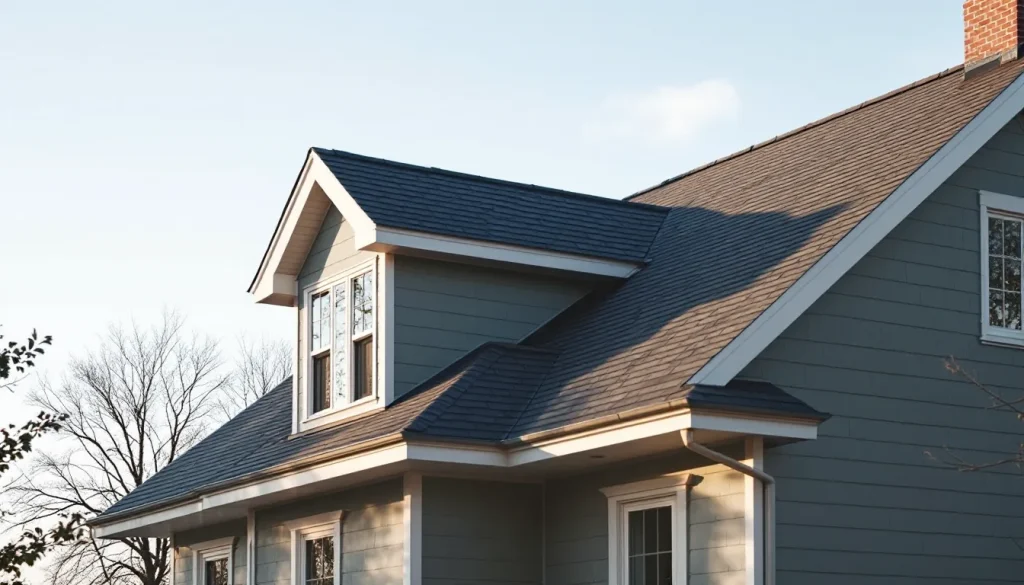
Knowing the parts of a roof matters when you are getting a contractor estimate, filing an insurance claim, or comparing inspection reports. The 18 essential terms cover the structural framework (ridge, hip, rafters, sheathing), the surface elements (shingles, valleys, eaves, drip edge), and the flashing and ventilation systems that prevent leaks. Here is the complete glossary with what each part does, why it matters, what failure looks like, and where to find more detail on the components that drive 80 percent of roof repair conversations.
The short version
- The 18 essential parts split into three categories: structural framework, surface elements, and protection systems.
- Structural: ridge, hip, valley, rafters/trusses, sheathing.
- Surface: shingles, underlayment, drip edge, flashing, fascia, soffit, gable/rake, gutters/downspouts.
- Protection: ridge and soffit vents, skylights, penetrations (vents, chimneys).
- Most leak claims involve flashing, valleys, or penetrations, not field shingles.
- Insurance adjusters and contractors use these terms interchangeably; knowing them prevents miscommunication and lost claim value.
The Short Answer: 18 Essential Roof Terms
The 18 essential parts of a roof, grouped by function:
Structural framework (5): ridge, hip, valley, rafters or trusses, roof sheathing.
Surface elements (7): shingles, underlayment, drip edge, flashing, fascia, soffit, gable and rake.
Edge and water management (3): gutters, downspouts, eaves.
Ventilation and penetrations (3): ridge and soffit vents, skylights, chimneys and vent stacks.
The structural framework is the bones of the roof. The surface elements are the visible roof you can see from the street. The water management systems control where water goes once it hits the roof. The ventilation and penetrations are the working parts of the roof that have to be detailed correctly to prevent leaks.
The Structural Framework
The structural framework of a residential roof has five parts that work together to carry the weight of the roof itself, the live loads from snow and wind, and the dead loads of the roofing materials. The framework determines the shape of the roof (gable, hip, gambrel, mansard) and sets the boundaries for everything that gets installed on top.
For style-specific framework discussion, see the dedicated style articles: gable roof, hip roof, gambrel roof, and mansard roof.
Ridge (the Highest Point)
The ridge is the highest horizontal line on the roof, where two opposing slopes meet at the top. On a gable roof, the ridge runs from one gable end to the other. On a hip roof, the ridge runs between the two intersections of the four slopes. A pyramid hip has no ridge (the slopes meet at a single peak).
Structurally, the ridge is either a beam (in stick-framed construction) or just a meeting line (in trussed construction). The ridge beam in a stick-framed cathedral ceiling carries significant load and is typically a glulam or LVL beam. In a trussed roof, the trusses are self-supporting and the ridge is just the line where opposing truss top chords come together.
The visible ridge has two functional elements: the ridge cap (special shingles or formed metal that covers the seam) and the ridge vent (if present). Both are described later in this article.
Common ridge failures: lifted ridge caps after high wind events, gaps at the ridge where the cap pulls away from the field shingles, and damaged ridge vents that allow water entry into the attic.
Hip (Where Two Slopes Meet at a Corner)
A hip is the sloping line that runs from a corner of the building up to the ridge. Hips are present only on hip roofs (and partially on Dutch gable and half-hip variants). The hip is the structural and visual line where two adjacent roof slopes meet at an angle.
The hip rafter (in stick-framed construction) is a structural beam that runs along the hip line. It carries the load of the jack rafters that frame into it from each side. Hip rafters are longer than common rafters for the same run because they run diagonally.
The hip cap is the row of special shingles or formed metal cover that runs along the hip line on the outside of the roof. Like the ridge cap, hip caps are exposed to wind from multiple directions and tend to lift before field shingles do. For style-specific hip detail, see hip roof.
Valley (Where Two Slopes Meet Inward)
A valley is the line where two roof slopes meet at an inward (concave) angle. Valleys occur at cross-gable intersections, cross-hip intersections, and at any place where a dormer or wing roof meets the main roof. Valleys are the highest-leak-risk part of the roof.
The reason is water concentration. A valley collects water from two slopes and channels it down to the gutter. The water volume in a valley can be 5 to 10 times the volume on an equivalent area of field shingle. Any flashing failure in a valley produces immediate, high-volume leaks.
Best-practice valley construction uses a 36-inch-wide self-adhered ice and water shield underlayment running the full length of the valley, followed by either a closed-cut shingle valley, an open metal valley, or a woven valley. The open metal valley is the highest-performing detail and is the standard for high-end residential and any home in a high-rainfall climate. See roof flashing for valley flashing detail.
| Valley type | Detail | Leak risk | Best for |
|---|---|---|---|
| Woven valley | Shingles from both sides interlace | Higher (no metal liner) | Budget residential, low-rainfall |
| Closed-cut valley | One side shingles run through, other cut | Moderate | Mainstream residential |
| Open metal valley | Metal channel exposed in valley center | Low | Premium residential, all climates |
| California valley | Modified closed-cut variant | Moderate | West Coast residential |
Rafters and Trusses
The rafters or trusses are the structural members that span from exterior wall to ridge. In stick-framed construction, rafters are individual sloped beams cut and installed on site. In trussed construction, prefabricated triangular truss assemblies are delivered to the site and lifted into place.
Most residential construction since 1980 uses trusses rather than stick-framed rafters. The reasons are speed (trusses install in hours, stick framing takes days), engineering (trusses are factory-engineered and certified), and material efficiency (trusses use less lumber for the same span).
Stick-framed rafters remain common in two situations: cathedral ceiling construction where the rafters double as the ceiling structure, and renovation work on older homes where the existing framing is being matched. Stick framing also gives more flexibility for irregular footprints.
For the engineering breakdown of residential truss systems, including span tables, load calculations, and the difference between fink, scissor, and attic trusses, see roof trusses.
Roof Sheathing
The roof sheathing is the wood panel surface installed over the rafters or trusses. Sheathing forms the working deck on which underlayment, shingles, and other roofing materials are installed. The standard sheathing material is 1/2-inch or 5/8-inch CDX plywood or OSB (oriented strand board).
Sheathing thickness is determined by rafter or truss spacing. Trusses and rafters at 16 inches on center can use 1/2-inch sheathing. Trusses at 24 inches on center require 5/8-inch sheathing for residential applications. Heavier roof loads (concrete tile, slate) require thicker sheathing or closer truss spacing.
Sheathing condition is a critical inspection point during any roof replacement. Soft or rotted sheathing has to be replaced before new roofing material is installed. Industry data suggests that 5 to 15 percent of residential roof replacements involve significant sheathing replacement, typically adding $500 to $3,500 to the total job cost.
For the complete sheathing discussion including material selection, spacing requirements, and rot detection, see roof sheathing.
The Surface Elements
The surface elements are everything that goes on top of the sheathing: the underlayment, the flashing, the visible roofing material, and the edge and water management systems. The surface elements are what fails first on most roofs and what gets replaced in a typical re-roof.
Shingles (the Visible Material)
Shingles are the most common residential roof covering, accounting for roughly 75 percent of residential roof installations in 2026. The term “shingle” technically applies to any small individual roof covering unit, but in modern American practice it usually refers to asphalt composition shingles.
The three asphalt shingle categories are 3-tab (the cheapest, 15 to 20 year service life), architectural or dimensional (the mainstream, 20 to 30 year service life), and premium impact-rated (Class 4 hail rating, 30 to 40 year service life).
Non-asphalt shingle materials include cedar shake and shingle (wood), slate (natural stone), metal shingle (interlocking metal panels), composite or synthetic slate, and clay or concrete tile. Each material has different installation requirements, cost profiles, and service lives.
| Material | 2026 cost per sq ft installed | Service life |
|---|---|---|
| 3-tab asphalt | $4.50 to $6.50 | 15 to 20 years |
| Architectural asphalt | $5.50 to $9.00 | 20 to 30 years |
| Impact-rated asphalt | $7.50 to $11.50 | 30 to 40 years |
| Standing seam metal | $11.00 to $18.00 | 50 to 70 years |
| Cedar shake | $13.00 to $22.00 | 30 to 40 years |
| Slate | $22.00 to $40.00 | 75 to 100 years |
| Concrete tile | $11.00 to $18.00 | 50+ years |
For the deep material comparison, see metal vs asphalt shingle roof.
Underlayment (the Secondary Water Barrier)
Underlayment is the layer of weather-resistant material installed between the sheathing and the shingles. It is the secondary water barrier: if water gets past the shingles (which happens regularly in heavy rain, wind-driven rain, or ice damming), the underlayment is what keeps it from reaching the sheathing.
The two main underlayment categories are felt (traditional asphalt-saturated paper) and synthetic (engineered polymer materials). Felt is cheaper and has 100 years of installation track record. Synthetic is lighter, more tear-resistant, more UV-stable for extended dry-in periods, and substantially more expensive.
Self-adhered ice and water shield is a specialty underlayment used in critical areas: along eaves (to prevent ice dam damage), in valleys, around penetrations, and around skylights. Most building codes require ice and water shield from the eave to 24 inches inside the warm wall line in any climate with a 30-degree or lower average January temperature.
For the felt versus synthetic decision in detail, see felt vs synthetic underlayment.
Drip Edge (the Eave Protection)
The drip edge is a metal flashing installed at the eaves and rakes of the roof. It is shaped to project beyond the fascia by about 1/2 inch, which causes water running off the roof to drip clear of the fascia and into the gutter.
Without a drip edge, water tends to wick back along the underside of the shingles and onto the fascia, causing rot and paint failure. With a properly installed drip edge, water cleanly exits the roof and the fascia stays dry.
The drip edge is required by IRC R905.2.8.5 at all eaves and rakes in residential construction. It is a small detail (typically a $300 to $600 line item on a 2,500 square foot roof) but its absence is one of the most common reasons fascia and soffit have to be replaced prematurely.
For full drip edge installation detail, see drip edge.
Flashing (Around Chimneys, Walls, Vents)
Flashing is metal sheet (typically aluminum, copper, or galvanized steel) used to seal joints where the roof meets other surfaces. The four most common flashing locations are around chimneys, where the roof meets vertical walls, at valleys, and around plumbing vents and other roof penetrations.
Flashing failure is the single most common cause of roof leaks. Industry estimates suggest 60 to 80 percent of residential roof leaks originate at flashing rather than at field shingles. The reason is that flashing has to bend, lap, and seal complex three-dimensional geometry, and any error in the bend, lap direction, or sealing creates a leak path.
The four primary flashing types are:
Step flashing. Used where a sloped roof meets a vertical wall. Individual pieces of metal flashing are interleaved with each course of shingles, creating a layered seal.
Counter flashing. Used over step flashing where the roof meets a masonry wall. The counter flashing is set into a mortar joint and laps over the step flashing.
Apron flashing. A single piece of L-shaped flashing at the lower side of a chimney or wall projection.
Cricket or saddle flashing. A small peaked structure built behind a chimney or large wall projection to divert water around the obstruction.
For the complete flashing detail breakdown, see roof flashing.
The Eaves: Fascia + Soffit
The eaves are the lower edges of the roof, where the roof overhangs the exterior walls. Two parts of the eave are visible: the fascia (the vertical board at the front of the eave) and the soffit (the horizontal panel that closes the underside of the overhang).
The fascia is the board to which gutters are attached. It runs along the entire perimeter of the eave. Fascia is typically 6-inch or 8-inch nominal lumber (1×6 or 1×8) or composite trim board, painted or finished to match the trim color of the home.
The soffit is the panel below the fascia, closing the underside of the eave overhang. Soffits are typically vinyl, aluminum, or wood. Most soffits include perforated panels or continuous vent strips that allow attic ventilation air intake.
For full fascia material and replacement detail, see fascia board. For soffit ventilation strategy, see soffit vents.
| Component | Material options | 2026 cost per linear foot replaced |
|---|---|---|
| Wood fascia | Pine, cedar, composite | $8 to $18 |
| Aluminum fascia | Coated coil over wood | $10 to $22 |
| Vinyl soffit (perforated) | PVC vented panels | $7 to $14 |
| Aluminum soffit (perforated) | Coated aluminum vented | $10 to $20 |
| Wood soffit | Plywood with vent strips | $8 to $16 |
Gable and Rake (the End-Wall Edges)
The gable is the triangular vertical end wall of a gable roof. The rake is the sloping edge of the roof at the gable end, running from the ridge down to the eave along the gable wall. The rake board (rake trim) is the wood or metal trim that finishes this edge.
The gable and rake are present only on gable, gambrel, and certain hybrid roof types. Hip roofs have no gable ends; they have hips at the corners instead.
The rake board is exposed to wind from the side and is one of the most common locations for paint failure, rot, and wind damage. In hurricane zones, the rake is the location where wind-driven uplift can lift the entire gable end overhang.
For style-specific gable detail, see gable roof.
Gutters and Downspouts
Gutters are channels installed along the eaves to collect rainwater running off the roof. Downspouts are vertical pipes that carry water from the gutters down to the ground. Together, the gutter and downspout system manages all the water that hits the roof and directs it away from the foundation.
The standard residential gutter is 5-inch or 6-inch K-style aluminum, available in pre-finished colors. Half-round gutters are a premium option, often used on historic and high-end custom residential. Box gutters and built-in gutters are specialty options for certain architectural styles.
One-piece (sometimes called continuous) gutters are manufactured on site to the exact length needed and have no end joints. This eliminates the most common gutter leak point. One-piece installation runs 30 to 50 percent more than sectional gutters but is the dominant residential product in 2026.
Downspout sizing matters. The standard 2×3 inch downspout handles approximately 600 square feet of roof drainage area. Larger 3×4 inch downspouts handle approximately 1,200 square feet. Undersized downspouts overflow during heavy rain events and cause water to spill at the eaves, undermining foundations and damaging landscaping.
For the complete gutter pricing and installation breakdown, see gutter installation cost.
Ventilation: Ridge + Soffit Vents
Attic ventilation is the system that allows air to flow through the attic, removing moisture and heat. Proper ventilation extends shingle life, prevents ice damming, and keeps attic temperatures within tolerable limits.
The standard modern system uses continuous soffit vents as the air intake and a continuous ridge vent as the exhaust. Cool outside air enters at the soffit, flows up through the attic, and exits at the ridge. The thermal stack effect drives the flow passively.
The minimum ventilation requirement per IRC R806 is a net free vent area equal to 1/300 of the attic floor area, with at least 40 percent and not more than 50 percent of the vent area at the upper portion (ridge) and the rest at the lower portion (soffit). For a 2,000 square foot attic, this means approximately 6.7 square feet of net free vent area, split roughly 50/50 between soffit and ridge.
Alternative ventilation systems include gable vents (only practical on gable roofs), turbine vents (active vents on the ridge), and powered attic ventilators (fans). Modern best practice is continuous ridge-and-soffit ventilation, but the alternative systems remain in use for specific applications.
For the complete attic ventilation breakdown including system selection and code compliance, see attic ventilation.
Penetrations: Skylights, Vents, Chimneys
Roof penetrations are any place where something goes through the roof: skylights, plumbing vent stacks, kitchen exhaust vents, bathroom exhaust vents, chimneys, and electrical service masts. Every penetration is a critical flashing detail.
Plumbing vent stacks are the most common penetration. Standard residential plumbing has 2 to 4 vent stacks penetrating the roof. The vent stack is flashed with a rubber boot (or a metal flange and storm collar in older homes) that seals around the pipe. The boot is the most failure-prone roofing component because the rubber material degrades over 10 to 15 years and cracks, allowing water to enter around the pipe.
Skylights are the second most common penetration in modern residential construction. The Velux brand dominates the residential market. Skylight flashing is provided as a manufacturer-engineered kit and includes head, sill, and side flashing. Proper skylight installation requires the manufacturer’s kit, not site-fabricated flashing. For installation cost detail, see skylight installation cost.
Chimneys are the most failure-prone penetration. The flashing detail (apron at the front, step flashing on the sides, counter flashing into the mortar joints, and a cricket at the back if the chimney is wider than 30 inches) involves multiple critical components that must all work together. Most chimney leaks are flashing failures rather than chimney structure failures.
| Penetration | Typical flashing type | Service life | Common failure |
|---|---|---|---|
| Plumbing vent stack | Rubber boot or lead flashing | 10 to 15 years (rubber), 50+ years (lead) | Rubber cracking |
| Bathroom exhaust vent | Metal cap with flashing flange | 15 to 20 years | Cap rust, screen damage |
| Skylight | Manufacturer kit (multi-piece) | 20 to 30 years | Curb flashing failure |
| Chimney (masonry) | Step + counter + cricket | 20 to 30 years | Counter flashing mortar joint failure |
| Chimney (metal) | Specialty manufacturer kit | 20 to 30 years | Storm collar caulk failure |
| Service mast (electrical) | Boot flashing | 15 to 25 years | Cracking around mast |
Why Knowing These Helps Homeowners
The 18 essential roof parts are the vocabulary of any roof estimate, insurance claim, or inspection report. Knowing the terms helps in five practical situations.
First, contractor estimates. When a contractor’s estimate says “replace 12 LF rake trim with PVC and re-flash to 6/12 step pattern,” you can verify what is being proposed. When the estimate omits flashing details, you can ask whether they are included.
Second, insurance claims. Insurance adjusters use these terms in claim documentation. A claim that distinguishes between “valley flashing damage” and “field shingle damage” gets different treatment and different payouts.
Third, inspection reports. Pre-purchase home inspections and post-storm inspections describe roof condition in these terms. Knowing what each term means lets you understand what is being flagged and how serious it is.
Fourth, repair vs replace decisions. Knowing whether a leak is at the field shingle (often a repair), at flashing (sometimes a repair, sometimes a re-roof), or at the sheathing (usually a re-roof) drives the right decision.
Fifth, contractor selection. A contractor who can explain step flashing versus counter flashing, or who can describe their valley detail correctly, is a different quality of contractor than one who waves at the roof and gives a single bottom-line number. For full contractor selection guidance, see how to choose a roofing contractor. For broader education on roof topics, see learn.
FAQs
What are the most important parts of a roof to inspect annually?
Flashing, valleys, and penetrations. These account for 60 to 80 percent of residential roof leaks. Annual visual inspection of chimney flashing, plumbing vent boots, skylight flashing, and valley areas catches most developing problems before they become active leaks.
What is the difference between a hip and a valley?
A hip is a line where two roof slopes meet at an outward (convex) angle, typically at a corner of a hip roof. A valley is a line where two slopes meet at an inward (concave) angle, where water collects and is channeled down. Hips are dry; valleys carry water.
How long does roof sheathing last?
50 to 80 years if it stays dry. Sheathing is replaced only when it gets wet (from a leak, ice dam, or storm damage) and rots. Industry estimates suggest 5 to 15 percent of residential roof replacements involve significant sheathing replacement.
What is the difference between fascia and soffit?
Fascia is the vertical board at the front of the eave where gutters mount. Soffit is the horizontal panel below the fascia that closes the underside of the eave overhang. The fascia is what you see when looking at the front of the eave; the soffit is what you see when looking up under the eave.
Why does flashing matter more than shingles?
Because flashing is where 60 to 80 percent of leaks originate. Field shingles cover the simple, flat parts of the roof. Flashing covers the complex three-dimensional geometry around penetrations, walls, valleys, and edges, and that geometry is where water finds a way in.
What is the difference between a rake and an eave?
An eave is the horizontal lower edge of a sloped roof, where the roof meets the exterior wall. A rake is the sloping edge of a roof at the gable end, running from the ridge down to the eave along the gable wall. Eaves run horizontally; rakes run on a slope.
Do all roofs need underlayment?
Almost all. IRC R905 requires underlayment under all asphalt shingle, metal, slate, and tile roofs. The only roof types that do not require underlayment are certain low-slope membrane systems (TPO, EPDM) where the membrane itself serves as the water barrier. For asphalt shingles, underlayment is non-negotiable.