
By The Roofing Brief Team | Last reviewed: November 2026
Squirrel roof damage is almost always chewing at a soft edge of the roof: fascia corners, eave returns, plastic vents and pipe boots, where gray and fox squirrels gnaw entry holes about the size of a baseball, roughly 2.9 inches across, according to the Internet Center for Wildlife Damage Management (ICWDM). Fix it in metal only after any young have left, and expect a standard HO-3 policy to exclude the chewing itself under its “birds, rodents or insects” clause.
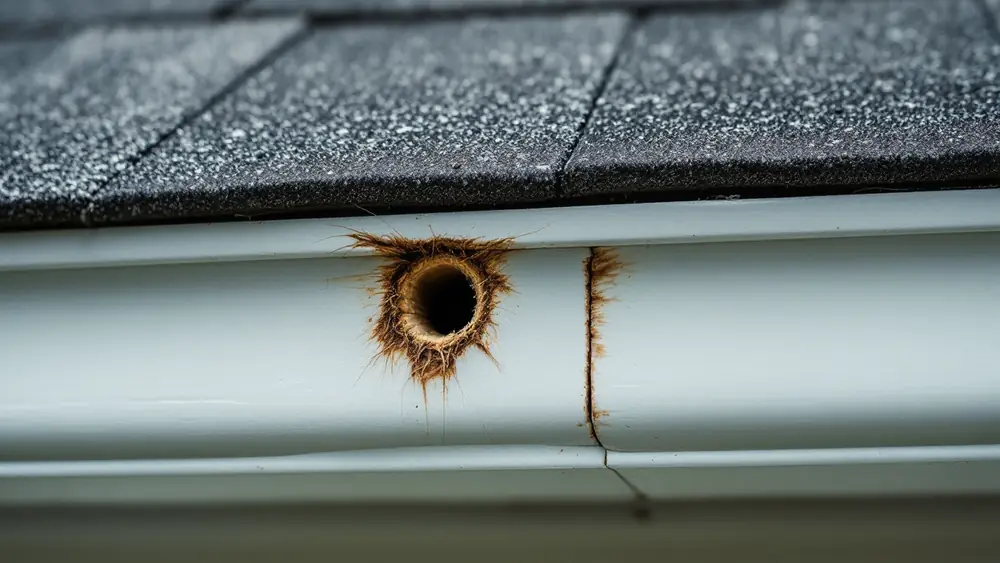
So yes, squirrels can damage your roof, but not the way storms do. They do not lift whole courses of shingles or crack a deck; they open one or two holes about 3 in wide at the wood and plastic parts, and the cost comes from what follows: rain at the hole, nesting in the attic and gnawed wiring, which ICWDM links to fires. Getting the animals out of the attic is covered in our squirrels in the attic guide. This page is about the roof itself: reading the damage, naming the animal, and repairing each part.
Where squirrel damage to a roof shows up
Squirrels chew where two building parts meet and leave a gap. UC IPM Pest Notes 74122 lists “small gaps under the eaves, overlapping roof sections, and knotholes,” and notes that squirrels traveling on power lines and fence tops “frequently find entrances at about these heights” (UC IPM, Tree Squirrels, updated 08/2016). Connecticut DEEP adds dormers, ridge vents, eaves and attic vents for flying squirrels (CT DEEP, Squirrel Nuisance Problems).
| Roof component | What the damage looks like | Metal repair | Source |
|---|---|---|---|
| Fascia corner at a gutter end or eave return | Rounded hole, chewed edge, bare wood fibers, often near where the gutter stops | Replace the chewed board, then wrap the corner in aluminum flashing or 19-gauge 1/2 in hardware cloth | UC IPM 74122; ICWDM |
| Soffit panel or soffit-to-wall joint | Torn vinyl or aluminum panel, hole chewed through the wood backing | Rebuild the backing, reset the panel, screen any vent opening at 1/4 in max | UC IPM 74122; 2021 IRC R806.1 |
| Roof-to-wall joint at a dormer or lower roof | Gap at the corner where step flashing ends | Close with sheet metal tied under the flashing | CT DEEP; UC IPM 74122 |
| Plastic ridge vent | Chewed end caps or louvers, nesting debris under the ridge cap | Aluminum external-baffle ridge vent, ridge cap re-laid | CT DEEP; Air Vent 84405 listing |
| Gable or box vent | Broken screen, chewed plastic louvers | Corrosion-resistant hardware cloth, openings 1/16 to 1/4 in | 2021 IRC R806.1; UC IPM 74122 |
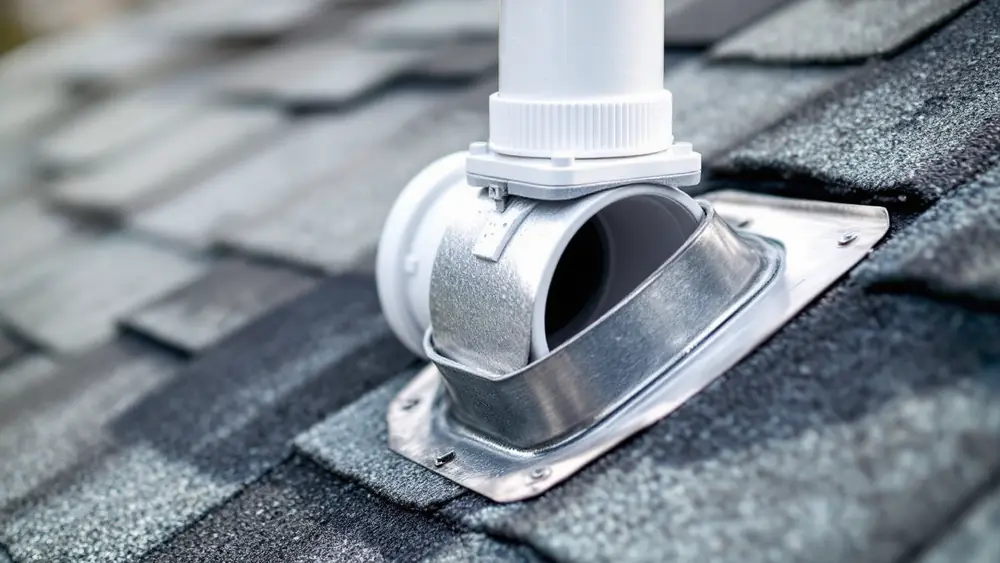
| Plumbing vent pipe boot | Lead lip chewed or folded back, rubber collar gnawed | All-steel boot such as the Quarrix ProBoot | Quarrix product page |
The plumbing vent row is the one homeowners miss, because the leak shows up as a ceiling stain, not a hole. Quarrix lists its ProBoot as all-steel with a nylon coating and a “pest resistant” feature that “prevents squirrel damage,” in a standard 3:12 to 8:12 pitch range (parts 58000-2 to 58012-2) and a high 8:12 to 14:12 range (58100-2 to 58112-2) (Quarrix ProBoot page, accessed November 2026). Boot options are compared in our best roof pipe boot guide.
Squirrel, raccoon, woodpecker or rot: who made the hole?
Hole size is the fastest test. ICWDM says fox and gray squirrels use holes the size of a baseball, red squirrels the size of a golf ball, and flying squirrels the size of a quarter, while raccoons “only need a 4-inch gap” and “may tear off shingles or fascia boards” (ICWDM, Raccoon Damage Identification). The table converts those comparisons into inches you can measure with a tape.
Raccoons are not rodents, which changes the coverage analysis; see is raccoon damage covered by insurance.
| Animal or cause | Reference object | Worked size | Other signs on the roof | Source |
|---|---|---|---|---|
| Gray or fox squirrel | Baseball, 9 to 9 1/4 in around | 9 / 3.1416 = 2.86 in to 9.25 / 3.1416 = 2.94 in across | Daytime activity, chewed edge, one or two holes | ICWDM; MLB Official Baseball Rules 3.01 |
| Red squirrel | Golf ball, 1.68 in minimum diameter | About 1.7 in | Piles of pine cones in attics or gutters | ICWDM; USGA Equipment Rules |
| Flying squirrel | Quarter, 0.955 in diameter | About 1 in | Night activity, stains below vents | ICWDM; US Mint coin specifications |
| Raccoon | 4 in gap | 4 in or more | Shingles or fascia torn off, smudges on climbing routes | ICWDM raccoon page |
| Woodpecker | Drilled holes in wood siding, eaves and trim | Several holes, often in rows | Pounding noise, damage peaks February to June | ICWDM woodpecker page |
| Wood rot | No animal | No round hole; soft, dark wood | Starts where water sits, often behind a gutter | Roofing Brief eave and fascia guides |
The baseball arithmetic uses the circumference limit in Rule 3.01 of the 2025 Official Baseball Rules, “not less than nine nor more than 9 1/4 inches,” divided by pi. A finished squirrel hole is usually that size or a little larger, because the animal gnaws from a smaller gap until it fits.
Woodpeckers are the common mix-up on cedar homes. ICWDM says they drill into “wood siding, eaves, window frames, and trim boards,” prefer cedar and redwood, choose natural or stained wood over painted wood, and do most damage from February through June (ICWDM, Woodpecker Damage Identification). A cluster of drilled holes in cedar trim points to a bird; a single ragged 3 in hole at a fascia corner points to a squirrel.
Rot has no chewed edge at all. If a screwdriver sinks into the 3/4 in board and the soft area follows a drip line behind the gutter, read our fascia board and gutter guide before blaming wildlife. Squirrels do favor wood that is already soft, so a chewed hole with rotten fibers around it usually needs both a new board and a fix for the water source.
When to repair: the squirrel baby calendar, worked out
Sealing a hole while young are inside is the most expensive mistake, because CT DEEP warns that “adults can cause severe damage by chewing to regain entrance to reach their young.” ICWDM gives the inputs: gray and fox squirrels breed in mid-December or early January, a small percentage breed again in June, gestation is 42 to 45 days, and young are weaned at 10 to 12 weeks (ICWDM, Tree Squirrel Biology). Adding those spans gives the dates below.
| Litter | Mating window | Plus 42 to 45 days: births | Plus 70 to 84 days: weaned |
|---|---|---|---|
| Winter litter | Dec 15 to Jan 5 | Jan 26 to Feb 19 | Apr 6 to May 14 |
| Summer litter (small share of females) | Jun 1 to Jun 30 | Jul 13 to Aug 14 | Sep 21 to Nov 6 |
Roofing Brief arithmetic from ICWDM inputs, rounded to the day. ICWDM’s own planning rule is shorter: young “may be present” from February through August. By the arithmetic, weaning at 70 to 84 days keeps a June-mated litter in the nest into early November, so the lowest-risk windows to close a roof hole for good are mid-May to early July and November to mid-January. Outside those windows, use a one-way door first and confirm no young, as set out in our guide to getting squirrels out of the attic.
How to repair squirrel roof damage, part by part
Order matters more than materials. Each step below names the material spec and the source that sets it.
- Confirm the hole is empty. Stuff it loosely with newspaper, as ICWDM and UC IPM 74122 suggest; if the paper stays in place for several days of fair weather, no squirrel is using the hole. If it is pushed out, install a one-way door with a 1 ft square minimum metal apron around it, per ICWDM.
- Seal every secondary gap before the main hole. ICWDM warns that squirrels “may cause a great deal of damage in their efforts to chew out,” so close smaller gaps first, down to 1/4 in at vents, and the active hole last.
- Cut out chewed and soft wood back to sound wood. Fascia is typically a nominal 1×6 or 1×8 board about 3/4 in thick; replace the full length between rafter tails rather than patching a 3 in hole with filler. Board choices are in our roofing fascia guide.
- Cover chew-prone corners in metal. ICWDM and CT DEEP both call for heavy 1/2 in wire mesh or aluminum flashing. A roll of Agway 19-gauge, 1/2 in mesh hardware cloth, 36 in by 10 ft, was listed at $29.99 (SKU 746137) by Hills Flat Lumber in November 2026.
- Screen vent openings at 1/4 in or smaller, not 1/2 in. The 2021 IRC R806.1 says openings larger than 1/4 inch “shall be provided with corrosion-resistant wire cloth screening, hardware cloth, or similar material with openings having a least dimension of 1/16 inch (1.6 mm) minimum and 1/4 inch (6.4 mm) maximum.” That is why UC IPM specifies 1/4 in hardware cloth for vents.
- Replace chewed plastic ridge vent with aluminum. The Air Vent 84405 is a 10 ft aluminum ridge vent rated at 18 sq in of net free area per linear foot, per its Sutherlands listing seen November 2026. The ridge cap shingles are nailed through the vent, so they come off and go back on.
- Swap a chewed lead or rubber pipe boot for a steel one sized to the pipe (1 1/2, 2, 3 or 4 in on the ProBoot line) and to the roof pitch.
- Reinstate the drip edge at the eave. The 2021 IRC R905.2.8.5 requires drip edge at eaves and rakes of shingle roofs, lapped at least 2 in, extending at least 1/4 in below the sheathing and fastened at no more than 12 in on center, as JLC’s code review summarizes. Product details are in our roof drip edge guide.
- Cut the access route. ICWDM says to trim limbs 6 to 8 ft from buildings; the South Carolina DNR tree squirrel sheet says 10 ft. Trimming to 10 ft satisfies both.
The two mesh sizes are not a contradiction. The 19-gauge, 1/2 in cloth is for wood corners where chewing strength matters; anything covering a ventilation opening must also meet the R806.1 limit of 1/4 in, so use 1/4 in cloth there. Gable openings need their net free area checked after screening, as our gable vent guide explains.
What squirrel roof repair costs: a worked example
Most squirrel jobs combine two to four small line items rather than one large repair. The example below prices a common pattern, one chewed fascia corner, one soffit section, one chewed ridge vent and one pipe boot, using the national ranges already compiled on our cost pages. It is a Roofing Brief estimate, not a quote, and it excludes wildlife removal and attic cleanup.
| Line item | Quantity | Unit range | Low | High | Basis |
|---|---|---|---|---|---|
| Fascia board replacement | 8 linear ft | $7 to $22 per LF installed | $56 | $176 | Angi and HomeGuide 2026, via our fascia guide |
| Soffit section repair | 4 linear ft | $9 to $34 per LF | $36 | $136 | Our soffit repair guide |
| Ridge vent replacement, installed | 1 job | $300 to $650 | $300 | $650 | Angi, via our roof vent cost guide |
| Pipe boot replacement, installed | 1 boot | $250 to $600 | $250 | $600 | Angi, via our roof vent cost guide |
| 19-gauge 1/2 in hardware cloth | 1 roll, 36 in x 10 ft | $29.99 | $30 | $30 | Hills Flat Lumber, as listed November 2026 |
| Total | $672 | $1,592 | Sum of the rows |
Two things push a bill past the $1,592 high end: rafter tails that rotted behind the chewed fascia, which our roof eaves repair guide prices separately, and second-story access. Unit ranges for each vent type are itemized in our roof vent replacement cost guide. Ask the roofer to quote the metal guarding as its own line, so you can see whether the price covers only the active hole or every chew-prone corner.
Does homeowners insurance cover squirrel damage to a roof?
Usually not for the chewing. The ISO HO 00 03 05 11 homeowners form, Section I, Coverage A and B, paragraph 2.c.(6), says the insurer does not cover loss caused by “(g) Birds, rodents or insects;” or “(h) Nesting or infestation, or discharge or release of waste products or secretions, by any animals” (HO 00 03 05 11, filed copy on Maine.gov). Squirrels are rodents, so a chewed fascia, vent or boot falls squarely inside item (g).
The same paragraph of HO 00 03 05 11 ends with one sentence worth reading twice: “any ensuing loss to property described in Coverages A and B not precluded by any other provision in this policy is covered.” That clause is the reason some claims for a fire from gnawed wiring, or water damage that follows a chewed opening, get a different answer than the chewing itself. Whether it applies depends on your insurer’s form, its endorsements and your state’s case law, so ask the adjuster which paragraph they rely on. Raccoons are not rodents, which changes the analysis for torn-off shingles; the wider coverage rules are in our homeowners insurance and roof damage guide.
For belongings, the form’s Coverage C peril 2, Windstorm Or Hail, covers rain damage inside only when “the direct force of wind or hail damages the building causing an opening in a roof or wall.” A squirrel hole is not a wind opening, so rain-soaked contents under a chewed vent are a weak claim under that wording.
Squirrel roof damage decision table
| If you find | Then do this | Source |
|---|---|---|
| A ragged hole about 3 in across at a fascia corner or eave return | Treat it as gray or fox squirrel; check for young before sealing | ICWDM |
| A hole 4 in or larger, or shingles and fascia torn off | Suspect a raccoon; inspect for structural tearing, not just chewing | ICWDM raccoon page |
| Quarter-size holes at dormers, ridge or attic vents, with night noise | Suspect flying squirrels; close gaps down to 1/4 in | ICWDM; CT DEEP; 2021 IRC R806.1 |
| Clusters of drilled holes in cedar or stained trim, February to June | Suspect woodpeckers; repair wood, then deter the bird | ICWDM woodpecker page |
| Soft, dark wood with no chewed edge | Fix the water source first, then replace the board | Roofing Brief fascia and eave guides |
| Active hole between late January and mid-May, or mid-July to early November | One-way door first; permanent metal repair after the hole tests empty | ICWDM inputs, Roofing Brief arithmetic |
| Chewed plastic ridge vent | Replace with an aluminum external-baffle ridge vent | Air Vent 84405 listing |
| Chewed lead or rubber pipe boot | Replace with an all-steel boot matched to pitch and pipe size | Quarrix ProBoot page |
| Tree limbs within 10 ft of the roof | Trim to 10 ft to meet both ICWDM and SC DNR | ICWDM; SC DNR |
If the damage list grows beyond animals, our types of roof damage guide covers hail, wind and flashing failures. Rats use the same roofline gaps, and our roof rats guide sets the 1/4 in sealing threshold for them.
Frequently asked questions
Can squirrels damage your roof?
Yes. Gray and fox squirrels gnaw holes about the size of a baseball, roughly 2.9 in across, at fascia corners, soffits, plastic vents and pipe boots, per ICWDM. They rarely damage the field of the shingles; the cost comes from leaks at the hole and chewed attic wiring.
Does homeowners insurance cover squirrel damage to a roof?
Usually not. The ISO HO 00 03 05 11 form excludes loss caused by “birds, rodents or insects” and by animal nesting or infestation. Its ensuing-loss sentence can still cover some resulting damage, such as a fire, so ask the adjuster which paragraph applies.
Can squirrels chew through a metal roof?
UC IPM 74122 lists sheet metal as a suitable material for closing squirrel entrances, and Quarrix sells an all-steel pipe boot specifically to stop squirrel damage. On metal roofs the weak points are the non-metal parts: wood fascia, plastic vents and rubber or lead pipe boots.
How do I keep squirrels off my roof?
Trim limbs 10 ft back from the roof, which meets ICWDM’s 6 to 8 ft rule and SC DNR’s 10 ft rule, and put metal over chew-prone corners. ICWDM says no frightening devices have been proven effective.