
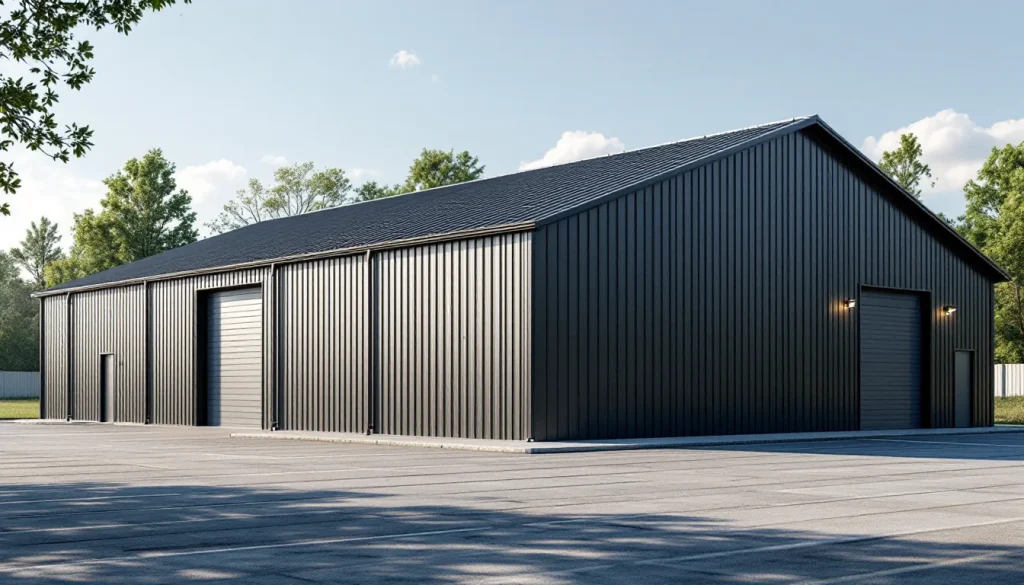
A single slope roof metal building in 2026 is a pre-engineered steel structure with one continuous pitched plane draining to a single low side, typically built at a 1:12 to 2:12 pitch and clad in standing-seam or through-fastened metal panels. The design dominates new commercial, agricultural, and self-storage construction because it costs 8% to 15% less than a comparable gable building, sheds water and snow (see our snow guards guide) predictably to one side, and gives the architect a clean roofline for solar arrays or clerestory glazing. The tradeoff is heavier purlin and rafter math at the high side, larger gutter sizing on the drainage edge, and stricter snow-load detailing in northern climates. Get the pitch, drainage, and bracing right and a Butler, Varco Pruden, Nucor, American Buildings, or Star Building Systems single-slope will outlast the tenant inside it.
The short version
- Minimum practical pitch is 1:12 for standing-seam, 1/2:12 for some membrane-clad single-slope systems. Below 1:12 you fight ponding and seam back-up.
- Snow load drives the rafter and purlin sizing more than wind in most US climates north of I-40. Verify ground snow load with ASCE 7-22 maps before you order steel.
- Drainage all funnels to one low side. Gutter capacity must be sized for the entire roof’s runoff. Undersized gutters are the most common new-build failure.
- Standing-seam panels with concealed clips outperform through-fastened R-panel for buildings over 5,000 square feet. Through-fastened is acceptable for ag and storage under 3,000 sf.
- Single-slope geometry simplifies solar panel mounting. Panel orientation aligns with roof pitch, eliminating tilt-mount hardware.
- Pre-engineered single-slope buildings from Butler, Varco Pruden, Nucor, American Buildings, and Star Building Systems ship in 6 to 12 weeks with stamped engineering for any US jurisdiction.
What a single-slope metal building actually is
A single-slope metal building has one continuous pitched roof plane that slopes from a tall front (or back) wall down to a shorter opposite wall. Unlike a gable building with two roof planes meeting at a ridge, the single-slope (also called shed-style or mono-pitch) sheds all water and snow to one drainage edge. The geometry is simple, the structural math is well-understood, and pre-engineered manufacturers have refined the cost-per-square-foot to the point that single-slope often beats gable on lots where there’s no specific reason to use a ridge.
The design works for warehouses, small industrial shops, self-storage rows, ag pole barns, equestrian arenas, retail strip centers, and a growing share of small commercial offices. The aesthetic clean-line look has also pulled it into modern residential and accessory dwelling unit projects, although that’s still a niche.
Pitch ranges and what each one does
Single-slope buildings live in a narrow pitch band. Too shallow and you get drainage problems and seam failures. Too steep and you waste steel and lose interior height utility. The table below shows the practical pitch ranges and what they’re used for.
| Pitch | Best use | Panel system | Snow climate fit |
|---|---|---|---|
| 1/4:12 to 1/2:12 | TPO/EPDM membrane single-slope, urban infill | Membrane only (not metal) | Marginal, southern only |
| 1:12 | Industrial, warehouse, light commercial | Standing-seam (concealed clip) | Acceptable to ~30 psf snow load |
| 1.5:12 to 2:12 | Most pre-engineered single-slope buildings | Standing-seam or through-fastened | Good through 60 psf |
| 3:12 to 4:12 | Ag, equestrian, pole barn | Through-fastened R-panel acceptable | Excellent, all US climates |
| 5:12 and steeper | Architectural, residential ADU, retail | Standing-seam, snap-lock, or shingles | Excellent |
The pitch decision compounds with the panel system. Standing-seam metal panels with concealed clips are rated by most manufacturers for 1/4:12 minimum on hydrostatic seams and 1:12 on hydrokinetic seams. Through-fastened panels (exposed-fastener R-panel, PBR-panel) need 3:12 minimum per most manufacturers’ warranties because the fasteners and lap joints can back up water at shallower pitches.
Snow load math you cannot skip
Single-slope roofs in snow climates fail in a specific pattern: the high side wants to dump snow toward the low side, but the steel underneath has to hold the load while it’s still up there. Unbalanced snow loading on a mono-pitch is a real engineering condition under ASCE 7-22 and the IBC, and pre-engineered manufacturers price the steel accordingly.
Ground snow load by region (typical ranges)
- Southern Sun Belt (TX, FL, AZ, southern CA): 0 to 5 psf
- Mid-Atlantic and lower Midwest (TN, NC, VA, KY, southern IL): 10 to 25 psf
- Upper Midwest and Northeast (MI, WI, OH, PA, NY, MA): 30 to 50 psf
- Northern New England (ME, NH, VT): 50 to 80 psf
- Mountain West (CO, UT, WY, MT, ID): 30 to 90 psf, very site-specific
- Alaska: 40 to 120+ psf depending on location
The pre-engineered building manufacturer will design the primary frame to the snow load you specify. If you spec the wrong number, the building gets undersized purlins, undersized rafters, and an undersized roof bracing system. Snow loads are not optional and not “approximate.” Pull the ASCE 7-22 ground snow load for your specific site from the local building department or a licensed structural engineer, then add it to the building order along with the importance factor and exposure category.
Drainage and gutter sizing (the most common failure point)
On a single-slope building, every drop of water hitting the roof drains to one side. A 60-by-100 building with a 1:12 pitch sheds 6,000 square feet of runoff into one gutter line. That’s the entire roof, not half of it. The math for gutter sizing is straightforward but routinely ignored on first-time owner-builder projects.
Gutter capacity rule of thumb
Per SMACNA and most metal building manufacturer specs, a 6-inch K-style gutter handles approximately 5,500 to 7,000 square feet of single-slope roof in a 4-inch-per-hour rainfall event. For larger buildings or higher-intensity rain climates (Gulf Coast, Pacific Northwest, Florida), step up to 7-inch or 8-inch gutters, or add a second downspout at the midpoint to halve the flow per outlet.
Downspout placement and quantity
Single-slope buildings need downspouts at least every 40 to 50 feet along the drainage edge. A 100-foot building needs three downspouts minimum, not two. The corners of the low side concentrate flow and need oversized outlets. Per IPC drainage tables, a 4-inch round downspout drains about 2,200 sf of roof at 4-inch-per-hour rain; a 6-inch round downspout drains 6,000 sf.
Internal drainage option
For large industrial single-slope buildings (over 20,000 sf), internal scupper-and-drain systems on the low side are often used in place of perimeter gutters. The scuppers cut through the low eave wall and dump into vertical drains inside the building envelope. This avoids ice damming on the low edge in cold climates and protects the gutter system from snow slide impact.
Panel system: standing-seam vs through-fastened
The two dominant panel systems for single-slope metal buildings handle water and movement very differently. The choice usually comes down to building size, climate, and budget.
Standing-seam (concealed clip)
Standing-seam panels lock together at the ribs with concealed clips that fasten to the purlin below. The clips allow the panels to expand and contract with temperature without breaking the watertight seal. McElroy Metal, MBCI, Englert, and most pre-engineered building OEMs offer standing-seam in 16-inch, 18-inch, and 24-inch widths. Standing-seam is the right choice for any commercial building over 5,000 square feet and any building with conditioned interior space.
- Hydrostatic seams (mechanically seamed, double-locked) work down to 1/4:12 pitch
- Hydrokinetic seams (snap-lock) work down to 1:12 pitch
- Thermal movement: 3/4 inch per 100 feet of panel run; clips accommodate this
- Service life: 40 to 60 years with proper coating (PVDF/Kynar 500)
- Cost: $5 to $9 per square foot for panel + clips + installation labor
Through-fastened (exposed-fastener R-panel / PBR)
Through-fastened panels are screwed directly to the purlin with exposed gasketed fasteners. They cost less, install faster, and work well for ag buildings, storage, and unconditioned shops. The downside is fastener life: the gasketed washers typically need replacement at 15 to 20 years, and the screw holes are a leak path the second a gasket fails.
- Minimum pitch: 3:12 per most manufacturer warranties (some allow 1:12 with sealant)
- Fastener count: 80 to 120 fasteners per square (100 sf) of roof
- Service life: 25 to 35 years for the panel; 15 to 20 years for the fasteners
- Cost: $3 to $5 per square foot for panel + fasteners + installation labor
For deeper comparison of metal panel profiles, see our corrugated metal roofing guide. For a head-to-head against shingle systems, see metal vs asphalt shingle roof.
Structural framing under the panels
A pre-engineered single-slope building rests on a primary frame of tapered steel rafters and columns. Purlins (Z-shapes, typically 8-inch or 10-inch) span between the rafters and support the roof panels. Eave struts run along the high and low edges. The geometry is asymmetric: the high columns carry more load than the low columns because the rafter slope concentrates gravity load toward the high side under snow.
Bracing requirements
- Roof bracing (rod bracing in panel-end bays) carries lateral loads to the columns
- Wall bracing at the end walls is required for wind and seismic loads
- Single-slope buildings need flange bracing on the bottom flange of the rafter at every other purlin in snow zones (unbalanced snow can flip load direction)
The most common structural shortcut on owner-built single-slope projects is skipping flange bracing or undersizing the rod bracing in the panel-end bays. Both show up under unbalanced snow load or 90+ mph wind events and can take down the entire building. The manufacturer’s engineering package specifies bracing exactly. Install all of it.
Insulation and condensation control
Single-slope metal buildings sweat (see our Dripstop vs. Condenstop guide) in spring and fall if the underside of the panel is uninsulated. Cold metal meeting warm interior humidity drips condensation onto whatever is below: equipment, inventory, hay bales, vehicles. The fix is one of three insulation strategies.
Vinyl-faced fiberglass blanket
Standard pre-engineered building insulation. R-13 to R-30 fiberglass roll with white vinyl vapor barrier on the room side. Installed by draping the roll over the purlins before the panels go on. Cost-effective and easy to install. R-19 is the typical commercial spec.
Rigid board over purlins
For higher R-values (R-30 to R-50), polyiso board is installed over the purlins with a vapor barrier and a second purlin layer above. Better thermal performance, no compression sag, but more expensive and adds 2 to 4 inches of stack height.
Anti-condensation factory-applied membrane
For unconditioned ag and storage buildings, factory-applied anti-condensation membranes (Dripstop, Condenstop) bond to the underside of the panel and absorb condensation droplets before they fall. Cost premium is small at the factory ($0.15 to $0.30 per square foot) and eliminates the need for blanket insulation in unconditioned applications. See our metal roof condensation guide for the full breakdown.
Solar panel mounting on single-slope
The single-slope geometry is the cleanest possible substrate for solar. Panels can mount flat to the roof plane without tilt-mount hardware, the orientation matches the roof pitch (which is often optimal in winter for northern latitudes), and standing-seam panels accept clamp-style mounts (S-5! clamps) that don’t penetrate the roof.
Standing-seam clamp mounting (no penetrations)
S-5! and similar clamps grip the standing-seam rib without piercing the panel. Solar mounting rails attach to the clamps. Zero roof penetrations means zero new leak paths and a 25-year solar install on a 40-year roof with the original watertight envelope intact. This is the gold standard for commercial single-slope solar.
Through-fastened panel solar mounting
On exposed-fastener R-panel roofs, solar mounts must penetrate the panel and seal against EPDM washer fasteners and butyl sealant. The penetrations are a future maintenance point but the installation works fine on roofs in their first 10 to 15 years of life. After that, the increased fastener density from solar mounts often coincides with the panel reaching the end of its original fastener service life, and the whole roof gets reworked at once.
Pre-engineered manufacturer comparison
The dominant US pre-engineered single-slope metal building suppliers in 2026 are Butler, Varco Pruden, Nucor (NCI Building Systems brands), American Buildings, and Star Building Systems. They sell through builder networks, ship steel pre-cut and pre-punched, and provide stamped engineering for any US jurisdiction.
| Manufacturer | Strengths | Common applications |
|---|---|---|
| Butler | MR-24 standing-seam, high-end commercial | Warehouse, distribution, industrial |
| Varco Pruden | SSR standing-seam, fast lead times | Light commercial, retail, office |
| Nucor (NCI brands) | Largest US capacity, broad price range | All segments, especially mid-size |
| American Buildings | Loc-Seam standing-seam, ag-friendly | Ag, equestrian, light industrial |
| Star Building Systems | Stargard finish, snow-zone engineering | Northern climates, cold storage |
Lead times in 2026 are 6 to 12 weeks from order to shipment for stock-sized buildings, longer for custom geometry. The builder network installs the steel, encloses the building, and handles utility tie-ins. Costs run $18 to $28 per square foot (see our cost per square foot guide) of footprint for a basic single-slope shell on a slab, before interior buildout.
Code requirements for single-slope buildings
Single-slope buildings fall under the IBC 2024 for commercial use or IRC 2024 for residential. Key code touchpoints:
- Snow load (ASCE 7-22): Ground snow load mapped by site, multiplied by exposure, thermal, and importance factors. Unbalanced single-slope snow loading rules in Chapter 7.
- Wind load (ASCE 7-22): Basic wind speed varies 90 mph (interior) to 180 mph (Gulf coast). Single-slope buildings have specific GCp coefficients for the windward and leeward edges.
- Seismic: Per IBC site-specific seismic design category
- Energy code (IECC 2024): Conditioned commercial single-slope needs R-19 to R-38 roof insulation depending on climate zone
- Fire rating: Most metal panel systems are non-combustible (Class A fire rating) by default. Verify if combined with rigid insulation.
The pre-engineered manufacturer’s stamped engineering package satisfies most jurisdictional plan review when submitted with site-specific loads. Owner-built or design-build single-slope projects often hit delays because the load values and detailing don’t match what the manufacturer assumed.
Cost breakdown: what a single-slope building actually runs
Pricing for a single-slope metal building in 2026 falls into three buckets: the steel shell from the pre-engineered manufacturer, the site preparation and foundation, and the interior buildout (if any). The numbers below are for a 50-by-80 building (4,000 sf) in a moderate snow zone (30 psf ground snow), 1.5:12 pitch.
| Item | Typical cost | Notes |
|---|---|---|
| Pre-engineered steel shell (delivered) | $45,000 to $70,000 | Frame, purlins, panels, trim, hardware |
| Foundation (concrete slab + footings) | $25,000 to $40,000 | 4-inch slab, perimeter footings, anchor bolts |
| Builder erection labor | $30,000 to $50,000 | Crane, crew, equipment |
| Insulation (R-19 blanket) | $6,000 to $10,000 | Vinyl-faced fiberglass |
| Gutters and downspouts | $3,500 to $6,000 | 6-inch K-style, three downspouts |
| Doors and openings | $5,000 to $15,000 | Walk doors, overhead doors |
| Total shell complete | $115,000 to $191,000 | $29 to $48 per sf of footprint |
Interior buildout (electrical, HVAC, finishes, partitions) adds $30 to $100 per sf depending on use. For per-square pricing on the roof component alone, see our roofing cost per square guide.
Common failures in single-slope construction
Undersized gutters and downspouts
The most common new-build failure. Owner-builder projects routinely spec 5-inch K-style gutters because that’s what the residential builder is used to. A 5-inch gutter overflows on a single-slope commercial building in any meaningful rain event. Size to 6-inch minimum, 7-inch or 8-inch for high-rain regions or large footprints.
Skipped flange bracing in snow zones
Pre-engineered drawings specify flange bracing on the bottom flange of the rafter at every other purlin. Erection crews sometimes skip this when the schedule is tight. The result shows up under unbalanced snow load when the rafter tries to roll under the asymmetric load. Inspect the steel before close-in.
Through-fastened panel below 3:12 pitch
Owner-builders spec’ing the cheaper through-fastened R-panel at 1.5:12 or 2:12 pitch because “it’ll be fine.” It’s not. Water backs up at the lap joints and through the fastener gaskets. Roof leaks start in year 3 to 5 and never go away. Use standing-seam for any pitch under 3:12.
Mismatched panel coating for the climate
Standard polyester paint coatings chalk and fade in high-UV climates (Phoenix, Las Vegas) within 8 to 12 years. PVDF (Kynar 500) coatings hold color and gloss for 30+ years and cost only 5% to 10% more at the factory. Specify Kynar in any application south of I-40 and on any building where appearance matters.
Skipped insulation in conditioned space
Code requires insulation in conditioned commercial single-slope buildings, but enforcement varies. Uninsulated metal buildings condense on the underside of the panel and rain on the contents. The fix is much more expensive after the panels are up. Insulate at install.
FAQ
What is the minimum pitch for a single-slope metal building?
For standing-seam panels with mechanically-seamed hydrostatic seams, 1/4:12 is the manufacturer minimum, with 1:12 being the practical recommendation. For snap-lock standing-seam, 1:12 is the minimum. For through-fastened R-panel, 3:12 is the warranty minimum (some manufacturers allow 1:12 with butyl sealant in lap joints, but it’s not recommended).
How long does a single-slope metal roof last?
Standing-seam panels with PVDF (Kynar) coating typically last 40 to 60 years. Through-fastened panels last 25 to 35 years, with fasteners needing replacement around year 15 to 20. The frame steel itself, once enclosed, can last 75+ years. The lifespan-limiting components are the panel coating, the fasteners, and the gutters.
What does a 50-by-100 single-slope metal building cost in 2026?
A 5,000-square-foot single-slope shell, complete (steel, foundation, erection, insulation, gutters, basic doors) runs $145,000 to $240,000 depending on snow zone, pitch, panel system, and region. Interior buildout adds $30 to $100 per square foot depending on use.
Can I put a single-slope metal building roof over an existing structure?
Yes, with engineering. Over-cladding an existing flat or low-slope commercial roof with a new pre-engineered single-slope structure is a common renovation strategy when the existing membrane is failing. The original structure becomes part of the floor system, and the new steel frame carries the new roof. Costs run 60% to 75% of full new construction.
Do I need a permit for a single-slope metal building?
Yes, in every US jurisdiction. Commercial single-slope buildings need full building permit plan review and a stamped engineering package. Agricultural buildings in some rural counties have simplified permit paths. Verify with the local building department before ordering steel because some jurisdictions require additional snow load or wind load review.
Bottom line
A single-slope metal building is the right choice when you want a clean roofline, simple drainage, easy solar substrate, and the lowest-cost-per-square-foot pre-engineered structure on the market. Get the pitch right (1:12 minimum for standing-seam, 3:12 for through-fastened), spec the snow load from ASCE 7-22 maps with no hand-waving, oversize the gutters to handle the entire roof’s runoff, and install every piece of bracing the manufacturer’s engineering package specifies. Done correctly, the building will outlast every tenant inside it.
The expensive failures (drainage backups, snow load collapse, panel system mismatch with pitch, fastener gasket failure) are all preventable at the design stage. Spend an hour with the manufacturer’s engineering team before you sign the order. That’s where the lifespan of the building gets locked in.