
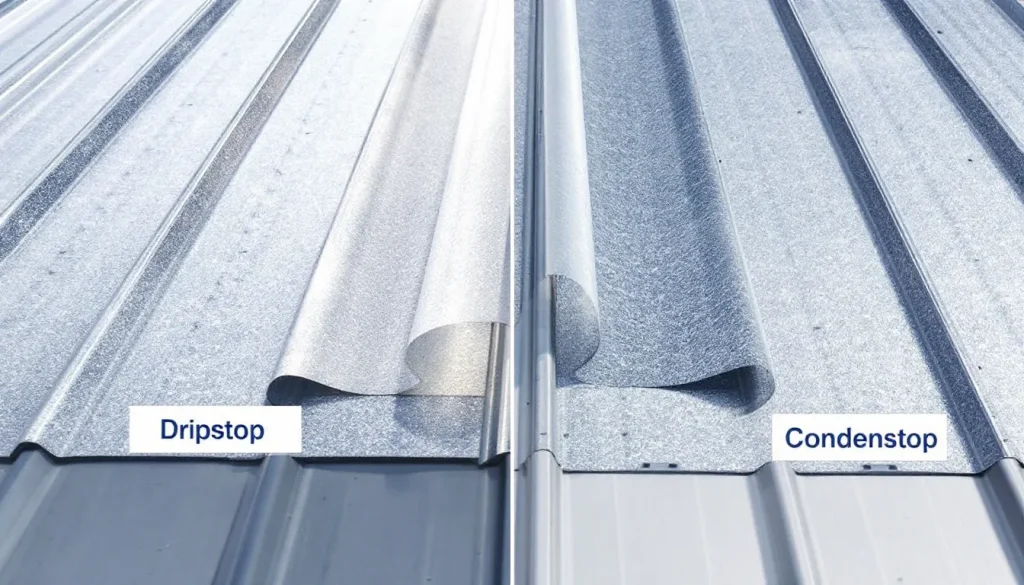
Dripstop and CondenStop are factory-applied anti-condensation membranes bonded to the underside of metal roof panels, and on the makers’ own numbers they hold about the same amount of water: up to 1,000 g/m2 for Dripstop Original and 21 lb per 100 sq ft (about 1,025 g/m2) for Fabral CondenStop. Both solve the same problem (condensation forming on the cold underside of a metal panel in an unconditioned building) with the same mechanism: a polyester fleece that soaks up overnight dew and releases it back to the air as vapor during the day. Dripstop is made by Filc in Slovenia, part of the Freudenberg Group since 2020, and is sold in the U.S. by Freudenberg Performance Materials in Durham, NC, often under rollformer names such as ABC Metal Roofing “Drip Stop” and McElroy Metal “MoistureLok”. CondenStop is made by Lantor BV in the Netherlands and appears in U.S. catalogs from Fabral and others. The practical difference is usually which brand your panel supplier runs, not absorption. Related: Heat cable for roofs.
The short version
- Both Dripstop and CondenStop are factory-bonded anti-condensation membranes for metal roof panels. Neither one adds meaningful R-value: Fabral lists CondenStop at R-0.3691.
- Dripstop (Freudenberg / Filc): up to 1,000 g/m2 for Dripstop Original, 1,500 g/m2 for Dripstop Drain and 2,500 g/m2 for Dripstop Soundcontrol, per the maker’s European product pages.
- CondenStop (Lantor BV): Fabral lists 21 lb of water per 100 sq ft, Class I flame spread per ASTM E84-04 and a 20-year no-delamination warranty.
- U.S. price evidence is thin and dated: Northland Steel quotes $0.10 to $0.15 per sq ft; Hansen Pole Buildings said in February 2022 it sells drip stop at under $0.60 per sq ft of roof surface.
- Both makers say the building must be ventilated so the fleece can dry each day. In a sealed building, neither works.
The short answer: why condensation is the problem
Metal roof panels lose heat to a clear night sky faster than the air below them, so the panel underside drops below the dew point first and water vapor in the building condenses on the bare steel. Freudenberg’s Dripstop site names the damage: corrosion of the structure, wet stored goods, and mold and mildew affecting people and livestock. In a pole barn, machine shed, carport or detached garage with no insulation, the result is “rain from the ceiling” on clear, humid nights. A membrane handles that without spray foam, batts or a sealed thermal envelope, which is why rollformers sell it as a panel option.
How the membranes work
Both products store dew temporarily and release it back to the air later in the day. The Fabral CondenStop page and the Freudenberg Dripstop pages describe the same three-step cycle:
- Absorption. When the panel drops below the dew point overnight, the fleece bonded to the underside pulls the droplets into its fibers by capillary action before they fall, into what the Northland Steel Dripstop sheet calls “specially designed pockets in the membrane”.
- Storage. The fleece holds the water. Capacity is the key spec: up to 1,000 g/m2 for Dripstop Original, and 21 lb per 100 sq ft for CondenStop per Fabral. Northland’s rule of thumb for Dripstop is about 1 quart per 10 sq ft.
- Release. As the building warms during the day, the stored water evaporates back into the air. Freudenberg’s spec block for Dripstop Original states that “for proper functioning it is necessary to allow the membrane to dry during the day” with ventilation at the ridge and gutter.
That drying step is the whole system. If the building air stays near 100% relative humidity all day, or there is no ridge and eave airflow, the fleece stays wet and the next night’s dew has nowhere to go. Lantor’s FAQ says the same thing: ventilate the building during the day. For underlayment choices on decked roofs, see our synthetic underlayment brands guide.
Side-by-side spec comparison
Every value below comes from a maker or a named rollformer document. Where a maker does not publish a figure, the cell says so.
| Spec | Dripstop (Original) | CondenStop (Fabral / Lantor) | Source |
|---|---|---|---|
| Manufacturer | Filc d.o.o., Slovenia (Freudenberg Group since 2020); U.S. office Durham, NC | Lantor BV, Netherlands | Dripstop About us; Lantor CondenStop |
| Water absorption | Up to 1,000 g/m2 (about 1 qt per 10 sq ft per Northland) | 21 lb per 100 sq ft (about 1,025 g/m2, our conversion) | Freudenberg; Northland Steel; Fabral |
| Fire / flame spread | A2-s1,d0 (EN 13501-1) on metal in Europe; UL 723 approved for flame spread and smoke in the U.S. | Class I per ASTM E84-04 | Freudenberg; ABC Metal Roofing; Fabral |
| Rain noise reduction | Up to 2 dB (ISO 140-18); Soundcontrol grade up to 6 dB | “Reduces noise”, no dB figure published | Freudenberg; Fabral |
| R-value | “Has almost none” | R-0.3691 | Northland; Fabral |
| Adhesion warranty | 20-year adhesion warranty (ABC panels) | 20-year no-delamination (Fabral); “at least 20 years” (Lantor) | ABC; Fabral; Lantor |
| Service temperature | -40°C to +80°C | Not published on Fabral page | Freudenberg |
| Standard color | Not stated on the U.S. pages | Light gray | Fabral |
| Field retrofit version | Dripstop DIY peel-and-stick roll (listed on the European site) | None listed | Dripstop DIY |
| Example U.S. panels | ABC PBR, MasterRib, Retro R; McElroy (as MoistureLok) | Fabral Grandrib 3 Plus, Grandrib 3, MP Panel (painted) | ABC; McElroy; Fabral |
On a real roof, the absorption numbers translate like this. A 1,000 sq ft roof is 92.9 m2. At Dripstop Original’s 1,000 g/m2 ceiling, that is about 93 kg, or roughly 24 gallons of storage before saturation. At Fabral’s 21 lb per 100 sq ft for CondenStop, it is 210 lb, or about 25 gallons. The two products land within about 3% of each other, so absorption alone should not decide the purchase.
Which one to choose: decision table
| If your building is… | Choose | Why (source) |
|---|---|---|
| Unconditioned, ventilated at ridge and eave, new panels on order | Whichever membrane your rollformer runs | Absorption is within about 3% (Freudenberg 1,000 g/m2 vs Fabral 21 lb/100 sq ft) |
| A roof run longer than one panel length (needs endlaps) | Ask for the supplier’s endlap detail before ordering | Fabral says CondenStop endlaps “should be avoided”; Northland fuses Dripstop at endlaps to lap length minus 1/4 in |
| Under a flame-spread spec from an insurer or code official | The product with the matching test report | CondenStop: ASTM E84-04 Class I (Fabral). Dripstop: UL 723 (ABC) |
| Noise-sensitive (hangar, arena, workshop) | Dripstop Soundcontrol, where sold | Up to 6 dB vs up to 2 dB for Original (Freudenberg, ISO 140-18) |
| High-humidity interior (livestock, wash bay) | Dripstop Drain, or add mechanical ventilation | Drain is rated up to 1,500 g/m2 with a drainage function (Freudenberg) |
| Existing roof already installed | Dripstop DIY peel-and-stick if available locally, or insulation | Factory membranes cannot be added after install (Dripstop FAQ) |
| Heated or cooled (conditioned) | Neither: insulation plus a vapor retarder | Dripstop “is not insulation”; CondenStop is R-0.3691 |
Where Dripstop wins
U.S. supply chain
Dripstop reaches U.S. buyers through rollformers that apply it at the plant. ABC Metal Roofing pre-applies it to its PBR, MasterRib and Retro R panels, and McElroy Metal states that its MoistureLok membrane is “derived from the Dripstop product line”. If your local supplier lists “Drip Stop”, “DripStop” or a house name, ask whether it is the Freudenberg product and which warranty applies.
Cost
Published U.S. prices are sparse. Northland Steel’s Dripstop sheet cites $0.10 to $0.15 per sq ft in a self-storage sales context (undated), and Hansen Pole Buildings replied to a reader in February 2022 that it sells drip stop “at under 60 cents per square foot of roof surface”. On a 1,500 sq ft pole barn that spread is $150 to $900 added to the panel order. Related: Metal roof cost per square foot.
Warranty and track record
Freudenberg dates the product to 1996 and the registered Dripstop trademark to 2006. In the U.S., ABC Metal Roofing lists a 20-year adhesion warranty on its Drip Stop panels. Read the panel warranty itself: the Northland Steel sheet warns that skipping the eave and endlap fusing step can lead to wicking, leaks and mildew, “ultimately voiding your panel warranty”.
Brand consistency
Because Dripstop is sold under several rollformer names (ABC Drip Stop, McElroy MoistureLok), the membrane may be the same while the warranty, panel profiles and prep rules differ by supplier. Compare the supplier’s own sheet, not the membrane brand, before you sign.
Product range
Freudenberg’s European line has three grades with published numbers: Original (1,000 g/m2, A2-s1,d0), Drain (1,500 g/m2, B-s1,d0) and Soundcontrol (2,500 g/m2, up to 6 dB, C-s1,d0). U.S. rollformer pages generally list a single “Drip Stop” option, so confirm which grade you are getting.
Where Condenstop wins
Absorption capacity
Lantor’s site claims CondenStop Advanced “absorbs 20-60% more moist than competitors” thanks to what it calls Microsphere technology. That is a maker claim with no published test method on the page. On the Fabral data that U.S. buyers can check, CondenStop holds 21 lb per 100 sq ft, which is about 1,025 g/m2 and essentially level with Dripstop Original’s 1,000 g/m2.
Color options
Fabral lists light gray as the standard CondenStop color, and Freudenberg describes Dripstop Original as “printable”. Neither U.S. page publishes a full color card, so if appearance matters (an exposed ceiling in a shop or event barn), ask for a sample. Related: Metal lean-to roof.
Documented flame-spread class
Fabral publishes a specific test result for CondenStop: Class I flame retardant per ASTM E84-04. For a building where an insurer or plan reviewer asks for an E84 class, that one line can save a submittal round. ABC’s Dripstop listing cites UL 723, which is the UL designation of the same tunnel test, so ask for the report either way.
Thickness for acoustic dampening
Here Dripstop actually has the stronger published numbers: up to 2 dB for Original and up to 6 dB for Soundcontrol (ISO 140-18), versus a general “reduces noise” statement for CondenStop on Fabral’s page. Most of the drumming people associate with metal comes from bare panels over open purlins, which is how most pole barns are built; our metal roof vs tile roof comparison covers rain noise on decked residential roofs.
Premium agricultural and industrial markets
Both makers claim first place: Lantor calls CondenStop “the first anti-condensation solution worldwide”, and Freudenberg calls Dripstop “the original” and the “world market leader”. Neither claim is independently verified on those pages. For a livestock or processing building, the relevant question is the supplier’s endlap rule and the grade (Dripstop Drain at 1,500 g/m2), not the marketing line.
The felt-backed alternative
Several U.S. rollformers sell a felt or fleece backing under their own names. Examples with public pages are McElroy Metal MoistureLok (Dripstop-derived per McElroy), ABC Metal Roofing Drip Stop and MetalMax Drip Stop. Treat any house-brand fleece as unknown until the supplier names the base product and gives you its absorption figure, flame-spread test and adhesion warranty in writing.
What to ask for
- Absorption in g/m2 or lb per 100 sq ft (benchmarks: 1,000 g/m2 Dripstop Original, 21 lb per 100 sq ft CondenStop)
- Flame-spread test: ASTM E84 class or UL 723 listing
- Adhesion or delamination warranty term (20 years is the published figure from ABC and Fabral)
- Eave and endlap prep: hold-back length and whether the edge is heat-fused or painted
- Which panel profiles the backing is offered on
The traditional alternative is field-installed laminated insulation or a vapor retarder under the panels. That adds a separate layer and labor, which is why McElroy and ABC both market the factory membrane as a labor saving (ABC claims “up to 25% versus traditional solutions”).
Tectum acoustic panels (a different solution entirely)
Armstrong TECTUM is an acoustic ceiling and wall panel made of aspen wood fiber held together with a cementitious binder, rated up to roughly NRC 0.85 to 0.90 depending on configuration per Armstrong. It is sometimes confused with anti-condensation membranes, but it is an interior acoustic finish for gyms, auditoriums and commercial spaces, not a dew-control layer. Use Dripstop or CondenStop for drip control and Tectum for reverberation.
What both products cannot do
They are not insulation
Fabral lists CondenStop at R-0.3691, and Freudenberg’s U.S. FAQ says plainly that Dripstop “manages moisture, not temperature”. For thermal performance you still need batts, blown-in, spray foam or rigid foam, sized to your IECC climate zone. See our insulation R-value chart for the per-inch numbers.
They cannot handle a sealed unventilated building
Freudenberg’s spec block requires ventilation “at the ridge and gutter” so the fleece dries daily, and Fabral says a properly ventilated building “is still important”. Neither maker publishes a vent ratio. A reasonable benchmark is the attic rule in IRC R806.2: 1/150 of the vented area as net free area, or 1/300 when the vents are split between high and low positions. For ventilation context on metal roofs, see our metal roof condensation guide.
They cannot replace a vapor barrier in a heated/conditioned space
If the building will be insulated and heated or cooled, the moisture control belongs in the insulation assembly: a vapor retarder on the warm side, chosen for your IECC climate zone. Freudenberg markets Dripstop for “non-climate-controlled buildings”, and McElroy says MoistureLok is not a substitute for proper ventilation and insulation. A membrane trapped inside a conditioned, sealed cavity has no daily drying cycle.
They cannot fix a leak
The Dripstop FAQ is explicit: it addresses condensation, not weather-related leaks. Water from a missed fastener, a failed endlap or a ridge closure will soak the fleece and then drip anyway. Northland Steel notes one upside: with no insulation in the way, a leak is easier to locate. See metal roof condensation for how to tell condensation from a leak.
Install considerations
Factory-bonded only
Both Dripstop and CondenStop are bonded to panels during rollforming, and the Dripstop FAQ answers “Can Dripstop be added after construction?” with “No”. The one exception is Freudenberg’s Dripstop DIY, a self-adhesive peel-and-stick roll with printed gridlines that the European site markets for existing garages, sheds and small barns. U.S. availability is not stated, so check with the dripstop.com sales office. Liquid “drip stop spray” products are a different category and were not part of either maker’s documentation.
Panel sealing remains the same
The Lantor CondenStop FAQ says panels with the fleece install with no different handling. Fabral notes a factory hold-back at side laps so the fleece does not sit inside the lap. The fleece must stay out of laps because it wicks: Northland’s sheet says capillarity is “why it does not go all the way into the lap of the panel”.
Eave drip path
The exposed fleece at the eave can pull rain back into the building. The prep rules differ by supplier:
- Dripstop, per Northland Steel: fuse the fibers on the eave overhang plus 1 in, on panel endlaps for the lap length minus 1/4 in, and on ridge cap laps for the lap length minus 1/4 in.
- Heat gun setting: 1,200°F, held about 1 in from the material and kept moving so the panel finish is not damaged. Do not fully melt the fleece, and let the panels cool before installing.
- CondenStop, per Fabral: paint the eave overhangs to seal the microfibers, and run full-length panels from eave to ridge to avoid endlaps.
- UV edge: Freudenberg says the roof edge with Dripstop must be protected from UV light.
In closed-eave installs, the soffit should be vented so the moisture released at the eave can leave the building.
Ventilation specification
Neither Freudenberg nor Fabral states a net free area ratio. Use the IRC R806.2 attic ratio (1/150, or 1/300 with balanced high and low vents) as a starting benchmark, and favor continuous ridge vent plus eave or wall openings, since that is where Freudenberg says airflow is needed. See our attic ventilation guide for the calculation method.
Climate considerations
Both membranes are sold for use worldwide (Northland says Dripstop has been used “on every continent”), but the drying step is what climate changes.
| Climate | Primary risk | What the maker documents point to |
|---|---|---|
| Hot/humid (FL, LA, TX coast) | High daytime humidity slows drying | Higher-capacity grade (Dripstop Drain, 1,500 g/m2) plus strong ridge ventilation |
| Cold/dry (MT, ND, WY) | Long nights below dew point; frozen dew | Rated to -40°C (Dripstop); eave fusing matters where snow sits at the edge |
| Marine (WA, OR coast) | Persistent dew, slow drying | Ventilation first; confirm grade and UV edge protection |
| Continental (OH, MI, IL) | Spring and fall dew cycles, freeze-thaw | Standard grade with ridge and eave ventilation |
| Desert (AZ, NV, NM) | Hot panels, fast drying | Standard grade; Dripstop’s upper service limit is +80°C |
Pricing comparison: 30×40 pole barn
For a 30×40 building, assume about 1,200 sq ft of roof surface before pitch and overhang. The add-on is priced per square foot of panel, so the math is direct:
| Price basis | Membrane add-on | Added cost on 1,200 sq ft | Source |
|---|---|---|---|
| Low published figure | $0.10 per sq ft | $120 | Northland Steel Dripstop sheet (undated) |
| High of that range | $0.15 per sq ft | $180 | Northland Steel Dripstop sheet (undated) |
| Seller’s ceiling | Under $0.60 per sq ft | Up to $720 | Hansen Pole Buildings, Feb 20, 2022 |
| Reader quote cited by Hansen | $1,600 on 2,510 sq ft ($0.64 per sq ft) | About $765 | Hansen Pole Buildings comment thread, 2022 |
For unconditioned buildings, a factory membrane is the lowest-cost drip fix on these figures, typically a few hundred dollars on a 1,200 sq ft roof. Insulation is priced separately and only makes sense if you plan to heat or cool the building. Get the membrane price as a line item on the panel quote, since these sources are two to several years old. See our corrugated metal roofing guide for panel selection.
Common questions buyers ask their rollformer
“Can you ship Dripstop on a 36-foot panel?”
Panel length is a rollformer limit, not a membrane limit; the Dripstop manufacturer FAQ says it is “compatible with standard panel dimensions produced by most rollformers”. Fabral goes further for CondenStop and recommends full-length panels from eave to ridge, so a 36-foot rafter run with no endlap is the preferred detail.
“Is the warranty separate from the panel warranty?”
Ask for both documents. ABC lists a 20-year adhesion warranty for its Drip Stop, Fabral a 20-year no-delamination warranty for CondenStop, and Lantor “at least 20 years” on the product. The panel’s paint and corrosion warranty is a separate document, and Northland warns that skipping the fusing prep can void it.
“Can I order Condenstop instead of Dripstop from McElroy?”
McElroy’s public pages list MoistureLok, which McElroy says is derived from the Dripstop product line; they do not list CondenStop. In the U.S., CondenStop appears on Fabral’s Grandrib 3 Plus, Grandrib 3 and MP Panel and on other builders’ pages. Lantor’s site has a distributor finder for other rollformers.
“Does it matter for residential applications?”
For a detached garage, carport, shed or pole barn that will stay unconditioned, a membrane is the intended use (Freudenberg’s U.S. site lists garages, carports and RV storage). For a house roof with conditioned space below, neither product is the right layer; you want insulation sized to your IECC climate zone with a vapor retarder on the warm side.
Frequently asked questions
Is Dripstop better than Condenstop?
On published maker data they are close: Dripstop Original absorbs up to 1,000 g/m2 and Fabral lists CondenStop at 21 lb per 100 sq ft (about 1,025 g/m2). Dripstop publishes more grades (Drain at 1,500 g/m2, Soundcontrol at 2,500 g/m2 and up to 6 dB), while Fabral publishes an ASTM E84-04 Class I result for CondenStop. For most pole barns, buy whichever one your rollformer applies and check the endlap and eave rules.
Does Dripstop or Condenstop replace insulation?
No. Fabral lists CondenStop at R-0.3691, and the Dripstop FAQ says it “manages moisture, not temperature”. If the building is heated or cooled, batts, blown-in, spray foam or rigid foam are still required for thermal performance.
Can I apply Dripstop to an existing metal roof?
Not the factory version: the Dripstop FAQ says it is added during panel manufacturing, not after installation. Freudenberg sells a self-adhesive Dripstop DIY roll in Europe for existing roofs; check U.S. availability with the maker. Otherwise the options are insulation under the panel or added ventilation. See our metal roof condensation guide for retrofit options.
Will Dripstop work in a sealed metal building with no ventilation?
No. Freudenberg requires ventilation at the ridge and gutter so the membrane dries during the day, and Fabral says a properly ventilated building is still important. Neither publishes a ratio; the IRC R806.2 attic benchmark is 1/150 net free area, or 1/300 with balanced high and low vents.
What’s the lifespan of Dripstop or Condenstop?
The published warranties are 20 years: ABC lists a 20-year adhesion warranty on Drip Stop panels, Fabral a 20-year no-delamination warranty on CondenStop, and Lantor “at least 20 years”. Fabral adds that CondenStop is polyester designed to last the life of the panel.
Bottom line
For a U.S. pole barn, machine shed or detached garage that will stay unconditioned, Dripstop and CondenStop perform about the same on paper (1,000 g/m2 vs about 1,025 g/m2), so buy the one your rollformer already applies. Published add-on prices run from $0.10 to under $0.60 per sq ft, a few hundred dollars on a 1,200 sq ft roof. The details that decide success are ridge and eave ventilation and the supplier’s eave and endlap prep.
Skip both if the building will be heated or cooled. For a conditioned metal building, insulation sized to the IECC climate zone with a vapor retarder on the warm side handles condensation and thermal performance together, and Freudenberg itself markets Dripstop for non-climate-controlled buildings only. For the broader diagnostic and retrofit context, see our metal roof condensation guide.