
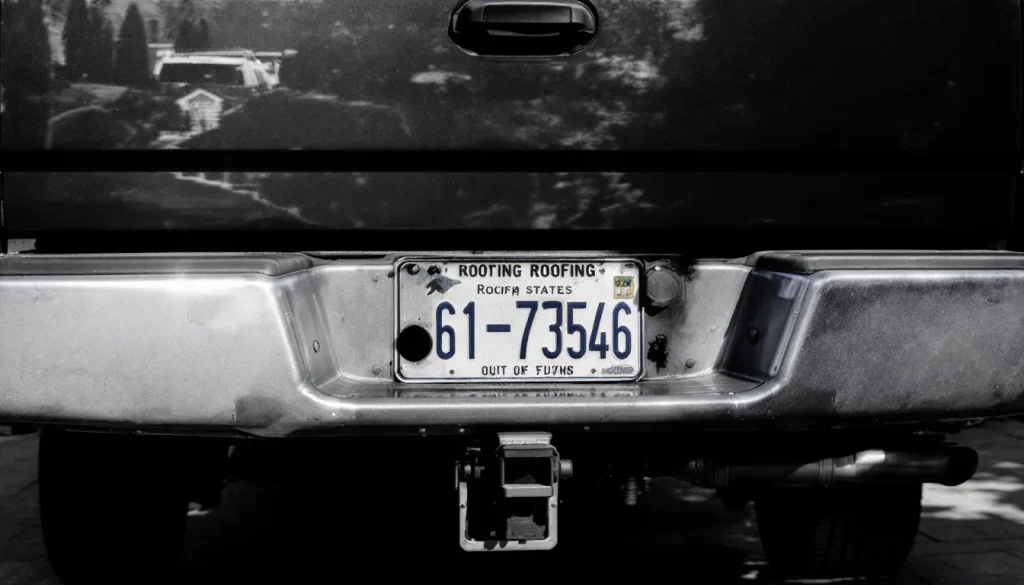
The 12 roofing contractor (for the full data set, see our the 2026 Roofing Contractor Industry Report) red flags below are storm-chaser tells: out-of-state license plates, door-knock pressure, full payment demanded up front, no permit pulled, no physical office, vague warranty language, assignment-of-benefits paperwork, cash-only deals, “free roof” insurance claim offers, supplier kickback schemes, and the disappearing-deposit pattern. Any single red flag is a yellow light. Two together is a stop sign. Three is a confirmed fraud profile. The Federal Trade Commission and most state attorneys general track these patterns because storm-chaser fraud spikes after every major hailstorm, hurricane, or tornado event, and the same handful of tactics show up every time.
The short version
- Out-of-state plates plus door-knock visit equals storm chaser. Default position is no.
- Any demand for 50% or more deposit is a cash-flow red flag. Industry norm is 10% to 33%.
- “We will work with your insurance” plus assignment-of-benefits paperwork is the insurance-fraud setup.
- No permit pulled means no inspection. No inspection means no recourse if the work fails.
- No physical office in your state means no way to enforce a warranty in 5 years.
- Cash-only deals at homeowner-favorable prices are tax-fraud setups that leave you uninsured if anything goes wrong.
The storm chaser business model
Storm chasers are roofing crews that follow major weather events from state to state, knocking doors in affected neighborhoods within 48 to 72 hours of the storm. The model works because (a) insurance claim windows are open, (b) homeowners are stressed and acting fast, and (c) the chasers will be in a different state by the time anyone tries to enforce a warranty. Some storm-chasing operations are legitimate (see our best roofing companies near you guide) national contractors with local subsidiaries. Most are not. The 12 red flags below sort the legitimate ones from the fraudulent ones.
If you are reading this after a recent storm in your zip code, slow down. The insurance carrier’s claim window is usually 6 to 12 months. You do not need to sign with the first crew that knocks. See our filing an insurance claim for roof damage guide for the timeline and our roofing scams reference for the broader fraud catalog.
Red flag 1: out-of-state license plates on the truck
The single highest-signal flag. A pickup with Alabama plates in suburban Denver three days after a hailstorm is a storm chaser, full stop. Legitimate national contractors use rental fleets or wrap-and-register local vehicles. The out-of-state (for the full data set, see our the 2026 State Roofing Code and Licensing Report) plate exists because the crew drove in from a thousand miles away, will be here for 4 to 8 weeks, and will leave when the next storm hits.
What to do: ask for the local contractor license number on the spot. In states with state-level licensing (California, Florida, Massachusetts), verify it on the license board website before they leave your porch. In states without state licensing (Texas, Ohio), ask for county or municipal registration. No registration plus out-of-state plates is a confirmed pass.
Red flag 2: door-knock visit with high-pressure close
Real local roofers do not knock doors. They run on referrals, prior customer relationships, manufacturer locator listings, and Google Maps profile traffic. A door-knock pitch is by definition unsolicited, which means the contractor needs to close the deal in a single visit because they will not get a second chance. The tells: “we can start tomorrow,” “we have a crew in your area today,” “this price is only good if you sign now,” “we found damage on your neighbor’s roof and noticed yours.”
What to do: take their card, say thank you, get three other bids. A real contractor will leave a card and follow up in a week. A storm chaser will escalate the pitch or move on within 10 minutes. The escalation itself is the data point.
Red flag 3: “free roof” or “we will handle your insurance claim”
The pitch sounds like a gift. The contractor offers to inspect the roof for free, file the insurance claim on your behalf, and “make sure you get a new roof at no cost to you.” What actually happens: they sign you to an assignment-of-benefits (AOB) document, file an inflated claim with your carrier, collect the insurance payout directly, and either disappear before the work is done or do substandard work because they have already been paid.
The AOB document is the legal mechanism. It transfers your right to receive insurance payment from you to the contractor. Florida’s legislature curtailed AOB abuse in 2019 and 2022, but the practice migrated to other states. Texas, Colorado, Tennessee, and Georgia all see significant AOB abuse. Never sign an AOB. The legitimate alternative is a direction-to-pay letter that names you as the payee, which keeps the contractor accountable to you.
Red flag 4: demand for 50% or more deposit
Industry norm in 2026 is 10% to 33% deposit, with the balance due on completion or split into materials-delivery and project-completion payments. Anything higher is a cash-flow problem. The contractor either has no working capital or is collecting deposits from multiple customers and using each new deposit to finance the previous customer’s materials. That model collapses when one customer cancels or one project goes over budget. The collapse looks like a contractor who suddenly stops showing up.
What to do: cap deposit at 33%. Pay by credit card or check, never cash. Hold final payment until the punch list is clear, the cleanup is done, and the permit is closed by the inspector. See how to negotiate roof replacement for the full payment schedule playbook.
Red flag 5: no permit will be pulled
Most municipalities require a permit for full roof replacement. The permit triggers an inspection, which is your independent confirmation that the work meets code. A contractor offering to skip the permit (“we can save you the permit fee,” “the inspector is backed up so it will just slow us down”) is dodging the inspection. Without an inspection, you have no third-party verification that the underlayment was installed correctly, the flashing was redone, the drip edge was added, or the ventilation was balanced.
The second flavor of this red flag is the owner-builder permit dodge. The contractor asks you to pull the permit yourself as the homeowner. That permit only exists for actual homeowners doing their own work. By pulling it, you are accepting liability for the work the contractor performs, which means if something fails you cannot sue them as a licensed contractor because they were not on the permit.
Red flag 6: no physical office, only a PO box or virtual address
Legitimate local roofers have a physical office, even if it is a small storefront with one employee answering phones. The office is where you go to drop off paperwork, pick up a warranty document, or pursue a complaint. A PO box or virtual mailbox is a deliberate barrier to in-person accountability. Storm chasers use them because there is no fixed location to enforce a judgment against.
Verification: ask for the office address, then drive past it. If it is a UPS Store, Mail Boxes Etc, Regus virtual office, or empty industrial unit, the contractor does not have a real local presence.
Red flag 7: vague warranty language
“Lifetime warranty” with no defined scope is marketing copy, not a warranty. A real warranty is a written document that specifies: what is covered (shingles, flashing, workmanship, labor), what is excluded (storm damage, ice dams, owner-caused damage), the duration of each coverage type (workmanship 10 years, materials 30 years, labor 5 years), and the claim process. If the contractor cannot produce that document before you sign, the warranty does not exist.
The follow-up: ask whether the warranty is contractor-issued or manufacturer-issued. Manufacturer warranties (GAF Golden Pledge, Owens Corning Platinum Protection, CertainTeed SureStart Plus) survive the contractor’s death or bankruptcy. Contractor-issued warranties do not. See questions to ask roofing contractor for the warranty-language interrogation script.
Red flag 8: cash-only at suspiciously low prices
A cash-only deal at 30% below market is a tax-fraud setup. The contractor is avoiding payroll tax, workers’ comp premiums, and income tax, which is why they can underprice the legitimate competition. Two problems for you: (1) if a worker falls, there is no workers’ comp policy, so the medical claim hits your homeowners insurance, and (2) if anything goes wrong, you have no paper trail to enforce a warranty or file a claim. The IRS does not care about the contractor’s tax evasion as much as the state attorney general cares about the consumer fraud.
Red flag 9: supplier kickback or “we have leftover materials”
The pitch: the contractor “just finished a big commercial job and has leftover premium shingles.” They will install them on your house at a discount. What is actually being sold: blemished or off-spec product, often pulled from job-site damage or a manufacturer reject pile, with no warranty coverage. Manufacturer warranties require the shingles to be purchased from an authorized distributor and installed within a defined timeframe of production. “Leftovers” violate both conditions, voiding the warranty.
The variant: the contractor offers a deep discount in exchange for letting them use your house as a “demo” or “billboard” project for the neighborhood. This pitch is almost always a deposit-collection setup. No real contractor needs your house as marketing.
Red flag 10: license number that does not check out
Every state with a roofing license has a public lookup. California CSLB, Florida CILB, Massachusetts CSL, Oregon CCB, Washington L&I. The lookup takes 30 seconds. A real contractor recites the number and waits while you check. A fraud gives a number that returns no results, a number for a different name, or a number with active complaints. Common dodges: the contractor uses the license of a relative or former employer (“I am working under my brother’s license”), which is illegal in every state. Another dodge: they give a residential builder license that does not include roofing.
Red flag 11: missing or fake certificate of insurance
The certificate of insurance (COI) names the contractor’s general liability and workers’ compensation carriers, policy numbers, coverage limits, and effective dates. Real COIs come from an insurance agent or broker, usually emailed directly. Fake COIs are PDF edits with mismatched dates, expired policy numbers, or carriers that do not exist. The verification: call the carrier listed on the COI and ask them to confirm the policy is active. The carrier will confirm or deny in 60 seconds. A contractor who refuses to authorize that verification is hiding something.
The other flavor: the contractor has general liability but no workers’ compensation. If a crew member falls without workers’ comp coverage, the injury claim defaults to your homeowners policy. Five-figure premium increases follow.
Red flag 12: the disappearing deposit
The final-stage red flag, the one you only see after you have already signed. The contractor collects a 50% deposit, delivers a partial materials drop to your driveway as proof of progress, then stops returning calls. Materials sit for 6 to 12 weeks. Eventually you discover the contractor has filed for bankruptcy or moved to another state. The materials in your driveway are owned by the supplier, not you, because the contractor never paid for them. The supplier files a mechanic’s lien on your house for the materials.
The prevention is upstream: never pay more than 33% deposit, pay by credit card so the charge is reversible, and require a conditional lien waiver from the supplier at materials delivery. The lien waiver confirms the supplier has been paid for the materials on your property. Without it, you are exposed to the lien even if you paid the contractor in full.
The combined-flag profile
A contractor with one red flag might still be legitimate. A contractor with three or more is a confirmed fraud profile and should be reported to the state attorney general. The classic combination: out-of-state plates (flag 1), door-knock pitch (flag 2), free roof through insurance (flag 3), 50% deposit demand (flag 4), and no permit (flag 5). That five-flag combination is the storm-chaser stack. It appears in every state after every major weather event.
Document the contact: photograph the truck plate, save the business card, note the date and time of the visit. If the contractor escalates pressure, the documentation supports a complaint to the state consumer protection division.
What to do if you already signed
If you signed with a contractor exhibiting these red flags and the work has not started yet, exercise the federal three-day cooling-off period (FTC Cooling-Off Rule). For door-to-door sales (see our free estimate vs. sales bait guide) over $25, you have three business days to cancel any contract in writing. Send the cancellation by certified mail and email. If they have already cashed your deposit, file a credit card chargeback within 60 days of the charge.
If work has started, stop further payment and document the work completed. Get a second roofer to inspect what is in place. File a complaint with the state attorney general’s consumer protection division and the state contractor licensing board. If an assignment-of-benefits document is involved, notify your insurance carrier in writing that you are revoking the assignment.
The post-storm timeline
Storm chasers operate on a 4-to-8-week window after a major weather event. After that, they move to the next storm zone. If you can wait 6 weeks before signing, you will filter out 90% of the fraudulent contractors automatically. The local roofers will still be there in 6 weeks. The chasers will not.
What to do in the first week: get the insurance claim filed (your carrier’s deadline matters here, usually 1 year). Document the damage with photos. Get one or two estimates from local roofers, not door-knock contractors. The estimates support the insurance claim and give you market pricing.
Related: Can a General Contractor Do Roofing? State Rules Explained
FAQ
Is every door-knock roofer a storm chaser?
No, but the base rate is high enough that the default position should be no. A legitimate local roofer almost never knocks doors. They run on referrals and inbound leads.
What if the contractor has a great Google Maps profile?
Verify the profile is real. Storm chasers create fake Google Maps profiles using virtual office addresses and paid review services. Cross-check the profile against the state license, the BBB profile, and the manufacturer certification locator. Real local contractors show up consistently across all four. Storm chasers show up only on the Google Maps profile.
Should I report a contractor showing these red flags?
Yes. File complaints with the state attorney general’s consumer protection division, the state contractor licensing board, and the Better Business Bureau. Reports are the data the AGs use to pursue enforcement. The contractor that knocked your door has likely knocked dozens of others.
Can I sue a storm chaser?
You can, but collecting on a judgment is hard when the contractor is in another state with no assets. The better strategy is to avoid signing in the first place, file a credit card chargeback if you already paid, and report the contractor to the AG.
Are out-of-state national contractors always bad?
No. Some national contractors with verified local subsidiaries, local crews, and local licenses do legitimate post-storm work. The 12 red flags sort them. A national contractor with no local license, no local office, and a 50% deposit demand is a storm chaser regardless of the brand on the truck.
Bottom line
The 12 red flags sort storm chasers from real roofers in the first 10 minutes of conversation. Any single flag is a yellow light, two together is a stop sign, three or more is a confirmed fraud profile. The load-bearing five are: out-of-state plates, door-knock pressure, free roof through insurance, 50% deposit demand, and no permit. Document any contractor showing these flags and report them to the state attorney general. For the broader fraud catalog see roofing scams, for the 21-question vetting script see questions to ask roofing contractor, and for the insurance-claim timeline see filing an insurance claim for roof damage.