
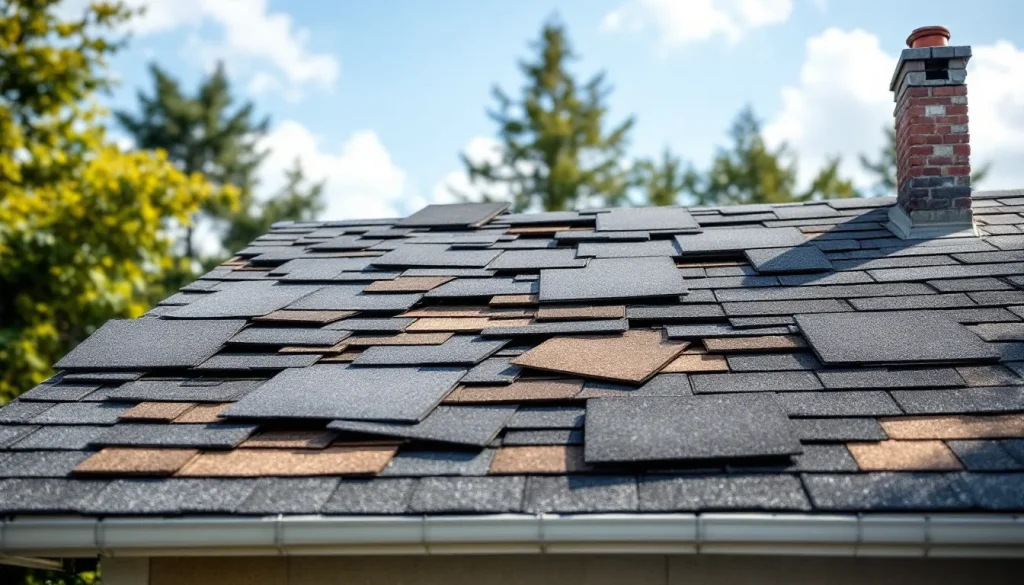
The shingles blowing off roof problem almost always comes down to one of six causes: a failed sealant strip that never reactivated after install, a hand-nailing offset error that put nails outside the strip line, edge uplift on a high-pitched slope, undersized or improperly driven nails, expired manufacturer wind coverage, or a wind event (see our the June 2026 Midwest storm outbreak guide) that simply exceeded what the shingle was rated for. Most asphalt shingles in 2026 are rated to ASTM D7158 Class H (150 mph) or Class G (120 mph), but the rating depends entirely on correct installation and an activated sealant strip. If your shingles blew off in 40 to 60 mph winds, the installation failed before the storm did. If they blew off in a 90+ mph event, the rating may have been exceeded. Either way, the immediate action is the same: tarp now, document for insurance, then call a roofer for the diagnosis.
The short version
- Six common causes: sealant strip never activated, hand-nail offset error, edge uplift, undersized nails, expired warranty, wind exceeded rating.
- Most modern architectural shingles are rated ASTM D7158 Class H (150 mph) or D7158 Class G (120 mph) with correct nailing.
- The rating only applies with 6-nail high-wind pattern, sealant activation, and starter strip at eaves and rakes.
- If shingles blew off in winds under 60 mph, the installation is at fault. Call the installer under workmanship warranty.
- If shingles blew off in 90+ mph winds, file an insurance claim. See filing an insurance claim for roof damage.
- Tarp immediately if more than 3 shingles are missing or if the underlayment is exposed. Tarp typically $200 to $600 emergency call.
What it actually is
An asphalt shingle stays on the roof through a combination of nails (6 per shingle in modern high-wind (for the full data set, see our the 2026 Severe Weather Roof Damage Report) installs) and a thermally activated sealant strip on the underside of each shingle that bonds to the shingle below. The sealant strip is the difference between a 60 mph rating and a 150 mph rating. Nails alone resist about 40 to 60 mph of uplift. Sealant strip activation pushes the assembly to 110, 120, 130, or 150 mph depending on product and install.
When shingles blow off, the failure is in one or both of those bond points. Either the nails pulled through or did not hold, or the sealant strip never bonded or has failed. The diagnosis is mostly about which one.
How to tell which case you have
Walk the roof (when safe) or use binoculars. Look at the underside of any shingle (for the full data set, see our the 2026 Shingle Brand Comparison Report) you can find on the ground after the storm. The clue is in the sealant strip.
- Sealant strip is clean and shiny. The strip never activated. This is an installation problem. Cold-weather install, shaded slope, or a manufacturing defect.
- Sealant strip has black gummy residue. The strip activated and bonded, but the bond failed. This is a wind event that exceeded the bond strength, or a sealant aging failure.
- Nail tears visible at the nail line. The nails pulled through the shingle. Undersized nails, over-driven nails, or nails outside the nail zone.
- Shingles missing along eaves or rakes. Edge uplift. Starter strip was missing, wrong, or not adhered.
- Shingles missing only on one slope. That slope took the wind hit. Common on high-pitched slopes facing the storm.
The six causes in detail
1. Sealant strip never activated
The sealant strip on the underside of a shingle is a heat-activated asphalt strip. It bonds when the roof reaches 70 to 80 degrees F for several consecutive days. If the roof was installed in cold weather (below 50 degrees F daytime highs) and the strip never reached activation temperature, the shingles are held on by nails alone and rated to 60 mph at best. The fix at install is to hand-seal each shingle with a dab of asphalt cement under the leading edge. Most installers skip this step. The strip then sits inactive through the winter, and the first spring storm (for the full data set, see the 2026 Roofing Hail and Storm Loss Database) peels the roof.
2. Hand-nail offset error
Modern architectural shingles have a clearly printed “nail zone” or “nail line” on the upper surface. Nails must go through this zone to hit the right structural part of the shingle and to allow the shingle above to overlap the heads. A common installation error is nailing too high (above the line) so the shingle below catches less of the head, or nailing too low (below the line, in the exposed area) which voids the warranty. Hand-nailed roofs with eyeballed placement are the worst offender. Pneumatic nailers used by experienced crews are more consistent.
3. Edge uplift on a high-pitched slope
Wind pressure on a roof is not uniform. The highest uplift forces are at eaves, rakes, and ridges, where the air accelerates over the edge and creates a low-pressure zone. ASCE 7 calculates these zones as 1.5 to 3 times the wind pressure of the field area. If the starter strip is missing or not properly adhered, the eave row lifts first. Once the first row lifts, the wind gets under the next row and the failure cascades upward. This is why you often see roofs that look intact in the middle but have a missing strip along one edge.
4. Undersized or wrong nails
Code (IRC R905.2.5) requires 12 gauge minimum, ring-shank, galvanized roofing nails of sufficient length to penetrate 3/4 inch into solid sheathing or fully through plywood/OSB. Common shortcuts: 1 inch nails that barely catch the deck, smooth-shank nails that pull out, or 16 gauge brads in pneumatic guns set for finer work. Any of these reduce holding power to a fraction of the rating.
5. Expired manufacturer wind coverage
Most manufacturers’ wind warranties cover the high wind rating (110-150 mph) for the first 10 to 15 years, then step down to a lower rating (60-90 mph) for the remainder of the warranty period. A 20-year-old shingle that is theoretically rated for 130 mph at install may now only be covered for 60 mph under warranty. If shingles blow off an aging roof, the manufacturer warranty likely will not pay, even though the shingle physically met spec.
6. Wind exceeded the rating
If the area got a verifiable 90+ mph gust, even a properly installed Class H shingle can fail. Hurricane Ian generated gusts over 150 mph in southwest Florida. Derechos routinely produce 80-100 mph straight-line winds. Tornadic winds over EF1 (86-110 mph) exceed most asphalt shingle ratings. In those events, the question is not “was the install good” but “what does the insurance (for the full data set, see our the 2026 State of Roofing Insurance report) policy say.”
ASTM D7158 vs D3161: what the rating actually means
| Standard | Class | Equivalent wind speed | Notes |
|---|---|---|---|
| ASTM D3161 | Class A | 60 mph | Old standard. Some 3-tab shingles still rated only to this. |
| ASTM D3161 | Class F | 110 mph | Most architectural shingles. |
| ASTM D7158 | Class D | 90 mph | Modern test, lower rating. |
| ASTM D7158 | Class G | 120 mph | Modern test, mid rating. |
| ASTM D7158 | Class H | 150 mph | Modern test, top rating. |
The ASTM D7158 standard is newer and considered more realistic. D3161 tests at a steady wind speed for 2 hours. D7158 tests against actual gust profiles. A shingle can be rated to both. When manufacturers advertise “130 mph wind warranty,” they typically mean D7158 Class G or a combined rating.
The key thing: the rating is a tested product capability. The installed performance depends entirely on whether the install used the correct nailing pattern, starter strip, and sealant activation. A 150 mph shingle installed with 4 nails (not 6) and no starter strip performs like a 70 mph shingle.
The 6-nail high-wind nailing pattern
Standard installation calls for 4 nails per shingle, driven into the nail zone. High-wind installation calls for 6 nails per shingle. The extra two nails are placed 1 inch in from each end of the shingle. This pattern is required by most manufacturers to qualify for the maximum wind warranty (130 to 150 mph).
Code in high-wind regions (Florida HVHZ, Texas Wind Borne Debris Region, coastal Carolinas) typically requires 6 nails. Outside those regions, code allows 4 but the manufacturer warranty drops to a lower wind class with 4 nails.
If you are in a wind-prone area, spec 6-nail at the bid. Cost is essentially zero extra. The labor difference between 4 and 6 nails per shingle is under 30 seconds per shingle and most quotes include this without itemization.
Tarp first: emergency cover after a blow-off
If shingles are missing and the underlayment is exposed, water is getting in or about to. Tarp the area before anything else.
- Call options. 24-hour emergency roofers ($300 to $800 typical), most insurance carriers have preferred-vendor lists, or DIY if it is reachable and safe.
- Use a heavy-duty blue or brown tarp. 6 mil minimum, 8×10 or larger. Lay it over the damaged area extending at least 4 feet beyond the damage on all sides.
- Anchor with 1×4 furring strips. Wrap the tarp edges around the strips and nail or screw the strips to the roof deck. The fasteners go through the strips, the tarp, and into solid wood.
- Run tarp up over the ridge if possible. Water sheds best when the tarp’s top edge is above the highest leak point.
- Photograph everything before tarping. Insurance will want pre-tarp photos.
Tarp is a 30 to 90 day fix while you wait for repair or replacement. Do not leave a tarp for a year. UV destroys polyethylene tarps in 6 to 9 months, and the fastener holes will leak.
Insurance: what wind blow-off claims look like
Wind damage is a named peril on virtually all homeowners policies (HO-3, HO-5). If shingles blew off in a windstorm, the claim is straightforward in principle. In practice:
- The carrier will check the local wind speed reading. NOAA, Weather Underground, or your local airport. If the official gust was under 50 mph, expect resistance.
- They will look at roof age. Over 15 years and many policies pay ACV (actual cash value) not RCV (replacement cost value). On a 20-year-old roof, ACV may be 30 to 50% of replacement cost.
- They will look at the deductible. Most policies in wind-prone states have a separate wind/hurricane deductible (1 to 5% of the dwelling coverage). On a $400k home that is $4,000 to $20,000 out of pocket before anything pays.
- They will inspect for installation defects. If the adjuster sees evidence of installation failure (no starter strip, wrong nails, hand-nail offset), they may deny on installation rather than wind.
If your claim gets denied, see roof insurance claim denied for the appeal path. The denial is often reversible with documentation, a public adjuster, or a contractor’s letter.
Repair vs. replace: when to do which
| Situation | Likely path |
|---|---|
| 3-10 shingles missing, roof under 10 years old | Spot repair with matching shingles. $300 to $800. |
| 10-30 shingles missing, roof 10-15 years old | Partial slope replacement if shingles can be matched. $1,000 to $3,000. |
| Multiple slopes affected, roof 15+ years | Full replacement. Color match impossible. |
| Sealant strip failure roof-wide | Full replacement. The whole roof is now rated to 60 mph regardless of original rating. |
| Hurricane event with major loss | Insurance-funded replacement (if covered). See best roof for hurricane. |
Matching is the silent killer. Asphalt shingles from 2010 are not available today. Even current-production shingles look different after 5+ years of UV exposure. If matching is critical (visible street-facing slope), most homeowners end up replacing the whole slope or the whole roof rather than living with a patch that does not blend.
Wind ratings by product (2026 lineup)
| Product | Wind warranty | Rating standard |
|---|---|---|
| GAF Timberline HDZ | 130 mph LayerLock | D7158 Class H, D3161 Class F |
| Owens Corning Duration | 130 mph SureNail | D7158 Class H, D3161 Class F |
| Owens Corning Duration Storm | 150 mph | D7158 Class H, D3161 Class F |
| CertainTeed Landmark | 110 mph standard, 130 mph high-wind nailing | D7158 Class G |
| Atlas StormMaster Shake | 150 mph | D7158 Class H, D3161 Class F |
| IKO Dynasty | 130 mph ArmourZone | D7158 Class H, D3161 Class F |
Almost every modern architectural shingle hits 130 mph when installed correctly with 6 nails and a starter strip. The 150 mph products require additional underlayment specifications and special nailing patterns that the installer has to follow precisely.
What about replacing a few missing shingles yourself
If the missing area is small, reachable, and you have matching shingles (sometimes the original roofer left a bundle in the attic), the DIY wind damage roof repair is straightforward.
- Carefully lift the shingle above the gap to expose the nails of the shingle below the gap.
- Slide the new shingle into the gap, aligning with the courses on either side.
- Nail through the new shingle’s nail zone with 1.25 inch galvanized ring-shank nails.
- Apply asphalt cement under the lifted shingle above to reseal it.
- Apply cement to the leading edge of the new shingle to seal it down (since the sealant strip will not activate alone).
If you do not have matching shingles, take a piece of a damaged shingle to a roofing supplier (ABC Supply, SRS Distribution, Beacon) and ask them to identify it. Most architectural shingles have a manufacturer mark on the underside.
Common mistakes that make it worse
- Reinstalling lost shingles found in the yard. The sealant strip is contaminated. They will blow off again in the next storm.
- Hammering nails too aggressively into the new shingles. Cutting through the shingle is worse than no nail.
- Skipping starter strip at eaves and rakes. First row will lift in the next storm.
- Using construction adhesive instead of asphalt roof cement. Wrong chemistry. Asphalt cement is what shingle manufacturers specify.
- Filing an insurance claim before tarp. Carriers can deny for failure to mitigate further damage.
- Settling with insurance on the first ACV offer. RCV recovery is available after replacement on most policies. See actual cash value roof.
FAQ
How much wind can a typical asphalt roof handle?
A correctly installed architectural shingle in 2026 should hold up to 110 to 130 mph, and premium products to 150 mph. The rating is product capability plus installation. Older 3-tab shingles are rated 60 to 90 mph. Realistic field performance is 10 to 30% below the lab rating because of imperfect installs.
If my neighbor’s roof is fine and mine blew off, is that proof of installer error?
Strong evidence, not proof. Wind speeds vary house to house based on terrain, tree cover, and roof geometry. But if you live on the same block, your roofs are the same age, and both had matching exposure, the differential is almost certainly install quality.
Will the insurance company cancel my policy if I file a wind claim?
Possibly. After 2 claims in 3 years, many carriers in wind-prone states non-renew. A single wind claim rarely triggers non-renewal but can trigger a premium increase at renewal. Worth filing if the claim exceeds your deductible by a meaningful margin.
Can I get a discount on insurance for installing a high-wind roof?
Yes. Florida, Texas, and most coastal states offer wind mitigation credits for Class H rated products, sixth-nail installation, secondary water barrier, and hurricane straps. The discount can be 10 to 30% off the wind portion of the premium. Get a wind mitigation inspection after install.
Why did only one slope lose shingles?
Because that slope took the storm hit. Wind pressure is directional. The slope facing the storm gets the uplift; the leeward slope gets relatively little. This pattern is normal in straight-line wind events. Tornadic events can affect all slopes.
Bottom line
Shingles blow off because of an installation defect, an aged sealant strip, or a wind event that genuinely exceeded the product rating. Most cases are installation, even when the homeowner thinks it is a storm. Tarp the damage immediately, photograph everything for insurance, then get a roofer to diagnose. If the cause is installer error and the roof is in the workmanship warranty window, the installer pays. If wind exceeded 60 mph and the roof was correctly installed, file an insurance claim and follow the path in filing an insurance claim for roof damage. For the next roof, spec 6-nail high-wind installation and an ASTM D7158 Class H product. The cost difference is trivial. The peace of mind in the next storm is worth it.