
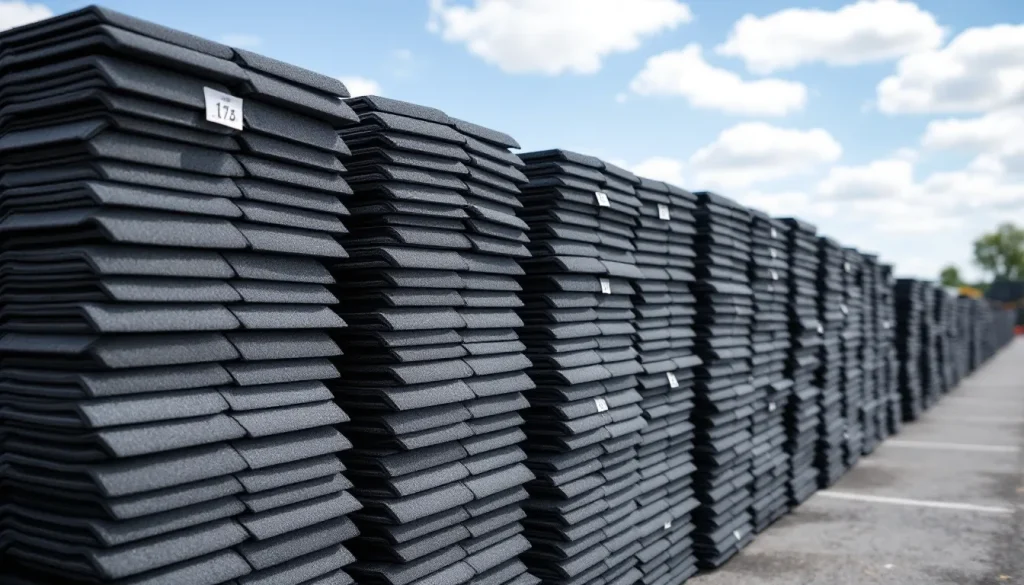
The roof shingles cost installed in 2026 runs $4 to $15 per square foot depending on the tier: 3-tab asphalt sits at $4 to $7, architectural (dimensional) lands at $5 to $8, and premium designer lines like GAF Grand Sequoia, Owens Corning Berkshire Collection, and CertainTeed Presidential Shake stretch from $8 to $15. On a 2,400 square foot home with a typical 24 squares of roof surface, that puts a full architectural reroof at roughly $18,000 to $24,000 installed, including tear-off, underlayment, drip edge, and ridge cap. The spread comes from material grade, regional labor, and how cut-up the roof is.
Last reviewed: August 2026.
The short version
- 3-tab installed: $4 to $7 per sq ft; bundles run $30 to $45 at supply, 3 per square.
- Architectural installed: $5 to $8 per sq ft; bundles run $40 to $70, 3 per square at ~33 sf each.
- Premium designer (Grand Sequoia, Berkshire, Presidential Shake): $8 to $15 installed; bundles $90 to $180.
- Waste factor: 10 to 15% on simple gables, up to 20% on cut-up roofs with hips, valleys, and dormers.
- Adders stack fast: tear-off $1.50 to $3/sf, ice and water $0.50 to $1/sf, synthetic underlayment $0.30 to $0.60/sf, drip edge $1.50 to $2.50/lf, ridge cap $4 to $8/lf, starter $1.50 to $2.50/lf.
- Regional: California and the Northeast price highest; Texas and the South Central states price lowest by 15 to 25%.
What you are actually paying for
A shingle roof quote is not one line item. It is a stack: shingles by the bundle, accessories by the lineal foot, labor by the square, plus disposal and permit. The shingle itself usually accounts for only 35 to 45% of the final number. That is why two contractors quoting the same Timberline HDZ roof can come in $4,000 apart: the cheaper one is using felt instead of synthetic, skipping ice and water in the valleys, or stapling instead of nailing. Reading the proposal line by line is the only way to compare apples to apples, which is why our new roof estimate breakdown insists on itemized adders, not lump sums.
2026 installed cost by shingle tier
Installed cost splits cleanly across the three main shingle tiers in 2026. 3-tab asphalt runs $4 to $7 per square foot, architectural (dimensional) runs $5 to $8, and premium designer lines run $8 to $15. Impact-resistant Class 4 shingles sit at $7 to $11. Lifespan climbs with price, from 15 to 20 years on 3-tab to 30 to 50 years on premium designer lines.
| Tier | Installed $/sf | Bundle price (supply) | Bundles per square | Typical lifespan |
|---|---|---|---|---|
| 3-tab asphalt | $4.00 to $7.00 | $30 to $45 | 3 | 15 to 20 yrs |
| Architectural (dimensional) | $5.00 to $8.00 | $40 to $70 | 3 | 25 to 30 yrs |
| Premium designer | $8.00 to $15.00 | $90 to $180 | 3 to 4 | 30 to 50 yrs |
| Impact-resistant Class 4 | $7.00 to $11.00 | $70 to $110 | 3 | 30 yrs |
The bundle math is the load-bearing detail most homeowners miss. A roofing square covers 100 square feet. Standard 3-tab and architectural shingles ship 3 bundles to a square, with each bundle covering roughly 33 square feet. Premium designer shingles like Grand Sequoia run heavier and thicker, so some lines drop to 4 bundles per square. If you want the underlying unit economics on bundles alone, our shingle bundle prices 2026 tracker keeps a rolling weekly supply price.
Brand-by-brand bundle pricing at the supply house, 2026
At the supply house in 2026, architectural bundles cluster tightly. GAF Timberline HDZ, Owens Corning Duration, and CertainTeed Landmark run $45 to $60 each, while IKO Cambridge and Tamko Heritage bottom out at $40 to $50. Premium designer lines jump sharply: GAF Grand Sequoia, OC Berkshire Collection, and CertainTeed Presidential Shake run $95 to $180 per bundle at three to four bundles per square.
| Brand and line | Tier | Bundle price | Per square (3 bundles) |
|---|---|---|---|
| GAF Timberline HDZ | Architectural | $45 to $55 | $135 to $165 |
| Owens Corning Duration | Architectural | $45 to $60 | $135 to $180 |
| CertainTeed Landmark | Architectural | $45 to $55 | $135 to $165 |
| IKO Cambridge | Architectural | $40 to $50 | $120 to $150 |
| Atlas Pinnacle Pristine | Architectural | $42 to $52 | $126 to $156 |
| Tamko Heritage | Architectural | $40 to $50 | $120 to $150 |
| Malarkey Vista | Architectural (Class 4 option) | $55 to $70 | $165 to $210 |
| GAF Grand Sequoia | Premium designer | $95 to $130 | $380 to $520 (4 bundles) |
| OC Berkshire Collection | Premium designer | $110 to $150 | $440 to $600 (4 bundles) |
| CertainTeed Presidential Shake | Premium designer | $140 to $180 | $560 to $720 (4 bundles) |
Supply pricing assumes contractor pickup at a regional yard like ABC Supply, Beacon, or SRS Distribution, the per-bundle reality we track in our shingle supply house pricing guide. Homeowner walk-up pricing at a big box runs 10 to 18% higher because retail margins replace the contractor rebate. Lead times have normalized in 2026: Timberline HDZ and Landmark are typically in stock, though some Malarkey Class 4 colors run two to three weeks out.
The 2,400 square foot worked example
A 2,400 square foot ranch with a simple gable roof measures larger than the home footprint because of pitch and overhangs. A 6/12 pitch ranch with 24-inch eaves typically squares out to about 2,400 sf of roof, or 24 squares. With a 15% waste factor, you need material to cover 27.6 squares, rounded up to 28 squares.
For architectural shingles at 3 bundles per square, that is 84 bundles. Buying GAF Timberline HDZ at $50/bundle delivers $4,200 in field shingles. Add hip and ridge cap (a 2,400 sf gable roof has roughly 50 lineal feet of ridge), starter strip around the perimeter and rakes (about 200 lf), drip edge (200 lf), synthetic underlayment for the full deck, and ice and water shield for the eaves and valleys.
| Line item | Quantity | Unit cost | Subtotal |
|---|---|---|---|
| Timberline HDZ shingles | 84 bundles | $50 | $4,200 |
| Hip and ridge cap (Seal-A-Ridge) | 50 lf | $6/lf installed | $300 |
| Starter strip (Pro-Start) | 200 lf | $2/lf installed | $400 |
| Drip edge (aluminum) | 200 lf | $2/lf installed | $400 |
| Synthetic underlayment | 2,400 sf | $0.45/sf installed | $1,080 |
| Ice and water shield (eaves, valleys) | 500 sf | $0.75/sf installed | $375 |
| Tear-off and disposal (one layer) | 2,400 sf | $2.00/sf | $4,800 |
| Labor to install shingles and accessories | 24 squares | $300/sq | $7,200 |
| Permit, dumpster, misc. | 1 | $650 | $650 |
| Total installed | $19,405 |
That works out to about $8.08 per square foot of roof, or $809 per square. Drop to a Tamko Heritage shingle and you save roughly $850 in materials. Step up to GAF Grand Sequoia and you add about $7,500 in shingle cost alone, putting the same job at roughly $27,000. For broader benchmarks across pitches and house sizes, the 2026 roofing cost report stacks this house against 14 archetypes.
Why waste factor is the line that surprises homeowners
Waste is not contractor padding. It is the difference between the rectangular bundles on the truck and the trapezoidal, hipped, valleyed shape of the actual roof. Every cut leaves a triangle of unusable material. A simple gable wastes 10 to 12%. A Cape Cod with two dormers and a cross gable wastes 15 to 18%. A Victorian with five hips, three valleys, a turret, and step flashing against two walls wastes 20%, sometimes more. Architectural shingles waste slightly more than 3-tab because the random shadow pattern means you cannot reuse cut-off pieces as starter or fill, and premium designer lines waste the most because the staggered exposure and thicker laminations force more deliberate cuts.
Tear-off versus overlay: the cost fork
You can either tear off the existing roof down to the deck or lay new shingles over the old (an overlay or “layover”). Tear-off adds $1.50 to $3.00 per square foot but is the only way to inspect decking, replace rotted plywood, install new ice and water shield, and qualify for most manufacturer warranties. Overlay saves the disposal cost but voids GAF’s System Plus and Golden Pledge warranties, adds roughly 400 pounds per square of dead load, and prevents leak diagnosis. Most jurisdictions cap roofs at two layers, and many 2026 code cycles (notably IRC R908) now require tear-off if any existing layer shows curling, cupping, or granule loss. See tear-off and reroof pricing for the breakdown by deck condition.
Itemized adders you should see on every quote
Every honest shingle quote breaks accessories out as separate line items rather than burying them. Expect tear-off at $1.50 to $3.00 per square foot, ice and water shield at $0.50 to $1.00, and synthetic underlayment at $0.30 to $0.60. Drip edge runs $1.50 to $2.50 per lineal foot, hip and ridge cap $4.00 to $8.00 per lineal foot, and starter strip $1.50 to $2.50 per lineal foot.
| Adder | 2026 installed price | Why it matters |
|---|---|---|
| Tear-off (single layer) | $1.50 to $3.00/sf | Required for warranty and code; double layer adds 50%. |
| Ice and water shield | $0.50 to $1.00/sf | Code in IRC climate zones 5 and up; valleys and penetrations always. |
| Synthetic underlayment | $0.30 to $0.60/sf | Replaces 15# felt; tear-resistant, walkable, UV-stable for 90 to 180 days. |
| Drip edge (aluminum) | $1.50 to $2.50/lf | Required by IRC R905.2.8.5; many old roofs lack it. |
| Hip and ridge cap | $4.00 to $8.00/lf | Matched cap shingles (Seal-A-Ridge, ProEdge) beat cut 3-tab on warranty. |
| Starter strip | $1.50 to $2.50/lf | Manufactured starter (Pro-Start, StarterMatch) beats cut shingles for wind warranty. |
| Step flashing replacement | $10 to $25/lf | Where roof meets wall; reuse is common but bad practice. |
| Pipe boots (lead or rubber) | $45 to $120 each | Lifetime lead boots cost more, last 40+ years vs 8 to 12 for rubber. |
| Ridge vent | $8 to $14/lf | Required for balanced attic ventilation under most warranties. |
| Deck replacement (CDX 1/2″) | $70 to $110/sheet installed | Budget 1 to 3 sheets per 24 squares on a typical reroof. |
Regional pricing in 2026
Labor drives 35 to 50% of the installed price, so regional wage rates and licensing requirements move the number more than material does. California posts the highest installed prices at $9 to $13 per square foot for architectural, driven by Title 24 cool-roof color requirements, prevailing wage rules in many counties, and contractor license bond costs. The Northeast (NY, NJ, MA, CT) sits at $8 to $12 because of strong union presence and winter labor scarcity. The Midwest runs $6.50 to $9. The Southeast prices at $5.50 to $8. Texas and the South Central states post the lowest installed prices at $5 to $7.50 per square foot, helped by a deep contractor labor pool, low licensing friction, and proximity to Tamko and GAF manufacturing plants in Joplin MO and Tuscaloosa AL.
Premium designer shingles: when the upcharge pencils out
Stepping from architectural to premium designer roughly doubles the shingle material cost. The math only pencils when the home value supports it. On a $300,000 ranch, putting CertainTeed Presidential Shake on the roof is a $6,000 to $9,000 upcharge that adds maybe $2,500 to appraisal. On a $900,000 traditional, the same shingle replaces what would otherwise need to be cedar shake (priced at $14 to $22 installed) and adds curb appeal that closes the gap on comparable sales. The Grand Sequoia, Berkshire Collection, and Presidential Shake lines are all SBS-modified asphalt with thicker laminations (typically 480 to 530 pounds per square versus 240 to 270 for architectural), which is why they ship 4 bundles per square instead of 3. Lifespan claims of 30 to 50 years are warranty terms; real-world replacement cycles run 25 to 35 years in most climates.
Class 4 impact-resistant: insurance arbitrage
Class 4 shingles (UL 2218 rated) cost $1 to $2 more per square foot installed but trigger insurance premium discounts of 15 to 35% in hail-prone states. In Texas, Colorado, Oklahoma, Kansas, and Nebraska, the discount alone can recover the upcharge in 6 to 10 years. Malarkey Vista and Atlas StormMaster Shake are the volume leaders. Carrier policies vary widely: State Farm, USAA, and Allstate all publish Class 4 discount schedules, but smaller mutuals (Texas Farm Bureau, Oklahoma Farmers Union) often offer the deepest cuts.
Labor: what a crew actually charges per square
Labor-only rates for shingle install in 2026 run $150 to $400 per square depending on pitch, story count, and tear-off involvement. A walkable 4/12 to 6/12 pitch single-story prices at the low end. Anything over 8/12 needs roof jacks and harnesses, pushing labor to $250 to $325 per square. Steep slope (10/12 and up) or three-story requires staging and bumps labor to $350 to $450 per square. Tear-off adds $50 to $150 per square on top of install labor. Crews typically install 20 to 30 squares per day on a simple roof, so a 24-square job is a one to two day project for a four-person crew. Our roof cost per square foot guide breaks down labor-only by metro.
How to read a quote and spot the cuts
The cheapest quote in the stack is almost always cutting one of four corners: skipping synthetic underlayment for 15# felt (saves $700 on a 24-square job), reusing existing drip edge and step flashing (saves $400 to $800), substituting cut 3-tab for manufactured hip and ridge cap (saves $200 but voids warranty on most architectural lines), or using a 25-year shingle instead of the 50-year HDZ the homeowner asked for. The four-line check: confirm shingle SKU, confirm underlayment product name (Synthetic GAF Tiger Paw or OC ProArmor versus generic felt), confirm starter and ridge cap are manufactured matched products, and confirm ice and water shield linear footage. If any of those four are missing or vague, the price is not comparable. For side-by-side review, our roof repair quotes comparison framework forces apples to apples.
Permits, dumpsters, and the line items contractors hide
Permits run $150 to $750 depending on jurisdiction. California coastal counties and most Northeast townships require a permit on any reroof; many Sunbelt cities only require one above $5,000 in work. A 20-yard roll-off dumpster runs $400 to $700 for a one-week rental and is required on tear-offs (a 24-square tear-off of architectural plus felt fills about 12 to 15 yards). Some contractors itemize, others bury it in overhead and profit. Either is fine, but if you see no dumpster line and no permit line, ask.
FAQ
How many bundles of shingles do I need for a 2,000 square foot house?
A 2,000 sf home footprint typically yields about 2,000 to 2,400 sf of roof depending on pitch and overhangs, or 20 to 24 squares. At 3 bundles per square plus 15% waste, plan on 69 to 83 bundles of architectural. Round up to the nearest full bundle; partial bundles are not returnable at most supply houses.
Is it cheaper to install shingles myself?
Materials only run 35 to 45% of the installed price, so a DIY job on a 24-square roof saves roughly $8,000 to $11,000 in labor. The real costs are the warranty (GAF and OC warranties require certified installers for full transferability), the insurance (homeowner policies do not cover injury during owner-performed roofing in most states), and the time (a four-person crew finishes in a day; a homeowner takes two weekends and a roof jack rental).
What is the cheapest 30-year shingle in 2026?
IKO Cambridge and Tamko Heritage trade the bottom slot at $40 to $50 per bundle, both carrying limited lifetime warranties (functionally 30-year). Atlas Pinnacle Pristine sits a tier above with Scotchgard granules that resist algae streaking, justifying the $2 to $5 bundle premium in humid climates.
Why does my neighbor’s roof cost less than mine for the same house?
Usually three reasons: their roof was an overlay (no tear-off), they used a 25-year shingle instead of a 30 or lifetime, or they skipped accessories (felt instead of synthetic, no ice and water, reused drip edge). Pitch and roof complexity also matter: a hip roof with the same footprint as a gable roof has 8 to 12% more surface area.
Does shingle color affect price?
Within a brand line, no; all colors price identically at the bundle. Across lines, cool-roof colors (CertainTeed Solaris, GAF Timberline CS) cost $5 to $10 more per bundle because of reflective granule technology. California Title 24 requires cool-roof shingles in many climate zones, baking that premium into the regional price.
Bottom line
On a typical 2,400 sf home with architectural shingles in 2026, expect $18,000 to $24,000 installed. The shingle itself is only $4,000 to $5,000 of that; the rest is tear-off, accessories, labor, and overhead. Three-tab is still available and runs $14,000 to $18,000 on the same house but gives up 10 to 15 years of lifespan and most modern wind warranties. Premium designer lines push the same job to $27,000 to $36,000 and only pencil on higher-value homes or as cedar shake replacements. The single biggest lever on your final price is not the shingle brand; it is the labor rate in your metro and whether the roof needs a full tear-off. Get three itemized quotes, confirm the four accessory line items (underlayment, starter, drip edge, ridge cap), and the apples-to-apples comparison falls out in 20 minutes. If you want to sanity-check the count yourself, the roof shingles calculator tool handles bundle math and waste factor in one pass.