
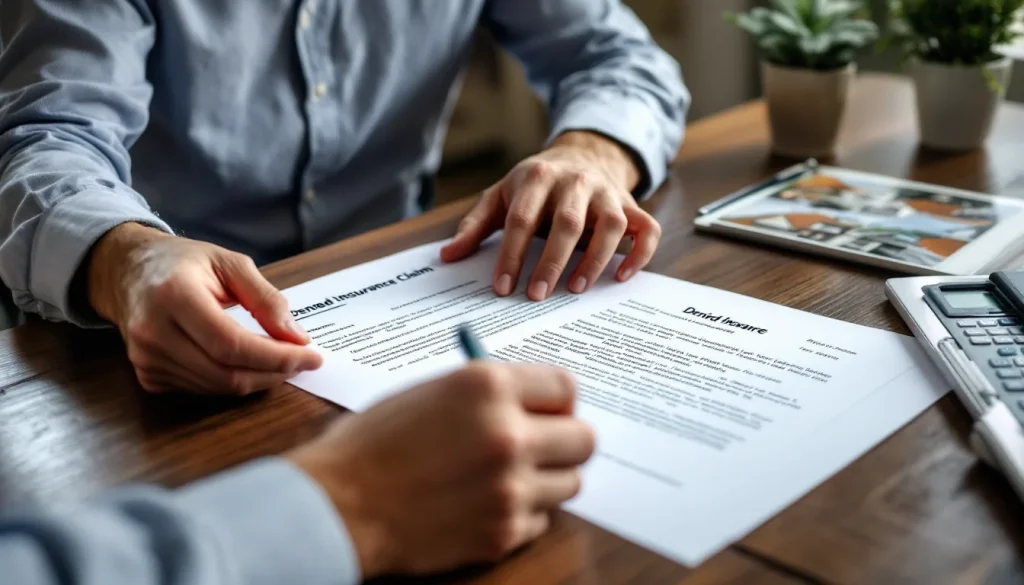
The roof insurance claim denied letter you just got almost always cites one of seven reasons: roof age exclusion (the policy will not pay for roofs over 15 or 20 years), wear and tear (carrier ruled the damage gradual, not a covered peril), partial damage (carrier offered to repair instead of replace), late filing (typically over 1 year from event), no documentation of the loss event, ACV cap that made the payout fall below the deductible, or a specific policy exclusion (cosmetic damage, named storm (see our the June 2026 Midwest storm outbreak guide) exclusion, manufacturer defect). About 60% of denied roof claims can be successfully reversed on appeal with the right documentation. The path: review the denial letter, request the adjuster report, get an independent roofer inspection, file a supplemental claim, and if needed escalate to your state Department of Insurance or hire a public adjuster. Public adjusters take 10 to 15% of the recovery (capped lower in FL and TX) and only get paid if you win.
The short version
- Seven typical denial reasons: age exclusion, wear and tear ruling, partial damage offer, late filing, no documentation, ACV under deductible, policy exclusion.
- About 60% of denials are reversible with the right appeal. The denial letter is rarely the final word.
- Always request the adjuster’s full inspection report in writing. You are entitled to it.
- Get an independent roofer’s inspection with photos, measurements, and a written estimate before appealing.
- Public adjusters take 10 to 15% of the recovery (capped at 10% in FL during emergencies, 10% in TX) and only get paid if you win.
- If the appeal fails, escalate to your state Department of Insurance. Free complaint, often resolves the issue.
What it actually is
An insurance (see our Florida residential roofing market guide) claim denial is the carrier’s formal decision that your loss is not covered under your policy. It comes as a letter (paper or email) citing the specific policy section the denial relies on. The letter is required by state law to state the reason in writing, which is what gives you the appeal hook.
The carrier (for the full data set, see our the 2026 State of Roofing Insurance report)’s reasoning is based on the adjuster’s inspection report. An adjuster (an employee of the carrier or a contracted independent adjuster) inspected the roof, documented findings, and made a coverage recommendation. The denial follows that recommendation. The adjuster’s report is the document you need to challenge.
How to tell which case you have
Read the denial letter and match it to one of these patterns. The appeal strategy depends on the reason.
| Denial reason | What it means | Appeal viability |
|---|---|---|
| Roof age exclusion | Policy excludes roofs over X years (typically 15-20) | Low. Read the schedule. Some policies cap age via separate endorsement. |
| Wear and tear | Carrier says damage is gradual, not a covered peril | High. Independent inspection often reverses. |
| Partial damage | Carrier offers repair instead of full replacement | High. Matching, code upgrade, and slope-rule arguments work. |
| Late filing | You filed after the policy’s notice deadline | Low to medium. Excuses for delay (illness, military service) sometimes accepted. |
| No documentation | Carrier says you cannot prove the loss date or cause | Medium. Weather data, neighbor claims, news reports help. |
| ACV under deductible | Depreciated value falls below your deductible | Low. Math is math, but ACV calculation can be challenged. |
| Policy exclusion | Specific clause excludes the cause (cosmetic, named storm, defect) | Varies. Read the exclusion exactly. |
The 7 reasons in detail
1. Roof age exclusion
Many carriers in storm (for the full data set, see our the 2026 Severe Weather Roof Damage Report)-prone states (FL, TX, LA, OK, AL, MS) added roof age endorsements in 2022 to 2025. Common forms:
- No coverage for roofs over 20 years (some over 15 years).
- Coverage on ACV basis only for roofs over 10 or 15 years.
- Mandatory wind/hail deductible doubled for roofs over 10 years.
If the denial cites age, read your policy declarations page and endorsements. The age clause should be explicit. If the roof is genuinely over the age threshold, the appeal is hard. If you replaced the roof more recently than the carrier has on file (they may be working off the original install date), supply the receipt and permit, and request reconsideration.
2. Wear and tear
This is the most common and most successfully appealed denial. The adjuster ruled that damage was caused by aging (for the full data set, see our the 2026 Roofing Material Lifespan Report) rather than a covered peril (wind, hail). The carrier does not cover wear and tear. The argument hinges on whether the damage is gradual or sudden.
Wear and tear denials usually happen because:
- The adjuster spent 15 minutes on the roof and called it as old shingles.
- The adjuster did not test for hail bruising (felt-test, splat marks, granule displacement).
- The adjuster used the carrier’s standardized damage threshold (8 to 10 hits per 100 sf) and your roof showed 7 hits.
The fix: get an independent roofer inspection. A roofer who is experienced with insurance work will document hail (for the full data set, see the 2026 Hail and Storm Loss Database) impact patterns, sealant strip failures from wind uplift, and impact marks on roof vents, gutters, and AC fins (which prove a storm event occurred). They will produce a written report with photos.
3. Partial damage
The adjuster acknowledges damage but only on part of the roof. The carrier offers to repair the damaged slope and pays only for that slope. Homeowners want full replacement because:
- Matching shingles 5+ years old is impossible. The repair will look different from the rest.
- Some states have matching laws (FL, NC, IA, KY) that require the carrier to pay for replacement of any part that cannot be matched.
- Building code may require code upgrades on the whole roof if more than a certain percentage is replaced (often 25%).
- Slope-by-slope replacement creates seam failures at the boundary.
Appeal arguments: cite the matching statute if you are in a matching state, request a slope-by-slope estimate that demonstrates partial replacement is impractical, and get the independent roofer to write a letter explaining why patchwork repair will fail.
4. Late filing
Most policies require notice “as soon as practicable” or within a specific window (typically 1 to 2 years from the date of loss for wind/hail). If you discover damage 18 months after the storm, the carrier may deny on timing. Florida specifically requires hurricane claims within 1 year of landfall (per FS 627.70132). Texas allows 1 year from date of loss with extensions for certain catastrophic events.
Appeal arguments: you could not have reasonably discovered the damage earlier (hidden hail damage on a high-pitch slope, etc.), serious illness or military deployment delayed filing, or the carrier’s adjuster told you to wait.
5. No documentation of the loss event
The carrier may deny if you cannot show a specific event caused the damage. The fix is supplying evidence:
- NOAA storm reports for your zip code and date.
- Local news coverage of the storm.
- Neighbor claims (your neighbor got a new roof from State Farm after the same storm. Their claim was approved. Yours should be too.).
- Hail map data from CoreLogic or HailWatch.
- Photographs of damage taken shortly after the event.
The pattern of denial often resolves once the documentation is supplied. The adjuster did not have it. You do.
6. ACV under deductible
Actual Cash Value (ACV) is replacement cost minus depreciation. On an aging roof, depreciation can wipe out most of the value. If your roof is 20 years old and ACV depreciation is 80%, a $20,000 roof’s ACV is $4,000. If your deductible is $5,000, the claim pays zero.
Appeal arguments: challenge the depreciation calculation (carriers sometimes apply higher depreciation than warranted), check if your policy is actually RCV not ACV (the carrier may have applied the wrong basis), or check if state law caps depreciation on roof claims. See actual cash value roof for the full depreciation math and how to challenge it.
7. Specific policy exclusion
Common exclusions in 2026 policies:
- Cosmetic damage exclusion. Hail dimples that do not compromise function may be excluded. Common in TX, OK, KS, NE.
- Named storm deductible. Hurricane claims may have a separate 1-5% deductible.
- Wind/hail exclusion. Some policies in coastal states have this entire peril excluded. The homeowner separately buys windstorm coverage.
- Manufacturer defect exclusion. If the damage is from defective shingles, the carrier denies and points you at the manufacturer warranty.
- Maintenance exclusion. If you failed to maintain the roof and that contributed, the carrier may deny.
Read the cited section of the policy. The exclusion has to clearly apply. Ambiguity is usually resolved in favor of the insured under contract law.
The 4-step appeal path
Step 1: Request the adjuster report in writing
Send a written request (email is fine) to your claims adjuster asking for:
- The full inspection report
- All photographs taken during the inspection
- The estimating document (Xactimate or equivalent)
- The specific policy sections cited for the denial
You are entitled to this under state insurance regulations in most states. The carrier has 30 days in most states to provide it. If they refuse, that is reportable to the Department of Insurance.
Step 2: Independent roofer inspection
Hire a roofer experienced with insurance claims (ask, “do you do insurance work?”). They charge $0 to $250 for the inspection. Many provide it free in exchange for being the contractor if the claim is approved.
The roofer documents:
- Number and pattern of hail impacts per 100 sf (test square method)
- Felt test (lifting a damaged shingle to see mat damage)
- Sealant strip failures from wind uplift
- Impact marks on collateral (gutters, vent caps, AC condensers, sidewall siding)
- Written estimate using same Xactimate format the carrier uses
Step 3: File a supplemental claim or formal appeal
Most carriers have a supplemental claim process. You submit the independent roofer’s report and request reinspection. The carrier may send out a different adjuster or a “ladder assist” (a more experienced inspector).
If supplemental fails, file a formal written appeal. The appeal letter should:
- Cite the policy provisions you believe apply
- Refute each point in the original denial
- Attach the independent roofer’s report
- Request a specific outcome (replacement, additional payment, new inspection)
Step 4: Escalate to the Department of Insurance or hire a public adjuster
If the appeal fails and you believe the denial is wrong, you have two paths:
- State Department of Insurance complaint. Free. Most states (FL, TX, GA, NC, OH) have online complaint forms. The DOI contacts the carrier, requires a written response within typically 21 days, and reviews the claim. Many appeals are resolved here without further action.
- Public adjuster. A licensed independent professional who represents you (not the carrier). Takes 10 to 15% of the recovery as their fee. Capped at 10% in FL during state-declared emergencies and 10% in TX. Worth it on claims over $10,000 where the carrier is dug in.
- Attorney. For larger disputes or bad-faith conduct. Most carriers settle before lawsuits actually file. Attorney fees may be recoverable under state bad-faith statutes (FL Florida Statute 624.155, TX Insurance Code 541, etc.).
When to hire a public adjuster
A public adjuster is worth it when:
- The claim is for $10,000 or more.
- The carrier is offering significantly less than your independent roofer’s estimate.
- The denial cites complex policy language you are not equipped to argue.
- You have already exhausted the supplemental and appeal process.
- You have neither the time nor the stomach for the process.
A public adjuster does not help when:
- The claim is under $5,000. Their fee eats most of the gain.
- The denial is on age exclusion or wear and tear with no good appeal grounds.
- The roof genuinely has no covered damage.
Verify the public adjuster is licensed in your state (every state requires it) and read reviews. The industry has both excellent professionals and bad actors.
Public adjuster fee caps by state
| State | Cap on PA fee | Notes |
|---|---|---|
| Florida | 10% for state-declared emergencies first year, 20% otherwise | FS 626.854 |
| Texas | 10% of claim amount | TX Insurance Code 4102 |
| California | No statutory cap, market typically 10-15% | License required |
| New York | Reasonable, typically 10-15% | License required |
| Most other states | Reasonable, typically 10-15% | License required |
The state Department of Insurance complaint
The DOI complaint is free and effective. The process:
- Find your state’s DOI website (each state has one).
- File a written complaint with the carrier’s name, your claim number, and the reason you believe the denial is wrong.
- Attach the denial letter, your appeal letter, and the independent roofer’s report.
- The DOI assigns a complaint specialist who contacts the carrier.
- The carrier must respond in writing within typically 21 days.
- The DOI reviews the response and either closes the complaint (in carrier’s favor) or pushes the carrier to reverse.
The carrier’s market conduct record is reviewed by the DOI for renewal of their state license. Carriers do not want a stack of unresolved complaints. The DOI complaint often produces results that direct appeal does not.
Documentation that wins appeals
Independent of the cause, these documents make appeals stronger:
- Photographs of the roof from before the loss (Google Street View, prior real estate listing photos, prior inspection reports)
- Photographs of damage taken within days of the event
- Photographs of collateral damage (gutters, vents, screens, AC fins, siding)
- NOAA storm reports showing the date and severity
- News articles or insurance industry reports confirming the storm
- Neighbor claim approvals (anecdotal but persuasive)
- The original purchase receipt and permit for the roof (proves age)
- The manufacturer warranty (proves wind rating and product class)
- Prior maintenance records (annual inspections, gutter cleaning, prior repairs)
The more documentation you bring, the harder it is for the carrier to maintain the denial.
Common mistakes that make it worse
- Accepting the first offer without question. Initial offers are typically 60 to 80% of what the claim is worth.
- Letting the carrier’s adjuster be your only inspection. Always get an independent.
- Filing a lawsuit before exhausting appeals. Most disputes resolve at appeal or DOI. Lawsuits are expensive.
- Hiring an unlicensed public adjuster. Verify license.
- Signing an assignment of benefits (AOB) without reading. AOB lets a contractor take over your claim and negotiate directly. Some are fine, some lock you out of your own claim.
- Talking to the adjuster without notes. Take notes on every call. Get every promise in writing.
- Missing the appeal deadline. Most carriers give 30 to 90 days to appeal. Read the denial letter for the deadline.
What about contractor-led “free roof” pitches
After major storms, roofing contractors knock doors offering “free roof inspections” and “I will handle your insurance for you.” Some are legitimate. Many are running schemes that include:
- Asking you to sign an assignment of benefits (AOB) that transfers your claim to them.
- Inflating damage estimates to claim more than the actual repair costs.
- Performing minimal work after collecting the insurance check.
- Disappearing before warranty work is needed.
The legitimate version: a local roofer with verifiable license, insurance, and references who inspects, documents, and offers to be your contractor if the claim is approved. The illegitimate version: a stranger from out of state with a clipboard.
Florida banned most roofing AOBs in 2023 specifically because of this fraud pattern. See our roofing scams guide for full coverage of the storm-chaser playbook.
FAQ
Can the carrier cancel my policy after I file a claim?
Mid-term cancellation is restricted by state law in most states. Non-renewal at the next policy anniversary is allowed in most cases. After 2+ claims in 3 years, many carriers non-renew in wind-prone states.
How long do I have to appeal a denial?
Most denial letters specify the appeal window (30, 60, or 90 days). State law may set a separate statute of limitations for filing suit, typically 2 to 5 years. Read your denial letter for the carrier’s deadline and do not let it pass.
Will I get a denied claim removed from my insurance record?
No. Even denied claims appear on the CLUE report (Comprehensive Loss Underwriting Exchange), which is what other carriers see when you shop coverage. The denial may affect rates for 5 to 7 years.
Does it cost anything to file a state DOI complaint?
No. The DOI complaint process is free in every state.
What if the adjuster lied or was dishonest?
Document everything. Bad-faith claims handling is actionable in most states. Florida (FS 624.155), Texas (Chapter 541), Washington, and others have explicit bad-faith statutes that allow recovery of legal fees plus penalties. Talk to an insurance attorney for valuation.
Bottom line
A denied roof claim is rarely the final word. About 60% of denials reverse on appeal with the right documentation. Request the adjuster’s report, get an independent roofer’s inspection, file a supplemental claim or formal appeal, and escalate to the state DOI or a licensed public adjuster if needed. The most common winning move is just supplying evidence the original adjuster missed. For background on the underlying issues, see filing an insurance claim for roof damage, actual cash value roof for ACV depreciation math, how much hail damage to replace roof for hail-specific thresholds, and class 4 impact resistant shingles for the upgrade that can prevent the next denial. Do not give up on a denial that does not match the facts. The appeal works more often than not.