
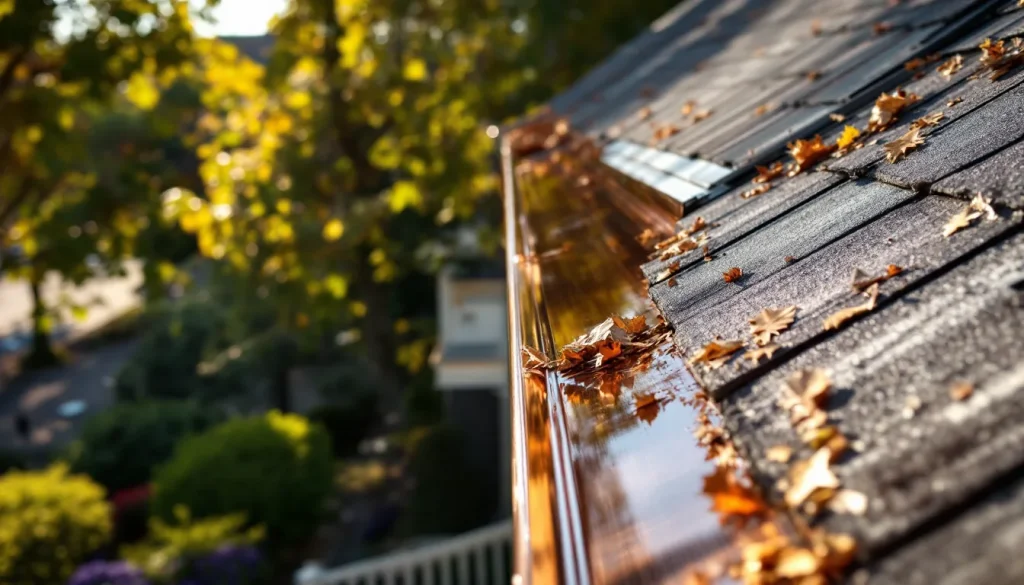
Five gutter materials dominate the 2026 residential market: aluminum, copper, galvanized or Galvalume steel, zinc, and vinyl. Each one comes with a service life, a corrosion profile, a freeze tolerance, and a price (see our 2026 gutter pricing guide) tag that you should understand before you sign anything. The wrong material on the wrong house wastes money in one of two directions: either you overpay for copper on a builder colonial that will get sold in 5 years, or you underpay for vinyl on a forever home and replace it three times in 30 years. Material choice is the single biggest lever in the gutter decision.
The short version
- Aluminum: 25 to 30 year life, $7 to $13 per foot installed, the default residential choice.
- Copper: 50-plus year life, $25 to $45 per foot installed, period-correct for traditional and historic homes.
- Galvalume or galvanized steel: 15 to 20 year life inland, 10 to 15 coastal, $9 to $16 per foot installed.
- Zinc: 50-plus year life with self-healing patina, $25 to $40 per foot installed, niche import product in the US.
- Vinyl: 10 to 15 year life if you are lucky, $4 to $8 per foot installed, brittle below 20 degrees Fahrenheit.
- Expansion coefficient matters in long runs: aluminum 0.013 inch per 10 feet per 100 degrees, copper 0.010, steel 0.007, vinyl 0.040.
- Galvanic corrosion is real: do not run copper flashings into aluminum gutters, do not run aluminum into copper.
Aluminum: the 75 percent default
Aluminum (see our rain gutter cost by material) gutters got their dominance honestly. The material is light, corrosion-proof in the chemistries it usually encounters (rain, road salt aerosol, urban air pollution), and forgiving enough that a continuous gutter machine can extrude 200 feet of it in an hour without a skilled metal worker present. The trade calls aluminum the workhorse because it is.
Standard aluminum gutter coil comes in two gauges. 0.027 inch is the residential default. 0.032 inch is the heavy-gauge upgrade, common in snow-load regions and on commercial work. The 0.032 gauge is roughly 20 percent more rigid and resists denting from ladders, ice fall, and tree branches noticeably better. The cost premium runs $1 to $2 per linear foot. On any property in the snow belt, 0.032 is the right call. On a one-story Florida ranch, 0.027 is fine.
Coil suppliers consolidated over the last decade. Spectra Metal Sales out of South Carolina is one of the two dominant aluminum gutter coil makers in the US, with a 35-year finish warranty on their painted product and 30-plus standard gutter colors to choose from. Englert is the other major name, with operations on the East Coast and Midwest and a similar product range. Both produce coil that runs cleanly through New Tech Machinery MACH II and Mark IV gutter machines, which are the two field machines that produce roughly 80 percent of US continuous aluminum residential gutter.
Service life on aluminum runs 25 to 30 years with twice-yearly cleaning. The failure modes at end of life are not corrosion (the metal is fine) but mechanical: hangers loosen, joints at corners crack from expansion-contraction cycles, paint chalks on the south face, and the front lip of the K-style profile gets bent from repeated ladder contact. By year 25 to 30 the system (see our the full roof rain gutter system guide guide) looks tired and starts dripping at the corners. By year 30 to 35 it is time for replacement.
For the cost breakdown on aluminum, see our gutter cost per linear foot guide.
Copper: the long-haul play
Copper is the only common residential gutter material with a service life that exceeds the typical homeowner’s tenure in the house. A properly installed soldered copper gutter system lasts 50 to 100 years. Period homes from the early 1900s in the Northeast and Midwest still run the original copper gutters in many cases. The metal does not corrode in any practical sense, the patina that develops over the first 7 to 15 years is protective rather than degradative, and the soldered joints, once made right, never leak.
The supply chain is small. Berridge in Texas does custom copper fabrication including K-style and half-round in 16 ounce and 20 ounce copper. Senox in Pennsylvania is a major distributor of copper coil, pre-fab sections, and downspout. Englert offers copper alongside aluminum. Most copper jobs are sectional, soldered at the seams, because continuous copper machines are rare and the metal is stiff enough that running it through a portable machine causes work-hardening problems.
The two thicknesses are 16 ounce (the residential default, equivalent to roughly 0.022 inch) and 20 ounce (commercial and high-end residential, roughly 0.027 inch). 20 ounce copper is more rigid, more expensive, and is the right call on long runs or in regions with heavy snow and ice loading.
Patina timeline: brown in year 1, dark chocolate brown by year 3 to 5, green verdigris emerging by year 7 to 15 depending on local humidity and air chemistry (faster in coastal and industrial areas, slower in dry inland). The patina is a self-protective layer of copper sulfate and copper carbonate compounds. It cannot be reliably accelerated by chemical treatment, despite the products that claim otherwise. If you want it lacquered for an extended bright-copper period, lacquer fails in 3 to 5 years and requires reapplication.
The choice between copper half-round and copper K-style is largely architectural. See k-style vs half-round gutters for the capacity and style comparison.
Galvalume and galvanized steel: the inland workhorse
Steel gutters have a corrosion-protection coating because bare steel rusts within months of exposure. The two common coatings are galvanized (zinc only, the older standard) and Galvalume (aluminum-zinc-silicon alloy, the modern standard developed by Bethlehem Steel in the 1970s). Galvalume has roughly 2 to 4 times the corrosion life of plain galvanized in equivalent conditions.
Both coatings rely on the principle of sacrificial protection: the coating metal corrodes preferentially to the steel underneath, even at scratch points and cut edges. As long as the coating layer remains, the steel is protected. When the coating wears through, usually at cut edges, fastener penetrations, and corners where the coating breaks during forming, the bare steel below starts to rust.
Service life by region:
- Inland Midwest, Mountain West, interior Northeast: 15 to 20 years for Galvalume, 10 to 15 for galvanized.
- Pacific Northwest interior, Southeast inland: 12 to 18 years for Galvalume, 8 to 12 for galvanized.
- Coastal (within 5 miles of saltwater): 10 to 15 years for Galvalume, 6 to 10 for galvanized. Often less.
- Industrial regions with acid rain exposure: 10 to 15 years for Galvalume.
The advantages of steel over aluminum are rigidity (steel handles ice and snow loading without deforming) and dimensional stability (low thermal expansion). The disadvantages are weight (steel is roughly 3 times denser than aluminum), eventual corrosion at cut edges and joints, and the fact that most steel gutters are sectional rather than continuous because gauge requirements are too high for portable machines.
Steel makes the most sense matched to a standing-seam metal roof of the same coating system. The metallurgy stays consistent and the appearance unified.
Zinc: the European import
Zinc gutters are common in central Europe, where they have been the dominant residential material for over 100 years. They are a niche product in the US, available through Drexel Metals, importers of VMZINC (a LafargeHolcim subsidiary) and Rheinzink (a German manufacturer), and a small number of specialty distributors.
Zinc has two real performance advantages over aluminum and copper. First, it self-heals: small scratches, dents, and cut edges oxidize over and form a protective zinc carbonate layer within 6 to 24 months. The implication is that you do not have to fuss about field damage during install or maintenance. Second, the patina is gray to dark gray, not green, and many architects prefer the look for modern and contemporary residential work where the green verdigris of copper would look wrong.
Service life on zinc is 50 to 100 years with no coating maintenance. The chemistry is mature: zinc roofs on European churches and civic buildings have demonstrated service lives of 150 years. The metal is roughly 30 percent denser than aluminum and forms similar to copper.
The challenges with zinc in the US market are price ($25 to $40 per linear foot installed) and installer scarcity. Aluminum gutter crews rarely know zinc. The forming, soldering, and detailing technique is closer to copper than aluminum. Vet the installer for actual zinc experience before signing.
Vinyl: the price-led option
Vinyl gutters are PVC extrusion sold in 8-foot and 10-foot sections at home centers. They cost $4 to $8 per linear foot installed, which makes them the cheapest option on the board. They have one redeeming use case: rental properties where the owner intends to replace every 8 to 12 years and never wants to spend more than $1,000 to $1,500 on the system.
The three failure modes that show up reliably:
- Cold-weather brittleness. PVC stiffness increases sharply below 20 degrees Fahrenheit. A bump from a ladder, a falling branch, or even normal expansion-contraction cycles at joints crack the gutter. Repair is fast but happens often.
- UV chalking. Exposed PVC loses surface gloss and becomes chalky white within 5 to 8 years on the south face. The structural strength is fine but appearance degrades.
- Joint failure. Vinyl uses snap-together joints with gaskets. The gaskets dry out and harden within 5 to 7 years. Leaks emerge at every joint.
The thermal expansion coefficient of vinyl is roughly 3 times aluminum and 4 times copper. On a 30-foot run, vinyl moves 0.36 inches between a 40-degree summer day and a 0-degree winter day. The slip-joint connectors are designed for this movement but they wear out cycling that much over years. Aluminum moves 0.09 inches over the same temperature range and accommodates the movement easily at corner joints.
Material comparison at a glance
| Material | Service life | Cost ($/lf installed) | Weight (lbs/lf, 5-in K-style) | Thermal exp. (in/10ft/100F) | Best use case |
|---|---|---|---|---|---|
| Aluminum 0.027 | 25 to 30 yr | $7 to $13 | 0.45 | 0.013 | Default residential |
| Aluminum 0.032 | 27 to 32 yr | $9 to $15 | 0.55 | 0.013 | Snow-load regions |
| Copper 16 oz | 50 to 100 yr | $25 to $45 | 1.40 | 0.010 | Traditional, historic homes |
| Galvalume steel | 15 to 20 yr inland | $9 to $16 | 1.55 | 0.007 | Matches metal roof |
| Zinc | 50 to 100 yr | $25 to $40 | 1.85 | 0.013 | Modern, contemporary, self-healing |
| Vinyl | 10 to 15 yr | $4 to $8 | 0.30 | 0.040 | Rental, short-term ownership |
Galvanic corrosion: the dissimilar metal trap
When two dissimilar metals contact each other in the presence of moisture, the more reactive metal corrodes faster than it would in isolation. This is galvanic corrosion, and it shows up in gutter systems more often than most homeowners realize. The classic case: a copper chimney flashing or a copper roof valley draining into an aluminum gutter. The runoff carries copper ions into the aluminum, and the aluminum corrodes through within 3 to 7 years instead of 25 to 30.
The rule: do not mix metals downstream. If you have copper flashings or copper roof penetrations, the gutter that catches their drainage should be copper. If you have aluminum gutter, the flashings draining into it should be aluminum, painted steel, or any non-noble metal. Stainless steel is acceptable as an intermediate.
This also applies to fasteners. Steel screws into aluminum gutter cause galvanic corrosion at the fastener point. Use aluminum, stainless steel, or coated fasteners. Copper systems use brass or copper fasteners exclusively.
On a remodel where you are keeping copper flashings and replacing failed gutters, the right answer is copper gutters. The wrong answer is aluminum gutters that will fail in a decade.
Freeze tolerance and ice loading
In the snow belt, gutters carry static loads of ice and dynamic loads of snow sliding off the roof. Material rigidity and hanger spacing both matter.
- Vinyl: Brittle below 20F. Cracks under ice load. The wrong choice in any region that sees real winter.
- Aluminum 0.027: Will deform under heavy ice load. Hanger spacing must close to 18 to 24 inches in snow regions to compensate.
- Aluminum 0.032: Holds up well to ice load with hanger spacing of 24 inches. The right aluminum spec for snow regions.
- Steel (Galvalume): Rigid enough to handle heavy ice without deformation. Good snow-region choice.
- Copper: Soft metal but rigid enough at 20 ounce gauge with proper hanger spacing. Common in Northeast historic homes that see real winter.
- Zinc: Similar to copper. Rigid enough at proper gauge and spacing.
Heated cable systems can keep gutters clear of ice when material and spacing are not enough. See heated gutter cable for the install detail and cost.
Coastal corrosion
Saltwater aerosol corrodes aluminum, steel, and zinc at meaningfully accelerated rates within 5 miles of the coast and severe rates within 1 mile. Copper handles salt air better than any of the others because the patina layer is protective against chloride attack.
Practical implication for coastal Florida, Carolinas, California, and similar:
- Aluminum service life drops from 25 to 30 years inland to 18 to 22 years coastal.
- Galvalume steel drops from 15 to 20 years inland to 10 to 15 coastal.
- Copper holds up at 50-plus years anywhere.
- Vinyl is unaffected by salt corrosion but degrades under coastal UV faster than inland.
If you are within a mile of saltwater and you want a 30-plus year system, the answer is copper. If you want a 15 to 20 year system at lower cost, aluminum 0.032 with twice-yearly fresh-water rinses extends life.
The expansion-contraction problem on long runs
Materials expand and contract with temperature, and gutter sections that are too long for their material crack at corners or pull fasteners. Linear thermal expansion coefficients (in/10ft/100F change):
- Aluminum: 0.013
- Steel: 0.007
- Copper: 0.010
- Zinc: 0.013
- Vinyl: 0.040
The implication on a 40-foot continuous aluminum gutter run that sees an 80-degree summer-to-winter temperature swing: the gutter moves 0.42 inches. Hidden hangers with sliding clips, rather than rigid fasteners, accommodate this movement. Expansion joints in long copper runs are standard practice on commercial work and on residential runs over 50 feet. Aluminum residential rarely needs expansion joints on runs under 60 feet because the movement is small enough to absorb at corner joints.
Vinyl needs slip joints every 10 feet because its expansion is 3 to 4 times higher than metal. Hence the section length of 8 to 10 feet, with sleeves at every joint. Each sleeve is a leak risk.
Matching the material to the architecture
Material choice is partly performance, partly architectural fit. Some pairings are obvious:
- 1900 to 1940 traditional, Tudor, colonial revival, craftsman: Copper half-round is the period-correct choice. Aluminum K-style looks anachronistic.
- 1950 to 1980 ranch, split-level, contemporary tract: Aluminum K-style is the right call. Anything else is overkill.
- 1980 to 2010 vinyl-sided builder colonial, McMansion: Aluminum K-style. Period. Copper looks wrong.
- 2010 to 2026 modern, contemporary, mid-century revival: Aluminum K-style or zinc half-round. Sometimes copper half-round on high-end modern work.
- Metal-roofed (standing seam) home: Galvalume steel gutter to match, or aluminum painted to match the roof color.
- Coastal contemporary: Copper if budget allows. Aluminum 0.032 if not.
The install and service interaction
Material choice interacts with install detail and ongoing service. Premium materials warrant premium install and zero shortcuts. Vinyl gets minimum-spec install because the system will be replaced before any of the corner-cutting matters.
For the full install detail, see rain gutter install guide and gutter installation. For ongoing maintenance scheduling and cost, see gutter cleaning cost and schedule. For the system that connects gutters to roof edge, see drip edge and fascia board. For full-roof pricing context, see roofing cost per square. For the broader library, browse learn.
The right material for your house
If you are reading this trying to decide and you do not want to read the rest:
- Own the house for 10-plus years, standard 1960s through 2010s residential architecture, inland climate: Aluminum 0.027 or 0.032 K-style. Done.
- Own a pre-1940 traditional, historic, or craftsman, plan to stay 15-plus years: Copper 16 ounce half-round. Period correct, lifetime install.
- Modern or contemporary, want zero patina maintenance, willing to spend: Zinc.
- Rental property or 5-year ownership horizon: Vinyl is acceptable. Aluminum is still better at modest cost premium.
- Standing seam metal roof: Galvalume steel gutter to match.
The material decision sets the trajectory for the next 20 to 50 years of your house. It is one of the few decisions where the more expensive option is almost always the right financial call over the ownership horizon.