
Last reviewed: September 2026.
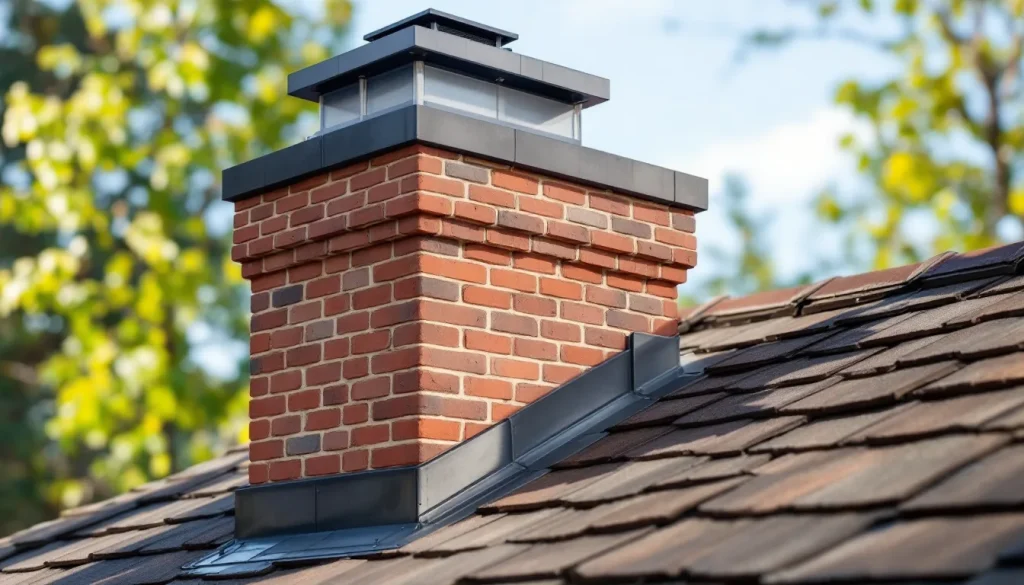
A correct chimney flashing installation is a four-part system, not a single piece of bent metal. Apron at the bottom, step flashing woven up both sides, counter flashing reglet-mounted into the masonry on all four faces, and a cricket framed on the uphill side of any chimney wider than 30 inches per IRC R1003.20. Skip any one part and the chimney becomes the highest-failure leak point on the roof. The sequence is fixed: ice and water shield first, then apron, then step flashing woven into the shingle courses one piece per course, then counter flashing tucked into a sawn reglet and sealed, then the cricket framed, sheathed, membrane-lined, and metal-clad. Most chimney leaks trace back to one of three shortcuts: continuous L-channel instead of woven steps, face-nailed counter flashing into brick instead of a reglet, or no cricket at all on a wide chimney. None of those shortcuts save more than 30 minutes of labor and all three create leaks within two to five seasons.
The short version
- Chimney flashing has 4 parts: apron (front), step (sides, one per shingle course), counter (over the step, reglet-mounted), cricket (uphill side, required >30 in wide).
- Sequence: ice and water shield, apron, step flashing woven course-by-course, counter flashing into mortar reglet, cricket framed last.
- Step flashing standard: 4×4-inch bent at 90 degrees, 24 to 26 gauge galvanized, copper for premium.
- Apron flashing: 6-inch leg up the chimney face, 4-inch leg out onto the roof minimum.
- Counter flashing is sawn or ground into a mortar joint (reglet), never face-nailed into brick.
- Cricket required by IRC R1003.20 for chimneys wider than 30 inches; minimum 1:2 slope.
- Install cost: $800 to $2,200 for a full four-part rebuild on a 30-to-48-inch chimney.
Why chimneys leak more than any other roof penetration
A chimney is the worst geometry on the entire roof. It is a vertical box that breaks the roof plane on all four sides, and unlike a vent pipe (round, small, one flashing piece) or a skylight (small, sealed perimeter, manufactured curb), a chimney has four faces, four corners, two different exposure conditions (the uphill face takes the runoff from the entire roof above it, the downhill face takes nothing), and is built out of porous masonry that absorbs water itself. Get the flashing sequence even slightly wrong and water finds its way behind the metal at one of the corners or behind the counter flashing on the high side.
The four-part system exists because no single piece of bent metal can handle all four conditions. The downhill face needs apron flashing to deflect water out onto the roof. The two side faces need step flashing woven into the shingles to handle water that runs down the chimney wall. The uphill face needs a cricket because otherwise it dams water and debris against the masonry, and the entire system needs counter flashing on top to seal where the masonry meets the bent metal. Take any of the four out and the system fails. The diagnostic for which part is failing on an existing chimney is in our chimney flashing leak repair guide; this piece covers the install from scratch.
What you need before you start
Materials for a typical 30-by-30-inch brick chimney on an asphalt shingle roof: roughly 12 to 16 feet of 24-gauge galvanized step flashing pre-bent to 4 by 4 inches, an 8-foot piece of 24-gauge L-stock for the apron, 16 to 20 feet of 24-gauge counter flashing pre-bent with a hem, a roll of 36-inch ice and water shield, 1×4 lumber and 1/2-inch sheathing for the cricket framing, polyurethane sealant (Geocel 2300 or NPC Solar Seal 900), and stainless ring-shank roofing nails or 1.25-inch galvanized roofing nails. Copper upgrades the entire kit at roughly 2.5x to 3x the material cost but doubles the service life.
Tools: cold chisel and 4-pound hammer (or a 4.5-inch grinder with a diamond blade) for cutting the reglet, tin snips, hand seamer (folding pliers), caulk gun, chalk line, framing square, circular saw, and a brick chisel for popping individual courses if you find rotten mortar. For new construction the reglet often gets cut into the brick before the mason finishes the joints, but on a retrofit you are cutting a fresh groove into existing mortar.
Step 1: ice and water shield underlayment
Before any metal touches the roof, the entire base of the chimney gets self-adhered ice and water shield, lapped up the chimney face 6 inches minimum and out onto the deck 12 inches minimum on all four sides. On the uphill side the membrane needs to extend at least 24 inches up the slope to back up the cricket. This is the second line of defense behind every flashing piece you install next; if water ever gets past the metal, the membrane catches it and routes it back out onto the shingle course below. For a primer on the membrane itself see our peel and stick underlayment guide and ice and water shield overview.
Step 2: apron flashing on the downhill face
The apron is the first metal piece installed. It is a continuous L-channel bent so one leg sits flat on the roof under the next shingle course up, and the other leg runs up the chimney face. Minimum dimensions: 6-inch vertical leg up the chimney, 4-inch horizontal leg out onto the roof. Length: the full width of the chimney face plus 4 inches on each side so the corners can be hand-bent around the chimney corners to begin the transition to the step flashing on the sides.
The horizontal leg gets nailed to the deck at the top edge only (so the shingle course covers all the fasteners) with two or three nails. The vertical leg up the chimney face does not get face-nailed into the brick; the counter flashing covers it later and holds it in place. Bed the underside of the horizontal leg in a continuous bead of polyurethane sealant against the underlayment so wind-driven rain cannot creep under it. The first shingle course laid over the apron should be cut and trimmed so the front lower edge of the shingle is 1 to 2 inches above the apron bend, giving a clean line that sheds water onto the next course down.
Step 3: step flashing woven into the shingle courses
This is where most failed installs go wrong. Step flashing is installed one piece per shingle course, woven into the courses as they go up. Each piece is 4 inches by 4 inches bent at 90 degrees, with one 2-inch leg lying on the roof and one 2-inch leg up the chimney face. The piece below each new shingle course laps over the piece in the course below by at least 2 inches. The horizontal leg of each piece gets one nail at the top edge into the deck (never through the vertical leg into the chimney). Then the next shingle course gets laid over the top, covering the horizontal leg. Then the next step piece. Then the next shingle. Continuing all the way up both sides of the chimney to the uphill corners.
The mistake that gives chimneys their reputation as leak sources is using a single continuous L-channel along the chimney side instead of weaving individual step pieces. The continuous piece is faster to bend and faster to install, but every shingle joint along its length is a potential leak path because there is no overlap forcing water back out. The woven system, properly executed, lets water hit the chimney face, run down to the next step piece, get deflected out onto the shingle course below, and continue down the roof. The continuous-channel system traps water at every shingle joint and feeds it under the metal. For the full step-by-step on weaving sequence see our dedicated step flashing installation guide.
Step 4: counter flashing into the masonry
Counter flashing is the cap that covers the vertical legs of the step flashing and the apron, tucked into a sawn or ground reglet in the chimney mortar. The reglet is a horizontal groove cut into the mortar joint 6 to 8 inches above the roof deck, deep enough to accept 1 inch of the counter flashing top edge. Cut the reglet with a 4.5-inch grinder and a diamond blade, vacuum out the dust, then bend the top edge of the counter flashing into a hem so it can be tucked into the groove and held in place by friction plus sealant.
The counter flashing is fabricated in stepped pieces that follow the slope of the roof on the chimney sides, with a continuous straight piece on the front (apron side) and a straight piece on the back (cricket side). Each stepped piece on the sides covers two to three shingle courses worth of step flashing. The top hem tucks into the reglet, the reglet gets back-filled with polyurethane sealant (not silicone, which fails on masonry), and the lower edge of the counter flashing laps down over the vertical leg of the step flashing by at least 2 inches. The counter flashing is never face-nailed into the brick. Fastener holes in brick become leaks within a few freeze-thaw cycles. Friction in the reglet plus sealant plus the hem holding the piece against the wall is what holds it in place. Full reglet detail in our counter flashing guide.
Step 5: cricket on the uphill side (required >30 in)
Any chimney wider than 30 inches on the side facing up the slope is required by IRC R1003.20 to have a cricket framed on the uphill side. The cricket is a small framed peak that diverts water around the chimney instead of letting it pool and dam against the upslope face. Without a cricket, the uphill face of a wide chimney collects leaves, pine needles, and ice every winter, holds water against the brick and the flashing, and rots the deck behind the chimney within five to ten years.
Construction sequence: frame the cricket (roof saddle) with 2×4 ridge and 1×4 rafters from the back face of the chimney up to a peak that meets the roof slope cleanly (minimum 1:2 slope on the cricket itself), sheath it with 1/2-inch plywood or OSB, lay ice and water shield over the entire cricket and 6 inches up the chimney face, then flash the cricket itself with two pieces of sheet metal joined at the cricket ridge with a 6-inch overlap and either soldered (copper) or hand-folded and sealed (galvanized). The bottom edges of the cricket flashing get woven into the regular shingle courses on either side of the chimney like step flashing. The top edges run up the chimney face and get covered by the back counter flashing. Cricket-specific install detail is in roof cricket design and install and our chimney cricket install piece. For a roof-saddle treatment on dormers and other obstacles, see roof saddle installation.
Step 6: corner detail (the highest-failure point)
The four corners of the chimney where the apron meets the step flashing on the sides, and where the cricket flashing meets the step flashing at the upper corners, are the highest-failure point in the entire system. On copper these corners get hand-folded and soldered solid; that is the gold-standard finish and what every chimney inspection report wants to see. On galvanized the corners get hand-folded into a pan shape, sealed at the lap with polyurethane, and backed by a piece of self-adhered membrane underneath. Either way, the corner has to be a continuous waterproof piece, not two separate pieces of metal butted together with a bead of caulk over the gap. The caulk-only approach fails the first season the chimney sees freeze-thaw cycling.
Cost: what a four-part chimney flashing install actually runs in 2026
A new four-part chimney flashing system installed on a standard 30-by-30-inch brick chimney on a walkable asphalt shingle roof runs $800 to $2,200 in 2026 contractor pricing. The low end assumes galvanized metal, easy roof access, and an existing chimney with sound mortar that takes a clean reglet cut. The high end assumes copper, a steep or tall chimney requiring a lift, and brick that needs repointing before the reglet can be cut. Add $400 to $1,200 for the cricket if one was not previously installed (most pre-1990 homes with wide chimneys do not have crickets).
Chimney flashing cost by scope (2026)
| Scope of work | Typical 2026 cost | Notes |
|---|---|---|
| Full four-part flashing rebuild (30 to 48 in chimney) | $800 to $2,200 | Low end galvanized with easy access; high end copper, steep or tall, or repointing needed |
| Add a cricket (if none existed) | $400 to $1,200 | Required on chimneys wider than 30 in (IRC R1003.20) |
| Single failed corner repair | $300 to $600 | Highest-failure detail on the chimney |
| Counter flashing replacement only | $500 to $1,200 | Reglet-mounted, not face-nailed |
| Re-flash chimney bundled into a re-roof | $400 to $900 over base shingle price | Cheapest time to do the work |
Ranges are 2026 contractor pricing cited in this guide; actual quotes vary by region, access, chimney size, and material. Copper runs roughly 2.5 to 3 times the galvanized material cost.
Repair work on existing flashing runs less than a full rebuild: a single failed corner is $300 to $600, replacing only the counter flashing is $500 to $1,200, and re-flashing the entire chimney as part of a re-roof is typically bundled at $400 to $900 over the base shingle pricing. Our roof repair cost breakdown includes chimney flashing line items for the most common scopes.
The 5 mistakes that cause 90% of chimney flashing leaks
First, continuous L-channel along the chimney sides instead of woven step pieces. Faster to install, guaranteed leak. Second, face-nailed counter flashing into brick instead of a reglet-mounted detail. Every nail hole is a leak. Third, no cricket on a chimney wider than 30 inches. Code violation and a guaranteed deck rot situation. Fourth, butted corners sealed with caulk instead of folded, soldered, or membrane-backed corners. The caulk fails first season. Fifth, skipping the ice and water shield underlayment so the only line of defense is the metal itself. Any small failure in the metal becomes a leak instead of getting caught by the membrane.
If you are diagnosing an existing leak rather than installing fresh, start with the chimney flashing leak repair walkthrough. If the leak has been ongoing long enough to show up as a ceiling stain, see water stain ceiling roof leak for the tracing method, and roof leak repair for the broader repair playbook. If the chimney work is being done as part of a re-roof, the four-part system gets installed alongside the rest of the roof flashing on the deck.
Bottom line
Chimney flashing done right is four parts in a fixed sequence: ice and water shield, apron, woven step flashing, counter flashing into a mortar reglet, and a cricket on any chimney wider than 30 inches. Corners get folded, soldered, or membrane-backed. Counter flashing never gets face-nailed into brick. The full install runs $800 to $2,200 on a typical residential chimney and lasts 30-plus years if executed correctly. Done wrong, it becomes the leak source for the entire roof within two to five seasons, and the repair bill once interior drywall and framing are involved typically exceeds the cost of doing the original install right.
Frequently asked questions
What are the four parts of a chimney flashing system?
A correct chimney flashing install is a four-part system: apron flashing on the downhill face, step flashing woven up both sides one piece per shingle course, counter flashing set into a masonry reglet on all four faces, and a cricket framed on the uphill side of any chimney wider than 30 inches. Leaving out any part turns the chimney into the roof’s highest-failure leak point.
When does code require a chimney cricket?
Per IRC R1003.20, a cricket is required on the uphill side of any chimney wider than 30 inches measured across the slope, built to a minimum 1:2 slope. The cricket diverts water and debris around the masonry instead of letting it dam against the uphill face. On narrower chimneys a cricket is optional, though many roofers still add one.
How much does chimney flashing installation cost?
A full four-part chimney flashing rebuild typically runs $800 to $2,200 in 2026 on a 30-to-48-inch chimney, depending on access, chimney size, and material. Copper upgrades the metal kit at roughly 2.5 to 3 times the galvanized material cost but can roughly double service life. Cutting a fresh reglet into existing mortar on a retrofit adds labor over new construction.
Why should counter flashing go into a reglet instead of being nailed to the brick?
Counter flashing is sawn or ground into a mortar joint, called a reglet, then sealed, and never face-nailed into brick. Face-nailing into masonry is one of the three shortcuts behind most chimney leaks because the fasteners open a path for water and the joint fails within a few seasons. The reglet lets the metal tuck in and shed water reliably.
What gauge and size is standard chimney step flashing?
Standard step flashing is 4 by 4 inches bent at 90 degrees in 24 to 26 gauge galvanized steel, with copper used for premium work. Each piece is woven into the shingle courses one per course, lapping the piece below by at least 2 inches. Apron flashing generally uses a 6-inch leg up the chimney face and a 4-inch leg out onto the roof.
What causes most chimney flashing leaks?
Most chimney leaks trace to one of three shortcuts: a continuous L-channel instead of woven step flashing, counter flashing face-nailed into brick instead of set into a reglet, or no cricket on a chimney wider than 30 inches. None of these saves more than about 30 minutes of labor, and each tends to create leaks within two to five seasons.