
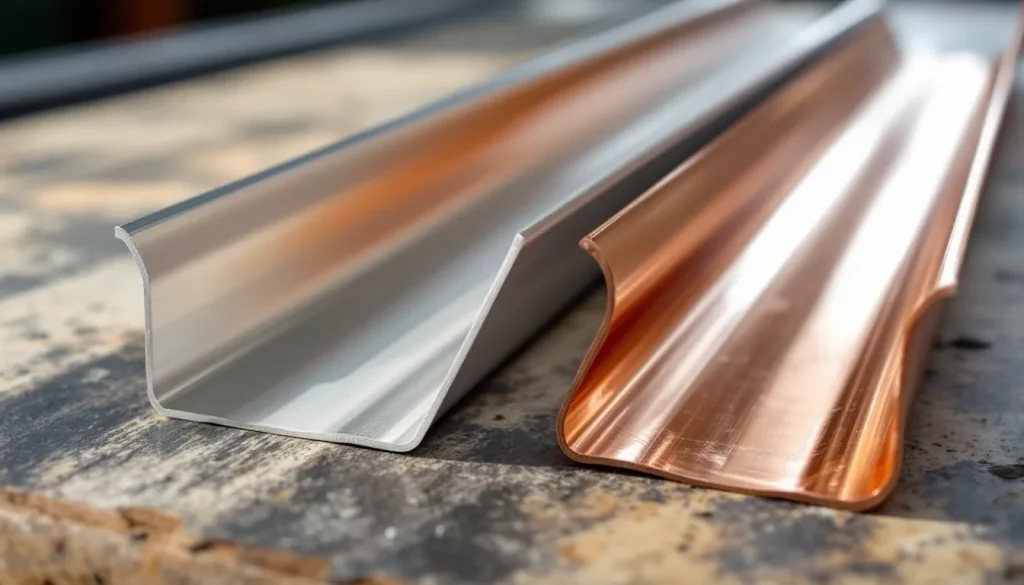
The choice between k-style vs half-round gutters comes down to three things: capacity, cost, and what the house is supposed to look like. K-style holds roughly 20 percent more water than half-round in the same nominal size, costs less in aluminum (see our gutter material comparison), and goes on roughly 75 percent of new residential installs in North America in 2026. Half-round looks period-correct on traditional, historic, and craftsman architecture, costs more in any material, and clogs less because the rounded profile has no flat trough corners for debris to accumulate. Neither is universally better. The right answer depends on the roof, the architecture, and the budget.
The short version
- 5-inch K-style holds 1.20 gallons per linear foot. 5-inch half-round holds 0.96 gallons per foot. Same nominal size, K-style wins capacity by 20 percent.
- 6-inch K-style holds 2.00 gallons per foot. 6-inch half-round holds 1.41 gallons per foot.
- K-style aluminum runs $7 to $13 per linear foot installed. Half-round aluminum runs $9 to $16. Half-round copper runs $25 to $45.
- K-style is the period-wrong choice on pre-1940 traditional architecture. Half-round is the period-correct choice.
- Half-round clogs less because debris washes through the rounded trough. K-style traps debris in the front-back trough corners.
- K-style mounts directly to fascia with hidden hangers. Half-round mounts with brackets that extend below the gutter and look more substantial.
- Aesthetic call: K-style looks modern and clean. Half-round looks traditional and craftsman.
What the two profiles actually look like in cross-section
K-style gutter has a flat back that sits against the fascia, a flat bottom (the trough floor), and a decorative front profile that looks like the letter K rotated 90 degrees from one angle, or like the ogee crown molding on a piece of furniture from another. The shape is meant to mimic colonial-revival crown molding, which is why the profile became popular on mid-century American houses imitating colonial architecture.
Half-round gutter has a true half-circle cross-section. The back is the vertical edge of the half-circle (which mounts to the fascia or to brackets that hold the gutter slightly forward of the fascia), the trough is the bottom curve of the half-circle, and the front is the opposite vertical edge. There are no flat corners. Water and debris move continuously around the curve.
The capacity difference comes from cross-sectional geometry. A 5-inch K-style has a cross-section of roughly 21 to 23 square inches. A 5-inch half-round has a cross-section of roughly 16 to 18 square inches. Same outside width, less area inside the half-round because the curve takes away corners.
Capacity math: gallons per linear foot
The headline number for any gutter is how many gallons per linear foot it can carry without overflow. This drives the sizing decision (see our gutter sizes and capacity guide for the full roof-area-to-gutter-size math).
| Profile | Nominal size | Cross-section (sq in) | Capacity (gallons/linear foot) | Approx. roof drainage capacity |
|---|---|---|---|---|
| K-style | 5 inch | 22 | 1.20 | Up to 1,200 sq ft |
| K-style | 6 inch | 36 | 2.00 | Up to 2,000 sq ft |
| K-style | 7 inch | 50 | 2.80 | Up to 3,000 sq ft |
| Half-round | 5 inch | 17 | 0.96 | Up to 900 sq ft |
| Half-round | 6 inch | 25 | 1.41 | Up to 1,400 sq ft |
| Half-round | 7 inch | 34 | 1.93 | Up to 1,900 sq ft |
The capacity figures assume gutters pitched at 1/4 inch per 10 feet toward the downspout (the standard pitch) and a downspout rated for the gutter capacity. Roof drainage capacity also assumes a downspout configuration that can move water out as fast as the gutter brings it in. A gutter only holds enough water to bridge from one downspout to the next. Beyond that, it overflows. For the downspout side, see downspout placement and sizing.
The practical implication of the capacity table: a 5-inch K-style handles up to a 1,200 square foot roof in 1 inch per hour rainfall. A 5-inch half-round on the same roof needs closer downspout spacing or an upsize to 6-inch to handle the same drainage. In Pacific Northwest, Southeast, and Gulf Coast regions where 1.5 to 2 inch per hour rainfall is normal, the smaller half-round capacity matters and you should plan for 6-inch as default on anything but a small house.
Cost comparison by material
Half-round costs more than K-style in every material (see our rain gutter cost), for two reasons. First, half-round is rarely continuous. Most half-round installs are sectional in 10-foot lengths because portable continuous half-round machines exist but are uncommon. The continuous fabrication efficiency that drops aluminum K-style cost to $7 to $13 installed does not apply to half-round in the same way. Second, half-round mounts with bracket-style hangers that are typically more expensive than K-style hidden hangers.
| Material | K-style ($/lf installed) | Half-round ($/lf installed) | Half-round premium |
|---|---|---|---|
| Aluminum 0.027 | $7 to $11 | $9 to $14 | ~25 percent |
| Aluminum 0.032 | $9 to $13 | $11 to $16 | ~20 percent |
| Copper 16 oz | $22 to $35 | $25 to $45 | ~15 to 25 percent |
| Galvalume steel | $9 to $14 | $12 to $17 | ~25 percent |
| Zinc | $22 to $35 | $25 to $40 | ~15 to 20 percent |
| Vinyl | $4 to $7 | $5 to $9 | ~25 percent |
For the full per-foot pricing breakdown across all materials including downspouts and labor inclusions, see our gutter cost per linear foot guide.
The clog factor: half-round wins on debris flow
Half-round gutters clog less than K-style for a geometric reason. K-style has flat corners at the back-bottom and front-bottom edges of the trough. Leaves, twigs, shingle granules, and roof debris collect in those corners and accumulate. Half-round has no corners. Debris that lands in the gutter either washes out the downspout or sits on a curved floor where the next rain event has a fair chance of moving it along.
The practical implication on cleaning frequency. K-style gutters in a wooded lot need cleaning twice a year minimum and sometimes three or four times for properties with heavy tree cover. Half-round gutters on the same property need cleaning twice a year and rarely more. For the cost and schedule detail, see gutter cleaning cost and schedule. The shingle-granule angle on debris collection is covered in roof granules in gutter.
This does not mean half-round is maintenance-free. Acorns, pine needles, and large leaves still hang up in any gutter. The advantage is in incremental debris and small particulate, which moves through half-round and stays in K-style.
Gutter guards work on both profiles. The choice of gutter cover for your installation is largely independent of K-style vs half-round, with one caveat: some screen-style guards are profile-specific. See best gutter guards and diy gutter guards for the product comparison.
Mounting hardware and what it looks like
K-style mounts to the fascia with hidden hangers. These are flat aluminum or steel brackets that snap into the back of the gutter and screw into the fascia. From the ground, the gutter looks like it floats on the fascia with no visible hardware. Hidden hangers go on every 24 to 30 inches (closer in snow regions). Brand-name hidden hangers include Spectra E-Z Lock (the dominant residential aluminum hanger), Raytec (also widely used), and F-Wave T-Rex (heavier-duty, common in commercial work).
Half-round mounts to the fascia or to extended brackets called “shank brackets” or “lookout brackets” that extend out from the fascia and cradle the gutter from underneath. The brackets are visible from the ground. On historic restoration work, they are often forged or cast in copper or brass to match the gutter material and become a deliberate architectural element. On modern half-round installs, the brackets are simple steel or aluminum, painted or coated to match.
Some half-round installs use exposed strap hangers, which wrap over the top of the gutter and attach to the fascia or to a continuous rod that runs along the back of the gutter. This is the most traditional mounting style and remains common on copper half-round work.
The visual difference is meaningful. K-style with hidden hangers looks clean and minimal from the ground. Half-round with shank brackets looks substantial and traditional. On a Tudor revival or a craftsman bungalow, the visible brackets are part of the design. On a 1990s vinyl-sided builder colonial, they would look out of place.
Architectural fit
The architectural fit question is the part of this decision that nothing in a spec sheet captures. K-style emerged in the mid-1900s as a manufactured-form imitation of crown molding. It looks correct on mid-century and later American residential architecture. It looks deliberately wrong on pre-1940 traditional houses where half-round or built-in box gutters were the period-correct detail.
K-style is the right call on:
- Ranch, split-level, and contemporary tract housing from 1950 to 1980
- Vinyl-sided builder colonials and McMansions from 1980 to 2010
- Modern and contemporary new construction (though some architects spec custom box or half-round)
- Cottage-style and farmhouse revival (though half-round also works here)
Half-round is the right call on:
- Pre-1940 traditional, colonial, Tudor, Cape Cod, Victorian, and Italianate
- Craftsman bungalows and arts-and-crafts era homes
- Historic restoration projects where period correctness is the goal
- High-end modern and contemporary projects where the architect specifies half-round as a deliberate design element
- Properties in historic districts with architectural review boards
On a 1925 craftsman with K-style aluminum gutter, the eye registers something off about the house. Most homeowners cannot articulate what is wrong. The answer is the gutter profile, and replacing it with half-round (copper or aluminum) makes the house look properly resolved.
The hidden-hanger vs bracket-hanger argument
The mounting hardware difference also has performance implications.
K-style hidden hangers transfer load directly to the fascia through the gutter back. The fascia carries the entire vertical load of the gutter, plus water weight, plus snow and ice load if applicable. A 5-inch K-style aluminum gutter full of water at 6.5 pounds per linear foot, plus the gutter material, plus snow and ice, can transfer 15 to 25 pounds per linear foot to the fascia. Hidden hangers every 24 inches spread that load. In snow regions, the fascia and the framing behind it have to be solid (no rot, no soft spots) for the system to hold up. For the fascia condition issue, see fascia rot from gutters.
Half-round bracket hangers, especially shank-style brackets that extend out from the fascia, transfer load partially to the fascia and partially to the wall through the bracket arm. The effective load distribution is different and in some cases gentler on the fascia. The bracket extension also separates the gutter slightly from the fascia, which improves airflow and slows fascia moisture damage in regions with heavy rainfall.
The practical implication: on a house with marginal fascia condition where you want to install gutter without first replacing the fascia, half-round with brackets is gentler. On a house with solid fascia, K-style with hidden hangers is more secure and less visible.
What the install crew actually has to do differently
From a crew’s perspective, K-style installation is faster. The hidden hangers snap and screw in fast. The continuous aluminum machine produces continuous runs. The only metalwork is at corners (inside and outside miters) and at downspout outlets. A 200-foot K-style aluminum job runs 6 to 9 hours for a two-person crew.
Half-round installation is slower because the gutter is usually sectional (each 10-foot section joined to the next), the brackets require more careful placement and fastening, and the corner detail is more involved. The same 200-foot job in half-round runs 9 to 14 hours for a two-person crew, contributing to the higher cost per foot.
Copper half-round adds additional time for soldering joints. A skilled copper installer can solder 8 to 12 joints per hour with clean weatherproof results. A 200-foot job with 22 sectional joints and 8 corner miters takes 4 to 6 hours of soldering work alone, on top of bracket installation. The full job runs 14 to 20 hours for a two-person crew and the labor premium is the reason copper half-round costs as much as it does.
For the install detail in full, see rain gutter install guide and gutter installation.
The continuous question
K-style aluminum and steel are routinely fabricated continuous on site with portable gutter machines. New Tech Machinery MACH II runs 5-inch K-style. New Tech Machinery Mark IV runs both 5-inch and 6-inch K-style from the same head. The continuous premium over sectional is roughly 30 to 50 percent and almost always worth it for the leak reduction.
Half-round is rarely continuous. Portable continuous half-round machines exist but are uncommon and require specialty equipment most aluminum gutter contractors do not own. Most half-round installs are sectional and the joints are sealed with butyl tape and pop rivets (aluminum, steel) or solder (copper, zinc). On copper and zinc, soldered joints become structural elements that are fully waterproof and last as long as the gutter itself, so the continuous advantage matters less. On aluminum and steel half-round, sectional joints are weaker than soldered joints and over 20-plus years the joints become the failure point.
The continuous-vs-sectional choice is largely material-driven. Aluminum K-style: go continuous. Copper half-round: sectional with soldered joints is the standard. For the full comparison, see continuous vs sectional gutters.
Mixing profiles on the same house
The general rule is to use one profile across the entire house. The exception is on architectural transitions, like a main house with K-style and a porch or carriage house wing with half-round. This can work if the design intent is intentional and the materials match. It usually does not work if it is the result of a partial replacement where the original was half-round and the homeowner cheaped out on the replacement section.
Mixing profiles also requires careful corner detail at the transition between sections. The K-style and half-round meet at an outside corner or where one wing meets the main roof. The joint detail and the visual transition need to be planned. Most contractors will steer customers toward consistency.
The final decision tree
If you are reading this trying to make the call:
- Pre-1940 traditional, Tudor, Victorian, craftsman bungalow, or historic district: Half-round, ideally in copper. Period correct, adds resale value.
- 1950 through 1980 ranch, split-level, contemporary: K-style aluminum, 5-inch or 6-inch depending on roof area. The right call.
- 1980 through 2010 builder colonial, vinyl siding, McMansion: K-style aluminum. Half-round looks like a costume.
- Modern or contemporary new build: Either works. K-style if the architect spec’d it. Half-round if the architect wanted a softer line.
- Coastal home in salt-exposure zone: Copper, either profile, for corrosion resistance.
- Heavy tree cover, want minimum cleaning: Half-round if budget allows for the lower debris-trap angle.
- Heavy rainfall region with smaller roof: 6-inch K-style for capacity. Half-round on a small house in Seattle is undersized.
The decision is not about which profile is universally better. It is about which profile is right for your house. K-style on a craftsman is wrong. Half-round on a 1990s tract colonial is wrong. K-style on a 1965 ranch is right. Half-round in copper on a 1920s Tudor is right. The architecture leads. The capacity math and the budget follow.
For the broader system context including how gutters integrate with drip edge, fascia, soffit ventilation, and downspouts, see drip edge, fascia board, soffit vents, and splash blocks vs extensions. For full-roof pricing context, see roofing cost per square and the learn library.