
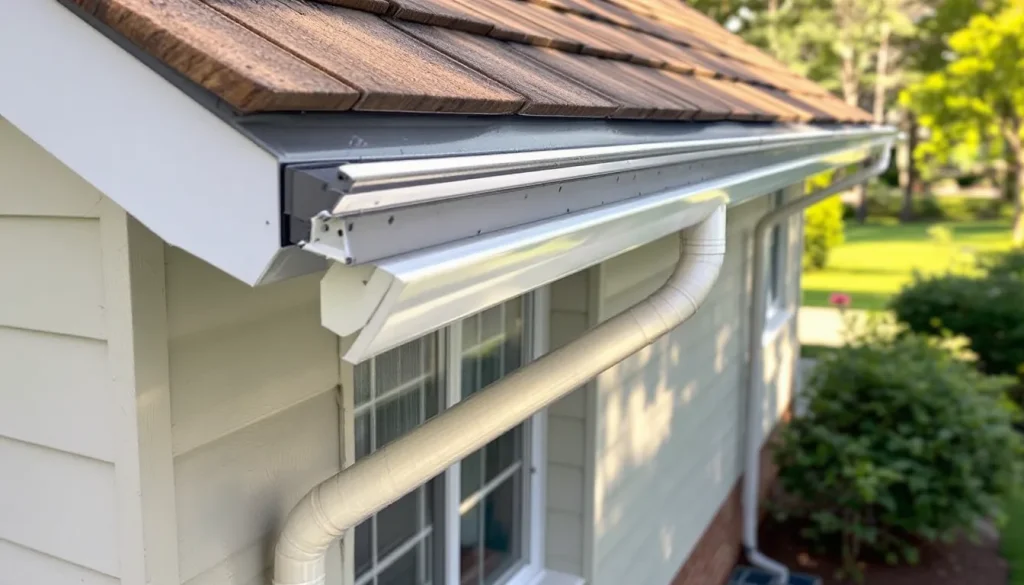
A properly designed roof rain gutter system has three jobs: catch the water sheeting off the roof plane, carry it to a corner without overflow, and drop it far enough from the foundation that it does not saturate the soil under the house. Get sizing right, set pitch to 1/4 inch per 10 feet, and place a downspout every 35 feet of run, and the system runs maintenance-light for 20+ years. Skip any of those and you get fascia rot, basement seepage, or both. This is the full design walkthrough: sizing math, pitch, hangers, downspout placement, and the 2026 installed cost by material.
The short version
- Gutter sizing is set by roof area times rainfall intensity. 5-inch K-style holds 1.20 gallons per linear foot of capacity. 6-inch K-style holds 2.00 gpl.
- Pitch the gutter 1/4 inch per 10 feet toward the downspout. Less and water pools, more and you get visible sag.
- Downspout placement: every 35 feet maximum, more often if the run drains a steep roof or a valley.
- Hidden hangers on 18 to 24 inch centers beat spike-and-ferrule. F-Wave T-Rex and Spectra hidden hangers are the contractor standard in 2026.
- Splash blocks (Quikrete concrete or polymer) handle normal lots. Flexible extensions (Frost King FE49) carry water 4 to 6 feet out on tight setbacks.
- Installed cost in 2026: aluminum K-style $7 to $13 per linear foot, copper half-round $25 to $45 per linear foot, galvalume steel $9 to $16, zinc $25 to $40.
Why most rain gutter systems fail before they wear out
Walk any neighborhood and the gutter failures look the same. Water sheeting off the front edge instead of running into the trough. Brown streaks down the fascia. A sag halfway between two downspouts. A washed-out flowerbed where the splash block used to sit. None of those failures are about the gutter itself, which is usually still structurally fine. They are about a design decision that was wrong on day one: gutter too small for the roof area, slope set flat, downspouts too far apart, or no terminal extension to move water away from the foundation.
A correctly designed system has redundancy built into each of those four variables. Capacity is sized for the peak 5-minute rainfall in your zip code, not the annual average. Slope is verified with a chalk line after the hangers go up. Downspouts are placed at every corner and at any mid-run where 35 feet is exceeded. And the ground discharge moves water at least 4 feet from the house wall in all conditions. Our companion piece on gutter installation walks through the install sequence; this article focuses on the design math behind it.
Sizing: matching gutter capacity to roof area
The two variables in gutter sizing are roof area drained and local rainfall intensity. Roof area is not square footage of the house footprint. It is the projected horizontal area of the roof plane that drains into the run of gutter you are sizing. A 1,200 sq ft ranch with a single ridge has two 600 sq ft drainage planes, one to each gutter run. A house with valleys, dormers, or upper roofs that drain onto a lower roof concentrates flow and requires either larger gutter or more frequent downspouts.
Capacity by profile (linear-foot basis):
| Gutter profile | Capacity (gallons per linear foot) | Max roof area drained (light rain zone) | Max roof area drained (heavy rain zone) |
|---|---|---|---|
| 5-inch K-style | 1.20 | 880 sq ft | 600 sq ft |
| 6-inch K-style | 2.00 | 1,400 sq ft | 1,000 sq ft |
| 5-inch half-round | 0.97 | 720 sq ft | 500 sq ft |
| 6-inch half-round | 1.55 | 1,150 sq ft | 820 sq ft |
| 7-inch K-style (commercial) | 3.00 | 2,100 sq ft | 1,500 sq ft |
“Light rain zone” is roughly the Pacific Northwest, Upper Midwest, and most of the Mountain West where the 5-minute peak intensity sits around 4 inches per hour. “Heavy rain zone” covers the Gulf Coast, Florida, and tropical-storm corridors of the Southeast where the 5-minute peak hits 7 to 9 inches per hour. Steep roofs (8/12 and above) shed water faster and behave like a higher rain zone even in moderate climates because the water arrives at the gutter with momentum and overshoots the back lip if the trough is undersized. Our companion on gutter sizes and capacity has the per-zip-code numbers if you want to design to your actual rainfall data.
The 6-inch rule
For any roof area over 800 sq ft draining to a single run, default to 6-inch K-style. The marginal cost is $2 to $3 per linear foot. The capacity gain is 67 percent. The math almost always favors the upgrade when you account for the cost of one overflow event soaking the fascia or basement. Architectural shingles, metal roofs, and any steep-pitch design also benefit from 6-inch because the water arrives faster.
The exception is small ranch and bungalow homes with simple gable roofs and modest pitch (4/12 to 6/12) where 5-inch is genuinely sufficient. In that case the cost savings of going with 5-inch is real and the capacity headroom is sufficient. The decision tree is roof area first, pitch second, climate third.
Pitch: 1/4 inch per 10 feet, verified
Gutters need to slope toward the downspout. The industry standard is 1/4 inch of drop per 10 feet of run. On a 40-foot run with the downspout at the far end, the high end of the gutter sits 1 inch above the low end. On a 50-foot run, 1.25 inches. Less slope and the water pools, accelerating internal corrosion and depositing sediment that eventually blocks the run. More slope and the gutter looks visibly off-level from the street, which homeowners hate and contractors get callbacks on.
The way to verify pitch is to snap a chalk line from the high point to the low point before hanging a single hanger. Mark the fascia at the high point (typically 1.5 inches below the drip edge to allow shingle overhang to drain into the trough rather than behind it). Calculate the drop for the run length and mark the low point. Snap the line. Hangers go on the line, not on a level reading.
Long runs (over 40 feet) often work better as a “split pitch” with the high point in the middle and downspouts at both ends. This halves the slope requirement, keeps the gutter visually level, and adds a second downspout for capacity. A 60-foot run split-pitched needs only 0.75 inch of drop on each half instead of 1.5 inches on a single pitch.
Downspout placement and sizing
Downspouts are the bottleneck in most failing systems. The gutter trough can have all the capacity in the world, but if the downspout cannot pass water through fast enough, the gutter overflows. Two rules:
- One downspout every 35 linear feet of gutter run, maximum.
- 2×3-inch downspout handles roof area up to 600 sq ft. 3×4-inch handles up to 1,200 sq ft. For anything larger, use 3×4 plus a mid-run additional downspout.
The 3×4-inch downspout passes roughly 2.5 times the water of a 2×3-inch at the same head pressure. The cost difference is $3 to $5 per linear foot. On any new install, default to 3×4-inch unless the architectural style demands the smaller profile. Our deep-dive on downspout placement and sizing covers the elbow-loss math for complicated geometries.
Placement also matters within the run. A downspout at the corner is structural-standard. A mid-run downspout (used when the run exceeds 35 feet) goes at the high point of a split pitch or 5 to 7 feet from the natural low point of a single-pitch run. Never place a downspout immediately above a basement window, an electrical service entry, or a deck stair stringer. Reroute the run if the geometry forces a bad location.
Hangers: hidden beats spike-and-ferrule
Three hanger types still see install volume in 2026. Hidden hangers are the contractor standard, mounted from inside the gutter into the fascia with a screw, invisible from the street. Spike-and-ferrule is the legacy system where a spike drives through the front face of the gutter into the fascia, with a ferrule sleeve to keep the gutter from collapsing. Strap hangers are used on older homes without continuous fascia and attach to the roof deck under the shingle starter course.
Hidden hangers win on every criterion that matters. They hold tighter (a 1.5-inch hex-head screw versus an 8-penny spike), they spread load more evenly (they grip the back wall of the gutter, not just one point on the front lip), and they spaced tighter (18 to 24 inches versus 24 to 36 inches for spike-and-ferrule). F-Wave T-Rex, Spectra Metal Sales, and Englert all sell hidden hangers in pro-grade aluminum and stainless. Senox makes the copper version that pairs with copper systems.
On 6-inch K-style in a heavy snow zone, drop hanger spacing to 18 inches and use a 2.5-inch screw. The weight of a fully iced gutter is enormous, and the failure mode is the front lip rolling forward, dumping the trough at the worst possible moment.
The four corner conditions
Inside corners, outside corners, end caps, and downspout outlets are where gutter systems leak. Each requires a specific approach.
- Inside (mitered) corner. Two gutter sections meet at a valley. Use a factory miter (Spectra, Englert) or hand-cut and seal with high-modulus polyurethane sealant, not silicone. Silicone fails in 5 to 8 years; polyurethane lasts 15 to 20.
- Outside corner. Same approach, with the cut reversed. Strip miters (where the front face is cut and folded) leak less than miters cut from two separate pieces.
- End cap. A flat or shaped piece riveted and sealed onto the open end of a gutter run. Two rivets minimum, sealed with the same polyurethane.
- Downspout outlet. A 3-inch or 4-inch hole cut in the bottom of the gutter, with a drop outlet riveted in place. The outlet flange sits on top of the gutter bottom and seals with polyurethane both sides.
Ground discharge: splash blocks vs extensions
Water exits the downspout at roughly 2 to 4 gallons per second during a heavy rain. If that water hits bare soil at the foundation, it digs a hole, washes mulch into the lawn, and saturates the soil under the footing. Two solutions handle 95 percent of homes.
Splash blocks are pre-cast concrete (Quikrete makes the standard 30-inch model) or polymer (similar dimensions, lighter, longer-lasting). They sit under the downspout, spread the water out over 30 inches of grade, and slow it enough that it spreads laterally rather than digging in. Splash blocks work well on lots with at least 6 feet of grade fall away from the foundation in the first 10 feet.
Flexible extensions (Frost King FE49, Amerimax Flex-A-Spout, and similar) are accordion-style tubes that snap onto the downspout outlet and carry water 3 to 6 feet farther from the foundation. They work on tight setbacks, on flat lots, and on any house where the splash block alone is not enough. The downside is they look industrial and tend to disconnect. Our comparison of splash blocks vs extensions covers the failure modes in detail.
For aggressive water management, route the downspouts into a buried 4-inch PVC line and discharge into a dry well or daylight outlet 20 to 30 feet from the house. The cost is $300 to $800 per downspout for the trenching and pipe, but it eliminates the foundation saturation risk completely. Our walkthrough on french drain gutter integration covers the wet-soil case.
Material choice and 2026 installed cost
Material choice drives 60 to 70 percent of the install cost. Five options dominate the 2026 residential market.
| Material | Profile | 2026 installed cost (per linear foot) | Service life | Notes |
|---|---|---|---|---|
| Aluminum (0.027 inch) | 5-inch K-style | $7 to $10 | 25 to 35 years | Default contractor spec. Light, won’t rust, paintable. |
| Aluminum (0.032 inch) | 6-inch K-style | $9 to $13 | 30 to 40 years | Heavier gauge resists ladder dents, higher capacity. |
| Galvalume steel | 5-inch or 6-inch | $9 to $16 | 30 to 50 years | Stronger, won’t dent. Best in snow country. Heavier so install labor up. |
| Vinyl (PVC) | 5-inch sectional only | $4 to $8 | 10 to 15 years | DIY-friendly. Sun-degraded south of 35N. Sectional joints leak by year 7. |
| Copper | 5-inch or 6-inch half-round | $25 to $45 | 50 to 75+ years | Architectural spec. Patinas to green-brown. Soldered joints. |
| Zinc | 5-inch or 6-inch half-round | $25 to $40 | 60 to 80 years | European spec. Self-healing patina. Limited US supply. |
For most homes, continuous-run aluminum K-style at the 6-inch profile is the right answer. Cost runs $9 to $13 per linear foot installed, service life is 30+ years, and the gauge resists most ladder and tree-limb damage. Steel makes sense in heavy-snow regions where ice loading would dent aluminum. Copper makes sense on historic homes, on architectural specs, or when the buyer wants 50+ year service and the upfront cost is acceptable. Our deep dives on gutter materials compared and K-style vs half-round gutters cover the tradeoffs profile-by-profile.
Continuous-run vs sectional
Continuous-run gutter (the roll-formed, no-joint type) is the industry standard for installed residential work in 2026. A contractor pulls a coil of aluminum (Spectra Metal Sales, Englert, or Berridge for copper) through a roll-former on the back of a truck and produces a single run cut to length. The only joints in the entire system are at corners, end caps, and downspout outlets. The leak count drops 80 to 90 percent versus sectional.
Sectional gutter, sold at home centers in 10-foot lengths, makes sense only for DIY installs on single short runs. Every 10-foot joint is a future leak. The cost savings versus contractor continuous-run install is roughly $3 to $4 per linear foot, but the lifespan drops by half. Our comparison on continuous-run vs sectional gutters walks through the math.
Heat tape and ice management
In any climate where the average January overnight temperature drops below 25F, ice damming and gutter ice loading become real failure modes. Three management options:
- Self-regulating heat cable (Frost King, Easy Heat) installed in zigzag pattern along the eave and dropped into the downspout. $3 to $6 per linear foot in materials, $8 to $14 per linear foot installed.
- Heated gutter inserts (Heater Trace, Bylin RIM2) that sit inside the gutter trough. Higher cost, cleaner appearance, longer service life.
- Roof-level prevention: continuous ridge-and-soffit ventilation plus R-49+ attic insulation to keep the roof deck cold and prevent the ice dam from forming in the first place.
The roof-level prevention is the durable fix. Heat cable is the bandage when retrofit insulation and ventilation are impractical. Our guide on heated gutter cable covers the install spec.
Maintenance schedule
Even a perfectly designed system requires periodic maintenance. The schedule is climate-dependent but the core tasks are universal.
- Twice yearly (spring and fall): clear debris from gutter trough and downspout outlet. In pine-heavy zones, three times per year.
- Annually: inspect hangers for loose screws, check sealant at miters and end caps, verify pitch with a level along the run.
- Every 5 years: reseal corner miters with fresh polyurethane (the original seal degrades).
- Every 10 to 15 years: check for fascia rot behind the gutter (the failure mode that ends the install). Our piece on fascia rot from gutters covers detection and repair.
Gutter cleaning costs $150 to $300 per visit for a typical 200-linear-foot residential install. Annualized over 25 years of service life, the maintenance cost is roughly 30 to 40 percent of the original install cost. Our breakdown on gutter cleaning cost and schedule has the regional numbers.
The 6 design defaults to specify
If you are working with a contractor and want a system that will outlast the roof under it, specify these six defaults on the contract:
- 6-inch K-style aluminum, 0.032-inch gauge, continuous-run roll-formed, in factory-painted color.
- Pitch: 1/4 inch per 10 feet, snapped to chalk line before install.
- Hidden hangers (Spectra, Englert, or F-Wave T-Rex) on 18-inch centers.
- 3×4-inch downspouts at every corner, mid-run additional if any run exceeds 35 feet.
- Mitered corners sealed with high-modulus polyurethane (not silicone).
- Ground discharge to splash blocks or buried 4-inch PVC to daylight 6+ feet from the foundation.
Those six lines on the contract represent the difference between a system that calls back in year 7 and one that runs maintenance-only through year 30. The cost difference is roughly $400 on a typical 200-linear-foot install. The avoided cost is one fascia repair plus one foundation water-intrusion event, which conservatively runs $3,000 to $12,000. The roof rain gutter system is one of the few components on a house where 5 percent more upfront spend prevents 50 percent more downstream cost.