
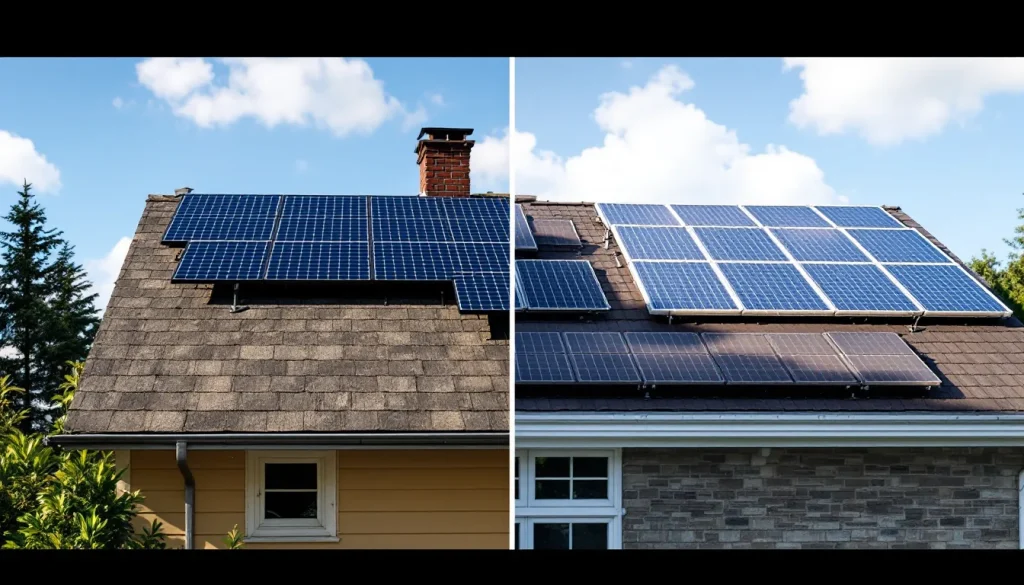
For homeowners shopping a roof-mounted solar install in 2026, the four types of solar energy that actually matter are photovoltaic (PV) panels, solar thermal collectors, solar shingles, and hybrid PV-thermal (PVT). Photovoltaic is 95 percent of the residential market. Solar thermal is a cost-effective niche for high hot-water households. Solar shingles are the integrated-aesthetic premium. Hybrid PVT is a specialty option that does both. Concentrated solar power exists but only at utility scale. This is the practical primer on which type fits which roof and which household.
The short version
- Photovoltaic (PV) panels convert sunlight directly to DC electricity, which an inverter converts to AC. Dominant residential type, 95 percent of US installs.
- Solar thermal collectors heat a fluid that heats a water tank. Best fit for households with high hot-water demand (4+ people) and southern exposure.
- Solar shingles integrate PV cells into shingle-shaped units. Tesla Solar Roof, GAF Energy Timberline Solar, CertainTeed Apollo. Premium price, premium aesthetic.
- Hybrid PV-thermal (PVT) generates electricity and heats water in a single panel. Niche product, limited US distribution.
- Concentrated solar power (CSP) uses mirror arrays to focus sunlight. Utility-scale only. Not relevant for residential.
- For most homes, PV panels are the right answer. Solar thermal pencils only for high-DHW households in sunny climates. Shingles only when aesthetic or architectural review demands it.
The 5 types of solar energy and where they live
Solar energy splits into five technology categories. Three are residential-relevant, one is niche, one is utility-only. Here is the quick taxonomy before we get into the design details.
| Type | What it produces | Residential relevance | 2026 install cost ($/W or per panel) |
|---|---|---|---|
| Photovoltaic (PV) | DC electricity, converted to AC | Dominant. 95% of residential installs. | $2.80 to $3.80 per watt installed |
| Solar thermal | Heated water | Niche. High-DHW households in sunny climates. | $4,000 to $9,000 per system |
| Solar shingles | DC electricity (same as PV) | Premium aesthetic. 3 to 5% of residential installs. | $4.50 to $7.50 per watt installed |
| Hybrid PV-thermal (PVT) | Electricity + heated water | Specialty. Limited US distribution. | $5,500 to $12,000 per system |
| Concentrated solar power (CSP) | Heat to drive turbine (utility scale) | None. Utility scale only. | n/a |
Photovoltaic (PV) panels: the dominant residential type
PV panels are what almost everyone means when they say “solar.” The technology is straightforward. A silicon-based photovoltaic cell, when exposed to sunlight, generates a small DC voltage. Sixty or 72 of those cells laminated under tempered glass form a panel rated 350 to 450 watts in 2026. A typical 24-panel residential array produces 8 to 10 kilowatts of nameplate capacity, which translates to roughly 11,000 to 14,000 kilowatt-hours per year in moderately sunny US climates.
The system has four primary components. Panels on the roof. Inverter (string or microinverter) that converts DC to AC. Combiner box and disconnect that handle the electrical interconnect. Monitoring system (often app-based via Enphase, SolarEdge, or Tesla Powerwall) that tracks production. Battery storage is optional and adds $8,000 to $16,000 to the system.
PV panel types within the residential market
Three panel technologies dominate 2026 residential PV. Monocrystalline silicon is the standard, accounting for roughly 85 percent of installs. Efficiency 20 to 23 percent. Polycrystalline is the older technology, lower efficiency (16 to 18 percent), and largely phased out of new residential. Thin-film (CdTe, CIGS) shows up occasionally on commercial flat roofs but is rare on residential pitched roofs.
Within monocrystalline, three sub-architectures are mainstream: PERC (passivated emitter rear cell, the legacy standard), TOPCon (tunnel oxide passivated contact, the 2024-2026 mainstream), and HJT (heterojunction, the high-efficiency premium). TOPCon panels from REC, Q CELLS, Jinko, and LONGi dominate the value-and-mid-range market. HJT panels from REC, Maxeon, and Panasonic carry premium pricing for efficiency above 22 percent.
Our breakdown on best solar panel brands compares the leading 2026 manufacturers across efficiency, warranty, degradation, and price-per-watt.
Inverters: string vs micro vs hybrid
String inverters connect all panels in series and feed one central inverter. Cheapest. Single point of failure. Production drops to the lowest-performing panel in any shaded string. SolarEdge and Sungrow lead in 2026.
Microinverters mount one inverter per panel on the back of each panel. Each panel operates independently. Best for partial shade conditions. Enphase IQ8 series dominates the US microinverter market in 2026.
Hybrid inverters add battery management to either architecture. Tesla, Enphase IQ Battery 5P, and Generac PWRcell are the mainstream 2026 systems. Our comparison on microinverter vs string inverter covers the design decision in detail.
When PV is the right answer
For nearly every household considering rooftop solar in 2026, PV is the right answer. It is the most mature technology, the lowest cost per kilowatt-hour generated, the deepest installer base, and the easiest to permit and finance. The 30 percent federal residential clean energy tax credit applies through 2032 (per current IRS Section 25D), making the payback math more favorable than any other rooftop solar type.
Our deep dive on solar installation cost 2026 covers the per-watt pricing by region and system size. Our piece on solar roof tax credit 2026 walks through the federal and state incentive stack.
Solar thermal collectors: the high-hot-water niche
Solar thermal is a distinct technology from PV. Instead of converting sunlight to electricity, it converts sunlight to heat. A collector on the roof (either flat-plate or evacuated-tube design) absorbs solar radiation. A heat-transfer fluid (water or glycol mix) circulates through the collector, picks up the heat, and transfers it to a domestic hot water tank via a heat exchanger. The system produces no electricity.
Two collector designs are mainstream. Flat-plate collectors are insulated boxes with a dark absorber plate and tubes running through. Lower cost ($800 to $1,800 per collector), 50 to 70 percent efficient in good conditions. Evacuated-tube collectors use individual glass tubes with vacuum insulation. Higher cost ($1,500 to $3,000 per collector), 60 to 80 percent efficient, perform better in cold climates because the vacuum insulation reduces heat loss.
A typical residential solar thermal system runs 2 to 4 collectors plus an 80 to 120 gallon hot water tank with an electric or gas backup element. Total installed cost: $4,000 to $9,000 in 2026. The 30 percent federal tax credit applies to qualifying solar thermal systems under Section 25D, the same as PV.
When solar thermal pencils
Solar thermal makes economic sense when three conditions align. First, the household has high domestic hot water demand. Four or more people, daily showers, frequent laundry. Below that, the system is oversized relative to actual hot water use. Second, the climate is sunny enough to deliver useful production. Anywhere south of 38N with 200+ sunny days per year is generally favorable. North of 38N, evacuated-tube collectors are required and payback extends. Third, the natural gas or electric rate for water heating is high. In low-rate regions where gas water heating costs $300 to $400 per year, solar thermal payback runs 15 to 20 years and may not pencil.
In the right conditions, solar thermal delivers a 30 to 60 percent reduction in water heating energy use and pays back in 8 to 15 years. The technology is mechanically simple, durable (25 to 30 year service life), and low-maintenance.
Solar shingles: PV in shingle form
Solar shingles are PV cells laminated into roofing-shingle-shaped units that nail or click into a continuous roof field. They generate electricity the same way PV panels do, but they look like part of the roof rather than something mounted on top of it. Three mainstream products dominate the 2026 US market.
| Product | Type | Per-shingle wattage | Installed cost |
|---|---|---|---|
| Tesla Solar Roof V4 | Glass shingle with PV cells | 71 W per active tile | $22 to $35 per sq ft (whole-roof system) |
| GAF Energy Timberline Solar | Nailable architectural shingle with PV | 45 W per active shingle | $4.50 to $7.50 per watt |
| CertainTeed Apollo II | PV cells on tile platform | 63 W per active tile | $5.00 to $8.00 per watt |
The advantage of solar shingles is aesthetic. There is no rack-mounted panel array on the roof. From the street, the roof looks like a normal architectural shingle field with slightly different reflectivity in the active section. For homeowners in HOAs that restrict visible solar panels, or for historic-district properties, or for owners who simply want the cleaner look, shingles deliver.
The disadvantage is cost and complexity. Solar shingles cost 50 to 100 percent more per watt than equivalent PV panels. Roof penetrations are more numerous (each shingle, not each rack mount). Replacement of an underlying shingle requires de-energizing a section. Output per square foot is lower than PV panels because the cells occupy less of the active area.
Our comparison on solar shingles vs panels covers the design decision in detail, and our piece on solar shingles cost has the 2026 pricing by product.
Hybrid PV-thermal (PVT)
PVT panels combine photovoltaic and thermal collection into a single unit. The PV cells on top generate electricity. A fluid loop behind the cells captures the heat that the cells reject and uses it to heat domestic water. The combined energy output (electricity + heat) is higher than either standalone PV or standalone thermal occupying the same roof area.
The technology is mature in Europe (Solimpeks, Naked Energy) and Japan but has limited US distribution in 2026. Domestic installs typically require a special order through a national distributor with a 6 to 10 week lead time. Total system cost runs $5,500 to $12,000 depending on size.
PVT makes sense when roof area is constrained and both electrical and hot-water demand are high. A small Northeastern home with 250 sq ft of usable roof and a family of 5 might benefit from PVT because the combined output exceeds what 250 sq ft of straight PV or straight thermal could deliver alone. For most US homes with sufficient roof area, straight PV plus an electric or gas water heater wins on cost and simplicity.
Concentrated solar power (CSP)
CSP uses mirror arrays to focus sunlight onto a central receiver, generating high-temperature heat that drives a steam turbine or Stirling engine. The technology is utility-scale only. The Ivanpah Solar Power Facility (Mojave Desert, 392 MW), Crescent Dunes (Nevada, 110 MW), and the Noor Complex (Morocco, 580 MW) are the largest operational CSP plants. There is no residential application.
The reason CSP does not scale down is geometric. The concentration ratio required to generate useful turbine-grade heat is roughly 500x to 1,000x. That requires either a parabolic trough field of acres or a heliostat array of dozens to thousands of mirrors. Neither fits on a residential roof. If you see a residential pitch that mentions CSP, the seller does not understand the technology. Walk away.
Decision tree: which type of solar fits which house
The right type of solar for your specific roof and household depends on three variables: what you want the energy for, how much roof you have, and how the architecture handles visible panels.
- Electricity reduction, large roof, standard architecture. PV panels. The mainstream choice. 95 percent of residential installs.
- Electricity reduction, HOA restricts visible panels. Solar shingles. Tesla Solar Roof, GAF Energy Timberline Solar, or CertainTeed Apollo.
- Hot water reduction, family of 4+, sunny climate. Solar thermal. Pays back faster than PV-plus-electric-water-heater in this specific case.
- Constrained roof, both electrical and hot water demand. Hybrid PVT. Niche.
- Anything residential involving CSP. Not a real product. Reject the pitch.
For homeowners weighing PV versus shingles, the cost-of-electricity-produced math almost always favors PV unless aesthetic or architectural review requires shingles. Our comparison on solar shingles vs panels works through the breakeven analysis. For homeowners weighing PV versus solar thermal, the decision depends on whether you want to offset electrical use or specifically hot water heating. PV can do both (electric water heater plus PV generates net-zero water heating electricity), but solar thermal does the water-heating job more efficiently when you have the demand.
Roof readiness for any solar type
All four residential solar types require the roof underneath to have meaningful remaining service life. The rule of thumb is the roof should have at least 80 percent of its expected service life remaining before installing solar. A 30-year architectural shingle roof needs to be under 6 years old. A 50-year standing-seam metal roof needs to be under 10 years old. A 25-year tile roof needs to be under 5 years old.
The reason is the cost of removing and reinstalling the solar array when the roof underneath fails. Removal and reinstall of a 24-panel PV array runs $3,000 to $6,000. If the roof under it fails in year 12 of solar service life, that cost eats most of the lifetime savings the array would have generated through year 25.
For homes with metal roofs, our piece on solar panels on metal roof covers the standing-seam clamp mounting that avoids penetrations entirely. For asphalt-shingle roofs, the install penetrates the shingle and seals with EPDM-and-flashing, which works well but counts against the underlying roof’s effective life.
The 4 questions to ask before signing
Whichever type of solar you choose, four questions separate good installs from problematic ones.
- What is the production guarantee, and what penalty does the installer pay if the system under-performs? Real installers guarantee 90 to 95 percent of modeled production for years 1 through 10 and pay a kWh credit for the shortfall.
- Who handles the inverter when it fails in year 12? The panel warranty is 25 years on most manufacturers. The inverter warranty is 10 to 12 years on string inverters, 25 years on Enphase microinverters. Plan for one inverter replacement on string systems.
- What happens at roof replacement time? Get the installer’s per-panel removal-and-reinstall price in writing at install time, not when the roof is failing.
- Is the installer NABCEP-certified and how long have they been in business? Solar has high installer churn. A 3+ year track record matters. Our piece on how to choose a solar installer covers vetting.
The four residential types of solar energy each fit a specific use case. PV panels for most homes. Solar thermal for high-hot-water households in sunny climates. Solar shingles when aesthetics or architectural review require an integrated look. Hybrid PVT for constrained roofs with both electrical and thermal demand. Concentrated solar is not residential. Once you know which type fits, the rest of the decision becomes manageable: panel brand, inverter architecture, battery storage, and installer selection. Our companion on solar installation companies vetting walks through the installer selection process step by step.