
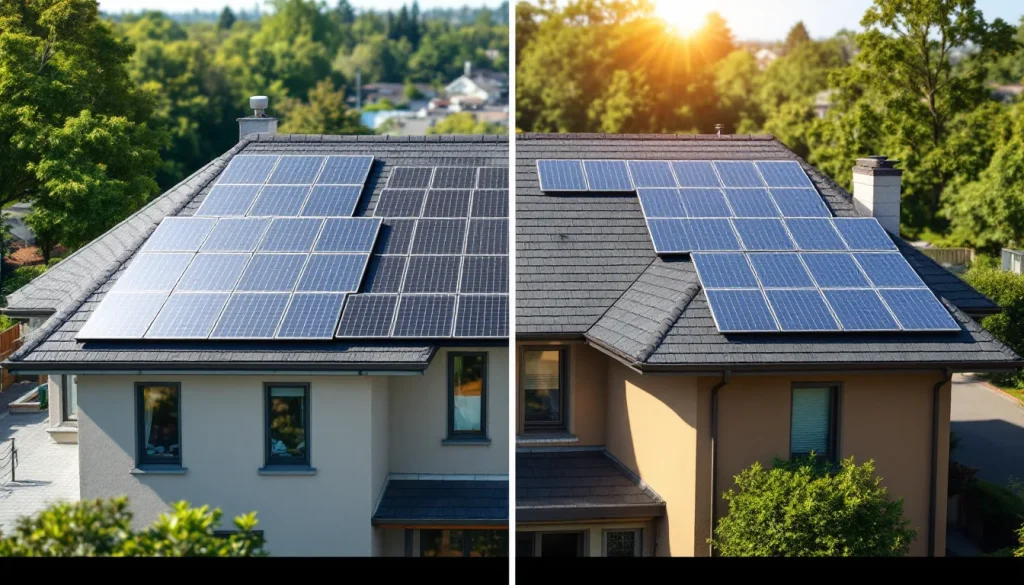
The solar shingles vs panels decision is not a tie. For most homes in 2026, conventional rack-mounted panels generate more watts per dollar, produce more energy per square foot of usable roof, and come with installer (see our solar installation companies) ecosystems that actually exist. Solar shingles win on three narrow scenarios: HOA-restricted neighborhoods, full roof replacements where you want the solar to disappear into the architecture, and homes where the existing roof has 15+ years of life left and you don’t want to pull it.
This guide runs the actual math on the two product categories that matter in 2026 (Tesla Solar Roof V3.5 and GAF Energy Timberline Solar versus rack-mounted Tier 1 panels), pulls real installer (see our solar installer finder) quotes from the field, and walks through the watts-per-square-foot calculation that determines whether your roof can produce enough energy to make either system worth installing.
What’s Actually on the Market in 2026
The solar shingle category has narrowed to two products with real installer networks and warranty backing.
Tesla Solar Roof V3.5. The current generation launched in late 2024, with V4 announcements pushed to 2027. Each “solar tile” is a glass-laminate module shaped like an architectural shingle. The system is a full roof replacement, meaning Tesla pulls the existing roof down to the deck, lays underlayment, and installs both active solar tiles and matching non-solar tiles to cover non-production areas. A typical 2,000 square foot home gets a quoted price in the $65,000 to $75,000 range pre-incentive for the roof plus a 9 to 12 kW solar system embedded in it. Tesla’s warranty is 25 years on the tile, 25 years on power output (at 80%+ of nameplate), and 12.5 years on weatherproofing.
GAF Energy Timberline Solar. A nail-down solar shingle that integrates with GAF’s standard Timberline asphalt shingle line. The active solar shingle is about 17 inches wide and produces 45 watts per shingle. Non-active areas use standard Timberline HDZ shingles, which means the roof can be partially solar without the all-or-nothing Tesla approach. Pricing on a typical install lands $55,000 to $65,000 for a 6 to 8 kW system on a 2,000 square foot home, including roof replacement. Warranty stacks the standard GAF Golden Pledge roof warranty (25 years) with a 25-year power production guarantee on the solar shingles.
The legacy CertainTeed Apollo and Luma Solar systems are still sold but with shrinking installer networks. SunStyle’s solar tiles ship in Europe and have limited US availability. The rest of the “solar shingle” market is vaporware, defunct (DOW Powerhouse, Forward Solar Roofing, SunTegra), or in beta.
On the rack-mounted side, 2026 panels run 400 to 460 watts each with module efficiencies of 21% to 23%. The top of the market is REC Alpha Pure-R (430 to 470 W), Maxeon SunPower (425 to 440 W), Q CELLS Q.TRON G2+ (430 W), and Panasonic EverVolt HK Black (420 to 440 W). Tier 1 budget options like Jinko Solar Tiger Neo, Trina Vertex S+, and Canadian Solar TOPHiKu7 land at 425 to 460 W per module at lower cost. For the full breakdown of what to look for in a panel, see our best solar panel brands guide.
The Watts-Per-Square-Foot Reality Check
This is the number that determines whether your roof can host enough capacity to make the project pencil. Roof area is fixed. The system has to fit on it.
Rack-mounted panels: 18 to 22 watts per square foot of array. A 60-cell panel measures about 17.5 square feet and produces 400+ watts. A 7 kW system needs roughly 350 square feet of unshaded south-facing roof. A 12 kW system needs about 600 square feet. These numbers assume nominal layouts with reasonable setbacks from edges, ridges, and obstructions.
Tesla Solar Roof V3.5: 7 to 9 watts per square foot of total roof area. Because the system uses a mix of active and inactive tiles (typically 30% to 50% of the visible roof is active, depending on roof geometry, orientation, and shading), the effective production density on a whole-roof basis is roughly one-third to one-half of rack-mounted panels. A 2,000 square foot roof produces 8 to 12 kW of capacity, not the 35 to 45 kW that math on pure module density would suggest.
GAF Energy Timberline Solar: 9 to 12 watts per square foot of active area. The shingles themselves are 9% to 12% efficient versus 20%+ for rack-mounted modules. A 2,000 square foot roof with active solar on 600 square feet of the south-facing slope produces about 6 to 8 kW.
The watts-per-square-foot gap is not a marketing artifact. It’s physics. Solar shingles have to fit power electronics, a small junction box, and a weatherproofing layer into a shingle-shaped form factor. Rack-mounted panels have a 60-cell or 66-cell silicon array with no other constraints on their geometry. The conventional panel wins on raw output every time.
That matters when your roof is small, north-facing, or shaded. A 1,400 square foot roof with 600 square feet of usable south-facing exposure can host 12 kW of rack-mounted panels or 4 to 5 kW of Tesla Solar Roof. If your annual usage is 14,000 kWh, only the panel system covers it.
System Pricing: Apples to Apples
The honest comparison requires controlling for what you’re actually buying. Solar shingles are a roof replacement plus a solar system. Rack-mounted panels are just a solar system. The all-in price comparison only works if you would have replaced the roof anyway.
Tesla Solar Roof V3.5, 2,000 square foot home, 10 kW system, full roof replacement: $65,000 to $75,000 installed pre-incentive. After the 30% federal Residential Clean Energy Credit, net cost lands $45,500 to $52,500. Our breakdown of Tesla Solar Roof cost details the price per square foot and Powerwall math.
GAF Energy Timberline Solar, 2,000 square foot home, 7 kW system, full roof replacement: $55,000 to $65,000 installed pre-incentive. After 30% ITC, net cost lands $38,500 to $45,500.
Rack-mounted panels, 2,000 square foot home, 7 kW system, existing roof: $17,500 to $24,500 installed pre-incentive at $2.50 to $3.50 per watt. After 30% ITC, net cost lands $12,250 to $17,150. Add a new asphalt shingle roof at $10,000 to $18,000 (depending on regional pricing and material grade) and you’re at $27,500 to $42,500 total pre-incentive, or $22,250 to $35,150 after the ITC on the solar portion.
The conclusion: when the roof needs replacement anyway, rack-mounted panels installed on a new asphalt roof come in $15,000 to $20,000 below either solar shingle system. When the roof has 15+ years of life and doesn’t need replacement, rack-mounted panels installed on the existing roof are $25,000 to $40,000 cheaper than tearing off a perfectly good roof to install Tesla.
For deeper cost breakdowns, see our solar installation cost 2026 guide and the solar shingles cost analysis.
Production: What Each System Actually Generates
System capacity in kilowatts is the headline number. Actual annual production in kilowatt-hours is what shows up on your utility bill. The conversion depends on regional solar irradiance, panel orientation, tilt, shading, and inverter losses.
National average production for rack-mounted panels in 2026: about 1,400 to 1,600 kWh per kW per year. A 7 kW system in Denver produces 11,200 to 12,600 kWh annually. The same system in Seattle produces 7,000 to 8,400 kWh annually. NREL’s PVWatts calculator is the free industry-standard tool for site-specific estimates.
Solar shingle production runs lower per nameplate watt because the tiles don’t tilt independently of the roof slope. A 10 kW Tesla Solar Roof on a 4:12 pitch roof in Denver produces about 13,500 to 15,000 kWh annually. The same nameplate capacity in rack-mounted panels at optimal tilt produces 14,500 to 16,500 kWh in the same location.
GAF Energy Timberline Solar performs similarly, with the added complication that partial-roof installs can leave parts of the array in afternoon shade that a rack-mounted system would have avoided through smarter panel placement.
For homes considering string inverters versus microinverters, that decision affects shading performance and panel-level monitoring. See our microinverter vs string inverter guide.
Payback Math: Honest Numbers
Payback period is the metric most homeowners ask about and the one most solar marketing distorts. The honest calculation is total system cost minus incentives, divided by annual electricity savings.
Sample case: 2,000 square foot home in central New Jersey, annual electricity use 12,000 kWh, retail rate 18 cents per kWh, 7 kW rack-mounted system producing 9,800 kWh per year.
System cost: $21,000 installed at $3.00 per watt. Federal ITC at 30%: $6,300. Net cost: $14,700. Annual savings (production minus a small amount of grid backup at full retail rate via net metering): $1,764. Payback period: 8.3 years. After payback, 17 years of free electricity remaining on the 25-year power warranty.
Same home, Tesla Solar Roof V3.5: $68,000 quoted, including roof replacement. Federal ITC applies to the solar portion only, roughly 60% of the total quote based on Tesla’s published cost allocation. Net cost: $55,760. Annual savings: $1,764. Payback period: 31.6 years. The 25-year warranty expires before payback.
Same home, GAF Energy Timberline Solar: $58,000 quoted, including roof. ITC on solar portion (roughly 50% of total): $8,700. Net cost: $49,300. Annual savings: $1,764. Payback period: 27.9 years.
The math breaks down for solar shingles in any scenario where the existing roof has remaining life. When you’re paying $15,000 to $20,000 for the solar power (see our types of solar energy for roofs guide) production and $35,000 to $50,000 for the roof, the solar payback gets dragged down by the roof spend. Conventional shingles on the same roof would cost $10,000 to $18,000, which makes the rack-mounted alternative dramatically more efficient on a dollars-per-kWh basis.
State incentives can flip the math in specific markets. New Jersey’s TREC program, Massachusetts SMART, Illinois SREC sales, and Maryland SRECs all push solar economics in favor of more capacity, which favors rack-mounted panels. Net metering policies vary by state and utility, and that decision can swing payback by years. See our net metering explained guide for the state-by-state breakdown.
When Solar Shingles Actually Win
Four scenarios where the math or the constraints favor solar shingles over rack-mounted panels.
HOA restrictions. Some HOAs prohibit rack-mounted solar visible from the street. Federal solar access laws preempt most outright bans, but design review processes can drag rack-mounted installs for years. Solar shingles look like a roof and clear design review fast.
Architecturally sensitive homes. Historic districts, contemporary architecture where roof penetrations matter, or houses where the resale value is tied to curb appeal. Tesla Solar Roof on a high-end home reads as architecture, not equipment.
Roof replacement plus solar in one project. When the existing roof is at end of life and would need replacement within 2 to 5 years, the all-in cost gap narrows. You’re paying for the roof either way. Solar shingles still cost $15,000 to $20,000 more than panels-on-new-asphalt, but the project sequencing is simpler.
Multiple roof planes with complex geometries. Tesla’s tile-by-tile install handles hips, valleys, and irregular planes better than rack-mounted systems that require contiguous rectangular zones. A heavily cut-up roof might host 6 to 8 kW of Tesla but only 4 to 5 kW of rack-mounted panels.
Outside those scenarios, rack-mounted panels are the right answer for the vast majority of homes. The decision comes down to whether you’re optimizing for cost per watt (panels) or for aesthetics and roof integration (shingles).
Installer Ecosystem: Where Solar Shingles Fall Short
Rack-mounted panel installation (see our solar panel installation services guide) is a mature trade with thousands of certified installers nationwide. NABCEP-certified PV installers exist in every state. Multiple competing bids are normal, and knowing how to compare solar system quotes keeps them honest. Equipment is interchangeable across brands. Warranty claims have functioning service infrastructure.
Tesla Solar Roof installation is done by Tesla’s in-house installation crews or a small set of certified third-party installers. Lead times in 2026 run 8 to 16 months from contract to install in most markets. Service after install is handled through Tesla’s app and a regional service queue. Third-party repair is essentially impossible because the tiles are proprietary.
GAF Energy Timberline Solar installation is done by GAF Master Elite roofing contractors who have completed the additional solar certification. The installer network is larger than Tesla’s but still concentrated in northeast and mid-Atlantic markets. Service is handled through the original installer plus GAF’s warranty program.
The installer ecosystem question matters most at year 8 to 12, when inverters fail, microinverters need replacement, or weatherproofing under panels needs attention. With rack-mounted panels, you call any solar installer. With Tesla, you call Tesla. With GAF, you call the original installer or hope GAF can reroute the warranty work to another certified contractor.
For homeowners working through installer selection, see our how to choose solar installer guide.
Roof Material Compatibility
Rack-mounted panels install on asphalt shingles, metal roofs, tile roofs (with specialized mounts), and most flat membrane roofs. Asphalt is the cheapest installation. Standing-seam metal is the cleanest (clamp-on attachment, no roof penetrations). Tile roofs are the most expensive due to tile-replacement labor and specialty mounts. See our guide on solar panels on metal roof for that specific install path.
Solar shingles only install as a full or partial roof replacement. They are roofing. There is no “add Tesla to your existing roof” option. The product is a roof system, not an add-on.
That constraint matters when comparing against alternatives like metal vs asphalt shingle roofing or higher-performance shingles like Class 4 impact resistant shingles. If you’re already evaluating a roof upgrade, the question becomes whether to spend $50,000 to $75,000 on solar shingles or $25,000 to $40,000 on a top-tier conventional roof plus rack-mounted panels.
Warranty: Read the Fine Print
Solar shingle warranties bundle roof and solar coverage, which sounds good and is mostly fine. The catch is what happens when there’s a leak.
Tesla Solar Roof: 12.5-year weatherproofing warranty, 25-year tile warranty, 25-year power production warranty. If a tile leaks at year 13, the tile is covered but the labor to access and replace it is your problem. Tesla’s documented service response times in 2025 ran 30 to 90 days for non-urgent issues.
GAF Energy Timberline Solar: GAF Golden Pledge roof warranty (25 years on materials and 25 years on workmanship through the installing contractor) plus 25 years on solar power production. Leak response goes through the original installer first, then GAF.
Rack-mounted systems: Panel manufacturer warranty (typically 25 years on power production, 25 years on product) plus inverter warranty (10 to 25 years depending on inverter brand) plus installer workmanship warranty (10 to 25 years). Roof warranty is separate and tied to the underlying roof material. See our solar roof warranty 2026 guide for full warranty stack analysis.
The Decision Tree
Roof in good condition, no HOA restrictions, want maximum solar output for minimum cost: rack-mounted panels on existing roof. This is the right answer for 70%+ of homes.
Roof at end of life, no HOA restrictions, want maximum solar output for minimum cost: new asphalt or metal roof plus rack-mounted panels. Total cost $25,000 to $50,000 depending on roof material and system size.
Roof at end of life, HOA prohibits visible panels, prioritize aesthetics over cost per watt: GAF Energy Timberline Solar or Tesla Solar Roof. Budget $55,000 to $75,000 all-in.
Historic district, high-end architecture, cost is secondary to integration: Tesla Solar Roof. Accept the long lead time, narrow installer network, and 25+ year payback.
Small roof, complex geometry, limited south-facing exposure: solar may not pencil in any configuration. Run NREL PVWatts on your specific roof before committing.
Solar economics in 2026 favor scale and simplicity. Rack-mounted panels do both. Solar shingles win specific niches. Know which niche you’re in before you sign anything. Our guides on solar roof tax credit 2026, best solar panel brands, and the full learn library cover every adjacent question.