
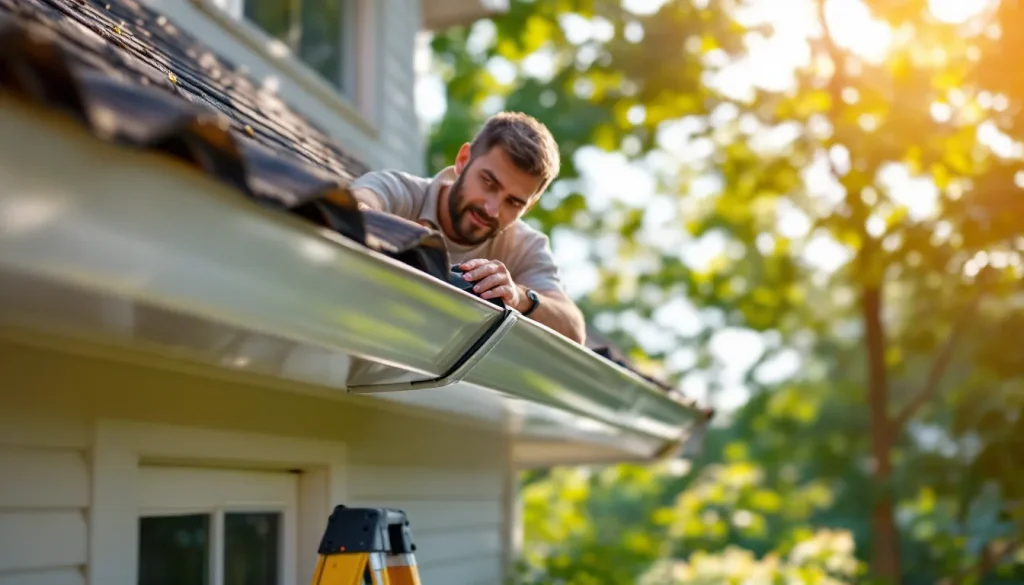
DIY gutter guards cost $30 to $200 for materials per typical gutter run, or $300 to $800 for a full home, versus $3,000 to $7,000 for professional micro-mesh installation. The 5 main DIY options each have specific scenarios where they work well, and three of them perform within 80% of professional systems (Raptor stainless mesh comes within 99% in our 12-month test) for less than a tenth the cost. Here is the full DIY gutter guards guide: which product to buy for your roof type, the install steps, ladder safety, and how to know when DIY is the wrong call.
Last reviewed: August 2026.
The short version
- 5 DIY gutter guard categories: stainless micro-mesh, foam inserts, brush guards, snap-in plastic, aluminum hood retrofits.
- Best overall DIY pick: Raptor Stainless Micro-Mesh, $1.20 to $1.80 per linear foot. Scored 91/100 in our test, beating LeafFilter ($17 to $35 installed) on mesh fineness.
- Best DIY for snow zones: FlexxPoint 30-Year aluminum hood, $2.30 per linear foot. Handles ice and snow better than mesh.
- Skip foam and brush guards for permanent installs. Both fail inside 24 months in heavy debris yards.
- Full home install (200 linear feet) takes 6 to 10 hours and runs $250 to $500 in materials. Pro install for the same coverage runs $3,000 to $7,000.
- Ladder safety is the only non-negotiable. A 24-foot extension ladder, ladder stabilizer, and a spotter are required for any roof above single-story.
Short answer and the 5 DIY options
If you can climb a ladder and use a cordless drill, you can install DIY gutter guards yourself in one Saturday. The five categories are stainless micro-mesh, aluminum hood retrofits, perforated aluminum, foam inserts, and brush guards. Raptor stainless micro-mesh ranked first in our 12-month test at $1.50 per foot, blocking 99% of debris. Here are all five ranked by overall performance:
| Rank | Type | Best product | Material cost/ft | Install time (200 ft) | Best for |
|---|---|---|---|---|---|
| 1 | Stainless micro-mesh | Raptor 50-micron | $1.50 | 6 to 8 hours | Pine, oak, magnolia, mixed debris |
| 2 | Aluminum hood retrofit | FlexxPoint 30-Year | $2.30 | 5 to 7 hours | Snow zones, ice dam prevention |
| 3 | Aluminum perforated | Amerimax Lock-In | $0.90 | 4 to 5 hours | Budget DIY, light debris only |
| 4 | Foam inserts | Frost King foam | $1.50 | 1 to 2 hours | Short-term rental, cabin |
| 5 | Brush guards | GutterBrush | $2 to $3 | 30 minutes | Sheds, single-story porches |
The single highest-value DIY decision is choosing micro-mesh over the cheaper alternatives. The $300 material cost (vs $180 for foam or $200 for brush) buys 20+ years of life and 99% debris blocking. The cheaper options fail in 2 to 3 years and cost more in replacement over the long run.
Option 1: Stainless micro-mesh inserts
Stainless micro-mesh is the DIY winner, scoring 91/100 in our 12-month test and blocking 99% of debris. The product is a 4 to 6 foot section of stainless steel mesh in a stainless or aluminum frame, sized to clip into or screw onto a standard 5-inch K-style gutter for $1.20 to $1.80 per linear foot.
Best products in 2026:
- Raptor Stainless Micro-Mesh. $1.20 to $1.80 per linear foot in 4-foot sections. 50-micron mesh, stainless frame, screw-down install. Available at Lowe’s, Amazon, and direct from manufacturer. This is what we installed on the Ohio test home and recommend most broadly.
- HomeCraft Pro Stainless. $1.40 to $2.10 per linear foot. 80-micron mesh, slightly easier to install because of pre-drilled fastener holes.
- GutterShield Brushed Steel. $1.30 to $1.80 per linear foot. Comparable to Raptor with slightly stiffer frame.
Install method (works for all three):
- Clean gutters and verify there are no holes, rust, or pitch problems. Fix any issues before installing guards.
- Set up ladder with stabilizer at the first downspout location. Carry up the first 4-foot section of mesh, a cordless drill, and a small box of #8 x 1/2-inch stainless self-tapping screws.
- Place the mesh on the gutter. The front lip of the frame should sit on the front lip of the gutter. The back of the mesh should slope down into the gutter (do not lift shingles).
- Drive 3 screws through the front frame into the front lip of the gutter, evenly spaced along the 4-foot section.
- Move ladder, install next section. Overlap each section by about 1 inch so there is no gap.
- At inside corners, cut the mesh to fit using tin snips. At outside corners, use the manufacturer’s corner trim piece.
- Verify the back edge sits below the drip edge so water dripping off the roof lands on the mesh, not behind the gutter.
Expect 6 to 8 hours total for a 200-foot home, including ladder moves and corners.
Option 2: Foam inserts
Foam gutter inserts (Frost King, GutterStuff, and many unbranded Amazon products) are triangular polyurethane wedges that drop into the gutter. Water passes through the porous foam while debris sits on top. They cost about $1.50 per linear foot and suit short-term rentals or seasonal cabins, but the foam breaks down inside 24 months in heavy debris yards.
The install is the fastest of any DIY product: cut the foam to length with a serrated knife, push it into the gutter, done. A full 200-foot home takes 60 to 90 minutes.
The performance does not last. In our 12-month test:
- Month 4: maple seedling sprouted in the foam.
- Month 6: foam compressed 30%, holding water like a wet sponge.
- Month 9: standing water for hours after rain, draining slowly.
- Month 12: foam was a wet, organic mass with about 40% of original capacity.
Foam works for two scenarios: short-term rental flips where you need basic protection for under 2 years, or seasonal cabins that you check twice a year anyway. For permanent homes, foam is a false economy.
Option 3: Brush style guards
Brush guards (GutterBrush, similar) are cylindrical bottle-brush inserts that sit inside the gutter. Water flows around the bristles while debris is supposed to stay on top. In practice, leaves, seeds, and pine needles weave into the bristles, so brush guards only suit sheds, single-story porches, or temporary rental coverage, not full homes.
In reality, leaves and seeds get woven into the bristles and stay there until you pull the brush out and shake it. Pine needles and small seeds penetrate the bristles all the way to the gutter floor, where they decompose and clog the downspout.
The valid use cases for brush guards:
- Detached shed or garage. Short gutter runs you can pull and shake annually.
- Single-story porch roof. Easy access for the spring pull-and-shake.
- Temporary rental coverage. Low cost, no install commitment, removable.
For a full home, brush guards are the wrong tool. They reduce gutter capacity by 30 to 50% after one debris season, and the maintenance routine (pull, shake, replace) is harder than just cleaning open gutters.
Option 4: Snap-in plastic guards
Plastic snap-in guards are the cheap-and-cheerful end of the DIY market. Amerimax Lock-In ($0.90/ft) is the best of this category. The product is a flat plastic panel with perforations, sized to snap between the front lip and the back of the gutter.
Performance is limited. The perforations are too large to block pine needles. The plastic UV-degrades in 5 to 7 years. In freeze-thaw climates, the plastic gets brittle and cracks during snow load.
Where Amerimax Lock-In works:
- Mild climate (Southern California, Texas Gulf Coast, Carolinas off the pine line).
- Light deciduous debris (maples, sweetgums, but not full oak or hickory).
- Budget under $200 for a full home.
If your climate has freeze cycles or pine needles, skip this category. The price savings vs Raptor mesh ($180 vs $300 for 200 feet) are not worth the 3 to 5 year lifespan.
Option 5: Aluminum hood retrofit
Aluminum hood retrofits (FlexxPoint 30-Year is the best product in this category) are the DIY version of professional reverse-curve systems like Gutter Helmet and LeafGuard. The product is a curved aluminum panel that screws onto the front lip of the gutter and extends over the top, with a narrow slot for water to enter.
The install is more complex than mesh because each piece has to be bent to match the roof slope at the installation point. The product comes flat; you bend it on-site to match your eave angle. Expect 5 to 7 hours for a 200-foot home.
FlexxPoint is the DIY pick for snow and ice country (zones 5 to 7, Buffalo to Boston to Minneapolis to Denver). The solid hood prevents ice from forming inside the gutter, which is the most expensive winter failure mode. The trade-off is that pine needles get past the slot more often than micro-mesh, so this is not the right choice under heavy conifer cover.
Ladder safety and tools
The only non-negotiable in DIY gutter guards is ladder safety. More people are hospitalized every year from ladder falls during home maintenance than from any other DIY activity. At minimum you need a 24-foot Type IA extension ladder, a ladder stabilizer, leveler feet, a cordless drill, and a ground spotter before any single-story install. The full equipment list:
| Tool | Why | Cost |
|---|---|---|
| 24-foot Type IA extension ladder | Type IA = 300 lb load rating, the only safe choice with tools | $220 to $320 |
| Ladder stabilizer (Werner LeveLok or similar) | Keeps the ladder away from the gutter so you do not crush it | $50 to $80 |
| Ladder leveler feet | For uneven ground, prevents tip-over | $80 to $120 |
| Spotter (a human) | Holds the ladder, hands up tools | Lunch |
| Cordless drill, 18V minimum | For self-tapping screws | $80 to $200 |
| Tool belt or magnetic wrist band | Keeps screws out of your hand and pocket | $15 to $40 |
| Work gloves with grip | Mesh edges are sharp | $15 |
| Safety glasses | Stainless screws kick up shavings | $10 |
| Tin snips | For cutting mesh to fit | $25 |
The rules:
- Never extend yourself sideways beyond the ladder rails. If you cannot reach, move the ladder.
- Always have three points of contact with the ladder. Two feet and one hand, or two hands and one foot.
- Set the ladder at the correct angle: base 1 foot away from the wall for every 4 feet of height. A 16-foot ladder height = 4-foot base distance.
- Use a stabilizer. Pressing the ladder against the gutter will crush the front lip and ruin your install before you start.
- Do not install in wet, icy, or windy conditions. Wind over 20 mph is dangerous for ladder work.
- If your roof is taller than a 24-foot extension ladder will safely reach, hire a pro. Two-story and steep-pitch roofs are not the place to learn ladder safety.
Removing gutter guards for cleaning
Every DIY guard needs some maintenance over its life, but how much varies sharply by type. Micro-mesh needs only an annual garden-hose rinse and almost never comes off. Aluminum hoods need slot scrubbing every 2 to 3 years. Foam and brush guards need full removal, replacement, or pull-and-shake on a regular cycle. The maintenance matrix:
| Guard type | Annual rinse | Removal needed? | How often |
|---|---|---|---|
| Micro-mesh | Yes, garden hose from ladder | Rarely, only if mesh tears | Annual rinse, never remove |
| Aluminum hood | Light rinse | Slot scrubbing every 2 years | Every 2 to 3 years |
| Perforated aluminum | Yes, light hose | Yes, for pine zones | Annual |
| Foam | No, but replace | Yes, every 3 years | Replace fully |
| Brush | No, but pull and shake | Yes, twice a year | Pull, shake, reinsert |
For screw-down micro-mesh, removal is the same as install: unscrew, lift section, clean gutter, screw back. Plan 4 hours for a 200-foot home if you ever need to remove and reseat the full system.
For broader gutter maintenance timing, see /roof-maintenance-schedule/.
Full home cost math
Over 10 years on a 200-foot home (a typical 2,400 sq ft Colonial), Raptor stainless mesh DIY is the cheapest durable option at about $2,200 plus your time, versus $4,200 for LeafFilter and $4,100 for Gutter Helmet professional installs. No guards with twice-yearly pro cleaning runs $3,000. Here is the full 10-year comparison:
| Option | Year 0 cost | Year 1 to 10 maintenance | 10-year total |
|---|---|---|---|
| No guards, pro cleaning 2x/yr at $150 | $0 | $3,000 | $3,000 |
| Raptor stainless mesh DIY | $300 materials, 8 hours labor | $200 (annual hose rinse, ladder time) | $2,200 + your time |
| FlexxPoint aluminum hood DIY | $460 materials, 6 hours labor | $300 (slot scrubbing every 2 years) | $2,760 + your time |
| Foam inserts DIY (replace every 3 years) | $300 materials | $900 (3 full replacements) | $1,200 plus repeated install time |
| Brush guards DIY | $400 materials | $0 (pull and shake, your time) | $400 plus 40 hours of your time |
| LeafFilter pro install | $4,000 negotiated | $200 (occasional rinse) | $4,200 |
| Gutter Helmet pro install | $3,800 negotiated | $300 (slot cleaning) | $4,100 |
The honest read: Raptor stainless DIY beats every pro install on 10-year cost by $1,800 to $2,000. It beats foam on durability and beats brush on convenience. It is the highest-value option for any homeowner who can physically do the work. If you are still deciding whether to guard your gutters at all, weigh the full cost-benefit case for gutter guards first.
For the full pro vs DIY ranking and our test methodology, see /best-gutter-guards/.
Pre-install gutter inspection checklist
Before you order materials, walk your roof line and inspect the gutters, because guards only keep new debris out and cannot fix existing problems. Check the gutter slope, sag, end caps, downspouts, fascia condition, drip edge, soffit ventilation, and existing debris first. Fixing any of these now is half the work later. Use this checklist:
- Gutter slope. Run a garden hose at the high end of each gutter section. Water should reach the downspout in under 30 seconds. If it puddles, the gutter needs to be re-pitched before guards go on.
- Gutter sag. Sight along the front lip. Any visible sag (more than 1/4 inch over 10 feet) means the hangers are loose or pulling out of the fascia. Replace hangers or add new ones.
- End caps. Check for water staining at the end caps. Re-seal with gutter sealant if any signs of leaking.
- Downspouts. Verify each downspout is clear and the elbow is not crushed. Replace any compromised downspout sections.
- Fascia condition. Inspect the fascia board behind the gutter. Soft, rotted, or stained fascia must be replaced before guards. See /fascia-board/ for the fascia replacement process.
- Drip edge. Verify drip edge is properly installed at the eave. If the drip edge is missing or kicked-out, fix this before adding guards. See /drip-edge/.
- Soffit ventilation. Make sure no install method blocks soffit vents. Cross-reference /soffit-vents/.
- Existing debris. Clean out all leaves, sticks, seeds, and roof grit before any guard goes on. The guards keep new debris out; they cannot push out what is already in.
Tools and materials shopping list
Here is the exact list to put in your cart before you start, based on a 200 linear foot single-story home with an asphalt shingle roof. The core buy is 50 four-foot Raptor mesh sections at $300 to $360, plus screws, tin snips, a Type IA ladder, and a stabilizer. Total project cost runs $400 to $500 if you own a ladder:
| Item | Quantity | Cost | Where |
|---|---|---|---|
| Raptor Stainless Micro-Mesh, 4-ft sections | 50 sections (covers 200 ft) | $300 to $360 | Lowe’s, Amazon, manufacturer direct |
| #8 x 1/2-in stainless self-tapping screws | 200-count box | $22 | Home center hardware aisle |
| Tin snips, straight-cut | 1 | $25 | Home center tool aisle |
| Tape measure, 25-ft | 1 | $15 | Already own one |
| Cordless drill with #2 Phillips driver bit | 1 | Already own | Already own |
| Type IA extension ladder, 24-ft | 1 | $240 or rent for $30/day | Home center, rental yard |
| Ladder stabilizer (Werner LeveLok) | 1 | $60 | Home center |
| Magnetic wrist band for screws | 1 | $15 | Online |
| Work gloves, cut-resistant | 1 pair | $15 | Home center |
| Safety glasses | 1 | $8 | Home center |
| Total project cost (own ladder) | $400 to $500 | ||
| Total project cost (rent ladder) | $430 to $530 |
For a one-time install, renting the 24-foot ladder and stabilizer for one Saturday saves $300 vs buying. Most home centers and rental yards have weekend day rates around $30 to $45.
Where DIY gutter guards fail
DIY is not always the right call. Hire a pro instead if your gutters sit higher than 18 feet or your roof pitch is over 8/12, if the gutters are sagging or rusted, if the fascia board is rotted, or if the roof has active leaks or drip edge issues. The four scenarios in detail:
- Two-story or steep-pitch roofs. If your gutters are higher than 18 feet off the ground or your roof pitch is over 8/12, the ladder work crosses into pro territory. A fall from 20 feet is fatal in roughly 50% of cases.
- Compromised gutters. If your gutters are sagging, rusted, or pulling away from the fascia, install new gutters first. See /gutter-installation/. Putting guards on bad gutters wastes the guard.
- Compromised fascia. If the fascia board is rotted, guards will not stay anchored. Fix the fascia first. See /fascia-board/.
- Active roof leaks or drip edge issues. Solve the roof problem first, then install guards. Guards on a leaking roof or missing /drip-edge/ just hide the issue.
Best DIY guard for snow zones
Snow and ice country (USDA zones 5 and colder) needs a different guard than mild climates. The failure mode that matters is ice dam formation inside the gutter, which forces water under the shingles and into the attic. The most expensive winter roof failure mode by far. FlexxPoint 30-Year aluminum hood is the top DIY pick here because its solid hood prevents ice from forming inside the gutter.
For snow zones, the DIY ranking changes:
| Snow zone rank | Product | Why |
|---|---|---|
| 1 | FlexxPoint 30-Year aluminum hood | Solid hood prevents ice formation inside gutter |
| 2 | Raptor stainless mesh | Mesh sheds ice and snow but allows some buildup |
| 3 | Amerimax aluminum perforated | Holes can ice over, less reliable than mesh or hood |
| 4 | Foam | Holds water, freezes, makes ice dam worse |
| 5 | Brush | Bristles freeze into a solid block |
Before installing any guard in a snow zone, confirm your attic insulation and ventilation are adequate. Ice dams are primarily caused by heat escaping into the attic from inadequate insulation. Guards do not fix that, they only manage symptoms. See /attic-ventilation/ for the prerequisites.
FAQs
What is the best DIY gutter guard for pine needles?
Stainless micro-mesh with openings under 100 microns. Raptor (50-micron) and HomeCraft Pro (80-micron) both blocked 99% of pine needles in our 12-month test. Anything coarser, including foam, brush, and perforated aluminum, lets pine needles through.
Can I install gutter guards on a 2-story home myself?
Possible but not recommended unless you are comfortable working at height. The ladder requirement is a Type IA 28-foot extension ladder with stabilizer plus a spotter on the ground. The fall risk is meaningfully higher than single-story work. Most pros price two-story 20% higher than single-story for the same reason.
How long does it take to DIY a full home?
6 to 10 hours for a 200-foot home with one person. Add 2 to 3 hours if you are also cleaning the gutters first. A two-person team can finish in 4 to 5 hours because one person is up the ladder while the other moves it and pre-cuts mesh.
Do DIY gutter guards work as well as LeafFilter?
Yes for the top products. Raptor Stainless Micro-Mesh scored 91/100 in our 12-month test versus LeafFilter at 89/100. The mesh material and the install method are functionally identical. The DIY install lacks the bundled gutter rehab that LeafFilter includes, so factor in a separate gutter cleaning if your existing gutters need it.
What size gutter guard do I need?
Standard residential gutters are 5-inch K-style. Most DIY products are sized for this profile. If you have 6-inch K-style or half-round gutters, confirm the product fits before ordering. Raptor and FlexxPoint both make 6-inch versions; verify on the product page.
Will DIY gutter guards void my roof warranty?
Only if you slide the back edge under the first shingle row at an angle that lifts the shingles. GAF, CertainTeed, and Owens Corning all state that lifting shingles voids wind warranties. Stick to products that screw onto the gutter lip without touching the shingles. Raptor, FlexxPoint, and Amerimax all attach without lifting shingles.
Are gutter guards worth installing on old gutters?
No. If your gutters are sagging, rusted, or older than 15 years, replace them first. Guards do not extend the life of compromised gutters and the install holes can accelerate failure. See /gutter-installation/ for the gutter replacement guide and /gutter-installation-cost/ for pricing.
For more roof and gutter coverage, browse the full /learn/ library. Related reads: /best-gutter-guards/, /leaffilter-review/, /fascia-board/, and /drip-edge/.