
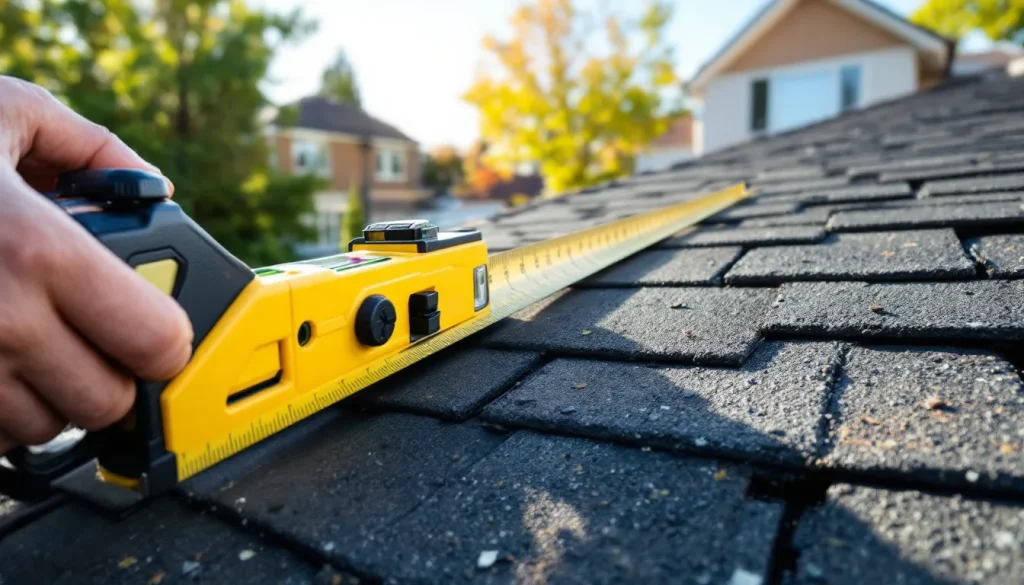
The roof pitch calculator method converts rise over run into degrees, percent, and the pitch multiplier you need for accurate roof area math. Four practical ways to get pitch: from inside the attic (level on a rafter), from the ground with a level held against a gable wall, from a smartphone inclinometer app, or from drone imagery using EagleView or Hover output. A 6/12 pitch equals 26.57 degrees, 50% slope, and a 1.118 area multiplier. A 12/12 pitch equals 45 degrees, 100% slope, and a 1.414 area multiplier. The math: pitch in degrees equals arctan(rise/run), percent equals (rise/run) x 100, multiplier equals the square root of (1 + (rise/run) squared). Code minimums by material: 2/12 for low-slope membranes, 2/12 for metal with sealed seams, 3/12 for double-layer asphalt, 4/12 for single-layer asphalt, 4/12 for clay and concrete tile. Below is the full method, conversion table, and the cases where pitch math matters for ordering shingles and underlayment.
The short version
- Pitch is rise over run, where run is always 12 inches. 6/12 means 6 inches of rise per 12 inches of horizontal run.
- Convert pitch to degrees: degrees = arctan(rise/12). 6/12 = 26.57 degrees. 12/12 = 45 degrees.
- Convert pitch to percent: percent = (rise/12) x 100. 6/12 = 50%. 12/12 = 100%.
- Pitch multiplier for roof area: multiplier = sqrt(1 + (rise/12)^2). 6/12 = 1.118.
- Four ways to measure: attic rafter + level, ground + level against gable, smartphone app, aerial drone or report.
- Code floor by material: asphalt 4/12 single-layer, 2/12 to under 4/12 double-layer, metal 2/12, tile 4/12, membrane 1/4 inch per foot.
What pitch actually is
Roof pitch is expressed as a ratio with the run always set to 12 inches. A 6/12 pitch means the roof rises 6 inches for every 12 inches of horizontal travel. A 4/12 pitch rises 4 inches. A 12/12 pitch (45 degrees) rises 12 inches per 12 inches of run.
The term “slope” is sometimes used interchangeably with pitch, but technically slope is the angle and pitch is the ratio. In practice, contractors, architects, and code books all use pitch (rise/run with run = 12) as the working unit. Degrees and percent are the conversion outputs.
The four formulas you need
Pitch ratio: rise (inches) / 12 (inches of run)
Degrees: arctan(rise/12)
Percent slope: (rise/12) x 100
Area multiplier: sqrt(1 + (rise/12)^2)
The area multiplier is the most useful for residential reroofing math. Multiply your house footprint by the multiplier and you get the actual roof surface area. A 2,400 sq ft footprint with a 6/12 pitch yields 2,400 x 1.118 = 2,683 sq ft of roof. That number drives the shingle bundle count, underlayment rolls, and ice and water shield order. For the full workflow, see our how to calculate roof square footage guide.
The conversion table
| Pitch | Degrees | Percent | Area multiplier | Common application |
|---|---|---|---|---|
| 1/12 | 4.76 | 8.3% | 1.003 | Low-slope membrane only (TPO, EPDM, modified bitumen) |
| 2/12 | 9.46 | 16.7% | 1.014 | Metal with sealed seams, low-slope asphalt (double layer) |
| 3/12 | 14.04 | 25.0% | 1.031 | Asphalt with double-layer underlayment, metal |
| 4/12 | 18.43 | 33.3% | 1.054 | Asphalt single-layer code minimum, ranch homes |
| 5/12 | 22.62 | 41.7% | 1.083 | Typical mid-century ranch and tract homes |
| 6/12 | 26.57 | 50.0% | 1.118 | Most common residential pitch in the US |
| 7/12 | 30.26 | 58.3% | 1.158 | Two-story tract, light walkable |
| 8/12 | 33.69 | 66.7% | 1.202 | Steep mid-Atlantic, hip-and-valley homes |
| 9/12 | 36.87 | 75.0% | 1.250 | Steep custom, roof jacks required for crew |
| 10/12 | 39.81 | 83.3% | 1.302 | Steep colonial revival, harness work zone |
| 11/12 | 42.51 | 91.7% | 1.357 | Very steep, +30% labor cost |
| 12/12 | 45.00 | 100.0% | 1.414 | Maximum-pitch residential, +40% labor |
| 14/12 | 49.40 | 116.7% | 1.537 | Mansard-style, scaffold required |
| 16/12 | 53.13 | 133.3% | 1.667 | Steeple, tower, A-frame |
| 18/12 | 56.31 | 150.0% | 1.803 | Cottage style, A-frame |
For a printable single-sheet version of this table, see our roof pitch chart reference.
Method 1: from inside the attic with a level
This is the cleanest method because you do not have to be on the roof. Tools: a 24-inch carpenter level and a tape measure.
- Find a clean, straight section of a rafter or truss in the attic.
- Hold one end of the level firmly against the underside of the rafter at the lower end.
- Adjust the level until the bubble is centered (the level is horizontal).
- Measure straight down from the far end of the level (12 inches away) to the underside of the rafter.
- That measurement in inches is your rise. The run is 12. Read off the pitch.
If the rafter is so steep that 12 inches of horizontal travel exceeds 12 inches of vertical drop, you have a pitch over 12/12 and the math reverses (run becomes the variable, rise stays at 12). For a custom pitch over 12/12, multiply by the multiplier in the table above.
Method 2: from the ground with a level against a gable wall
Use this when you have a gable end visible from the ground. Tools: a 24-inch level, a tape measure, a step ladder if needed.
- Hold the level against the gable wall siding so one end of the level touches the bottom of the roof line (the soffit).
- Adjust until level. The far end of the level is now 12 to 24 inches away from the wall, horizontally.
- Measure from the far end of the level up to the underside of the roof line directly above.
- If you used a 12-inch level, the measurement in inches is the rise. If you used a 24-inch level, divide by 2.
Pro tip: extend the level out perpendicular to the gable wall, not parallel. You are measuring rise on the slope of the gable, not the gable wall itself.
Method 3: smartphone inclinometer app
Modern smartphones have a hardware accelerometer accurate enough for roofing work. Free apps that work well: iHandy Level (iOS), Bubble Level (Android), Measure (built-in iOS). Procedure:
- Calibrate the app on a known flat surface.
- Place the phone flat against the roof surface (you have to be on the roof) or against a board placed flat against the soffit and roof line.
- Read the angle in degrees.
- Convert degrees back to pitch using the table above, or compute: rise = 12 x tan(degrees).
Accuracy: typically within 0.5 degrees, which is plenty for ordering material. The phone-against-roof method requires going up there, so the indirect “phone against a board against the gable” version is safer and usually accurate within 1 degree.
Method 4: drone imagery or aerial measurement report
If you have already ordered an EagleView, Hover, or Roofr report for the project, the pitch is on page 2 or 3 of the PDF. These services use photogrammetry from aerial imagery and report pitch to the nearest half-step (4/12, 4.5/12, 5/12). Reports run $20 to $50 and include total roof area, pitch by plane, plane-by-plane areas, ridges, hips, valleys, and rakes. For when this makes sense, see our 2026 aerial roof measurement software report.
Why pitch math drives every other roof calculation
Once you have the pitch, three downstream calculations open up:
- Roof area from footprint. Footprint sq ft x area multiplier = roof sq ft. A 2,400 sq ft footprint with 6/12 pitch yields 2,683 sq ft of roof. See our roof area vs footprint calculator for the full method.
- Bundles of shingles. Roof sq ft / 100 = squares. Squares x 3 (architectural) or x 4 (Class 4) = bundles before waste. See our shingle bundle calculator.
- Labor multiplier. Steep pitches cost more. Standard labor is priced through 7/12. Add 15% for 8/12, 25% for 9/12, 35% for 10/12, 50% for 12/12 and above. See our roof cost per square foot guide.
Code minimums by material
| Material | Minimum pitch | Special notes |
|---|---|---|
| Asphalt shingles, single layer underlayment | 4/12 (33.3%) | IRC R905.2.2 standard |
| Asphalt shingles, double layer underlayment | 2/12 (16.7%) | IRC R905.2.2 low-slope provision |
| Metal standing seam, sealed seams | 1/4 inch per foot (1.04%) for some products, more typical 2/12 | Manufacturer-specific |
| Metal exposed fastener (R-panel, 5-V) | 3/12 (25%) | Some products allow 2/12 with butyl tape |
| Clay and concrete tile | 4/12 (33.3%) | Some clay flat tile rated to 3/12 with peel-stick membrane |
| Wood shake | 4/12 (33.3%) | IRC R905.7 |
| Slate | 4/12 (33.3%) | Some historic slate goes to 3/12 with copper underlayment |
| TPO, EPDM, modified bitumen | 1/4 inch per foot (1.04%) | Low-slope membrane standard |
| Built-up roof (BUR) | 1/4 inch per foot (1.04%) | Maximum slope 3/12 in most product lines |
Worked example: typical 2,400 sq ft ranch with 6/12 pitch
Step through the full pitch-to-bundle workflow:
Pitch: 6/12
Degrees: arctan(6/12) = 26.57 degrees
Percent: (6/12) x 100 = 50%
Area multiplier: sqrt(1 + (6/12)^2) = sqrt(1 + 0.25) = sqrt(1.25) = 1.118
Roof area: 2,400 sq ft x 1.118 = 2,683 sq ft
Squares: 2,683 / 100 = 27 (rounded up from 26.83)
Bundles (architectural, 7% waste): 27 x 3 x 1.07 = 86.67, round up to 87 bundles
That single chain (pitch to area to squares to bundles) is the whole residential reroofing math universe. For the bundle waste factor by roof complexity, see our shingle bundle prices 2026 deep dive.
Worked example: steep 8/12 hip with valleys
Same 2,400 sq ft footprint but an 8/12 pitch hip with three valleys and a dormer.
Pitch: 8/12
Area multiplier: sqrt(1 + (8/12)^2) = sqrt(1 + 0.444) = sqrt(1.444) = 1.202
Roof area: 2,400 sq ft x 1.202 = 2,885 sq ft
Squares: 2,885 / 100 = 29 (rounded up)
Bundles (architectural, 13% waste for complex hip): 29 x 3 x 1.13 = 98.3, round up to 99 bundles
Labor multiplier: +15% for 8/12 pitch over standard 6/12 labor rate
The pitch change from 6/12 to 8/12 added 200 sq ft of roof area and 12 bundles. The labor multiplier adds another 15% on the install cost. For the full labor cost breakdown by pitch, see our roof replacement cost per square guide.
Pitch and ice and water shield placement
Steeper pitches shed water and snow faster, which reduces the ice-dam risk at the eave. But code does not reduce the ice-and-water shield requirement based on pitch alone. IRC R905.1.2 still requires ice and water shield 24 inches past the interior wall line in any region where the January average is 25F or below, regardless of whether the pitch is 4/12 or 12/12. Most contractors in cold zones (IECC 5 to 8) run the shield 36 to 48 inches past the wall to give margin against ice-dam backup.
On low-slope sections (2/12 to under 4/12), code requires either two layers of cemented underlayment or a self-adhered ice and water shield over the entire roof surface. Pitch math drives this decision: if any plane on your roof falls below 4/12, that plane gets the low-slope treatment regardless of what the main roof is doing. For the underlayment product side, see our best synthetic underlayment brands guide.
Pitch and warranty coverage
Manufacturer warranties on asphalt shingles assume the shingle is installed within the rated pitch range. GAF Timberline HDZ, OC Duration, and CertainTeed Landmark all list a 2/12 minimum with the low-slope underlayment requirement. Going below 2/12 voids the warranty. There is no upper-pitch limit in the warranty terms (12/12, 16/12, 18/12 are all fine), but high-pitch installations sometimes require additional fastening per the manufacturer’s high-wind detail. For the full warranty-tier comparison, see our 2026 shingle brand comparison report.
Mixed-pitch roofs (a main + a porch)
Many homes have a steep main roof and a low-slope porch addition. You cannot use one pitch for the whole roof. Treat each plane separately:
- Plane 1 (main roof): footprint area x multiplier for main pitch
- Plane 2 (porch): footprint area x multiplier for porch pitch
- Total roof area: sum of all planes
EagleView and Hover reports break this out automatically. Hand-measurement requires sketching the floor plan, dividing into rectangles for each pitch, and computing separately.
FAQ
What is the most common residential roof pitch in the US?
6/12 (26.57 degrees, 50% slope) is the most common single pitch in single-family construction, used on roughly 35% of homes built since 1990. 4/12, 5/12, and 7/12 split most of the remaining 50% of the residential stock.
Is a 12/12 pitch considered steep?
Yes, 12/12 (45 degrees) is at the upper edge of what most residential crews will walk without harnesses and roof jacks. Labor cost runs 35% to 50% above standard 4/12 to 6/12 pricing. Custom homes, A-frames, and some Victorian and Tudor styles use 12/12 and steeper.
Can asphalt shingles be installed on a 2/12 pitch?
Yes, with the IRC R905.2.2 low-slope provision: a double layer of underlayment is required (typically self-adhered ice and water shield over the entire roof, or two cemented layers of 15 lb felt). Most contractors avoid asphalt under 4/12 because the long-term performance is shorter and warranties are tighter.
How do I measure pitch on a roof I cannot get on or see clearly?
Order an aerial measurement report (EagleView, Hover, Roofr) for $20 to $50. The report includes pitch. If you only need a rough estimate, look at a photo of the gable end with a known reference (like a window or door) and measure ratio. Pitch is the easiest variable to get within 0.5 of a step using nothing but a side photo.
Does pitch affect roof lifespan?
Indirectly, yes. Steeper roofs shed water faster, get less UV exposure per square foot of surface, and accumulate less debris. Asphalt shingles on a 10/12 pitch typically outlast the same shingles on a 4/12 pitch by 3 to 5 years, all else equal. Low-slope (under 4/12) is the shortest-lived asphalt application.
Bottom line
Pitch is the input that drives every downstream roof calculation: area, bundle count, underlayment, ice and water shield, and labor cost. Four practical ways to measure it. One conversion table to convert between pitch ratio, degrees, percent, and area multiplier. For 95% of residential roofs the pitch is between 4/12 and 10/12, the area multiplier is between 1.054 and 1.302, and the math is one multiplication step. Get the pitch right and the rest of the estimate falls in line. Get it wrong and you are off by 5% to 15% on every line item. For the full residential cornerstone, see our residential roofing guide 2026.