
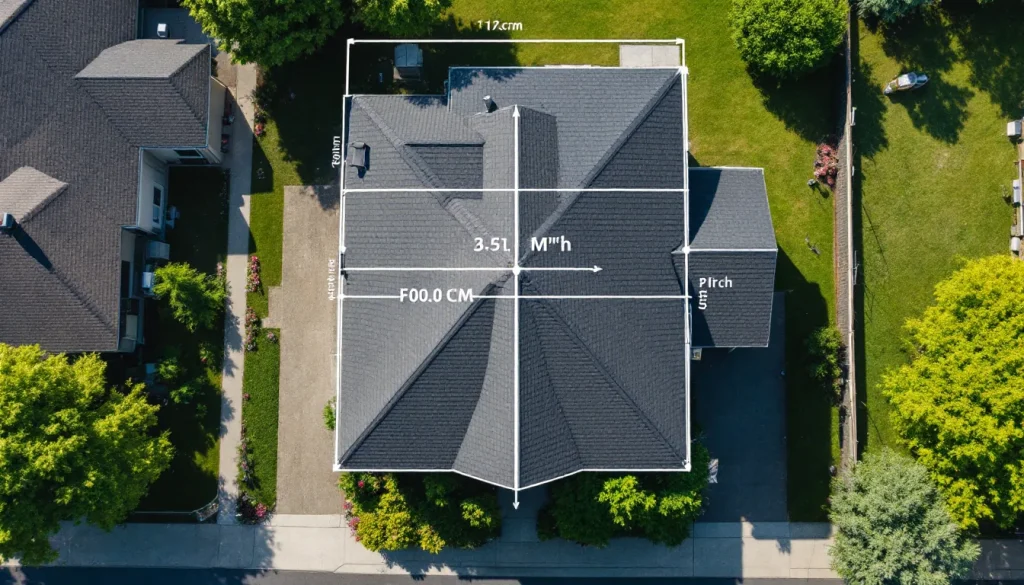
The roof area calculator uses a simple step-by-step method: measure the house footprint, multiply by the pitch multiplier, and add overhang. House footprint is the outside-wall outline measured from the ground. Pitch multiplier converts horizontal area to actual roof surface area: 1.054 at 4/12, 1.118 at 6/12, 1.202 at 8/12, 1.302 at 10/12, 1.414 at 12/12. Overhang adds 12 to 24 inches around the perimeter. For a 40 ft by 60 ft footprint (2,400 sq ft) with a 6/12 pitch and 18-inch overhangs, the roof area is 2,400 x 1.118 plus the overhang strip, or about 2,883 sq ft total. That converts to 29 squares for shingle ordering. Roof area is not the same as project area: a project that includes a porch, dormers, or a garage add-on needs each plane calculated separately and summed. Below is the full three-step method, the overhang math, dormer add-ons, and the worked examples for common house sizes.
The short version
- Step 1: measure house footprint (length x width at the foundation outline).
- Step 2: multiply footprint by pitch multiplier (1.054 at 4/12, 1.118 at 6/12, 1.302 at 10/12).
- Step 3: add overhang strip (perimeter x overhang depth, typically 12 to 24 inches).
- Dormers add 30 to 80 sq ft each. Cross-gables add 15 to 25%. Hip with valleys uses the same multiplier as a gable of the same pitch.
- Project area = roof area + porch roof + garage roof + dormer rebuild. Footprint alone undercounts by 5 to 15%.
- EagleView, Hover, Roofr give the answer in a $20 to $50 report. Manual math gets you within 5%.
Why footprint is not the same as roof area
House footprint is a flat (horizontal) measurement. Roof area is the actual sloped surface that gets covered in shingles. Because the roof rises and falls over the footprint, the actual surface is larger than the footprint. The steeper the pitch, the bigger the gap.
On a 4/12 pitch, the roof surface is only 5.4% larger than the footprint. On a 12/12, it is 41.4% larger. Get this wrong and you under-order shingles, underlayment, ice and water shield, and ridge cap. For the pitch-to-multiplier conversion table and the math, see our roof pitch calculator method guide.
Step 1: measure the house footprint
Two practical ways. Tape measure walks the foundation outline. Aerial or county-assessor lookup pulls it from public records.
Tape measure method. Walk the outside of the foundation with a 100-ft tape. Measure each outside wall to the nearest 6 inches. Sketch the floor plan as you go, noting any bumpouts, bay windows, or chimneys. Multiply length by width for a rectangle, or break L-shaped and T-shaped homes into rectangles and sum. Typical accuracy: within 2%.
County assessor method. Most US counties publish the assessed footprint in the property record. Pull from the assessor portal or Zillow public data tab. Typical accuracy: within 3% to 5% but often outdated for homes that have been added onto.
Aerial method. EagleView, Hover, and Roofr all measure footprint from satellite or drone imagery and return it on the PDF report. Accuracy is the best available, typically within 1%. See our 2026 aerial roof measurement software report for a head-to-head.
Step 2: multiply footprint by pitch multiplier
Pitch multiplier formula: sqrt(1 + (rise/run)^2). For run = 12 (which is how pitch is expressed): multiplier = sqrt(1 + (rise/12)^2).
| Pitch | Multiplier | Roof area on a 2,400 sq ft footprint |
|---|---|---|
| 2/12 | 1.014 | 2,434 sq ft |
| 3/12 | 1.031 | 2,474 sq ft |
| 4/12 | 1.054 | 2,530 sq ft |
| 5/12 | 1.083 | 2,599 sq ft |
| 6/12 | 1.118 | 2,683 sq ft |
| 7/12 | 1.158 | 2,779 sq ft |
| 8/12 | 1.202 | 2,885 sq ft |
| 9/12 | 1.250 | 3,000 sq ft |
| 10/12 | 1.302 | 3,125 sq ft |
| 11/12 | 1.357 | 3,257 sq ft |
| 12/12 | 1.414 | 3,394 sq ft |
If your home has different pitches on different planes (a main 8/12 hip plus a porch 3/12), treat each plane as its own footprint x multiplier calculation. The table above only works for a single uniform pitch.
Step 3: add the overhang strip
Overhangs are not part of the house footprint but they are part of the roof. They cover the eave (typically 12 to 24 inches deep) and the rake (typically 4 to 12 inches deep). For typical residential construction, the overhang adds 80 to 200 sq ft of roof area.
Overhang math: perimeter (in feet) x average overhang depth (in feet) x the same pitch multiplier. For a 40 x 60 footprint:
Perimeter: 2 x (40 + 60) = 200 ft
Average overhang: 18 inches = 1.5 ft (typical eave 24 inches, rake 12 inches, average 18)
Overhang strip area: 200 x 1.5 = 300 sq ft
Adjusted for 6/12 pitch: 300 x 1.118 = 335 sq ft
Some calculators skip the overhang on the assumption that footprint already includes it. It does not. Footprint is from outside foundation wall to outside foundation wall. The overhang sits past the wall. If you skip this step you undercount by 4% to 10% on a typical house.
Worked example: 40 x 60 ranch with 6/12 pitch
Footprint: 40 x 60 = 2,400 sq ft
Pitch multiplier (6/12): 1.118
Base roof area: 2,400 x 1.118 = 2,683 sq ft
Overhang strip: (perimeter 200 ft x 1.5 ft avg overhang) x 1.118 = 335 sq ft
Total roof area: 2,683 + 335 = 3,018 sq ft
Squares: 3,018 / 100 = 31 (rounded up from 30.18)
Most online calculators stop at the 2,683 sq ft number and miss the overhang. That is why hand-calculated shingle counts come in low and contractors send extra bundles back. For the bundle math from this point forward, see our estimate shingle bundles needed guide and our shingle bundle calculator.
Worked example: 2,200 sq ft footprint with a cross-gable
A cross-gable home has a secondary roof that crosses the main roof at right angles, creating valleys. The footprint stays the same, but the roof area picks up the secondary plane.
Footprint: 2,200 sq ft
Main pitch (7/12): 2,200 x 1.158 = 2,548 sq ft
Cross-gable secondary plane (typical 250 to 400 sq ft of horizontal footprint, same pitch): 350 x 1.158 = 405 sq ft (counted twice because cross-gables roof both sides)
Subtotal: 2,548 + 405 = 2,953 sq ft
Overhang: 1.5 ft avg x perimeter (220 ft) x 1.158 = 382 sq ft
Total roof area: 3,335 sq ft
Cross-gables typically add 10% to 20% to the roof area vs a simple gable on the same footprint. The complexity also bumps the waste factor on shingles from 7% to 12 to 15%. For full waste-factor logic, see our how to measure a roof for shingles guide.
Dormer add-on math
Dormers are small bumpouts on the main roof, each with their own little roof. They have to be added separately.
| Dormer type | Typical roof add (sq ft) | Notes |
|---|---|---|
| Eyebrow dormer (small) | 15 to 30 | No vertical sides, just a bulge in the roof |
| Shed dormer (small) | 30 to 60 | Single-pitch low-slope |
| Shed dormer (large) | 80 to 200 | Bedroom-width, full second story |
| Gable dormer (single window) | 40 to 80 | Mini-gable, two planes meeting at a ridge |
| Hip dormer | 60 to 120 | Four-sided mini-hip |
Two single-window gable dormers add roughly 100 to 160 sq ft to roof area, which is 1 to 1.5 squares of shingles, plus 4 to 6 bundles of ice and water shield around each dormer flashing, plus 50 to 80 ft of step flashing. The labor cost on dormer work runs 2x to 3x the per-square cost of the main roof because of the small cuts, flashing details, and slow movement on the dormer roof itself.
Hip vs gable: same multiplier, different waste
A common misconception: hip roofs need a different multiplier than gables. They do not. A hip roof of pitch X over a footprint of area Y has the same total roof surface as a gable of the same pitch and footprint. The math is the same because the volume swept by the pitch over the footprint is the same.
What changes is the waste factor on shingles. A simple gable wastes about 7%. A hip with four planes wastes 10% to 12%. A hip with valleys, dormers, and saddles can waste 13% to 17%. For the full waste factor table, see our how to calculate roof square footage guide.
L-shaped and T-shaped house footprint math
For non-rectangular homes, break the footprint into rectangles, calculate each, and sum.
L-shaped house, main rectangle 40 x 50 = 2,000 sq ft, ell 20 x 30 = 600 sq ft
Total footprint: 2,000 + 600 = 2,600 sq ft
Pitch (6/12): 2,600 x 1.118 = 2,907 sq ft of roof
Add valley overlap correction (the inside corner where the two roof sections meet): subtract 0 sq ft (the valley is shared roof area, not added or subtracted)
Add overhang: perimeter of L-shape (220 ft if 40 + 50 + 20 + 30 + 30 + 20 = 190, then doubled for two sides…the cleaner version: trace the outline and add segment lengths)
The clean rule: trace the outline of the foundation walking it once, sum the segments to get perimeter, then multiply by overhang depth. For an L-shaped home, the outside outline perimeter is usually 200 to 240 ft on a 2,400 sq ft footprint.
Roof area vs project area
Roof area is the surface that gets shingles. Project area is the total surface area touched by the project, which may include:
- Main roof (the part calculated above)
- Detached or attached garage roof
- Front porch roof
- Back patio cover or pergola roof
- Dormers (separate planes within the main roof)
- Shed or workshop roof if covered in the same project
When you call a contractor, ask whether the quote is for the main roof only or the whole project. A 2,683 sq ft main roof often comes with a 200 sq ft porch and a 400 sq ft attached garage, for a total project of 3,283 sq ft. Quote-to-quote comparisons fall apart when one bid covers only the main roof and another covers the whole project. For the full quote-comparison method, see our new roof estimate breakdown.
Reference: roof area by footprint and pitch (quick lookup)
| Footprint | 4/12 | 6/12 | 8/12 | 10/12 | 12/12 |
|---|---|---|---|---|---|
| 1,200 sq ft | 1,265 | 1,342 | 1,442 | 1,562 | 1,697 |
| 1,500 sq ft | 1,581 | 1,677 | 1,803 | 1,953 | 2,121 |
| 1,800 sq ft | 1,897 | 2,012 | 2,164 | 2,344 | 2,545 |
| 2,000 sq ft | 2,108 | 2,236 | 2,404 | 2,604 | 2,828 |
| 2,400 sq ft | 2,530 | 2,683 | 2,885 | 3,125 | 3,394 |
| 2,800 sq ft | 2,951 | 3,130 | 3,366 | 3,646 | 3,959 |
| 3,000 sq ft | 3,162 | 3,354 | 3,606 | 3,906 | 4,242 |
| 3,500 sq ft | 3,689 | 3,913 | 4,207 | 4,557 | 4,949 |
| 4,000 sq ft | 4,216 | 4,472 | 4,808 | 5,208 | 5,656 |
Add 4% to 10% for overhang and dormers. Multiply roof area by $5 to $8 for an architectural asphalt installed price in 2026 to get a quick budget number. For the full per-sq-ft pricing methodology, see our roof cost per square foot guide.
Sanity-check your number with a second method
Before you place the material order, run the calculation two ways and compare. Method 1: footprint x pitch multiplier plus overhang. Method 2: aerial report or on-roof tape measure. If the two numbers are within 5% of each other, trust the larger one. If they are more than 10% apart, something is off (most often the pitch was measured wrong or a plane was missed). The cost of a $25 aerial report is far less than the cost of a 5% over-order on shingles, and the time saved on a re-measure outweighs the report cost on every project.
FAQ
Is my homeowners insurance roof area the same as the contractor roof area?
Usually not. Insurance carriers typically work from public-record footprint x a default pitch multiplier (often 1.10 to 1.15 regardless of actual pitch), so the insurance carrier’s roof area runs 5% to 10% lower than the actual measured roof on steep-pitch homes. Provide the contractor’s measurement or an EagleView report to true up the claim payout.
Does roof area include the garage roof?
Only if the garage is under the same roof plane as the house (attached, common ridge). A detached garage gets its own footprint calculation. An attached garage with its own roof plane gets counted separately and added to project area.
How accurate is footprint x pitch multiplier vs an EagleView report?
For a simple gable or hip home with regular shape, footprint x pitch multiplier is typically within 3% to 5% of the EagleView number once you add the overhang strip. For complex roofs (cross-gables, multiple dormers, mixed pitches), the manual method can be off by 10% or more, and the aerial report is worth the $20 to $50.
What is the most common error in homeowner roof area math?
Skipping the overhang strip. The second most common is using the house’s living-area square footage (which includes the second floor) instead of the ground-level footprint. The roof only sees the footprint, not the total living area.
Should I round up when I order shingles?
Yes, always. Shingles come in full bundles only. Most contractors order 2 to 3 extra bundles as attic stock for future repairs. Rounding decisions add up over the project: 86.6 bundles rounds to 87 plus 3 attic stock equals 90, or exactly 30 squares.
Bottom line
Footprint, multiplied by pitch multiplier, plus overhang. Three steps. The pitch multiplier table runs from 1.054 at 4/12 to 1.414 at 12/12. The overhang adds another 4% to 10%. For a typical 40 x 60 ranch with 6/12 pitch and 18-inch overhangs, the answer is 3,000 to 3,100 sq ft of roof, which converts to 30 to 31 squares of shingles. That single number drives every line item in the contractor quote and every gut-check on what is fair pricing. For the full estimate-to-quote workflow, see our roof cost estimator guide and our residential roofing guide 2026.