
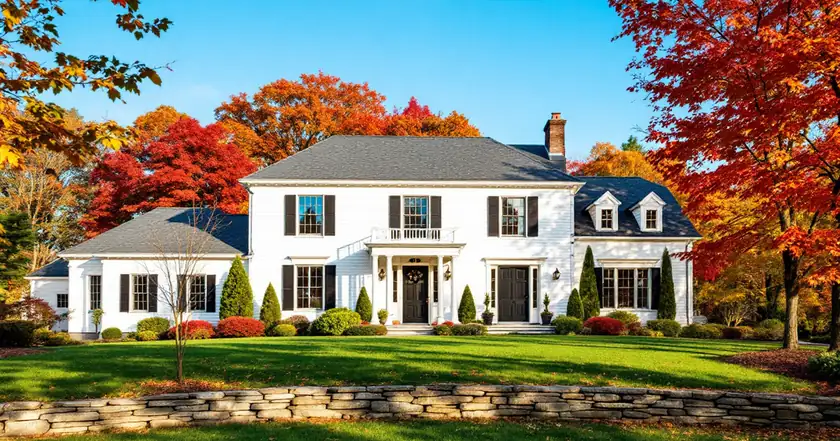
Roof replacement cost in Connecticut usually lands between about $10,600 and $17,150 for a 2,000 sq ft architectural asphalt roof with tear-off, by our labor-adjusted estimate, and Fixr’s Connecticut data puts the typical job at $12,000 to $16,000. Connecticut costs more than the national baseline for reasons specific to the state: roofers earn about 12% more than the U.S. median, the state code requires an ice barrier everywhere and sealed deck seams (or full peel-and-stick underlayment) on tear-off reroofs, and 147 of 169 towns sit in a designated hurricane-prone wind region.
This page is the Connecticut breakdown. For national ranges by material and size, start with our roof replacement cost guide. For how big metros compare, see roof replacement cost by metro.
By The Roofing Brief Team. Last reviewed: October 2026.
Key numbers at a glance
These are the Connecticut figures most homeowners search for, each tied to a named source. Treat them as planning ranges, not quotes: roof area, pitch, layers to remove, deck condition and material decide where a specific house lands.
| Measure | Connecticut figure | Source |
|---|---|---|
| Typical total, 2,000 sq ft architectural shingle roof | $12,000 to $16,000; most common about $14,000 | Fixr, Connecticut (updated Jan. 31, 2025) |
| Labor-adjusted estimate, same roof | $10,600 to $17,150 ($5.30 to $8.57 per sq ft) | Roofing Brief estimate (arithmetic below) |
| Roofer median wage, Connecticut vs U.S. | $29.84 vs $26.65 per hour (12.0% higher) | BLS OEWS, May 2025, SOC 47-2181 |
| Ground snow load by town | 30, 35 or 40 psf (40 psf in 18 northern towns) | 2022 CT State Building Code, Appendix AY |
| Ultimate design wind speed by town | 115 to 129 mph | 2022 CT State Building Code, Appendix AY |
| Contractor credential | Home Improvement Contractor registration with DCP for jobs over $200 | Conn. Gen. Stat. 20-419 and 20-420 |
| Home Improvement Guaranty Fund cap | Up to $25,000 per claim (raised from $15,000 on July 1, 2022) | Conn. Gen. Stat. 20-432; P.A. 21-197 |
How much does a new roof cost in Connecticut?
A new roof in Connecticut typically costs about $5.30 to $8.57 per square foot of roof for architectural asphalt with tear-off, which puts a 2,000 sq ft roof near $10,600 to $17,150. Published Connecticut guides agree on a $12,000 to $16,000 middle, but their headline averages swing from $8,562 to $14,000 because each one prices a different roof size.
The gap between sources is mostly a roof-area problem. This Old House’s $8,562 statewide average and its $4.84 per sq ft asphalt price imply about 1,370 sq ft of roof ($6,630 divided by $4.84), a much smaller job than Fixr’s 2,000 sq ft cross-gable. Put on a per-square-foot basis, the sources line up far better than their headlines suggest.
| Source | What it prices | Total | Per sq ft of roof |
|---|---|---|---|
| This Old House, Connecticut (updated June 17, 2026) | Asphalt on a median home (implied roof about 1,370 sq ft) | $6,630 | $4.84 |
| Fixr, Connecticut (updated Jan. 31, 2025) | 2,000 sq ft cross-gable, 30-year architectural | $12,000 to $16,000 | $6.00 to $8.00 |
| CT Insider (Jan. 4, 2026) | Average per roofing square, from local roofers it interviewed | $925 per square ($650 to $1,400) | $9.25 ($6.50 to $14.00) |
| RoofCostData, Connecticut (May 11, 2026) | 2,000 sq ft architectural with tear-off, tracked CT cities | $11,200 to $20,700 | $5.60 to $10.35 |
| Roofing Brief estimate | Site baseline $5 to $8 per sq ft, adjusted for Connecticut roofer wages | $10,600 to $17,150 for 2,000 sq ft | $5.30 to $8.57 |
Sources: each publisher’s Connecticut cost page on the date shown. The per-square-foot column is our arithmetic (total divided by roof area; one roofing square is 100 sq ft). The last row starts from our 2026 roofing cost report baseline for architectural asphalt and applies the labor adjustment worked out below. It excludes deck replacement, skylights and steep or cut-up roofs.
Connecticut roof cost by material
Architectural asphalt is the default Connecticut reroof and the cheapest durable option, at roughly $4.84 to $8.57 per sq ft installed depending on the source. Metal runs about $8.67 per sq ft in This Old House’s Connecticut data, wood about $12.61 and slate about $15.53, so the same 2,000 sq ft roof ranges from under $10,000 to over $31,000 on material alone.
| Material | CT installed cost per sq ft (This Old House) | CT range per sq ft (Fixr) | 2,000 sq ft roof at the This Old House rate |
|---|---|---|---|
| Asphalt shingles | $4.84 | $3 to $5 (basic asphalt); $4.50 to $12 (architectural) | $9,680 |
| Metal | $8.67 | $4.50 to $12 | $17,340 |
| Wood (cedar) | $12.61 | $14 to $18 | $25,220 |
| Clay tile | $15.43 | Not listed | $30,860 |
| Slate | $15.53 | $9 to $16 | $31,060 |
| Composite / synthetic | Not listed | $10 to $20 | Not calculated |
Sources: This Old House, Connecticut roof replacement cost (June 17, 2026), which builds material costs from RSMeans data; Fixr, Connecticut (Jan. 31, 2025). The last column is our arithmetic: 2,000 sq ft multiplied by the This Old House rate. For national material pricing, see our metal roof cost guide. Slate is common on older Connecticut houses; if yours has it, our historic roof replacement guide covers repair-versus-replace decisions.
Cost by house size: 1,200 to 3,000 sq ft homes in Connecticut
A Connecticut house’s floor area is not its roof area. A one-story 1,600 sq ft ranch carries about 2,000 sq ft of roof at a 6/12 pitch, while a two-story 2,200 sq ft colonial carries only about 1,375 sq ft, so the colonial’s roof can cost less. Multiply the footprint by about 1.25 to estimate roof area, then by $5.30 to $8.57.
| House size | Stories | Estimated roof area | Connecticut estimate, architectural asphalt |
|---|---|---|---|
| 1,200 sq ft | 1 | 1,500 sq ft (15 squares) | $7,950 to $12,860 |
| 1,500 sq ft | 1 | 1,875 sq ft | $9,940 to $16,070 |
| 1,600 sq ft | 1 | 2,000 sq ft | $10,600 to $17,140 |
| 2,200 sq ft | 2 | 1,375 sq ft | $7,290 to $11,780 |
| 2,200 sq ft | 1 | 2,750 sq ft | $14,580 to $23,570 |
| 3,000 sq ft | 2 | 1,875 sq ft | $9,940 to $16,070 |
| 3,000 sq ft | 1 | 3,750 sq ft | $19,880 to $32,140 |
Method (Roofing Brief estimate): footprint = floor area divided by stories; roof area = footprint x 1.118 (the slope factor for a 6/12 pitch) x 1.12 (allowance for one-foot overhangs), rounded to x 1.25; cost = roof area x $5.30 to $8.57. Steeper pitches, dormers and multiple roof planes add area and labor. For worked national figures by size, see our 1,200 sq ft, 1,500 sq ft, 2,000 sq ft and 3,000 sq ft roof cost pages, or measure your own roof with our roof replacement cost calculator.
Why Connecticut labor pushes the price up
Connecticut roofers earned a median of $29.84 an hour in May 2025, 12.0% above the U.S. median of $26.65, and a mean of $32.93, 17.8% above the U.S. mean of $27.95 (BLS OEWS). Because labor is roughly half or more of an installed roof, that wage gap alone lifts a Connecticut bid by about 6% to 7% over the national baseline.
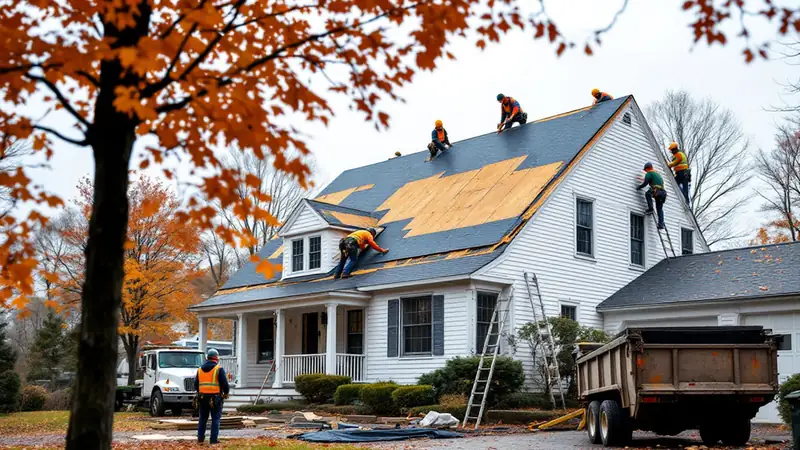
Connecticut also has relatively few roofers. BLS counts about 790 roofing jobs statewide, a location quotient of 0.54, meaning roofers make up about half the share of local employment they do nationally. A thin labor pool tends to stretch scheduling in peak season, and the wage spread inside the state is wide: the 75th-percentile Connecticut roofer earned $44.93 an hour.
| Area | Roofer median wage (May 2025) | vs U.S. median | Roofing jobs | Implied 2,000 sq ft architectural roof |
|---|---|---|---|---|
| United States | $26.65/hr ($55,440/yr) | Baseline | 166,900 (BLS OOH, 2025) | $10,000 to $16,000 |
| Connecticut (statewide) | $29.84/hr ($62,070/yr) | +12.0% | 790 | $10,600 to $17,150 |
| Bridgeport-Stamford-Danbury metro | $81,310/yr (about $39.09/hr) | +46.7% | 130 | $12,330 to $20,480 |
| Hartford-West Hartford-East Hartford metro | $65,710/yr (about $31.59/hr) | +18.5% | 350 | $10,930 to $17,780 |
| New Haven metro | $60,800/yr (about $29.23/hr) | +9.7% | 180 | $10,480 to $16,930 |
Source: BLS Occupational Employment and Wage Statistics, May 2025, SOC 47-2181 (state and metro estimates, confirmed through the BLS public data API). Hourly metro figures are the annual median divided by 2,080 hours. The Bridgeport-Stamford-Danbury estimate rests on only about 130 jobs, so treat its premium as a direction, not a precise markup. The last column is a Roofing Brief estimate using the method in the next table.
| Step | Figure | Arithmetic |
|---|---|---|
| 1. National baseline, architectural asphalt | $5.00 to $8.00 per sq ft | Roofing Brief 2026 roofing cost report |
| 2. Connecticut wage premium | 11.97% | $29.84 / $26.65 = 1.1197 |
| 3. Labor share of installed price (assumption) | 50% at the low end, 60% at the high end | The share our metro cost report uses |
| 4. Low end per sq ft | $5.30 | $5.00 x (1 + 0.50 x 0.1197) |
| 5. High end per sq ft | $8.57 | $8.00 x (1 + 0.60 x 0.1197) |
| 6. 2,000 sq ft roof | $10,600 to $17,150 | 2,000 x $5.30 and 2,000 x $8.57, rounded |
For wage data in every state, see our 2026 roofing labor wage report.
What changes the price of a roof in Connecticut
Beyond size and material, Connecticut bids move on a short list of state-specific drivers: town wind and snow values, the state’s sealed-deck and ice barrier amendments, the age of the house, whether it is owner-occupied for sales tax, and whether an insurance claim is paying. Each one is traceable to a code section, statute or published data set.
| Driver | Effect on the bid | Source |
|---|---|---|
| Roofer wages | About +6% to +7% statewide over the U.S. baseline; more in Fairfield County | BLS OEWS, May 2025 |
| Sealed deck seams on every tear-off reroof | Adds membrane strips over all sheathing joints, unless full peel-and-stick is used | 2022 CT State Building Code, amended IRC R905.1.1 |
| Ice barrier required statewide | Self-adhering membrane at all eaves on shingle roofs | CT amended IRC Table R301.2 (“Ice barrier underlayment required: YES”) |
| Town wind speed (115 to 129 mph) | Towns at 129 mph need shingles labeled ASTM D7158 Class G or H, or D3161 Class A, D or F | CT amended Table R905.2.4.1; Appendix AY |
| Pre-1978 house plus added insulation | May trigger a snow-load check or framing upgrade on a permitted reroof | CT amended IEBC Section 304.1.1 |
| Two existing layers, or slate | Full tear-off required; no overlay | IRC R908.3.1.1 (2021 edition, adopted in CT) |
| Rental or income property | Roofing labor becomes taxable at 6.35% | CT DRS, IP 2018(2) |
| Permit fee | About $210 to $505 on a $16,000 job in three sample towns | Town fee schedules (table below) |
| Rotted or plank decking | Deck repair or new sheathing priced per sheet or per sq ft | Contractor bid; see our roof decking replacement cost guide |
The Connecticut code rules that add cost to a reroof
Connecticut’s residential code is the 2022 Connecticut State Building Code, which adopts the 2021 International Residential Code with state amendments and applies to permit applications filed from October 1, 2022 (DAS Office of the State Building Inspector). Several of those amendments touch a roof replacement directly, and they are why two Connecticut bids for the same house can differ by more than material choice.
Sealed roof deck seams
Connecticut amended IRC Section R905.1.1 to require a strip of self-adhering polymer-modified bitumen membrane, at least 4 inches wide and complying with ASTM D1970, over all joints in the roof decking, with underlayment applied over the whole roof on top. The alternative is a full self-adhering ASTM D1970 underlayment. Plank decks of lumber less than 3 feet in nominal width are exempt from the strips.
The adopted text, as corrected by the state’s Errata 1 of April 12, 2023, applies the strips to all joints in the roof decking. It does not carry the new-construction or full-deck-replacement limit that a 2022 code change proposal (CCP 22-002) had suggested. Because IRC Section R908.1 requires materials and methods used to replace an existing roof covering to meet Chapter 9, the rule reaches a reroof that tears off to the deck; a recover over one existing layer, where IRC R908.3.1.1 allows it, leaves the joints covered.
| Step (2,000 sq ft roof, 4 x 8 sheathing) | Figure | Arithmetic |
|---|---|---|
| Sheets of sheathing | About 62.5 | 2,000 / 32 sq ft per sheet |
| Seam length to tape | Up to about 750 linear ft | 62.5 sheets x 12 ft of shared edge per sheet |
| Rolls at 67 ft each | About 11 to 12 rolls | 750 / 67 = 11.2 |
| Example material cost | About $596 | 3 five-packs of GAF Roof Deck Seam Tape, 4 in x 67 ft, listed at $198.57 per 5-pack on Home Depot in October 2026 |
The material figure is a Roofing Brief estimate from one retail listing and excludes labor. Retail prices change, and the code requires a product labeled ASTM D1970, so confirm the label on whatever product your roofer uses. Ask every bidder whether the seam strips or full peel-and-stick are in the price; a bid that leaves them out is not comparable.
Ice barrier at every eave
Connecticut’s amended Table R301.2 answers “YES” for ice barrier underlayment statewide, so IRC Section R905.1.2 applies everywhere in the state. The ice barrier must run from the eave edge to a point at least 24 inches inside the exterior wall line. On a house with deep overhangs, that can mean two courses of membrane at the eaves. Our ice and water shield guide explains products and coverage.
Town-by-town wind and snow values
Connecticut does not use the national maps for wind and snow. Appendix AY of the state code lists every one of the 169 municipalities: 107 towns at 30 psf ground snow load, 44 at 35 psf and 18 at 40 psf; ultimate design wind speeds from 115 mph to 129 mph; and 147 towns flagged as hurricane-prone. Your town’s row sets the shingle wind class a reroof must meet.
| Town | Ultimate design wind speed | Ground snow load | Hurricane-prone region | Shingle wind class required (ASTM D7158 / D3161) |
|---|---|---|---|---|
| Stamford | 120 mph | 30 psf | Yes | G or H / A, D or F |
| Bridgeport | 120 mph | 30 psf | Yes | G or H / A, D or F |
| Hartford | 120 mph | 30 psf | Yes | G or H / A, D or F |
| New Haven | 125 mph | 30 psf | Yes | G or H / A, D or F |
| Waterbury | 120 mph | 35 psf | Yes | G or H / A, D or F |
| Norwich | 125 mph | 30 psf | Yes | G or H / A, D or F |
| Stonington | 129 mph | 30 psf | Yes | G or H / A, D or F |
| Torrington | 115 mph | 40 psf | No | D, G or H / A, D or F |
| Salisbury | 115 mph | 40 psf | No | D, G or H / A, D or F |
Source: 2022 Connecticut State Building Code, Appendix AY and amended IRC Table R905.2.4.1. Wind class requirement is our reading of the table: towns up to 116 mph may use ASTM D7158 Class D, G or H; towns from 117 to 129 mph need Class G or H. Shingle bundle wrappers typically state the wind class, so check it before the shingles go up. Our ASTM D3161 vs D7158 explainer covers what the classes mean.
Older houses and the snow-load check
Connecticut added Section 304.1.1 to its existing building code: when a reroof needs a permit, structural elements supporting snow loads must be brought up to the snow and drift loads required for new buildings. The exceptions cover most houses, including any designed under the 1978 or later Connecticut code and any reroof with no net increase in roof insulation R-value. Pre-1978 houses adding insulation at reroof time are the group to ask about.
Tear-off or overlay
The IRC adopted in Connecticut bars a recover (a new layer over the old one) when the roof already has two or more layers, when the existing covering is slate, clay or cement tile, or when the old roof is water-soaked or deteriorated (IRC R908.3.1.1). With Connecticut’s sealed-seam rule applying to decking, a full tear-off is also the only way a roofer can tape the deck joints. Our overlay vs tear-off guide compares both routes.
Permits and the 25% repair rule in Connecticut
A full roof replacement in Connecticut needs a building permit. The state’s amended IRC Section R105.2 exempts only “repairs that are limited to 25 percent of roof covering and building siding within one calendar year,” so a full reroof, or repeated repairs past 25% in a year, needs a permit. Town fees are usually set per $1,000 of job value plus the state education fee of $0.26 per $1,000.
| Town | Posted fee formula | Fee on a $16,000 reroof | Source |
|---|---|---|---|
| Hartford | $50.26 for the first $1,000, $30.26 per $1,000 after | $504.16 | City of Hartford fee schedule |
| West Hartford | $32 for the first $1,000, $17 per $1,000 after, plus $0.26 per $1,000 state fee | $291.16 | Town of West Hartford permit fee chart |
| Stamford | $13 per $1,000 residential (minimum $60), plus $0.26 per $1,000 state fee | $212.16 | City of Stamford building permit fees |
Fee arithmetic is ours from each town’s posted schedule; confirm the current schedule with your building department before you budget. The $0.26 per $1,000 state education fee rate is published by the Connecticut Department of Administrative Services. For how permits and inspections work generally, see our roof permit cost and process guide.
Registration, contracts and the guaranty fund
Connecticut does not license roofers as a separate trade. Instead, anyone doing residential home improvement work, which the statute defines to include roofs, must hold a Home Improvement Contractor registration from the Department of Consumer Protection when the job price exceeds $200 (Conn. Gen. Stat. 20-419 and 20-420). Registration requires proof of at least $20,000 in general liability insurance (20-421).
The registration matters for your money. Registered contractors pay $100 a year into the Home Improvement Guaranty Fund (20-432), which can pay a homeowner up to $25,000 per claim after a qualifying judgment or order against a registered contractor. That cap rose from $15,000 on July 1, 2022 (P.A. 21-197), so guides still quoting $15,000 are out of date. You can check any registration on the state’s eLicense lookup.
Under Conn. Gen. Stat. 20-429, a home improvement contract is not valid or enforceable against the owner unless it meets every one of these requirements:
- It is in writing.
- It is signed by the owner and the contractor.
- It contains the entire agreement.
- It shows the date of the transaction.
- It lists the contractor’s name, address and registration number.
- It includes a notice of the owner’s cancellation rights; Connecticut’s home solicitation law lets the buyer cancel until midnight of the third business day after the transaction.
- It states a starting date and a completion date.
- It is entered into by a registered contractor or salesman.
- It discloses other contractor entities the owners have been involved in during the previous five years.
Changes to the contract must also be in writing and signed by both parties. Our questions to ask a roofing contractor page turns this into a hiring checklist.
Sales tax: owner-occupied homes vs rentals
In Connecticut, a roofer does not charge sales tax on roofing labor for an owner-occupied home of one to three units, but must collect the 6.35% tax when the roof is on existing income-producing property, such as a rental house. Either way, the roofer pays tax on the materials and builds it into the price (Connecticut DRS, IP 2018(2)).
| Property | Tax on the roofing service? | Example on a $15,000 job |
|---|---|---|
| Owner-occupied 1 to 3 family home | No (materials tax is inside the price) | $0 added |
| Rental or other income-producing residential property | Yes, 6.35% | About $952.50 added |
| Extended shingle warranty sold separately | Yes, the warranty sale is taxable | Depends on warranty price |
Source: Connecticut Department of Revenue Services, Informational Publication 2018(2), Building Contractors’ Guide to Sales and Use Taxes, Roofing and Roof Warranties entries. The $952.50 figure is our arithmetic ($15,000 x 6.35%) and assumes the whole charge is the taxable service. Landlords should confirm treatment with a tax professional.
Insurance rules that shape a Connecticut roof claim
Connecticut has several statutes that change how an insurance-paid roof works, and most cost guides skip them. The matching law, the contract rules for insurance repair work and the hurricane deductible window can each move what you pay out of pocket by thousands of dollars on the same storm damage.
| Statute | What it says | Why it matters for a roof |
|---|---|---|
| Conn. Gen. Stat. 38a-316e (matching) | When replacement items do not match adjacent items in quality, color or size, the insurer must replace all such items with like kind and quality for a reasonably uniform appearance | If replacement shingles cannot match, a covered partial loss may extend to adjacent undamaged roof areas; the Connecticut Supreme Court held matching disputes go to appraisal as part of the amount of loss (341 Conn. 735) |
| Conn. Gen. Stat. 38a-313a (repair contracts) | Before insurance repair work starts, the contractor must give a written scope and estimated total price, and disclose in 12-point type that the insured may be named joint payee; no power of attorney or waiver of rights | A noncompliant contract or document is void, which protects owners who sign storm-repair paperwork in a hurry |
| Conn. Gen. Stat. 38a-316a (hurricane deductible) | An insurer may apply a hurricane deductible only from a National Hurricane Center hurricane warning for any part of the state until 24 hours after it ends, for hurricanes with sustained winds of 74 mph or more in the state | Roof damage outside that window falls under the regular deductible |
| Conn. Gen. Stat. 38a-316d (nonrenewal) | Nonrenewal may not be based solely on catastrophe losses, and claims paying under $500 or inquiries alone may not trigger nonrenewal or a premium increase (limits apply) | In most cases, asking your insurer about roof damage is not by itself grounds for a premium increase |
Source: Connecticut General Statutes, chapter 700, as published by the Connecticut General Assembly. Policy terms still control how much is paid, including whether a roof is settled at replacement cost or actual cash value. See insurance non-renewal and roof age for how insurers treat older roofs.
Financing and programs for a Connecticut roof
There is no federal tax credit for a 2026 roof replacement: Public Law 119-21 ended the 25C and 25D homeowner credits for work placed in service or installed after December 31, 2025, and asphalt and metal roofs had not qualified under 25C since 2022. Connecticut’s main state route is financing through the Connecticut Green Bank, not a grant.
The Green Bank’s Smart-E loan, for owner-occupied buildings of one to four units, lists FORTIFIED roofs as an eligible upgrade, and allows roof repair only alongside a solar, FORTIFIED roof, attic or wall insulation project. Its posted maximum is $50,000, with standard APRs of 6.99% for 5 to 10 years and 7.49% to 7.99% for longer terms (ctgreenbank.com, October 2026). The Connecticut Insurance Department promoted the IBHS FORTIFIED Roof standard to builders in July 2026, but its release named no grant or required insurance discount. Conn. Gen. Stat. 38a-316b requires premium discounts for storm shutters and impact-resistant glass, not roofs, so ask your insurer directly about any FORTIFIED credit. Our roof financing options page compares loan types.
Which roof should you pick in Connecticut?
For most Connecticut houses, architectural asphalt with the code-required sealed seams and ice barrier is the value choice. Metal makes sense for long ownership and heavy snow towns, slate for houses that already have it, and a FORTIFIED Roof designation when you want the Green Bank loan route or are on the shoreline.
| If your situation is | Then consider | Why |
|---|---|---|
| Typical colonial or cape, selling within 10 years | Architectural asphalt with full tear-off | Lowest cost per sq ft in every Connecticut source above |
| Town at 40 psf snow load (mostly Litchfield and Windham County towns) | Metal, or asphalt with extra ice barrier coverage | Snow sheds from metal; ice barrier is required statewide either way |
| Shoreline town at 125 to 129 mph | Shingles with a Class H wind label, or a FORTIFIED Roof | Highest design wind speeds in the state; FORTIFIED is Smart-E eligible |
| Existing slate in sound condition | Slate repair before replacement | Slate cannot be overlaid, and a full slate roof costs about $31,000 on 2,000 sq ft at This Old House’s rate |
| Two existing shingle layers | Budget a full tear-off | IRC R908.3.1.1 bars a third layer |
| Storm damage with an open claim | Get a written scope and price first; check the matching question | 38a-313a and 38a-316e apply |
| Rental property | Add 6.35% sales tax to the budget | Roofing labor on income property is taxable |
How to price a Connecticut roof replacement, step by step
Pricing a Connecticut roof well takes about an hour of homework before the first estimate. Pull your town’s code values, measure or estimate roof area, set a per-square-foot range, and then make every bidder price the same Connecticut-specific scope so the quotes are comparable.
- Look up your town in Appendix AY. Note its wind speed and ground snow load; they set the shingle wind class and matter for heavy materials.
- Estimate roof area. Divide floor area by stories, then multiply by about 1.25 for a 6/12 pitch with overhangs; steeper roofs run higher.
- Set your range. Multiply roof area by $5.30 to $8.57 for architectural asphalt, or use the material table for other roofs.
- Check registration. Look up each bidder’s Home Improvement Contractor registration on eLicense before the estimate visit.
- Ask for the same scope in writing. Tear-off of all layers, deck seam strips or full peel-and-stick, ice barrier at eaves, drip edge, ventilation, permit and disposal.
- Get deck pricing as a unit price. Rotted sheathing is found only at tear-off, so ask for a per-sheet price rather than a lump allowance.
- Read the contract against 20-429. Confirm the registration number, start and completion dates, and the three-business-day cancellation notice.
- Confirm the permit. The contractor typically pulls it; the fee should match your town’s schedule.
Find a roofer in your part of Connecticut
We publish scored shortlists of roofing contractors for Connecticut’s main metros, built from registration, certification and complaint records: best roofers in Hartford, best roofers in New Haven, best roofers in Bridgeport, best roofers in Waterbury and best roofers in Norwich. For neighboring states, compare roof replacement cost in Massachusetts and roof replacement cost in New Jersey. For the neighbor to the west, see our guide to roof replacement cost in New York.
Verified roofers in Connecticut metros
Pricing a roof is half the job; the other half is choosing who installs it. The Roofing Brief ranks manufacturer-certified roofers in 5 Connecticut metros, scoring each on a published formula and checking the leaders against state licence and BBB records.
- Best roofers in Hartford, CT: five certified contractors ranked and checked against licence and BBB records, led by Millstream Construction (TRB Score 90.8).
- Best roofers in Bridgeport, CT: five certified contractors ranked and checked against licence and BBB records, led by DiGiorgi Roofing & Siding, Inc. (TRB Score 91.3).
- Best roofers in New Haven, CT: five certified contractors ranked and checked against licence and BBB records, led by DiGiorgi Roofing & Siding, Inc. (TRB Score 93.1).
- Best roofers in Waterbury, CT: five certified contractors ranked and checked against licence and BBB records, led by DiGiorgi Roofing & Siding, Inc. (TRB Score 93.8).
- Best roofers in Norwich, CT: five certified contractors ranked and checked against licence and BBB records, led by JFK Roofing LLC (TRB Score 95.6).
Frequently asked questions
How much does it cost to replace a roof on a 2,200 square-foot house?
In Connecticut, a 2,200 sq ft two-story house has about 1,375 sq ft of roof at a 6/12 pitch, so architectural asphalt runs about $7,290 to $11,780 by our estimate. A one-story 2,200 sq ft house has about 2,750 sq ft of roof, or roughly $14,580 to $23,570. Steep pitches, dormers, deck repairs and premium materials push the total higher.
Will insurance cover a 20-year-old roof?
Insurance may cover a 20-year-old roof for sudden damage such as wind or a falling tree, but not for wear and age. Policy terms decide whether an older roof is paid at replacement cost or depreciated actual cash value. Connecticut’s insurance statutes do not set a roof-age rule, but its matching law (38a-316e) can extend a covered claim to adjacent areas when shingles cannot match.
What is the 25% rule for roofing?
In Connecticut, the 25% rule is a permit threshold. The state’s amended IRC Section R105.2 exempts from permits only repairs limited to 25 percent of the roof covering and siding within one calendar year. Anything larger, including a full replacement, needs a building permit, and permitted work must meet the current code, including ice barrier and sealed deck seams.
Is $30,000 too much for a roof?
For a typical Connecticut house in architectural asphalt, $30,000 is high: our estimate puts a 2,000 sq ft roof at $10,600 to $17,150, and Fixr’s typical range is $12,000 to $16,000. It can be reasonable for a one-story house with about 3,750 sq ft of roof, a steep or complex roof, major deck replacement, metal, or slate, which runs about $31,000 on 2,000 sq ft.
Is it cheaper to put a metal roof or shingles?
Shingles are cheaper to install in Connecticut. This Old House’s Connecticut data prices asphalt at $4.84 per sq ft and metal at $8.67, so a 2,000 sq ft roof costs about $9,680 in asphalt versus $17,340 in metal. Metal can make sense for owners staying long term or in 40 psf snow towns, where shedding snow matters.
Do I need a permit to replace a roof in Connecticut?
Yes. A full roof replacement needs a building permit in Connecticut because the state code exempts only repairs limited to 25 percent of the roof covering within one calendar year. Fees are set by each town, usually per $1,000 of job value, plus a state education fee of $0.26 per $1,000. Hartford’s posted schedule works out to about $504 on a $16,000 job.
Does a roofer need a license in Connecticut?
Connecticut has no separate roofing license, but any contractor doing residential roofing worth more than $200 must register as a Home Improvement Contractor with the Department of Consumer Protection. Registration requires at least $20,000 in liability insurance and funds the Home Improvement Guaranty Fund, which can pay homeowners up to $25,000 per claim. Verify registration on the state eLicense site.
Can I get a tax credit for a new roof in Connecticut in 2026?
No federal credit applies to a 2026 roof: Public Law 119-21 ended the 25C and 25D homeowner credits after December 31, 2025, and standard roofs had not qualified since 2022. In Connecticut, the Green Bank’s Smart-E loan can finance a FORTIFIED roof, with a posted maximum of $50,000. Check current IRS guidance and a tax professional before relying on any credit.
Sources
- U.S. Bureau of Labor Statistics, Occupational Employment and Wage Statistics, May 2025, SOC 47-2181 Roofers (national, Connecticut, and Bridgeport-Stamford-Danbury, Hartford and New Haven metro estimates).
- Connecticut Department of Administrative Services, Office of the State Building Inspector: 2022 Connecticut State Building Code (with Errata 1), including amended IRC R105.2, R301.2, R905.1.1, Table R905.2.4.1, Appendix AY and amended IEBC 304.1.1.
- International Code Council, 2021 International Residential Code, Sections R905.1.2 and R908.3.1.1.
- Connecticut General Statutes, chapter 400 (Sections 20-419, 20-420, 20-421, 20-429, 20-432), chapter 740 (home solicitation sales) and chapter 700 (Sections 38a-313a, 38a-316a, 38a-316b, 38a-316d, 38a-316e).
- Connecticut Department of Revenue Services, IP 2018(2), Building Contractors’ Guide to Sales and Use Taxes.
- Connecticut Department of Administrative Services, code training and education fee on municipal building permits.
- City of Hartford fee schedule; Town of West Hartford permit fee chart; City of Stamford building permit fees.
- Connecticut Green Bank, Smart-E Loans and eligible upgrades pages (October 2026).
- Connecticut Insurance Department, press release, July 17, 2026, on FORTIFIED roofing standards.
- Public Law 119-21 (July 4, 2025), Sections 70505 and 70506; IRS FAQ FS-2025-05.
- Fixr, Roof Replacement Cost in Connecticut (Jan. 31, 2025); This Old House, Cost of Roof Replacement in Connecticut (June 17, 2026); CT Insider, How Much Does a Roof Replacement Cost in CT? (Jan. 4, 2026); RoofCostData, Connecticut (May 11, 2026).