
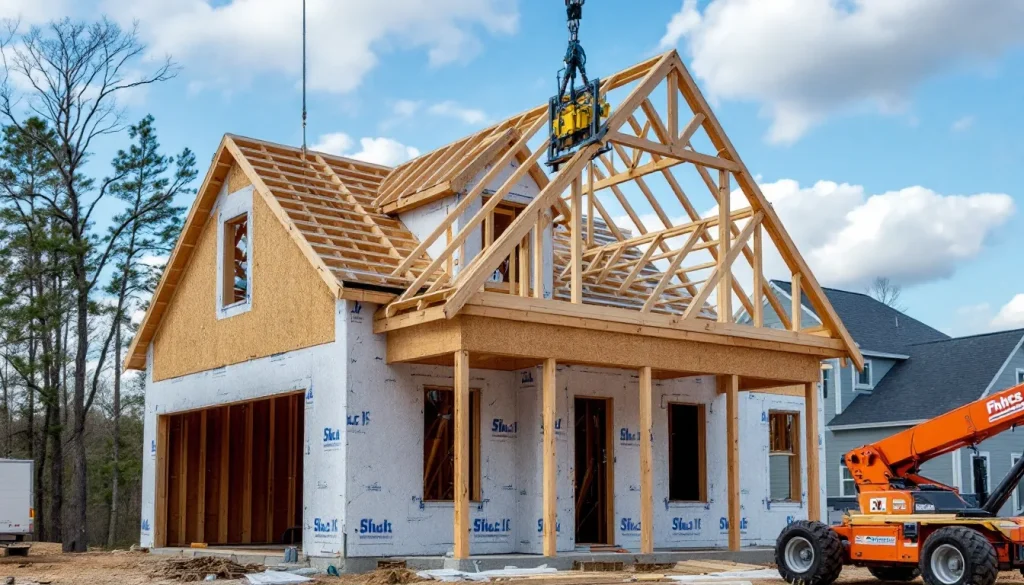
Roof trusses are prefabricated triangular wood framing assemblies that span the entire width of a home with no internal load-bearing walls required. In 2026, roof trusses cost 30 to 50 percent less per square foot than stick-built rafters, install 50 to 70 percent faster, and span up to 60 feet without intermediate supports. Here is the complete breakdown of truss (see our roof truss cost and types) types, span limits, costs, and the decision framework for truss vs rafter construction across new builds and additions.
The short version
- Trusses are engineered, factory-built, and trucked to the site, where a crew sets a 2,400-square-foot roof in 1 day.
- Cost runs $4 to $9 per square foot of roof area installed, versus $8 to $14 for stick-built rafters.
- The Fink truss is the residential workhorse, covering roughly 65 percent of US single-family construction.
- Standard truss spacing is 24 inches on center, with 16-inch spacing reserved for heavy snow loads and tile roofs.
- Every truss carries an engineered design seal from a licensed engineer, with span, load, pitch, and species specified.
- Modifying a truss in the field almost always voids the engineering; cuts and notches require an engineer-stamped repair detail.
The Short Answer: Why Trusses Dominate New Construction
Roof trusses are the default framing method for roughly 80 percent of new single-family construction in the United States as of 2024 NAHB data. Three factors drive the dominance: cost (engineered web-and-chord geometry uses 30 percent less lumber than equivalent stick framing), install speed (a crane sets 50 to 80 trusses in a single day, replacing 4 to 7 days of stick-build labor), and span (trusses cross 40 to 60-foot widths without interior load-bearing walls, opening up the floor plan below). The clear span is the architectural feature that makes great rooms, vaulted family rooms, and open kitchen-to-living-room layouts buildable on a typical wood-framed budget.
Truss vs Rafter: The Engineering Difference
A rafter is a single dimensional-lumber piece (typically 2×10 or 2×12) running from the top plate of the exterior wall to the ridge board at the peak. The load path goes from the roof deck down through the rafter, into the ceiling joist that ties the two rafters together at the bottom, and into the wall plates. A truss is a triangular assembly of smaller dimensional members (typically 2×4 or 2×6) connected by toothed metal connector plates (MTC plates) at every node, engineered to act as a single structural unit. The web members inside the triangle take tension or compression depending on geometry, distributing the load across a much more efficient material profile.
The framing decision affects the floor below in subtle ways. Trusses do not provide attic floor space unless designed as attic trusses. Rafters do, because the ceiling joists become the attic floor structure. The structural elements that connect every roof type are covered at parts of a roof.
King Post Truss: The Simplest Form
The king post truss is the oldest engineered truss form, with documented use dating to the medieval period. The geometry is simple: two top chords, a bottom chord, and a single vertical king post running from the bottom chord midpoint up to the peak. King post trusses are economical for short spans of 16 to 30 feet and shed simpler look, used today on garages, porches, small additions, and rustic-style timber-frame applications. The visible king post timber-frame style is a premium architectural feature with installed cost of $40 to $80 per square foot.
Queen Post Truss: Mid-Range Spans
The queen post truss extends the king post geometry with two vertical posts spaced symmetrically and a horizontal tie beam connecting them. The geometry spans 30 to 50 feet efficiently and is the historical predecessor to the modern Howe truss. Queen post trusses appear in barn frames, traditional church construction, and architectural timber-frame work. For commodity residential framing, the geometry has been displaced by the Fink truss because of cost.
Fink Truss: The Residential Workhorse
The Fink truss is the W-shape pattern of internal web members that defines roughly 65 percent of US single-family residential roof framing. The web pattern, with two diagonals running up to the peak and two short diagonals near the heel, distributes load efficiently across spans of 24 to 36 feet, the most-common residential roof widths. The standard Fink truss uses 2×4 top and bottom chords with 2×4 web members, MTC plate connections, and Southern Yellow Pine or Spruce-Pine-Fir lumber. Installed cost runs $3.50 to $7 per square foot of roof area.
Scissor Truss: Vaulted Ceiling Option
The scissor truss creates a vaulted interior ceiling by sloping the bottom chord upward toward the peak, with the bottom chord pitch typically half of the top chord pitch. A 6/12 top chord with a 3/12 bottom chord gives a partial vault, while a 12/12 top with 6/12 bottom gives a dramatic cathedral feel. Scissor trusses run 15 to 30 percent higher in cost than equivalent Fink trusses because of the more complex web geometry and the longer lumber lengths required. Headroom-restricted bonus rooms over garages use modified scissor or attic geometries.
Attic Truss: For Usable Floor Space
The attic truss is engineered with a clear-space center bay (typically 8 to 14 feet wide and 7 to 8 feet tall) flanked by web members, allowing the homeowner to finish out usable floor area inside the truss zone. The web pattern locates load-bearing chords at the outside walls of the attic room, with the bottom chord serving as the attic floor joist (rated for 30 to 40 pounds per square foot residential live load). Attic trusses run 40 to 70 percent higher in cost than Fink trusses but eliminate the need for a separate framed second story.
Howe Truss: Heavy-Load Applications
The Howe truss has vertical web members in tension and diagonal web members in compression, the inverse of the Pratt truss configuration. The Howe pattern is engineered for heavy point loads and long spans, making it the default for industrial buildings, commercial roofs, and post-frame construction. Residential use is limited to extreme-snow-load applications in the Rocky Mountain region, where 80 to 100 pounds per square foot ground snow loads require the additional capacity.
Cost Per Square Foot: Trusses vs Stick-Built
| Framing Method | Material Cost / sq ft | Labor Cost / sq ft | Total Installed / sq ft |
|---|---|---|---|
| Fink Truss (24-ft span, 5/12 pitch) | $2.20 to $3.40 | $1.50 to $3.00 | $3.70 to $6.40 |
| Fink Truss (36-ft span, 6/12 pitch) | $2.80 to $4.20 | $1.80 to $3.40 | $4.60 to $7.60 |
| Scissor Truss (32-ft span) | $3.80 to $5.60 | $2.00 to $3.80 | $5.80 to $9.40 |
| Attic Truss (28-ft span) | $5.20 to $7.80 | $2.40 to $4.20 | $7.60 to $12.00 |
| Stick-Built Rafters (24-ft span) | $3.00 to $4.80 | $5.00 to $8.20 | $8.00 to $13.00 |
| Stick-Built Rafters (36-ft span) | $4.20 to $6.40 | $6.20 to $9.80 | $10.40 to $16.20 |
NAHB 2025 construction cost data composited with regional sawmill pricing. The truss-cost advantage grows as span increases, because stick-built rafters at longer spans require larger dimensional lumber (2×12 instead of 2×10), and the unit price of larger lumber rises faster than truss component lumber.
Span Ratings and Engineering
Every roof truss carries an engineered design seal from a licensed engineer in the state where the building is constructed. The design package specifies the maximum span, the dead load (the roof material weight), the live load (snow and wind), the pitch, the lumber grade and species, the plate type and size at every connection, and the deflection limit. The Truss Plate Institute (TPI) publishes the design standard TPI 1, which is referenced by the International Residential Code (IRC) and adopted across all 50 states.
Common residential truss design loads are 30 to 40 pounds per square foot top chord live load (snow), 10 pounds per square foot top chord dead load (roofing material plus sheathing), 10 pounds per square foot bottom chord dead load (insulation plus drywall), and 10 pounds per square foot bottom chord live load (attic storage if accessible). Higher-snow regions and tile-roof applications drive the design loads upward, with 50 to 70 pounds per square foot top chord live load common in mountain states.
Truss Spacing: 24-Inch On Center Standard
Standard residential truss spacing is 24 inches on center, which works with all common sheathing thicknesses (7/16-inch OSB minimum per roof sheathing) and all common roofing materials. Tighter spacing of 16 inches on center is specified for tile roofs (because of the higher dead load), for heavy-snow regions (above 50 pounds per square foot ground snow), and for specific architectural details requiring tighter truss bracing. The tighter spacing increases truss count by 50 percent and pushes installed cost up proportionally.
Engineered Truss Stamping
Building inspectors require the engineered truss drawings stamped by a licensed PE to be on site during framing inspection. The drawing package includes the truss layout (showing every truss location, type, and identification number), the per-truss design sheets (with span, load, and material specs), and the bracing requirements. Missing or unstamped drawings will fail framing inspection in most jurisdictions, with rework required before the inspector returns.
Installation: Crane-Set vs Hand-Set
Crane-set installation is the dominant method, with a boom crane or telehandler lifting trusses from a delivery truck and setting them on the top plates in sequence. A crew of 3 to 5 framers ground-handles, ties, plumbs, and braces each truss as it lands. Crane rental runs $400 to $900 per day plus a delivery fee. Hand-set installation (no crane) is used on small additions, remote sites, and small budgets, with trusses carried up ladders, walked into position, and tilted up by the crew. Hand-set is slower (1 to 2 days vs 4 to 6 hours for a typical roof) and limited to spans under 28 to 32 feet.
Truss Bracing: The Safety-Critical Step
Trusses are stable in their plane but unstable out of plane until permanent bracing is installed. The temporary bracing during setting (2×4 boards nailed across the top chords at 8 to 10-foot intervals) prevents domino collapse if a single truss tips. The permanent bracing per the engineered drawings includes diagonal web bracing, lateral chord bracing at specified web members, and ceiling diaphragm action through the drywall and sheathing. Field-installed bracing errors are a leading cause of long-span truss roof failures.
Modifying Trusses: Almost Always Voids the Engineering
Cutting, notching, or drilling a truss chord or web member almost always voids the engineered design. The truss is designed as a single load path, and removing material from any member changes the load distribution unpredictably. Electricians and HVAC contractors are the most-common offenders, drilling holes for wiring runs and ductwork through chords. Any field modification requires an engineer-stamped repair detail (typically a plywood or LVL gusset bolted across the modified member) before drywall close-up.
Truss Damage Repair
Damaged trusses (from fallen trees, fire, water rot, or sagging from inadequate bracing) require engineered repair details. The repair package is specific to the damage location and the original truss design. Common repair details include lap-spliced sister members, plywood gusset reinforcement, and steel strap reinforcement at MTC plate joints. The sag identification, severity assessment, and contractor decision framework is at sagging roof repair. Trusses showing visible sag, separated MTC plates, or chord splits should be inspected by a structural engineer, not a general contractor.
Truss vs Rafter Decision Framework
Choose trusses when: the design includes spans over 24 feet, the floor plan benefits from no interior load-bearing walls, the project budget rewards cost efficiency, and the schedule benefits from 1-day install. Choose rafters when: the design requires a finished attic with conventional ceiling height, the roof shape includes complex multi-plane geometry (Mansard, complex hip), the project is a small addition where crane access is impractical, or the homeowner specifically wants exposed timber framing for aesthetic reasons.
Most major roof shapes (gable roof, hip roof, gambrel roof) can be built either way. Mansard roof geometry is rarely trussed because the steep lower slope and shallow upper slope require complex truss profiles. Cathedral ceilings without an interior space above can be built with scissor trusses or with stick-built rafter-and-ridge construction.
Truss Manufacturing: Who Builds Them
Trusses are built in fabrication plants by regional manufacturers, with delivery radii of 75 to 250 miles from the plant. The 2024 NAHB Builder Survey identified roughly 1,650 truss manufacturing plants across North America, with the top 50 plants producing more than half of total volume. Major national truss manufacturers include MiTek (engineering software and plate supply, with affiliated independent fabricators), Builders FirstSource (in-house truss plants serving their lumber yard distribution), and Eagle Metal Products (plate supply and design software).
MTC Plate Connections: The Engineering Detail
The metal truss connector plates that join chord and web members at every node are an engineered component, not a generic fastener. The plates are stamped from 16 to 20-gauge galvanized steel with hundreds of small teeth pressed at right angles to the plate face. The teeth penetrate the adjacent lumber when the plate is pressed in by a hydraulic press at the truss plant, with the truss plate plant achieving tooth-driving pressures of 5,000 to 8,000 pounds per square inch. The resulting joint develops both shear and tension capacity rated per ANSI TPI 1, with capacities ranging from 250 to 1,500 pounds per square inch of plate area depending on plate type and lumber species. MiTek, Eagle Metal, Alpine Engineered Products, and Cherokee Metal Products dominate the plate supply market.
Field-driven MTC plates do not develop full design capacity. The pneumatic-hammer-installed plates used in some site-built truss repairs achieve roughly 60 percent of the engineered capacity, which is why engineered repair details specify plywood gussets or bolted steel plates rather than field-driven MTC plates. A truss that arrives with a plate visibly backed out (one or more teeth not fully embedded, gap visible between the plate and the lumber surface) should be rejected and replaced rather than installed.
Lumber Species and Grade Selection
Truss design specifies lumber species and grade because the allowable stresses vary significantly between species. Southern Yellow Pine #1 dense has the highest allowable bending stress at 2,000 psi, supporting longer spans and higher loads at smaller member sizes. Spruce-Pine-Fir #2 (the common Canadian dimensional lumber) carries 1,200 to 1,500 psi allowable bending. Douglas Fir-Larch #2 (the Pacific Northwest standard) sits at 1,500 to 1,800 psi. The truss design package specifies the species and grade explicitly, and substituting at the truss plant or on site invalidates the engineering.
Roof Sag Diagnosis on Truss Roofs
Visible sag on a truss-framed roof typically indicates one of three problems. First, missing or inadequate permanent bracing, allowing trusses to rack and twist under live load. Second, attic storage exceeding the 10 pounds per square foot bottom chord live load that residential trusses are typically rated for. Third, water damage at one or more truss heel locations, with the MTC plate slipping or the lumber rotting at the connection point. The sag inspection sequence, severity grading, and contractor decision framework is at sagging roof repair.
Energy Heel and Raised Heel Trusses
The energy heel truss (also called the raised heel) is a Fink or similar truss with the heel raised 12 to 24 inches above the standard heel height to allow full insulation depth at the eave without compression. Standard trusses pinch the insulation at the eave where the top chord meets the wall plate, leaving 2 to 4 inches of usable insulation depth instead of the full attic depth (typically R-49 to R-60 in cold climates). Raised heel trusses cost 10 to 18 percent more than standard trusses but allow full ceiling-line insulation across the entire ceiling area, improving energy performance by 5 to 12 percent on a cold-climate home. The 2024 IECC energy code is pushing raised heel adoption in cold-climate states.
Truss Delivery Logistics
Delivered truss bundles weigh 1,500 to 4,000 pounds per bundle and require a truck with a piggyback forklift or a delivery to a site with crane access. The truss manufacturer typically delivers within a 75 to 250-mile radius of the plant, with delivery fees ranging from $250 to $900 depending on distance and accessibility. Trusses are typically delivered the day before the framing crane arrives or staged at a yard until needed. Storing trusses flat on the ground for more than 30 days risks warp and lumber moisture uptake.
Snow Load and Wind Load Adjustments
Truss design loads vary by location. The IRC ground snow load map sets the base, with values ranging from 0 to 100 pounds per square foot ground snow across the contiguous United States. Wind load follows the ASCE 7 design wind speed map, with values from 90 to 180 miles per hour design wind across coastal and tornado-prone regions. Trusses for high-wind zones include heel hurricane-strap connection details, with the strap connection from the truss heel to the top plate engineered for the uplift load.
Inspection Checklist for Buyers Reviewing Truss Roofs
Buyers reviewing a home with truss roofing should check for six conditions during the home inspection. First, visible sag in any roof plane, particularly mid-span between supports. Second, separated or backed-out MTC plates visible in the attic (a flashlight inspection identifies these quickly). Third, evidence of field modification (cuts, notches, drilled holes through chords or webs), with no engineered repair documentation. Fourth, missing or inadequate permanent bracing per the original truss layout. Fifth, water staining on truss chords or MTC plates indicating active or historical leaks. Sixth, attic storage loading that exceeds the design live load. The full inspection process and cost expectations are at roof inspection cost.
Renovation Implications: Removing Walls Below Trusses
Truss-framed roofs span the full width of the home without internal load-bearing walls, which means renovation projects can typically remove interior walls without engineered support. The verification step is to confirm the wall in question is non-bearing by checking the truss design package (engineer-stamped drawings show which walls support trusses) or by structural engineer inspection. Walls running parallel to the truss span are typically non-bearing. Walls running perpendicular to trusses are typically also non-bearing on truss-framed roofs but may support second-story floor joists in two-story homes. Trust the engineering documentation, not field assumptions.
Frequently Asked Questions
How long do roof trusses last?
Properly installed trusses in a dry attic environment last the full life of the building, typically 80 to 120 years. The dominant failure modes are water damage from a long-running leak, fire, or biological decay from prolonged moisture. The trusses themselves are not a service-life-limited component the way roofing materials are. Full roofing lifespan context at how long does a roof last.
Can I add storage to a truss attic?
Common Fink trusses are not designed for attic storage live load. Storing more than 10 pounds per square foot of household items across the bottom chords risks deflection, MTC plate slippage, and ceiling drywall cracking. Attic trusses are the engineered option for usable attic space. Light, occasional storage (boxes near the access hatch) is generally tolerable but not endorsed.
How much does a truss roof cost vs a rafter roof?
For a typical 2,400-square-foot single-story home, the truss option runs $9,000 to $15,000 installed. The rafter option runs $19,000 to $32,000 installed, primarily because the rafter labor cost is 2 to 3 times higher. Trusses dominate new construction for this cost reason.
What is the maximum span of a roof truss?
Standard wood trusses span up to 60 feet with engineered design. Longer spans (70 to 100 feet) are possible with engineered wood products like glulam top chords or with steel-reinforced trusses, but the design moves into specialty commercial territory. Residential maximum span is typically limited by the lumberyard catalog to 40 to 50 feet.
Are trusses stronger than rafters?
Per pound of lumber, trusses are dramatically stronger because the triangular geometry distributes load into tension and compression members rather than bending. For an equivalent span and loading, a Fink truss uses roughly 30 percent less lumber than a stick-built rafter system while achieving the same load capacity and stiffness.
Can roof trusses be repaired if damaged?
Yes, with an engineered repair detail. Common repairs include plywood gusset reinforcement at the damaged area, sister-member splicing, and steel strap reinforcement at MTC plate joints. The repair detail must be designed and stamped by a licensed structural engineer. DIY truss repair without engineering is unsafe and is rejected by every code official.
Do I need an engineer for roof trusses?
The truss manufacturer’s engineer provides the stamped design package for the standard truss layout. Modifications, repairs, additions, and any deviation from the catalog design require a project-specific engineer. The cost of an engineered repair detail typically runs $400 to $1,200, depending on complexity.
Roof trusses dominate North American residential framing because the engineering, the install economy, and the architectural freedom all favor the prefabricated approach. The Fink truss covers the bulk of typical single-family work, with scissor, attic, and Howe variants available where the design calls for them. For the sheathing layer that installs on top of the trusses, the breakdown is at roof sheathing, and the pitch chart that drives every truss-design conversation is at roof pitch chart.