
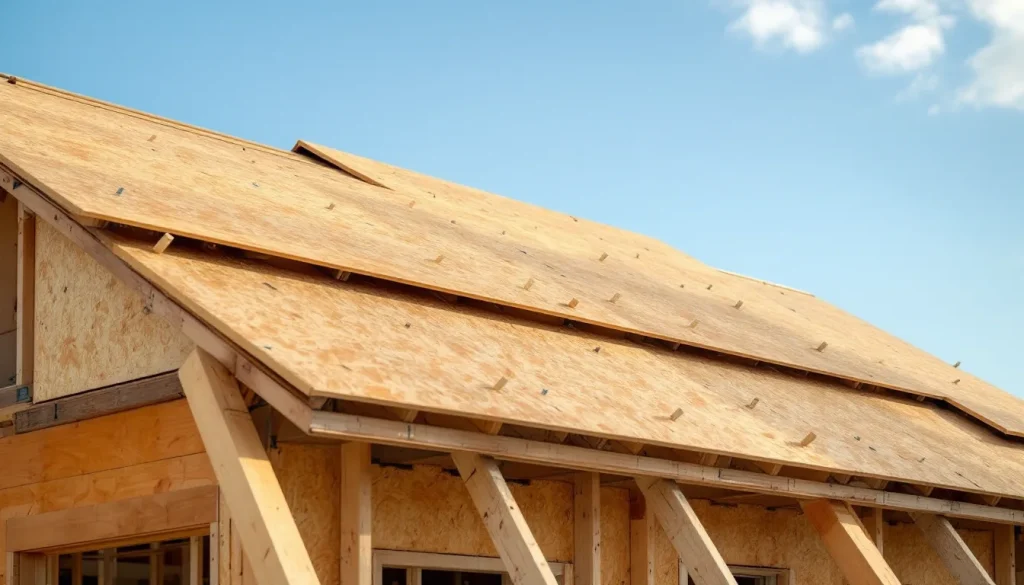
Roof sheathing (see our roof decking replacement cost) is the wood panel layer (OSB or plywood) installed across the rafters or trusses, providing the deck surface that underlayment and roofing materials attach to. In 2026, the OSB vs plywood debate has narrowed: APA-rated OSB at 7/16-inch is now the standard for most residential applications at $1.20 to $1.80 per square foot installed, while 1/2-inch plywood remains the choice for premium installations and high-load zones. Here is the complete breakdown of materials, thicknesses, code requirements, and replacement decisions during a reroof.
The short version
- 7/16-inch APA-rated OSB at 24-inch truss spacing is the residential default and meets IRC R803.2 minimums.
- Plywood at 15/32 or 1/2 inch is the upgrade for premium homes, tile roofs, and humid climates where edge swelling matters.
- Installed sheathing cost runs $1.20 to $1.80 per square foot for OSB and $1.60 to $2.40 per square foot for plywood.
- The APA span rating (32/16, 40/20, 48/24) is the published panel-strength rating that ties thickness to support spacing.
- Sheathing replacement during reroof runs $5 to $12 per sheet installed, with 2 to 6 sheets typical and 20 plus on damaged roofs.
- Florida HVHZ jurisdictions require 5/8-inch plywood or equivalent for new hurricane-rated assemblies.
The Short Answer: OSB Wins for Most, Plywood for Premium
Three decades after OSB displaced plywood as the dominant residential sheathing material, the head-to-head comes down to one tradeoff: cost versus moisture recovery. OSB is 20 to 30 percent cheaper per sheet, has more uniform thickness and grade across pieces, and meets the same APA span ratings as plywood. Plywood handles getting wet better, with quicker drying and less permanent edge swelling. For 80 percent of single-family residential work, the cost savings of OSB win. For tile roofs, slate roofs, copper standing seam, and homes in humid coastal markets, the plywood premium pays back over the install lifecycle.
What Roof Sheathing Does
The deck panel serves four structural and functional roles. First, it provides a continuous surface for nailing or stapling underlayment and roofing materials. Second, it acts as a structural diaphragm, transferring lateral loads (wind, earthquake) into the wall framing through the connection between sheathing edges and the wall top plate. Third, it distributes point loads (a contractor walking across, a fallen branch, hail impact) across multiple rafters or trusses. Fourth, it creates the air barrier and vapor-control plane that the underlayment closes off. The deck does not protect against water by itself; that is the underlayment’s job, detailed at felt vs synthetic underlayment.
OSB Construction: Oriented Strand Board Basics
Oriented strand board is made from wood strands (3 to 6 inches long, 1/2 to 1-1/2 inches wide, 0.020 to 0.030 inches thick) aligned in layers and bonded with phenol-formaldehyde or MDI (methylene diphenyl diisocyanate) resin under heat and pressure. The strand orientation alternates layer to layer (face strands aligned with the long axis, core strands cross-aligned), creating the directional strength that mimics plywood ply orientation. Modern OSB is produced from fast-growing softwood species like aspen, poplar, and southern yellow pine, with mill yields 30 to 50 percent higher than equivalent plywood production from the same log volume.
Plywood Construction: Multi-Ply Hardwood Layers
Plywood is built from rotary-peeled veneers (1/8 to 1/4-inch thick) cross-laminated in odd numbers of plies (3, 5, 7, 9) with the grain direction alternating each layer. Roof sheathing plywood is typically Group 1 species (Douglas fir, southern pine) at 4-ply or 5-ply construction. The cross-grain layering gives plywood its dimensional stability, its split resistance, and its faster drying when wet (because there are no compressed-strand swelling zones at the edges, just open veneer cell structure).
Cost Comparison: OSB vs Plywood
| Material + Thickness | Cost per 4×8 Sheet (2025) | Cost per sq ft | Installed Cost per sq ft |
|---|---|---|---|
| OSB 7/16-inch APA-rated | $22 to $32 | $0.69 to $1.00 | $1.20 to $1.80 |
| OSB 15/32-inch APA-rated | $26 to $36 | $0.81 to $1.13 | $1.30 to $1.95 |
| OSB 5/8-inch APA-rated | $32 to $44 | $1.00 to $1.38 | $1.55 to $2.20 |
| Plywood 15/32-inch CDX | $36 to $52 | $1.13 to $1.63 | $1.60 to $2.40 |
| Plywood 1/2-inch CDX | $42 to $58 | $1.31 to $1.81 | $1.75 to $2.55 |
| Plywood 5/8-inch CDX | $54 to $74 | $1.69 to $2.31 | $2.10 to $3.00 |
Composite pricing from Home Depot, Lowes, 84 Lumber, and regional building-products distributors. Lumber commodity prices fluctuate 25 to 60 percent year-over-year, with the 2021 lumber price spike doubling these numbers temporarily and the 2024 to 2025 settling-out returning to the values shown. For total roof cost including sheathing, the breakdown is at how much does a new roof cost.
Thickness: 7/16, 15/32, 1/2, 5/8, 3/4 Inch
| Thickness | APA Span Rating | Max Rafter Spacing | Typical Use |
|---|---|---|---|
| 3/8 inch (rarely used) | 24/0 | 16 inches OC | Re-roof over existing deck (not new) |
| 7/16 inch | 24/16 | 24 inches OC | Standard residential, asphalt shingles |
| 15/32 inch (1/2) | 32/16 | 24 inches OC | Premium residential, metal roofing |
| 1/2 inch (full) | 32/16 | 24 inches OC | Tile roofing, premium markets |
| 5/8 inch | 40/20 | 24 inches OC heavy loads | HVHZ Florida, tile, slate |
| 3/4 inch | 48/24 | 32 to 48 inches OC | Heavy commercial, long-span |
The first number in the APA span rating is the maximum roof rafter or truss spacing in inches; the second number is the maximum floor joist spacing. Both numbers assume the panel is installed perpendicular to the supports with the strength axis crossing the supports. The full APA specifications are published in the APA Plywood Design Specification and the APA Engineered Wood Construction Guide.
IRC R803 Code Requirements
The 2021 International Residential Code Section R803 governs roof sheathing for one and two-family residential construction. R803.2 requires wood structural panels to conform to DOC PS 1, DOC PS 2, or ANSI A190.1. R803.2.1.1 sets thickness minimums based on rafter spacing and load: 7/16-inch panel at 24-inch rafter spacing for snow loads up to 30 pounds per square foot, with thicker panels required for heavier snow loads. R803.2.2 sets the panel installation requirements: 1/8-inch gap at all panel edges to accommodate moisture expansion, blocking required at panel edges in seismic categories D0, D1, and D2.
APA Span Ratings: The Underlying Standard
The APA Engineered Wood Association (the trade and standards body for the structural wood panel industry) publishes the span rating system that ties panel thickness to support spacing. A panel stamped 24/16 carries roof loads at 24-inch rafter spacing and floor loads at 16-inch joist spacing. The stamp also includes the panel grade (Sheathing, Single-Floor, Structural I), the exposure rating (Exposure 1 for typical construction, Exterior for prolonged moisture), the manufacturing mill number, and the species group.
OSB Strengths: Cost, Uniformity, Availability
OSB has three durable advantages over plywood. First, cost: the 20 to 30 percent savings per sheet adds up to $400 to $900 on a typical reroof. Second, uniformity: every OSB sheet is built from controlled-input strands with consistent density, while plywood quality varies with the underlying log quality. Third, availability: OSB is produced in higher mill volumes, with shorter lead times during peak-season shortages. The void-free face also accepts fasteners more predictably than plywood with knots and voids.
OSB Weaknesses: Edge Swelling When Wet
The single significant OSB weakness is permanent edge swelling when the panel gets wet during construction or from a prolonged leak. The compressed strands at the panel edges absorb water, swell 2 to 5 percent permanently, and leave a visible bump where the edge meets the adjacent panel. Modern OSB (Advantech, LP TechShield, Norbord Force) includes edge-seal treatments that reduce but do not eliminate edge swelling. The practical implication is that OSB should be covered with underlayment within 30 to 60 days of installation, with rapid coverage in rain-prone weeks. If an OSB deck takes a long-term leak (a year or more), the edge swelling typically requires sheet replacement rather than just drying.
Plywood Strengths: Water Recovery, Premium Markets
Plywood handles construction-period moisture better than OSB. A plywood deck that gets soaked in a thunderstorm dries to its original dimensional state within 7 to 14 days, while an OSB deck retains 50 to 80 percent of the edge swelling permanently. Plywood also accepts fasteners more reliably in the 5/8 and 3/4-inch thicknesses, with less risk of strand pullout under high-cycle loading from thermal expansion. For tile roofs (where the dead load is 800 to 1,200 pounds per roofing square versus 200 to 350 for asphalt), plywood is the safe specification.
When Sheathing Replacement Is Required
During a reroof, sheathing replacement is required in five conditions: visible rot or soft spots from prior leaks, OSB edge swelling that exceeds 1/4 inch, delaminated plywood where the plies have separated, broken sheets at hip and valley framing, and any deck that shows sag exceeding L/240 between supports. The deck is walked, probed, and marked during the tear-off stage before underlayment goes down, with bad sheets pulled and replaced sheet-for-sheet. The detection process is documented at the inspection level at roof inspection cost and at how to get a roof inspection.
Identifying Sheathing Damage During Reroof
Three indicators reveal hidden sheathing damage during tear-off. First, soft spots underfoot: a tear-off crew walks every square inch of deck and feels the deflection difference between sound and rotten panels. Second, visible staining on the underside (from attic): a homeowner who has noticed water stains on attic insulation or rafters has localized the problem area, and that area should be cut and replaced. Third, fastener withdrawal: nails or staples that pull out with light pressure indicate the wood structure has lost its grip, signaling internal decay. Major sag and structural failure indicators are covered at sagging roof repair.
Cost to Replace Decking: $5 to $12 per Sheet Installed
Sheathing replacement during reroof is priced as a line item add to the base reroof contract. The typical addendum runs $40 to $90 per sheet installed, covering: material cost ($25 to $44 per sheet), labor to cut out and replace ($15 to $40 per sheet), nail and fastener cost ($1 to $2 per sheet), and disposal. A typical home with light damage replaces 2 to 6 sheets ($80 to $540 contingency budget). A home with prior reroofs and deferred leaks may replace 20 to 50 sheets ($800 to $4,500). Contracts should specify the per-sheet adder rate so the homeowner is not surprised by mid-project change orders.
Sheathing and Underlayment Sequence
Once the deck is sound, the underlayment install sequence is: ice-and-water shield at eaves (extending 24 inches inside the warm wall line per IRC R905.1.2), valleys, and around penetrations, followed by synthetic or felt underlayment across the rest of the deck. The complete underlayment discussion is at felt vs synthetic underlayment. For metal roofs specifically, the underlayment must be rated for high-temperature exposure (180 degrees Fahrenheit continuous), as discussed in the metal roof installation sequence.
Hurricane-Zone Sheathing Upgrade
Florida HVHZ jurisdictions (Miami-Dade and Broward counties under Section 1620 of the Florida Building Code) require 5/8-inch plywood or APA-rated OSB equivalent for new construction and substantial reroof projects. The thicker deck provides the fastener pullout strength required by ASCE 7 design wind pressures of 170 to 180 miles per hour. Florida sheathing nailing patterns are more dense than standard IRC requirements: 6 inches on center at panel edges and 6 inches on center in the field (vs the 6/12 default).
The deck-to-rafter connection is upgraded too, with ring-shank 8d common nails at the dense pattern, often with hurricane-strap or H-clip reinforcement at the eaves. The full hurricane-rated assembly discussion sits at best roof for hurricane, with the panel-side details at corrugated metal roofing for storm-rated metal applications.
H-Clips and Panel Edge Support
H-clips are small metal connectors installed between panel edges at the unsupported mid-span between rafters, providing edge support that prevents panel deflection and edge sag at the seams. IRC R803.2.3 requires either blocking at unsupported panel edges or H-clips at the mid-span between supports. The H-clip cost is roughly $0.05 per clip with 1 to 2 clips per panel edge, adding $30 to $80 per residential roof for materials. Installation is fast (clips slide on during panel placement) and the structural benefit is significant for thinner panels at wider rafter spacing. Florida HVHZ and other high-wind jurisdictions sometimes require blocking instead of clips for the additional diaphragm action.
Sheathing Fastener Patterns
The IRC default fastener pattern is 8d common nails (0.131 inch diameter, 2.5 inch length) at 6 inches on center along panel edges and 12 inches on center across the panel field (the so-called 6-12 pattern). High-wind zones use the 6-6 pattern (6 inches edge and field both), which doubles the fastener count and significantly increases the panel-to-rafter shear capacity. Florida HVHZ goes further with 6-6 pattern of ring-shank 8d nails, which carry 30 to 50 percent higher pullout capacity than smooth-shank nails. Pneumatic coil nailers driving 8d nails are the typical installation method, with hand-driven nails reserved for repairs and small areas.
Radiant Barrier Sheathing
Radiant barrier sheathing (LP TechShield, Norbord Radiant, Huber ZIP System with R-Sheathing) integrates a reflective aluminum foil layer on the underside of the OSB panel, reflecting roughly 95 percent of radiant heat back up toward the roof and reducing attic temperatures by 8 to 15 degrees Fahrenheit in hot climates. The cost premium runs $4 to $9 per sheet, or $0.13 to $0.28 per square foot of roof area. Performance is best in hot, sunny climates with attic-located HVAC equipment, where the reduced attic temperature improves HVAC efficiency by 4 to 10 percent. In cold climates with conditioned attics or no attic at all, the benefit is minimal.
ZIP System Sheathing: Integrated WRB
Huber Engineered Woods ZIP System sheathing integrates a water-resistive barrier directly onto the panel face, eliminating the separate underlayment step on certain assemblies. ZIP Roof panels carry a green-colored WRB coating that meets ICC-ES AC310 for use as the water-resistive barrier under metal roofing and certain other materials. The panel cost premium runs $12 to $18 per sheet ($0.38 to $0.56 per square foot), and the install savings on underlayment labor partly offsets the premium. The system has gained significant traction in production builder markets since 2018.
Re-Sheathing vs Overlay
An old deck that has been reroofed several times may have nail-fastener density too high for new asphalt shingle attachment, with the new nails not getting full purchase. The reroof options are: re-nail the deck (only if the deck itself is sound), overlay with a thin underlayment-grade panel like 3/8-inch sheathing (rarely accepted by code or warranty), or full deck replacement. Most warranty terms (GAF Lifetime, CertainTeed Integrity, Owens Corning Total Protection) require new shingles to be installed over an inspected and sound deck.
Frequently Asked Questions
How thick should roof sheathing be?
7/16-inch OSB or 15/32-inch plywood at 24-inch rafter or truss spacing is the residential standard meeting IRC R803.2. For older homes decked with dimensional lumber, our guide to roof boards covers plank types, sizes, spacing, and thickness. Tile and slate roofs require 5/8-inch minimum. Florida HVHZ requires 5/8-inch minimum for substantial reroof projects. Heavy-snow regions may specify 1/2 inch as the minimum to handle 50 plus pounds per square foot ground snow load.
Is OSB or plywood better for roof sheathing?
For typical residential construction, OSB at 7/16-inch is the standard and meets all code requirements at lower cost. For premium markets, tile roofs, slate roofs, copper and zinc standing seam, and humid coastal climates, plywood at 15/32 or 1/2 inch is worth the premium because of better water recovery and fastener-holding consistency.
Can I install new roofing without replacing old sheathing?
Yes, when the existing deck is structurally sound, free of rot, and dimensionally stable. The reroof contract typically includes a per-sheet replacement allowance for sheets that fail inspection during tear-off. A reroof on a 25-year-old home will typically replace 2 to 8 sheets; a reroof on a 50-year-old home with prior leaks may replace 20 to 50 sheets.
How long does roof sheathing last?
Sound, dry roof sheathing lasts the full life of the building, 80 to 120 years. The service-life-limiting factor is water exposure from underlayment or roofing failures. A roof that has been properly maintained, with leak repairs done promptly, will retain its original deck through 3 or 4 roofing replacements. Full roofing context at how long does a roof last.
What is the difference between CDX plywood and OSB?
CDX plywood is the C-D grade construction plywood with Exposure 1 glue rating, the historical standard for roof sheathing. The C face has small open knots, the D back has more defects, and the X glue is rated for short-term moisture exposure during construction. OSB is the engineered-strand alternative at lower cost with equivalent structural performance per the APA span ratings.
Does roof sheathing need a vapor barrier?
No vapor barrier is installed directly above the sheathing. The underlayment is not a vapor barrier; it is a water-shedding layer with some vapor permeability. Vapor control happens at the warm-side ceiling assembly (the drywall and the kraft-paper or polyethylene vapor retarder above the insulation in cold climates).
How is roof sheathing fastened?
8d common nails or 8d ring-shank nails at 6 inches on center at panel edges and 12 inches on center in the field is the IRC default. Florida HVHZ and other high-wind zones specify 6 inches on center field nailing as well as edges. Pneumatic nailers driving 8d coil nails are the typical installation method, with hand-nailing limited to small repairs and additions.
Roof sheathing decisions are mostly about understanding that the deck is the foundation of the entire roofing assembly, not the roof material itself. A 7/16-inch OSB deck properly installed, kept dry through underlayment coverage, and inspected during every reroof will support 80 to 120 years of structural service. The decision between OSB and plywood is mostly about market tier and moisture exposure. For the underlayment that sits directly on top, see felt vs synthetic underlayment, and for the truss or rafter framing below, see roof trusses.