
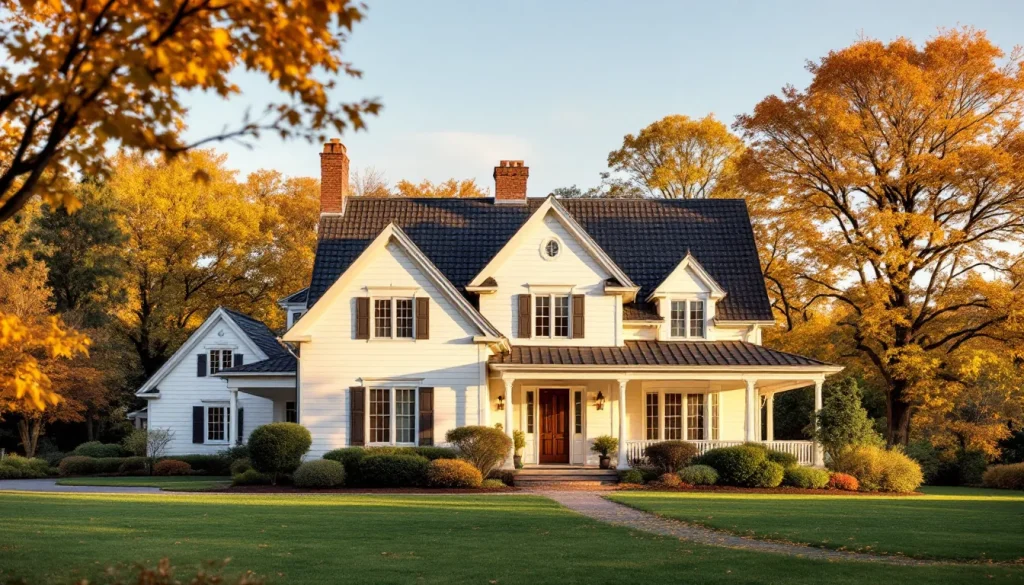
A gambrel roof is the two-sided, double-pitched barn-style design with two slopes per side: a steep lower slope and a gentler upper slope that meet at a horizontal break called the gambrel line. In 2026, a gambrel roof costs 10 to 25 percent more than a comparable gable, but the attic-space efficiency is unmatched among standard residential roof styles. The classic Dutch Colonial home is the most common gambrel application, with strong modern revival in farmhouse and modern barn-style residences across the suburban Northeast and Midwest. Here is the practical breakdown of when the gambrel premium pays off.
The short version
- A gambrel has two sloped sides (not four like a mansard) with each side broken into a steep lower pitch and shallow upper pitch.
- 2026 installed cost runs $7.50 to $14 per square foot for asphalt, $13 to $24 for metal, $22 to $40 for cedar shake.
- Best application: any home where attic space conversion matters more than four-sided wind protection (barns, Dutch Colonials, modern farmhouses).
- Wind performance is weaker than a hip roof because of the exposed gable ends, but stronger than people assume because of the broken-pitch geometry.
- Modern revival: every major production builder offers a gambrel-influenced “modern farmhouse” plan in 2026, and most modern barndominium plans use a gambrel as the primary roof.
The Short Answer: Design + Best Application
A gambrel roof has two sloped sides, each of which is broken into two pitches. The lower pitch is steep, typically 60 to 75 degrees. The upper pitch is gentler, typically 25 to 40 degrees. The two ends of the building are vertical gable walls, often heavily fenestrated to bring light into the converted attic space.
The best application is any building where (a) the attic needs to be converted to usable floor area, and (b) the architectural style permits or demands a gable-end profile. That is why the gambrel dominates barn construction (storage volume is the whole point of a barn) and Dutch Colonial residential (the style demands the silhouette). In 2026, the modern farmhouse and barndominium revivals have brought the gambrel back to mainstream residential construction in the suburban Northeast, Midwest, and Texas.
Gambrel vs Mansard: The 2-Side vs 4-Side Distinction
The gambrel and the mansard roof are both double-pitched roofs designed to maximize attic floor space. They are constantly confused. The structural distinction is simple: a gambrel has two sloped sides, a mansard has four.
That distinction has cascading consequences. Because a gambrel has two vertical gable end walls, it has more exposed wall area and worse wind performance than a mansard. Because it does not have to wrap around four sides of the building with steep slopes and dormers, it is dramatically cheaper to build. Because the framing is simpler, structural engineering is more straightforward and most production builders can frame a gambrel without custom shop drawings.
| Feature | Gambrel | Mansard |
|---|---|---|
| Sloped sides | 2 | 4 |
| End walls | Vertical gable | Sloped (no gable) |
| 2026 cost premium vs gable | +10 to 25% | +50 to 90% |
| Origin | Dutch Colonial (1600s) | French (Mansart, 1640s) |
| Best modern application | Barns, modern farmhouse | Urban/civic, custom French |
| Wind code performance | Moderate (gable ends are weak point) | Better (no gable ends) |
| Attic floor area | 75 to 85% of footprint | 85 to 95% of footprint |
The Attic-Space Math: Why Gambrel Maximizes Usable Square Footage
The whole reason gambrel roofs exist is to put more usable cubic footage inside the building envelope without adding a story. The math is simple geometry: a gable roof at a 9:12 pitch on a 30-foot-wide house creates an attic with about 525 square feet of headroom over 7 feet. A gambrel roof on the same footprint, with a 70-degree lower pitch and a 30-degree upper pitch, creates about 720 square feet of usable headroom. That is a 37 percent gain in usable attic floor at almost the same total height.
The economic logic is the same as for a mansard, just at a smaller premium. At 2026 build costs of $200 to $300 per finished square foot for residential, an additional 200 square feet of usable attic adds $40,000 to $60,000 in market value. The gambrel premium over a gable on the same house is typically $5,000 to $15,000. The return on the upgrade is one of the best in residential construction.
History: Dutch Colonial Origins
The gambrel roof reached North America with Dutch settlers in the early 17th century, but it is older than that. Gambrel-like double-pitched roofs appear in Northern European agricultural buildings going back to medieval times, where the form was used for similar reasons: maximizing hay storage volume in barns.
The Dutch Colonial style took the gambrel from the barn to the residence. In the Hudson River Valley and on Long Island, Dutch settlers built homes with gambrel roofs from the 1640s onward. The Dirck Bensen House (built in 1700, restored) in Brooklyn is one of the best surviving examples, and the form became the defining feature of “Dutch Colonial” American residential architecture.
The form also moved into Federal-era and Colonial Revival construction (1880 to 1930) and became standard on American Foursquare and certain Cape Cod variants. The modern revival started in the late 2010s with the rise of “modern farmhouse” architecture and accelerated through the barndominium movement (combining residential with shop or barn function under a single gambrel roof). For background on historic preservation of these forms, the National Park Service maintains technical preservation briefs on Dutch Colonial detailing.
Cost Per Square Foot in 2026
Gambrel pricing in 2026 reflects two structural facts: more roof surface area per square foot of floor than a gable (because of the steep lower slope), but simpler framing and detailing than a mansard. The premium over a gable is modest enough that it pencils on most projects.
| Material | Installed cost per square foot (2026) | Cost premium vs gable equivalent | Service life |
|---|---|---|---|
| Asphalt architectural shingles | $7.50 to $11.00 | +12 to 18% | 20 to 30 years |
| Premium asphalt (impact-rated) | $10.00 to $14.00 | +12 to 18% | 30 to 40 years |
| Standing seam metal | $13.00 to $20.00 | +15 to 22% | 50 to 70 years |
| Metal corrugated (barndominium) | $8.50 to $13.00 | +10 to 15% | 40 to 60 years |
| Cedar shake | $22.00 to $32.00 | +18 to 25% | 30 to 40 years |
| Slate | $30.00 to $48.00 | +20 to 28% | 75 to 100 years |
The premium over a gable comes from two sources: roughly 12 to 15 percent more roof surface area per square foot of floor, and slightly more complex flashing at the gambrel line (the horizontal break between the two pitches). For full pricing context across all styles, see how much does a new roof cost.
Material Best-Pairings
The gambrel’s geometry creates one critical material decision: the gambrel line. Where the two pitches meet, the material on the lower slope has to terminate or transition cleanly, and water has to be directed away from the upper slope’s bottom edge.
| Material | Gambrel line detail | Best application |
|---|---|---|
| Asphalt shingles | Step flashing with woven course at break | Mainstream residential |
| Standing seam metal | Continuous panel, mechanical break at line | Modern barndominium |
| Cedar shake | Hand-cut transition course at break | Restoration and high-end custom |
| Corrugated metal (panels) | Z-flashing across break | Agricultural and pole-barn style |
| Slate | Lead step flashing at break | Historic preservation |
For the modern farmhouse and barndominium segment, standing seam metal carried unbroken across the gambrel line is the strongest detail. The single mechanical break in the panel is the only weak point, and it can be detailed with a continuous Z-flashing for full weather protection. For asphalt, the woven course at the break has to be detailed exactly per the manufacturer’s spec or it will leak within five years. See metal vs asphalt shingle roof for the detailed material comparison.
Wind Performance and Snow Load
The gambrel’s wind performance is mixed. The two vertical gable end walls are the weakness, just as they are on a standard gable roof. They present a large vertical surface to horizontal wind, and the wind uplift at the gable peak is one of the worst load conditions in residential construction.
That said, the broken-pitch geometry of the gambrel does help in two ways. First, the steep lower slope is so steep that wind pressure against it is mostly compressive (the roof gets pressed against the structure, not lifted off). Second, the kink at the gambrel line disrupts the airflow that would otherwise create uplift on a continuous slope. The combined effect is that a gambrel performs better than a gable of the same height in moderate wind events but no better in extreme events where the gable end fails first.
IRC R301 specifies the basic wind speed design for residential construction. For gambrel in any zone with a basic wind speed above 130 mph, plan on hurricane-rated framing connectors at the gable end walls and a continuous load path from the roof to the foundation. See hurricane proof roof for the connector and load path detail.
Snow performance is excellent. The steep lower slope sheds snow quickly, and the upper slope at 25 to 40 degrees still sheds reasonably well. Drift loads are minimal compared to a mansard upper deck. In high-snow climates (40+ psf ground snow load), gambrel framing should still be sized to ASCE 7-22 unbalanced snow load criteria, but the geometry is friendly to snow management.
The Hip Variant: Hip Gambrel
A “hip gambrel” or “gambrel hip” is a hybrid that takes the gambrel profile on the two main sides of the building and adds hip slopes at the gable ends, eliminating the vertical gable walls. The result looks like a mansard but is structurally a gambrel.
The hip gambrel is a regional Long Island and New England variant, common on shore homes where the wind exposure from the gable ends was a documented problem. The cost premium over a standard gambrel runs 15 to 25 percent. The wind performance improves materially, getting close to (but not equal to) a full hip roof.
In 2026, the hip gambrel is mostly seen in two contexts: storm-rebuild reconstruction in coastal New England where carriers require improved wind performance, and high-end custom residential where the owner wants the gambrel silhouette without the gable end vulnerability.
Modern Gambrel: Barn-Style and Modern Farmhouse
The gambrel has had a significant resurgence in residential design since 2018, driven by three trends.
Modern farmhouse. The architectural movement popularized by HGTV personalities and Restoration Hardware aesthetic now accounts for an estimated 20 to 30 percent of new single-family residential construction in suburban markets. Most modern farmhouse plans use either a steep gable or a gambrel as the primary roof, and the gambrel is gaining share as the style matures.
Barndominiums. The combined residence-and-shop building, originally a Texas and Oklahoma phenomenon, has spread nationally. The standard barndominium roof is a gambrel with corrugated metal cladding. 2026 production prices for a 3,000 square foot barndominium with a gambrel roof typically run $180,000 to $260,000 turnkey.
Accessory dwelling units. ADU regulations in California, Oregon, Washington, and several Northeast states have allowed two-story detached accessory units on single-family lots. The gambrel is popular for ADUs because it gives a usable second floor without making the structure look like a full second story.
Gambrel Roof Framing Considerations
Gambrel framing is straightforward in concept but has two engineering details that have to be handled correctly.
The first is the gambrel line. The horizontal break between the two pitches is a structural hinge point. In a stick-framed gambrel, this point is typically reinforced with a continuous purlin (a horizontal beam running the length of the building) or with knee walls inside the attic that brace the joint. In a trussed gambrel, the joint is built into the truss web pattern and engineered for the full design load.
The second is the gable end wall. The vertical gable wall above the second-floor plate line is a non-bearing wall in most gambrels, but it has to resist the full lateral wind load against the gable surface. In any wind zone above 110 mph design speed, this wall typically needs continuous sheathing extending from the second floor down to the foundation, hold-down hardware at corners, and balloon framing rather than platform framing for the gable wall.
Roof trusses for gambrels are widely available from major suppliers but cost 25 to 40 percent more than equivalent gable trusses. The premium reflects the more complex truss geometry. See roof trusses for the engineering background on residential truss systems.
Cost vs Gable: The Direct Comparison
The gambrel’s main competitor is the standard gable, and the cost-benefit math is straightforward.
| Cost item | Gable (baseline) | Gambrel | Delta |
|---|---|---|---|
| Roof framing (2,500 sf home) | $18,000 | $22,000 to $25,000 | +22 to 39% |
| Roof material + install (asphalt) | $14,000 | $16,500 to $19,000 | +18 to 36% |
| Finished attic floor (sq ft gained) | 500 to 700 sf | 900 to 1,200 sf | +40 to 70% |
| Finished value of attic floor gained | baseline | +$45,000 to $80,000 | large positive |
| Net cost-benefit | baseline | Strongly positive if attic is finished |
The cost-benefit only works if you actually finish the attic. A gambrel with an unfinished attic is a worse deal than a gable, because you paid the premium without capturing the floor area benefit. The classic gambrel decision is therefore: build the gambrel only if you are committed to finishing the upstairs.
Cost vs Mansard: When to Choose Which
If you want maximum attic floor area and you have the budget, the mansard delivers more square footage and better wind performance than the gambrel. But the cost premium is dramatic.
| Cost item | Gambrel | Mansard | Delta |
|---|---|---|---|
| 2,500 sf home installed cost | $22,000 to $30,000 | $48,000 to $135,000 | +120 to 350% |
| Attic floor area gained | 900 to 1,200 sf | 1,700 to 1,900 sf | +50 to 60% |
| Cost per sf of attic gained | $23 to $33 | $25 to $71 | roughly comparable at low end |
| Annual maintenance budget | $150 to $400 | $500 to $1,200 | +200 to 300% |
| Insurance premium impact | Minimal | +10 to 30% | Mansard penalty |
For most owners, the gambrel is the better economic choice. The mansard makes sense only when the architectural style demands it, when the four-side floor area gain is critical, or when you are restoring a historic building where the original roof was a mansard.
Gambrel Maintenance Realities
The gambrel is a low-maintenance roof relative to mansards, but the gambrel line break is the inspection point that matters. Annual inspection items:
Walk the gambrel line. The horizontal flashing or transition course at the break between the two pitches is the most common leak point. Look for lifted flashing, separated shingle courses, or water staining on the inside of the gable wall just below this line.
Inspect gable end soffits and rake trim. The gable end walls of a gambrel are subject to wind-driven rain along the eaves. Soft rake trim, peeling paint, or efflorescence on masonry below the gable peak indicates moisture intrusion at the wall-to-roof transition.
Check attic ventilation. Most gambrel attics are conditioned space (finished living area), which means the roof assembly is either continuously vented at the eaves and ridge or built as an unvented assembly per IRC R806. Confirm which type yours is and that vents are not blocked.
Annual maintenance budget: $150 to $400 for a single-family home with a properly built gambrel. This is comparable to a gable and dramatically less than a mansard.
FAQs
What is the difference between a gambrel roof and a mansard roof?
A gambrel has two sloped sides and two vertical gable ends. A mansard has four sloped sides and no vertical gable. The gambrel is cheaper and simpler, the mansard gives more usable floor area but costs significantly more.
How much does a gambrel roof cost in 2026?
For a 2,500 square foot home, expect $22,000 to $40,000 for asphalt shingles, $33,000 to $60,000 for standing seam metal, $55,000 to $90,000 for cedar shake. The gambrel premium over a gable runs 10 to 25 percent.
Is a gambrel roof good for snow country?
Yes. The steep lower slope sheds snow effectively, and the upper slope at 25 to 40 degrees handles moderate snow loads well. Gambrel framing in high-snow climates should still be engineered to ASCE 7-22 unbalanced snow load criteria, but the geometry is fundamentally snow-friendly.
Why are gambrel roofs used on barns?
Storage volume. A barn’s whole purpose is interior cubic footage for hay, equipment, or livestock. The gambrel maximizes the cubic volume inside a given footprint and ridge height. The same logic now drives the barndominium and modern farmhouse residential applications.
Do gambrel roofs hold up in hurricanes?
Moderately. The gable end walls are the weakness, and at design wind speeds above 130 mph the gable end has to be reinforced with continuous sheathing, hold-down hardware, and balloon framing. A properly engineered gambrel can meet code in Florida and Gulf state hurricane zones, but a hip roof is structurally better.
Can I add dormers to a gambrel roof?
Yes, and dormers are common on gambrel residential roofs (especially Dutch Colonial). The dormer is typically built into the steep lower slope. The flashing at the dormer-to-roof joint is the highest-leak-risk detail on a gambrel and should be installed by an experienced roofer.
How long does a gambrel roof last?
Service life is driven by material, not by roof style. Asphalt on a gambrel lasts 20 to 30 years. Standing seam metal lasts 50 to 70 years. Cedar shake lasts 30 to 40 years. Slate lasts 75 to 100 years. Maintenance of the gambrel line flashing is the limiting factor for premature failure. See how long does a roof last for the full breakdown.