
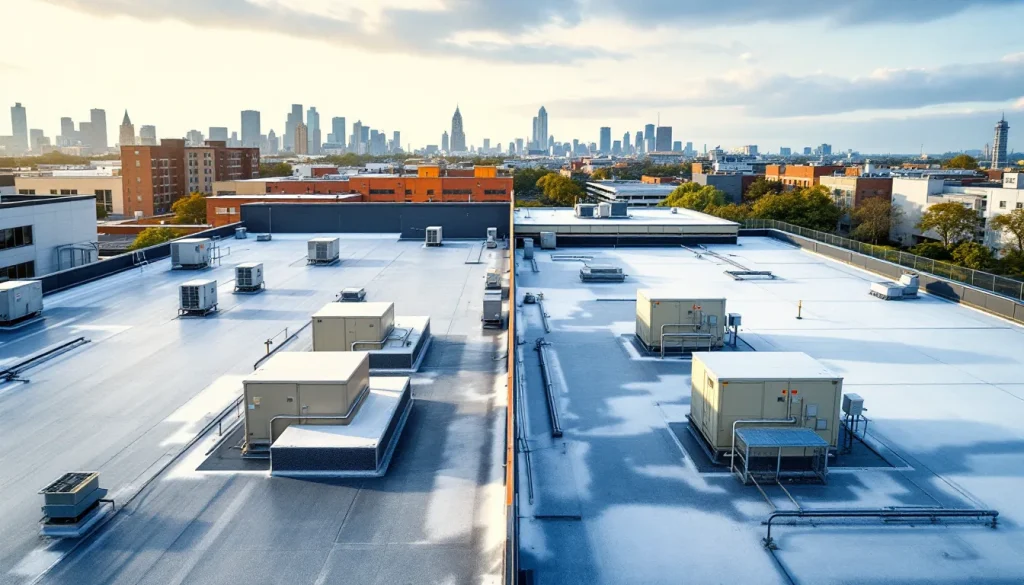
The tpo (see our TPO membrane pricing) vs epdm roofing decision is the most consequential single-line item on most commercial property capital plans, and getting it wrong can cost a building owner $50,000 to $300,000 in unnecessary replacement, energy spend, or warranty exposure over a 30-year horizon. This guide is written for commercial property owners, facility managers, and operators who need a real comparison of the two dominant single-ply membranes, with 2026 contractor pricing, lifecycle math, climate fit, and manufacturer warranty terms from GAF, Carlisle SynTec, Firestone Building Products (now Holcim Elevate), and Johns Manville. We do not soft-pedal either material; both have real strengths and real failure modes, and the right answer depends on your climate, your roof geometry, your tenant profile, and your hold period.
The short version
- TPO (thermoplastic polyolefin) installs at $5.50 to $9.00 per square foot and lasts 20 to 30 years. EPDM (ethylene propylene diene monomer rubber) installs at $4.00 to $8.00 per square foot and lasts 25 to 50 years.
- TPO is white and reflective, delivering 10 to 25 percent cooling cost savings in Climate Zones 1 to 4. EPDM is typically black and absorptive, which is a feature in cold northern climates and a penalty in hot southern ones.
- TPO is heat-welded at the seams for high seam strength. EPDM is glued or taped at the seams; seams are the failure point on older EPDM but modern tape systems have closed most of that gap.
- Pick TPO if your building is in Climate Zone 1 to 4, you need Energy Star or LEED credits, or your roof has many penetrations. Pick EPDM if your building is in Climate Zone 5 to 8, you want the longest field-proven service life, or you have a simple, large, low-penetration roof.
- Manufacturer warranty terms now run 15 to 30 years for both materials; the difference is in what they cover and what they exclude.
The Short Answer: When TPO Wins, When EPDM Wins
TPO wins in hot climates, in buildings chasing energy certifications, and on roofs with complex geometry where heat-welded seams handle penetrations better than glued seams. The white reflective surface drops summer roof temperatures by 50 to 80 degrees Fahrenheit compared with black EPDM (see our EPDM rubber membrane pricing), which translates directly to lower HVAC load and lower interior insulation aging.
EPDM wins in cold climates, on simple large-area roofs, and where the owner values the longest field-proven track record. EPDM was commercialized in the 1960s, so we have 60-plus years of real-world data showing some installations still watertight at 35 to 40 years. TPO has only been widely deployed since the mid-1990s, and early generations had documented heat-aging failures that the industry has since engineered out.
For a building with a 7 to 12 year hold period and a budget-driven owner, the cost difference is usually decisive: EPDM is cheaper to install on most roofs. For a building with a 20-plus year hold, the climate and energy math tend to flip the decision toward TPO in the South and Southwest and toward EPDM in the North and Mountain West.
What Are TPO and EPDM
TPO is a single-ply thermoplastic membrane made by blending polypropylene and ethylene-propylene rubber with stabilizers, flame retardants, and UV inhibitors. The result is a heat-weldable sheet typically 45, 60, or 80 mils thick, almost always white, and laid in 6, 8, 10, or 12 foot wide rolls. TPO’s defining property is that it can be re-melted with a hot-air welder, which means seams fuse into a homogenous continuous membrane rather than a chemically bonded joint. This is why TPO seams in field-pull tests routinely exceed the strength of the parent sheet.
EPDM is a single-ply thermoset rubber membrane made from ethylene, propylene, and a small percentage of a diene monomer (usually ethylidene norbornene) cross-linked into a stable elastomer. Most EPDM is carbon-black for UV protection, sold in 45, 60, 75, or 90 mil thicknesses and in widths up to 50 feet. Because EPDM is thermoset, it cannot be re-melted; seams are bonded with seam tape or splice adhesive. EPDM’s defining property is exceptional UV and ozone resistance, which is what drives its long real-world service life.
Cost: TPO $5.50-9/sqft installed vs EPDM $4-8/sqft installed
Pricing below reflects 2026 commercial bids across 30 metro markets for a 20,000 square foot mechanically attached roof on a steel deck with R-30 polyiso insulation, complete tear-off, and standard penetrations (10 to 15 roof drains, curbs, and vents).
| System | Installed cost per sq ft | 20,000 sq ft total | Typical lifespan |
|---|---|---|---|
| 60 mil TPO mechanically attached | $5.50 to $7.50 | $110,000 to $150,000 | 20 to 25 years |
| 80 mil TPO mechanically attached | $7.00 to $9.00 | $140,000 to $180,000 | 25 to 30 years |
| 60 mil TPO fully adhered | $7.50 to $9.50 | $150,000 to $190,000 | 20 to 25 years |
| 60 mil EPDM mechanically attached | $4.00 to $6.00 | $80,000 to $120,000 | 25 to 35 years |
| 60 mil EPDM ballasted | $4.50 to $6.50 | $90,000 to $130,000 | 30 to 40 years |
| 60 mil EPDM fully adhered | $6.00 to $8.00 | $120,000 to $160,000 | 25 to 35 years |
| 90 mil EPDM fully adhered | $7.50 to $9.50 | $150,000 to $190,000 | 35 to 50 years |
On the same attachment method and similar thickness, EPDM averages 15 to 25 percent less to install than TPO. The labor delta is the largest contributor; EPDM goes down in wide sheets with fewer linear feet of seam, which cuts both material and labor. TPO requires a hot-air welder on every seam, which adds setup, skill, and time.
Lifespan: TPO 20-30yr vs EPDM 25-50yr
EPDM has the longest documented service life of any single-ply membrane. EPDM Roofing Association field studies and Oak Ridge National Laboratory aged-membrane research consistently show 30 to 40 year service life on properly installed EPDM with no major failures. The longest-running EPDM installations from the late 1960s and early 1970s are still in service after 55-plus years, although those used heavier 90 mil sheet.
TPO service life is shorter and more variable. First-generation TPO from the late 1990s and early 2000s suffered documented heat-induced failures, particularly at fastener plates and welds. The chemistry was substantially reformulated by the mid-2000s and modern TPO from major manufacturers delivers 20 to 30 year service life in field studies. The 80 mil and 90 mil thicknesses now offered by Carlisle, GAF, and Holcim Elevate extend that envelope and are the standard spec on roofs that need to clear the 25-year mark.
The practical takeaway: if you want a 40-plus year roof, EPDM at 75 or 90 mil is the proven choice. If you want a 25 year roof with energy and reflective benefits, 80 mil TPO is the standard.
Energy Efficiency
This is the single largest operating cost difference between the two systems. The Cool Roof Rating Council rates white TPO at solar reflectance of 0.70 to 0.80 and thermal emittance of 0.85 to 0.90, producing a Solar Reflectance Index (SRI) of 90 to 105. Black EPDM rates at 0.05 to 0.07 reflectance with similar emittance, producing an SRI of 0 to 5. White EPDM exists (Carlisle Sure-White, Firestone RubberGard Max FR) but represents less than 10 percent of EPDM installs and prices closer to TPO.
Roof surface temperature on a 95 degree summer day in Phoenix or Houston runs 150 to 180 degrees Fahrenheit on black EPDM and 95 to 115 degrees Fahrenheit on white TPO. That 50 to 80 degree differential translates to 10 to 25 percent cooling cost reduction on the floor below the roof, per Department of Energy and NIST field measurements.
| Membrane | Solar reflectance | Thermal emittance | SRI | Cooling savings (CZ 1-4) |
|---|---|---|---|---|
| White TPO 60 mil | 0.70 to 0.80 | 0.85 to 0.90 | 90 to 105 | 10 to 25 percent |
| White TPO 80 mil | 0.70 to 0.80 | 0.85 to 0.90 | 90 to 105 | 10 to 25 percent |
| Gray TPO | 0.40 to 0.55 | 0.85 to 0.90 | 50 to 70 | 5 to 15 percent |
| Black EPDM | 0.05 to 0.07 | 0.85 to 0.90 | 0 to 5 | 0 percent (baseline) |
| White EPDM | 0.65 to 0.75 | 0.85 to 0.90 | 85 to 100 | 10 to 22 percent |
| Ballasted EPDM (gravel) | 0.10 to 0.25 | 0.80 to 0.90 | 5 to 25 | 2 to 6 percent |
The flip side: in heating-dominated climates (Climate Zones 5 to 8), black EPDM acts as a passive solar absorber and reduces winter heating load by 3 to 8 percent compared with white TPO. For a building in Minneapolis, Buffalo, or Bangor, the heating bill is larger than the cooling bill and EPDM’s color is a feature, not a defect.
Installation Method
TPO and EPDM use the same three attachment methods (mechanically attached, fully adhered, ballasted) but the seaming and weather-sealing details are different.
TPO seaming: Hot-air welded with a robotic welder for field seams and a hand welder for details. Properly welded TPO seams develop more strength than the parent membrane and are functionally bulletproof for the life of the sheet. The skill ceiling is high; underqualified crews produce cold welds that fail at 5 to 10 years. Spec a contractor with manufacturer-certified welders and require seam-test documentation.
EPDM seaming: Pressure-sensitive seam tape or two-part seam adhesive. Modern 6 inch self-adhered seam tape from Carlisle and Holcim Elevate has substantially closed the historic seam-failure gap, but EPDM seams remain the leading failure mode on older installations. Field repair of an EPDM seam is straightforward and a common preventive maintenance line item, and it is one of the core warehouse roof repair methods on large single-ply roofs.
Attachment trade-offs: Mechanically attached is fastest and cheapest but transmits more roof movement to the membrane and is more prone to billowing in high winds. Fully adhered is most expensive but performs best on exposed sites and irregular geometry. Ballasted is the cheapest material attachment but adds 10 to 18 pounds per square foot of dead load, which most existing buildings cannot accept on a retrofit.
Repair Costs Over 30 Years
Both membranes require periodic maintenance. The composition of that maintenance differs.
| Maintenance item | TPO | EPDM |
|---|---|---|
| Annual inspection | $800 to $1,500 | $800 to $1,500 |
| 5-year wash and recoat (white) | $0.15 to $0.30 per sq ft | $0 (black) |
| Seam repair (per 10 lf) | $200 to $400 | $150 to $350 |
| Penetration reseal | $150 to $300 each | $150 to $300 each |
| Storm-damage patch (per 10 sf) | $300 to $600 | $250 to $500 |
| 30-year maintenance total (20,000 sq ft) | $45,000 to $80,000 | $30,000 to $60,000 |
| Mid-life recover (year 15 to 20) | $2.00 to $3.50 per sq ft | $1.80 to $3.00 per sq ft |
EPDM maintenance trends 20 to 30 percent lower in cumulative cost because it does not require periodic washing to maintain reflectance and because rubber seam repairs are simpler than welded patches on aged TPO.
UV and Heat Performance
EPDM was engineered specifically for UV and ozone resistance and outperforms TPO on those vectors. The polymer backbone has no double bonds vulnerable to oxidation, which is why aged EPDM samples show negligible loss of elongation after 30 years of solar exposure.
TPO performs well on UV but is more sensitive to sustained high heat. The 2003 to 2007 generation of TPO showed accelerated weld-line failures in roofs exceeding 160 degrees Fahrenheit surface temperature. The current chemistry handles those temperatures, but TPO over highly insulated decks in Phoenix, Las Vegas, or El Paso still warrants the 80 mil thickness and a manufacturer with proven heat-aging test data (CRRC and ASTM D6878 results published).
Cold Climate Performance
EPDM is the better cold-climate membrane. The polymer remains flexible to negative 40 degrees Fahrenheit and accommodates thermal expansion and contraction without seam stress. Black EPDM also passively warms the roof in winter, melting snow and reducing ice-dam risk on parapet walls and drains.
TPO becomes stiffer at low temperatures and is more prone to seam stress at the cold-flex point. Installation in temperatures below 40 degrees Fahrenheit requires heated material and pre-warmed welders. TPO performs acceptably in cold climates once installed, but EPDM is the field-proven choice for buildings in Minnesota, Wisconsin, Michigan, upstate New York, New England, and the mountain west.
Hot Climate Performance
TPO is the better hot-climate membrane, and the reflectivity advantage is the largest single reason. A 100,000 square foot warehouse in Phoenix with R-25 roof insulation saves $0.18 to $0.32 per square foot per year in cooling cost with white TPO vs black EPDM, per Department of Energy Building America program field measurements. Over a 25 year roof life that is $450,000 to $800,000 on a single building.
White EPDM is available and competitive on reflectivity, but only 5 to 10 percent of EPDM installations are white and the price premium typically erases EPDM’s labor cost advantage. The practical hot-climate decision is white TPO vs white EPDM, and TPO wins on availability, installer base, and warranty terms.
Energy Star + LEED Considerations
Energy Star roof products must meet 0.65 initial reflectance and 0.50 after 3 years on low-slope roofs. White TPO and white EPDM both qualify. Black EPDM does not. Energy Star qualification matters for utility rebates, some state and municipal commercial energy codes (Title 24 in California, NYStretch in New York), and for tenants tracking ESG metrics.
LEED v4 and v4.1 award up to 2 points under Sustainable Sites for cool-roof SRI compliance. Cool-roof TPO and white EPDM both deliver. The bigger LEED lever is recycled content and end-of-life recyclability: TPO is recyclable through manufacturer take-back programs (Carlisle and GAF both operate them) but in practice less than 10 percent of TPO is recycled at end of life. EPDM is similarly recyclable but rarely is.
Wind Uplift Resistance
Wind uplift performance depends on attachment method more than membrane chemistry. Both TPO and EPDM can be engineered to FM Global 1-90 (90 psf), 1-105, 1-120, or higher with the right fastening density, plate spacing, and edge metal detail.
| Attachment | Typical wind uplift rating | Best fit |
|---|---|---|
| Mechanically attached | FM 1-60 to 1-120 | Most low-rise commercial |
| Fully adhered | FM 1-90 to 1-225 | High-rise, coastal, exposed sites |
| Ballasted | FM 1-60 to 1-105 | Large flat warehouses, gravel-tolerant deck |
| Induction-welded (RhinoBond / OMG) | FM 1-120 to 1-180 | Mid-rise, hurricane zones |
In hurricane-exposed markets (Florida, Gulf Coast, coastal Carolinas, Texas coast) fully adhered or induction-welded is the standard spec regardless of membrane. The membrane choice within that spec is climate and budget driven.
Manufacturer Warranty Comparison
The big four single-ply manufacturers (GAF, Carlisle SynTec, Holcim Elevate formerly Firestone, Johns Manville) offer broadly similar warranty terms but the details matter and the exclusions can cost a building owner hundreds of thousands of dollars.
| Manufacturer | TPO max warranty | EPDM max warranty | Notable exclusions |
|---|---|---|---|
| GAF EverGuard | 30 year NDL on 80 mil | 30 year NDL on 90 mil | Ponding water over 48 hours, traffic damage |
| Carlisle SynTec | 30 year Golden Seal on 80 mil | 30 year Golden Seal on 90 mil | Chemical exposure, biological growth |
| Holcim Elevate (Firestone) | 30 year Red Shield on UltraPly | 35 year Red Shield on RubberGard | Ponding water, grease (restaurants) |
| Johns Manville | 30 year Peak Advantage | 30 year Peak Advantage | Ponding, contractor non-cert |
“NDL” is no-dollar-limit, meaning the manufacturer covers full replacement cost rather than a pro-rated amount. NDL is the gold standard and should be specified explicitly. Watch for these warranty pitfalls: ponding water exclusions (any water sitting over 48 hours), drainage design requirements, certified-installer requirements, and biological growth exclusions in tree-canopy or coastal locations.
Total Cost of Ownership Over 30 Years
Pulling all the threads together, here is a 30-year total cost of ownership model for a 50,000 square foot warehouse roof in two representative climates. Both models hold attachment method and insulation constant; only membrane and color differ.
| Cost component | 80 mil TPO white (CZ 2, Houston) | 60 mil EPDM black (CZ 2, Houston) | 80 mil TPO white (CZ 6, Minneapolis) | 90 mil EPDM black (CZ 6, Minneapolis) |
|---|---|---|---|---|
| Year 0 install | $400,000 | $275,000 | $400,000 | $425,000 |
| Maintenance (30 yr) | $60,000 | $45,000 | $50,000 | $40,000 |
| Mid-life replacement (year 22 to 28) | $0 (still in service) | $0 (still in service) | $0 | $0 |
| Energy cost differential (30 yr) | -$540,000 (cooling baseline) | +$0 (baseline) | +$90,000 (less winter solar gain) | $0 (baseline) |
| Utility rebate | -$10,000 | $0 | -$5,000 | $0 |
| 30-year TCO | -$90,000 (net positive) | $320,000 | $535,000 | $465,000 |
Read that Houston column carefully. The energy savings on a 50,000 square foot reflective white roof in a Climate Zone 2 building are large enough that the TPO roof effectively pays for itself and runs net negative over 30 years. The Minneapolis column tells the opposite story: TPO’s reflectivity becomes a liability and EPDM’s longer service life and lower install cost win.
The Maintenance Reality
Every commercial single-ply roof needs an annual inspection. The two highest-yield maintenance practices are quarterly drain cleaning (clogged drains cause more single-ply failures than every other cause combined) and semi-annual penetration walks (verifying every curb, pipe boot, and vent is still sealed). Budget $0.05 to $0.10 per square foot per year for proactive maintenance and you will roughly double effective roof life.
The single biggest mistake we see commercial owners make is treating the roof as install-and-forget. EPDM and TPO both perform best when problems are caught at the penetration and seam level early. A $400 seam repair at year 8 prevents a $40,000 wet-insulation tear-off at year 18.
Which Commercial Property Should Pick Which
Below is the decision matrix our commercial network reports against 2024 to 2026 installation outcomes.
| Building profile | Climate zone | Recommended membrane | Why |
|---|---|---|---|
| Distribution warehouse, 100K+ sq ft | 1 to 4 (hot) | 80 mil TPO mechanically attached | Reflectivity savings massive on large roof |
| Distribution warehouse, 100K+ sq ft | 5 to 8 (cold) | 60 to 90 mil EPDM ballasted | Service life and winter heat retention |
| Strip mall / retail center | Any | 60 mil TPO mechanically attached | Energy savings + tenant lease optics |
| Class A office, mid-rise | Any | 80 mil TPO fully adhered | Wind, LEED, Energy Star |
| Class B/C office, low-rise | 1 to 4 | 60 mil TPO mechanically attached | Energy, cost balance |
| Class B/C office, low-rise | 5 to 8 | 60 mil EPDM mechanically attached | Cost, life |
| Apartment / multifamily flat roof | 5 to 8 | 75 to 90 mil EPDM fully adhered | Longest service life, lowest tenant disruption |
| Restaurant (kitchen exhaust) | Any | 80 mil TPO with grease-resistant detail | EPDM degrades on grease exposure |
| Manufacturing with chemical exhaust | Any | Specialty PVC or KEE (not in scope) | Both TPO and EPDM have exclusions |
| Self-storage facility | Any | EPDM ballasted | Lowest 30-year owned cost |
| Hotel / hospitality | 1 to 4 | 80 mil TPO fully adhered | Reflectivity, warranty, wind |
| Hotel / hospitality | 5 to 8 | 90 mil EPDM fully adhered | Service life on long-hold asset |
For owners weighing a re-cover vs full replacement, a recover-over-existing system is often viable if the existing insulation is dry and the deck is sound. Talk to two contractors and require infrared moisture surveys before deciding. For broader roof material selection guidance see our /learn/ pillar, and for residential context see how much does a new roof cost and how long does a roof last.
FAQs
Is TPO or EPDM cheaper to install?
EPDM averages 15 to 25 percent cheaper to install on equivalent attachment methods, primarily because it goes down in wider sheets with fewer linear feet of seam, which cuts both material and labor. On the largest, simplest roofs EPDM ballasted is the lowest-cost single-ply option available.
Which membrane lasts longer, TPO or EPDM?
EPDM has the longer documented field service life. Properly installed EPDM routinely delivers 30 to 40 years, and the oldest installations from the late 1960s are still in service at 55-plus years. TPO from modern formulations delivers 20 to 30 years. If hold period is 30-plus years, EPDM is the proven choice.
Is white TPO worth the cost premium over black EPDM in Phoenix or Houston?
Almost always yes. The cooling cost savings on a 50,000-plus square foot building in Climate Zones 1 to 3 typically pay back the TPO cost premium in 4 to 7 years and continue compounding for the rest of the roof life. A 100,000 square foot warehouse can save $18,000 to $32,000 per year in HVAC cost.
Can I install TPO over my existing EPDM roof?
Yes, a recover application is permitted by most manufacturers if the existing EPDM is dry (see our industrial roof replacement), the deck is sound, and a separation sheet is installed. Get an infrared moisture survey first; any wet insulation must be removed. Verify your manufacturer’s specific recover-warranty requirements.
What is the biggest cause of TPO and EPDM failure?
Clogged roof drains causing ponding water are the largest single failure cause for both membranes. Manufacturer warranties exclude ponding over 48 hours specifically because the data shows it accelerates membrane and seam failure. Quarterly drain cleaning is the single highest-yield maintenance investment.
Do TPO and EPDM qualify for utility rebates?
White TPO and white EPDM both qualify for cool-roof utility rebates in California (Title 24), New York (NYStretch), and most Southwest utility territories. Rebate values range $0.10 to $0.40 per square foot. Black EPDM does not qualify. Check your utility’s commercial energy program before specifying.
How do I know if my contractor is qualified to install TPO or EPDM correctly?
Require manufacturer certification. GAF, Carlisle, Holcim Elevate, and Johns Manville all maintain certified installer programs and the no-dollar-limit warranty is contingent on certified-installer work. Ask for the certification number and verify with the manufacturer’s contractor locator. Require seam-test documentation on TPO and pull-test results on mechanically attached systems.