
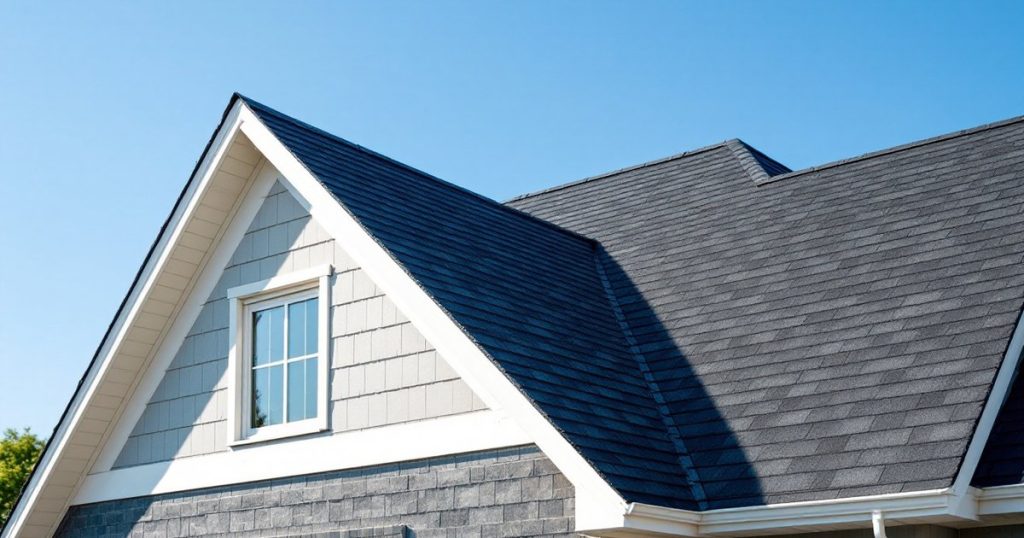
Asphalt shingles pros and cons come down to one trade: the lowest installed price of any common steep-slope roof (about $5 to $8 per square foot for architectural shingles in our 2026 Roofing Cost Report) in exchange for the shortest service life, about 20 years in the NAHB and Bank of America life-expectancy study. Every pro and con below carries a number and a named source, so you can check it before you sign a contract.
By The Roofing Brief Team. Last reviewed: October 2026.
Asphalt shingles: key numbers at a glance
These six figures answer most of the asphalt shingle decision. Each comes from a code, a standards body, a trade association or our own dated cost report, and each is a typical range rather than a quote for a specific house.
| Question | Number | Source |
|---|---|---|
| Installed cost, architectural | $5 to $8 per sq ft ($10,000 to $16,000 for 2,000 sq ft of roof) | Roofing Brief 2026 Roofing Cost Report |
| Installed cost, 3-tab | $4 to $6 per sq ft | Roofing Brief 2026 Roofing Cost Report |
| Typical service life | About 20 years (3-tab); 20 to 30 years assumed for asphalt overall | NAHB/Bank of America study (2007); InterNACHI chart; U.S. EPA C&D debris report (2015 data) |
| Fire rating | Class A available as standard on fiberglass-mat lines | ANSI/UL 790 listing on maker data sheets (for example GAF Timberline HDZ) |
| Share of U.S. homes | About 4 in 5 homes; 73% to 81% of the residential market | ARMA FAQ; Roofing Brief Roofing Material Market Share Report |
| Shingle waste recycled into roads | 641,000 tons in 2024, roughly 5% of annual shingle waste | NAPA IS-138 (2024 season); EPA; Roofing Brief arithmetic |
What are the pros and cons of asphalt shingles?
The pros of asphalt shingles are low cost, a Class A fire rating, code-listed wind classes, optional Class 4 hail resistance, light weight and a deep installer pool. The cons are a short service life, wind resistance that can fade with age, heat absorption on dark colors, a 2:12 slope floor and a waste stream that is mostly landfilled. The scorecard below puts a number on each.
| Factor | Pro or con | The number | Source |
|---|---|---|---|
| Upfront cost | Pro | $5 to $8 per sq ft vs $10 to $18 for standing-seam metal | Roofing Brief 2026 Roofing Cost Report |
| Fire | Pro | Class A (highest of A, B, C) on most fiberglass lines | ANSI/UL 790 (ASTM E108) listings on maker data sheets |
| Wind | Pro, with a caveat | Top classes: ASTM D7158 Class H, ASTM D3161 Class F (110 mph test) | ASTM D3161, ASTM D7158 via NRCA; IRC R905.2.4.1 |
| Hail | Pro only if upgraded | UL 2218 Class 4 = 2.00 in steel ball; Class 4 lines cost $8 to $13 per sq ft | IBHS; Roofing Brief 2026 Roofing Cost Report |
| Weight | Pro | About 1.8 to 3.0 lb per sq ft vs about 9.35 for 1/4 in slate | Maker EPDs and data sheets; National Slate Association |
| Installer availability | Pro | 166,900 roofer jobs in 2025; median $26.65 per hour (May 2025) | BLS Occupational Outlook Handbook; BLS OEWS |
| Service life | Con | About 20 years vs 40 to 80 for metal and 60 to 150 for slate | NAHB 2007; InterNACHI chart |
| Aging in wind | Con | Most tested products lost wind resistance between years 5 and 10 | IBHS Roof Aging Farm, 10-year report (2026) |
| Heat | Con | Dark steep-slope roofs reflect about 4% to 18% of sunlight | Cool Roof Rating Council, Cool Colored Roofs fact sheet |
| Low slopes | Con | Not allowed below 2:12; double underlayment from 2:12 up to 4:12 | IRC R905.2.2 (2021 and 2024) |
| Cold-weather install | Con | Seal strips need sun and temperatures above 40°F to activate | GAF cool-weather installation guidance |
| Recycling | Con | About 641,000 tons recycled into pavement vs about 11 to 13.5 million tons generated | NAPA IS-138 (2024); FHWA; EPA (2015 data) |
The pros of asphalt shingles
The strongest case for asphalt shingles is price per square foot today, backed by fire and wind ratings that are written into the building code rather than marketing copy. The six pros below are listed in the order most buyers weigh them, each with the figure and the document behind it.
1. The lowest installed cost of the common steep-slope roofs
Architectural asphalt shingles run about $5 to $8 per square foot installed and 3-tab about $4 to $6, according to our 2026 Roofing Cost Report. On 2,000 square feet of roof surface (20 squares), that is about $10,000 to $16,000 for architectural shingles against $20,000 to $36,000 for standing-seam metal and $30,000 to $60,000 for natural slate.
Asphalt prices did rise in 2026. The same report tracks two rounds of manufacturer increases (4 to 8 percent in spring, then 6 to 9 percent effective June 1, 2026), yet the gap to metal widened because Section 232 tariffs on steel and aluminum rose to 50 percent in April 2026. Your quote can land outside these ranges with steep pitch, multiple tear-off layers or deck repairs.
2. A Class A fire rating comes standard on most lines
Most fiberglass-mat asphalt shingles are listed Class A, the highest of the three fire classes, under ANSI/UL 790 (the same test as ASTM E108). GAF’s Timberline HDZ data sheet, for example, lists “UL Listed to ANSI/UL 790 Class A.” Metal, tile and slate often reach Class A too, so fire is a shared strength rather than a reason to pay more.
The code treats them differently, though. The 2021 IRC Section R902.1 counts clay or concrete tile, slate and metal sheets as Class A without testing only when they sit on noncombustible decks. Asphalt shingles earn their Class A through a tested, listed assembly, so check the listing on the bundle wrapper.
3. Code-recognized wind classes up to Class H
Asphalt shingles are wind-rated under two ASTM tests, and the IRC requires the wrapper to show the class its Table R905.2.4.1 sets for your local basic wind speed. Under ASTM D3161 (fan test), Class A passes at 60 mph, Class D at 90 mph and Class F at 110 mph, per NRCA’s Professional Roofing summary. Under ASTM D7158-16, Class D, G and H correspond to ultimate design wind speeds up to 115, 150 and 190 mph.
| Test standard | Class | What the shingle passed | Source |
|---|---|---|---|
| ASTM D3161 (fan-induced) | Class A | 2-hour test at 60 mph | NRCA Professional Roofing, Sept 2018 |
| ASTM D3161 (fan-induced) | Class D | 2-hour test at 90 mph | NRCA Professional Roofing, Sept 2018 |
| ASTM D3161 (fan-induced) | Class F | 2-hour test at 110 mph | NRCA Professional Roofing, Sept 2018 |
| ASTM D7158-16 (uplift) | Class D | Ultimate design wind speed up to 115 mph | NRCA Professional Roofing, Sept 2018 |
| ASTM D7158-16 (uplift) | Class G | Ultimate design wind speed up to 150 mph | NRCA Professional Roofing, Sept 2018 |
| ASTM D7158-16 (uplift) | Class H | Ultimate design wind speed up to 190 mph | NRCA Professional Roofing, Sept 2018 |
Maker wind warranties are a separate number from the ASTM class. GAF Timberline HDZ carries 110 mph standard and 130 mph with GAF starter strips at eaves and rakes; Owens Corning Duration lists 130 mph; CertainTeed Landmark lists 110 mph, upgradable to 160 mph with CertainTeed starter and hip and ridge. Those terms come from 2026 maker warranty documents and depend on installation to the maker’s nailing pattern.
4. Class 4 hail resistance is available when you pay for it
Impact-resistant asphalt shingles reach UL 2218 Class 4, the top class, which means the shingle survived a 2.00 inch steel ball without cracking (Class 1 to 3 use 1.25, 1.50 and 1.75 inch balls, per IBHS). Class 4 lines cost about $8 to $13 per square foot installed in our cost report, so the upgrade adds roughly $6,000 to $10,000 on 2,000 square feet when you compare range ends. Our Class 4 impact-resistant shingles guide covers which products qualify.
The steel-ball test is not the whole story. The Insurance Institute for Business and Home Safety (IBHS) tested 24 impact-resistant products with laboratory-made hailstones in its November 2025 ratings, covering about 95 percent of impact-resistant shingles sold each year. Most rated Good and none rated Excellent, and IBHS says it does not recommend products rated Marginal or Poor for hail areas.
5. Light enough for standard roof framing
Architectural asphalt shingles weigh about 184 to 300 pounds per square (1.8 to 3.0 pounds per square foot), per the manufacturers’ environmental product declarations and data sheets compiled in our shingle weight by brand report. Quarter-inch slate weighs about 935 pounds per square, according to the National Slate Association, and Eagle Roofing lists its standard-weight Malibu concrete tile at about 903 pounds per 100 square feet installed.
That difference matters on a reroof. A home framed for asphalt usually needs no structural check to stay with asphalt, while a switch to slate or standard-weight tile may need an engineer to confirm the rafters can carry three to five times the dead load.
6. The deepest installer and parts pool
Asphalt is the default U.S. roof: ARMA says four out of five homes are roofed with asphalt shingles, and our roofing material market share report puts asphalt at roughly 73 to 81 percent of the residential market. ARMA’s Q2 2026 shipment report counts 82,968,064 squares of U.S. shingles shipped in the first half of 2026, down 4.7 percent from 2025.
That volume means repairs, matching shingles and storm crews are easier to find than for slate or clay tile. The BLS counted 166,900 roofer jobs in 2025, with a median wage of $26.65 per hour in May 2025, and most of that workforce installs asphalt.
The cons of asphalt shingles
The disadvantages of asphalt shingles cluster around time: the roof wears out sooner, can lose wind grip as it ages and ends up in a landfill more often than not. Climate and roof shape add a few more limits. The six cons below each carry the figure and source that make them more than opinion.
1. The shortest service life of the common steep-slope roofs
Asphalt shingles last about 20 years in both the NAHB and Bank of America Study of Life Expectancy of Home Components (2007) and the InterNACHI life-expectancy chart, and the U.S. EPA assumes a 20 to 30 year service life in its debris estimates. InterNACHI lists metal at 40 to 80 years, slate at 60 to 150 years and clay or concrete tile at 100-plus years.
Architectural shingles typically outlast 3-tab, with 25 to 30 years commonly reported by installers. Our asphalt shingle roof lifespan guide breaks down the ventilation, climate and installation factors that move the number, and the roof lifespan by material report shows every source side by side.
2. Wind resistance can fade as the seal strip ages
IBHS published 10-year results from its Roof Aging Farm in September 2026, testing shingles weathered in South Carolina, Wisconsin and Ohio. Many products gained wind resistance in their first few years, but most began to decline between years five and 10, and the rate varied widely by product. IBHS found unsealing, the loss of the adhesive bond that holds each course down, was the single greatest driver of wind vulnerability.
All products in that study carried the highest current wind classification, yet their aged performance differed dramatically. The practical takeaway is that the ASTM class printed on the wrapper describes a new shingle, so keep the product name and installation records for insurance and future claims.
3. Dark shingles absorb most of the sun’s heat
Traditional dark-colored steep-slope roofing reflects only about 4 to 18 percent of sunlight, while a light-colored cool roof reflects about 70 percent, according to the Cool Roof Rating Council’s Cool Colored Roofs fact sheet produced with Lawrence Berkeley and Oak Ridge national laboratories. The same document credits cool roofs with cutting cooling loads by up to 20 percent.
Reflective-granule asphalt shingles exist, but most of the market still sells darker blends. In hot climates, compare the rated solar reflectance on the Cool Roof Rating Council directory before choosing a color, and expect metal or tile to offer more reflective options.
4. Asphalt shingles are not allowed on low slopes
The 2021 and 2024 IRC Section R905.2.2 allows asphalt shingles only on roof slopes of 2 units vertical in 12 units horizontal (2:12) or greater, and slopes from 2:12 up to 4:12 need a double underlayment layer. Standing-seam metal is allowed down to 1/4:12 under R905.10.2. Our minimum roof pitch for asphalt shingles guide covers the underlayment details.
5. Cold-weather installs may not seal right away
Self-sealing strips on asphalt shingles need warmth, sun and temperatures above 40°F to activate, per GAF’s cool-weather installation guidance, and IKO’s cold-weather notes say manual sealing with asphalt roofing cement may be needed until it warms up. A winter install that never seals before a windstorm is the same unsealing risk IBHS identified in aged roofs, so ask whether your installer will hand-seal.
6. Most old shingles still go to landfills
U.S. asphalt shingle debris totaled about 13.5 million tons in 2015 (EPA), and FHWA estimates about 11 million tons a year. The National Asphalt Pavement Association counted 641,000 tons of recycled asphalt shingles used in pavement in 2024, down 20 percent from 797,000 tons in 2023, with about 1.44 million tons left in stockpiles. That works out to roughly 5 to 6 percent recycled; the full breakdown is in our shingle waste and recycling report.
ARMA converts the 2024 tonnage to about 256,400 residential roofs, assuming 2.5 pounds per square foot on a 2,000 square foot roof (2.5 tons per roof, and 256,400 roofs times 2.5 tons equals 641,000 tons). Recycling depends on a local processor, so ask your contractor where the tear-off goes.
7. Long warranties are mostly prorated
A “lifetime” or “50-year” asphalt shingle warranty is a limited warranty against manufacturing defects, not a promise of service life. Full, non-prorated coverage commonly lasts 10 years on the standard lifetime lines from GAF, Owens Corning and CertainTeed, and enhanced warranties usually require a manufacturer-certified contractor and matching system components. Read the warranty booklet for your exact product before relying on a term.
Cost per year of service: when asphalt stops being the cheapest roof
Asphalt wins on day-one price, but dividing installed cost by published service life shows the gap narrowing. The table below is Roofing Brief arithmetic for 2,000 square feet of roof, using the cost ranges from our 2026 Roofing Cost Report and the life-expectancy sources named in each row. The low figure pairs the low cost with the long life; the high figure pairs the high cost with the short life.
| Material | Installed cost (2,000 sq ft) | Service life used | Cost per year of service | Life source |
|---|---|---|---|---|
| 3-tab asphalt | $8,000 to $12,000 | 20 years | $400 to $600 | NAHB 2007; InterNACHI |
| Architectural asphalt | $10,000 to $16,000 | 20 to 30 years | $333 to $800 | NAHB 2007 (20); EPA assumption (20 to 30) |
| Standing-seam metal | $20,000 to $36,000 | 40 to 80 years | $250 to $900 | InterNACHI |
| Concrete tile | $14,000 to $38,000 | 50 years (floor) | $280 to $760 | NAHB 2007 (“over 50 years”) |
| Synthetic slate | $24,000 to $40,000 | 35 to 50 years | $480 to $1,143 | InterNACHI (up to 35); NAHB 2007 (50) |
| Natural slate (S1) | $30,000 to $60,000 | 75 years (minimum) | $400 to $800 | National Slate Association |
Worked example: $16,000 divided by 20 years is $800 a year for an architectural roof at the expensive, short-life end, while $10,000 divided by 30 years is $333. The math leaves out financing, repairs, tile underlayment replacement and resale value, so treat it as a comparison tool. The point it makes is simple: if you will own the house for less than about 20 years, asphalt’s lower upfront cost usually wins; past that, the long-life materials start to catch up.
Asphalt shingles vs metal, tile, slate and synthetic
Asphalt shingles cost the least and weigh little, but metal, tile and slate last at least twice as long by the published life-expectancy charts. The comparison below lines up each material on the same six attributes, with the source for every row. For the metal side in depth, see our metal roof pros and cons page, and for tile, our tile vs shingle roof comparison.
| Attribute | Asphalt (architectural) | Metal (standing seam) | Concrete or clay tile | Natural slate | Synthetic slate | Source |
|---|---|---|---|---|---|---|
| Installed cost per sq ft | $5 to $8 | $10 to $18 | $7 to $19 (concrete); $11 to $25 (clay) | $15 to $30 | $12 to $20 | Roofing Brief 2026 Roofing Cost Report |
| Published service life | About 20 years (3-tab); 20 to 30 assumed | 40 to 80 years | 100+ years; “over 50” in NAHB | 60 to 150 years; 75-year minimum for S1 | 10 to 35 (InterNACHI); 50 (NAHB) | InterNACHI; NAHB 2007; EPA; National Slate Association |
| Weight | About 1.8 to 3.0 lb per sq ft | Steel 1.5 to 2.0; aluminum 0.5 to 0.75 lb per sq ft | About 9 lb per sq ft (Eagle standard concrete) | About 9.35 lb per sq ft (1/4 in) | Varies by product; check the maker data sheet | Maker EPDs; Englert; Eagle Roofing; National Slate Association |
| Minimum slope | 2:12 (double underlayment to 4:12) | 1/4:12 standing seam; 3:12 lapped without sealant | 2-1/2:12 | 4:12 | Per the product’s ICC-ES evaluation report | IRC R905.2.2, R905.10.2, R905.3.2, R905.6.2 |
| Fire class | Class A by UL 790 listing | Class A on noncombustible deck by code; tested assemblies otherwise | Class A on noncombustible deck by code; tested assemblies otherwise | Class A on noncombustible deck by code; tested assemblies otherwise | Class A (DaVinci, per Westlake Royal) | IRC R902.1; maker listings |
| Hail impact | Class 4 on upgraded lines only | Class 4 on many steel products (check listing) | Varies by product | Varies by thickness and grade | Class 4 (DaVinci, per Westlake Royal) | UL 2218 listings on maker data sheets |
Should you pick asphalt shingles? A decision table
Asphalt shingles are the right call for most owners with a 4:12 or steeper roof, a budget near the national baseline and a holding period under about 20 years. Match your situation to a row below; the recommendation column points to the pro or con that decides it.
| If your situation is | Then | Why (sourced above) |
|---|---|---|
| You plan to sell within 10 to 15 years | Choose architectural asphalt | Lowest upfront cost; you will not own the roof long enough to use a 50-year material |
| You will hold the home 30+ years | Price standing-seam metal or tile against asphalt | Cost per year of service can drop below asphalt’s $333 to $800 |
| You are in a hail-prone area | Class 4 asphalt rated Good by IBHS, or Class 4 metal | UL 2218 Class 4; IBHS advises against Marginal or Poor products |
| You are in a high-wind or coastal zone | Asphalt labeled ASTM D7158 Class H, installed to the maker’s high-wind pattern | IRC R905.2.4.1 class requirement; IBHS aging data on unsealing |
| Your roof is between 2:12 and 4:12 | Asphalt with double underlayment, or standing-seam metal | IRC R905.2.2 and R905.10.2 |
| Your roof is below 2:12 | Do not use asphalt shingles | Prohibited by IRC R905.2.2; use a membrane or standing seam |
| You live in a hot, sunny climate | Light or cool-rated asphalt, or reflective metal or tile | Dark steep-slope roofs reflect only about 4% to 18% of sunlight |
| Recycling matters to you | Confirm a local shingle recycler before signing | Only about 5% to 6% of shingle waste reaches pavement |
How to get the pros and limit the cons
Most asphalt shingle failures trace back to choosing the wrong class or installing outside the maker’s instructions. Work through these seven steps in order before you sign. Each one targets a specific con from the list above, and none of them requires paying for a different roofing material.
- Look up your basic wind speed. Ask the building department for the design wind speed and the shingle class IRC Table R905.2.4.1 (or your local code) requires, then confirm the wrapper label matches.
- Choose the impact class for your hail risk. In hail country, shortlist UL 2218 Class 4 products and check their current IBHS rating before paying the premium.
- Pick the color with heat in mind. In hot climates, compare rated solar reflectance in the Cool Roof Rating Council directory rather than judging by eye.
- Verify attic ventilation. The IRC R806.2 baseline is 1/150 of the vented attic area in net free vent area (1/300 when its conditions are met), and maker warranties typically require ventilation that meets code. Our attic ventilation guide shows the math.
- Use one maker’s system. Matching starter, shingle and hip and ridge from one brand is how the higher wind warranties (GAF 130 mph, CertainTeed 160 mph) are earned.
- Schedule around temperature. If the install falls below about 40°F, get hand-sealing written into the contract.
- Ask where the tear-off goes. Request a recycler name, and keep the product name, lot and install date on file for future insurance and warranty claims.
For product-by-product picks once you have settled on asphalt, see our best asphalt shingles ranking, and for the differences between 3-tab, architectural and luxury grades, our types of asphalt shingles guide.
Frequently asked questions
What are the downsides of asphalt shingles?
The main downsides are the shortest service life of the common steep-slope roofs (about 20 years in the NAHB 2007 study), wind resistance that can fall as the sealant bond ages (IBHS 10-year aging research, 2026), low solar reflectance on dark colors (about 4 to 18 percent per the Cool Roof Rating Council), a 2:12 minimum slope under the IRC, and a waste stream where only about 5 percent is recycled into pavement.
What roof shingles should you stay away from?
Avoid any shingle whose wrapper does not show the ASTM D7158 or D3161 wind class your local code table requires for your wind speed. In hail country, skip non-impact-rated lines and impact-resistant products that IBHS rated Marginal or Poor, since IBHS says it does not recommend those in hail areas. Also avoid mixing brands of starter, shingle and ridge cap if you want the maker’s enhanced warranty.
How many years should an asphalt shingle roof last?
Plan on about 20 years for 3-tab and 20 to 30 years for architectural shingles. The NAHB and Bank of America 2007 study and the InterNACHI chart both list asphalt at about 20 years, and the EPA assumes a 20 to 30 year service life in its debris estimates. Hot, high-UV climates, poor attic ventilation and weak installation can shorten that.
Does a 30-year shingle really last 30 years?
Not reliably. The 30-year or lifetime label is a limited warranty term, not a measured service life, and most maker warranties give full coverage only for an initial period, commonly 10 years on the GAF, Owens Corning and CertainTeed lifetime lines, before proration or reduced coverage. Field service life for architectural shingles is usually reported at 20 to 30 years.
What shingles do most roofers use?
Most roofers install laminated architectural asphalt shingles. Laminated products account for about 95 percent of U.S. asphalt shingle demand in Mordor Intelligence’s 2025 estimate, and asphalt covers roughly 73 to 81 percent of U.S. homes depending on the source. The volume lines include GAF Timberline HDZ, Owens Corning Duration and CertainTeed Landmark.
Which brand of shingles is considered the best?
No independent body ranks every shingle brand. The closest public scorecard is the IBHS Hail Impact-Resistant Shingle Ratings, which in November 2025 rated 24 impact-resistant products covering about 95 percent of that segment, with most rated Good and none Excellent. For standard lines, compare the wind class, impact class and warranty terms printed on each maker’s data sheet.