
By The Roofing Brief Team. Last reviewed: October 2026.
The right chimney flashing sealant depends on which joint you are sealing: a gun-grade polyurethane rated ASTM C920 Class 35 for masonry, such as Sikaflex NP 1 or Loctite PL Roof and Flashing (both rated for plus or minus 35% joint movement), goes in the counter flashing reglet, while a brush-on elastomeric coating embedded with fabric, such as ChimneySaver FlashSeal, is the patch for flashing that has already been tarred or cracked. Neither replaces the flashing itself: IRC R903.2.1 requires flashing around roof openings and, where it is metal, sets a minimum of 0.019 inch corrosion-resistant sheet.
One fact the shopping results hide: the three brush-on chimney flashing sealers that fill the top of the SERP (FlashSeal, Chimney RX Elastomeric Flashing Sealant and MasonryDefender Chimney Flashing Sealer) all list SaverSystems of Richmond, Indiana as the manufacturer on their data sheets. They differ in container size (1 gallon vs 1/2 gallon), colors and warranty (7 years with fabric, 5 years, or a defects-only warranty), not in how they are applied.
Chimney flashing sealant: key numbers at a glance
Every figure below comes from the maker’s own data sheet or a standard, linked in the Source column. Sheets are revised: the Sikaflex NP 1 sheet is version 02.05 from February 2026, while the SaverSystems brush-on sheets carry 2015 and 2019 dates, so check the date before you buy.
| What you need to know | Number | Source |
|---|---|---|
| Movement rating of the two Class 35 polyurethanes | Plus or minus 35% (ASTM C719) | Sika NP 1 PDS, Feb 2026; Loctite TDS, rev. 10/30/2024 |
| Minimum and maximum joint depth for gun-grade sealant | 1/4 in minimum, 1/2 in maximum; depth about half the width | Sika NP 1 PDS |
| Gun-grade yield at a 1/4 by 1/4 in bead | 24.3 to 30.9 linear ft per 10 to 10.5 oz cartridge | Sika, Loctite, Geocel and Sashco sheets |
| Minimum temperature for the brush-on chimney sealers | 45°F and rising, with 12 hours of dry weather to cure | FlashSeal data sheet |
| Full cure before painting or a hose test | 7 days (Loctite, Sika NP 1); 4 days (Geocel 2300); 6 to 12 hours (SaverSystems brush-ons) | Maker data sheets |
| Minimum thickness for metal flashing under the code | 0.019 in (No. 26 galvanized sheet) | IRC R903.2.1, as reproduced in the 2025 California Residential Code |
Where sealant goes on a chimney flashing, joint by joint
Sealant does one load-bearing job on a properly built chimney: it closes the reglet, the groove cut into a mortar joint where the top edge of the counter flashing is tucked. Everywhere else, the overlapping metal sheds the water. IKO’s flashing installation guide puts it bluntly: “roofing caulk is NOT flashing,” and caulk “is only to be used as a secondary protection in select circumstances.”
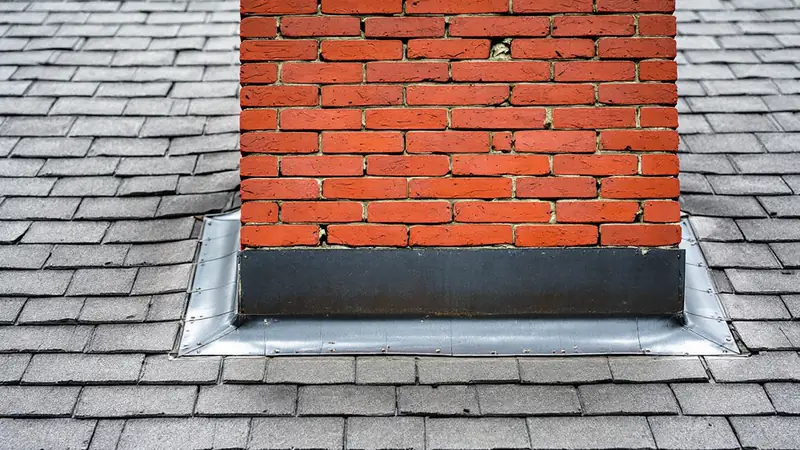
The table maps each joint of the four-part system (apron, step flashing, counter flashing, and back pan or cricket) to the product family that belongs there, with the ASTM C920 rating where one applies. Full build sequence and dimensions are in our chimney flashing installation guide.
| Joint on the chimney | Seal it? | Product family | Why |
|---|---|---|---|
| Top edge of counter flashing in the mortar reglet | Yes, always | Gun-grade ASTM C920 sealant rated Use M (masonry) and Use A (aluminum) | This is the only joint where sealant is the primary water barrier; IKO says to “seal the indent with roofing caulking” |
| Top edge of surface-mounted counter flashing (siding or stucco chimneys) | Yes | Gun-grade polyurethane or tripolymer | Water runs down the wall face and into an open top edge |
| Bottom edge of counter flashing where it laps over step flashing | No | None | Step flashing is nailed to the deck and counter flashing is set in the masonry so the two can move separately; IKO notes deck-only nailing keeps “differential movement” from breaking the flashing |
| Step flashing under each shingle course | No, unless the shingle maker says so | None | Each piece laps the one below; IRC R903.2.1 sets a metal thickness for flashing and never mentions sealant |
| Apron and back-pan corner overlaps | A dab at the lap | Gun-grade sealant | IKO tells installers to “apply your sealant where the flashing will overlap” at corners |
| Exposed nail heads on the apron | Yes | Gun-grade sealant | Covers a penetration the shingles do not |
| Old flashing that has been tarred, retarred or cracked | Yes, as a stopgap | Brush-on elastomeric with reinforcement fabric | The SaverSystems data sheets name this exact use |
| Chimney crown (the top slab) | Different product | Crown coating, not flashing sealant | See our chimney waterproofing guide for crown and repellent products |
Chimney flashing sealants compared from maker data sheets
Nine products show up for “chimney flashing sealant” at Home Depot, Lowe’s, Amazon and chimney-supply stores. They fall into three families: gun-grade elastomeric sealants classified under ASTM C920 (the standard that assigns a movement Class and Use letters such as M for masonry and A for aluminum), brush-on elastomeric coatings, and asphalt roof cement. The table compares what each maker actually publishes.
| Product | Chemistry and form | Standard and movement | Application temperature | Cure and paint | Source |
|---|---|---|---|---|---|
| Sikaflex NP 1 (formerly MasterSeal NP 1) | Aromatic polyurethane, 10.1 oz cartridge | ASTM C920 Type S, Grade NS, Class 35, Use NT, M, A, T, O, I; plus or minus 35%; 800% elongation (ASTM D412) | Service range minus 40°F to 180°F; store at room temperature 24 hours before cold-weather use | Skins within 24 hours; full cure about 1 week; paintable with non-rigid coatings | Sika PDS v02.05, Feb 2026 |
| Loctite PL Roof and Flashing (PL S30) | Polyurethane, 10 oz cartridge, black | ASTM C920 Type S, Grade NS, Class 35, Use NT, M, A; plus or minus 35%; 589% elongation | Apply 40°F to 100°F, best at 60°F to 90°F surface | Skin 30 minutes; cure about 7 days; paint after full cure | Loctite TDS ref. 801786 |
| Geocel 2300 Construction Tripolymer | Solvent-based tripolymer, 10.3 oz cartridge, clear or colors | Plus or minus 25% (ASTM C719, 2004 sheet); 1,062% elongation clear, 1,180% colors | Warm the cartridge below 40°F; do not apply until surfaces over 140°F cool | Tack-free 45 minutes; cure 4 days; latex paint after 24 hours | Geocel 2300 data sheet, 2015; 2004 sheet |
| Sashco Through the Roof! (cartridge) | Clear elastomeric, 10.5 oz cartridge | Conforms to ASTM C794 (adhesion in peel); no C920 class published | 0°F to 120°F surface; can go on wet surfaces and in rain | Tack-free 30 minutes; cured 1 week; latex paint after 24 hours | Sashco technical data |
| ChimneySaver FlashSeal | Water-based elastomeric resin blend, brush-on, 1 gallon | 200% elongation; 7-year warranty only with reinforcement fabric and professional application | 45°F and rising; 12 hours of dry weather | Touch-dry 30 to 60 minutes; cured 6 to 12 hours | SaverSystems data sheet, 2015 |
| Chimney RX Elastomeric Flashing Sealant | Water-based elastomeric, brush-on, 1/2 gallon, black | No elongation published; warranty covers manufacturing defects only | 45°F and rising; 12 hours of dry weather | Touch-dry 30 to 60 minutes; cured 6 to 12 hours | SaverSystems data sheet, 2015 |
| MasonryDefender Chimney Flashing Sealer | Water-based elastomeric, brush-on, 1/2 gallon | No elongation published; 5-year “intact and in place” warranty | 45°F to 95°F; no rain within 4 hours | Touch-dry 30 to 60 minutes; cured 6 to 12 hours | SaverSystems data sheet, 2019 |
| Henry 208R Rubberized Wet Patch | SBS rubber-modified asphalt roof cement, 0.90 gallon can or 10.1 oz cartridge | ASTM D4586 Type I; 100% wet-surface adhesion per ASTM D3409 | Adheres from 5°F to 120°F; works on wet surfaces | No cure time published; not for vertical faces in hot weather thicker than 1/8 in | Henry 208R label |
| Flex Seal Liquid | Liquid rubber coating, brush-on, 16 oz can | No ASTM class or elongation published | 32°F to 120°F surface | No cure time published; apply 24 hours before heavy rain | Flex Seal Liquid FAQ |
Two details change the shopping decision. The Sika NP 1 data sheet is marked “for professional use only” and notes that NP 1 is an aromatic urethane that “may discolor over time with UV exposure,” which matters on a light-colored chimney. Only two sheets in the group allow wet surfaces, Through the Roof! and Henry 208R, and of those only Through the Roof! is a clear, paintable gun-grade sealant, which is why it suits an emergency reglet patch in rain.
Best chimney flashing sealant for your situation
Pick by what is already on the chimney, not by brand. The thresholds come from each product’s published limits, such as the 40°F minimum on Loctite PL and the 45°F minimum on the brush-ons; where a data sheet is silent, the table says so.
| If your chimney flashing… | Use | Avoid | Data sheet reason |
|---|---|---|---|
| Has clean, bare reglet joints (new reflash or old sealant fully cut out) | Sikaflex NP 1 or Loctite PL Roof and Flashing | Asphalt roof cement | Both are ASTM C920 Class 35, Use M and A, rated plus or minus 35% movement |
| Is wet, or rain is coming before the bead can skin | Sashco Through the Roof! | Water-based brush-ons, which “may wash away” | Sashco rates it for wet surfaces and rain; FlashSeal needs 12 dry hours |
| Has old tar or roof cement you cannot fully remove | Geocel 2300 (asphalt compatible) or a SaverSystems brush-on with fabric | Polyurethanes | Loctite and Sika both list asphalt and tar as contaminants |
| Is prefinished steel with a Kynar (PVDF) finish | Geocel 2300 | Through the Roof! | Sashco says it “will not adhere to” Kynar; Geocel lists Kynar 500 finishes as a substrate |
| Is copper or galvanized steel | Sikaflex NP 1 with the matching Sika primer | Unprimed polyurethane | Sika says copper, galvanized and Kynar “typically require” primer |
| Has cracked step-to-brick joints across a whole face (roughly 2 to 3 ft sections) | FlashSeal or MasonryDefender, fabric-reinforced | A gun bead smeared over the crack | FlashSeal warranty is 7 years only “when used with reinforcement fabric” |
| Will be painted to match the brick | Through the Roof! or Geocel 2300 (latex paint after 24 hours) | Silicone | Sashco: “Unlike silicone, paint sticks” |
| Is below 40°F on repair day | Through the Roof! (0°F surface) or Henry 208R (5°F) | Loctite PL (40°F minimum) and brush-ons (45°F minimum) | Published application ranges |
If none of these rows fits because the flashing itself is missing, rusted or face-nailed to the brick, or a chimney wider than 30 in has no cricket, sealant is the wrong purchase. That diagnosis is covered step by step in our chimney flashing leak repair guide.
Why old tar and silicone decide which sealant will stick
Most chimneys that need sealant have been “fixed” before, usually with asphalt roof cement or silicone. That history matters more than brand. The Loctite PL Roof and Flashing data sheet lists, as limitations, fillers impregnated with “oil, asphalt, tar” and contact with “butyl caulking compounds, silicone sealants (uncured and cured).” Sika requires NP 1 substrates to be free of “asphalt, tar,” “membrane materials, and sealant residue.”
The brush-on products take the opposite position. All three SaverSystems data sheets say the coating “repairs flashings that have been tarred, retarred, or cracked,” which is why they sell next to chimney supplies rather than next to caulk, with warranties of 5 to 7 years at most. The compatibility table pulls the substrate lines from each sheet.
| Substrate already on the chimney | Sikaflex NP 1 | Loctite PL Roof and Flashing | Geocel 2300 | Through the Roof! | SaverSystems brush-ons |
|---|---|---|---|---|---|
| Old asphalt roof cement or tar | Remove first | Remove first | Listed as asphalt compatible | Adheres to “most existing roof patches” | Designed for tarred flashing |
| Old cured silicone | Remove residue | No contact, cured or uncured | Not addressed; test first | Will not adhere; use a silicone remover | Not addressed; test first |
| Kynar (PVDF) prefinished metal | Primer typically required | Not addressed; test first | Listed substrate | Will not adhere | Not addressed; test first |
| Brick and mortar | Use M, primerless on most masonry | Use M; 45 pli peel on mortar (ASTM C794) | Primerless on brick | Adheres to brick and mortar | Adheres to brick |
| Damp surface | Must be dry | Must be dry | Dew dampness “will not interfere” | Wet and rain allowed | Must be dry; no rain for 4 to 12 hours |
How to seal flashing around a chimney, step by step
There are two procedures, and they do not mix. Re-caulking the reglet is a gun-grade job on clean joints 1/4 to 1/2 in deep; coating old flashing is a brush-on job with fabric. Each step below names the measurement or cure time its data sheet sets.
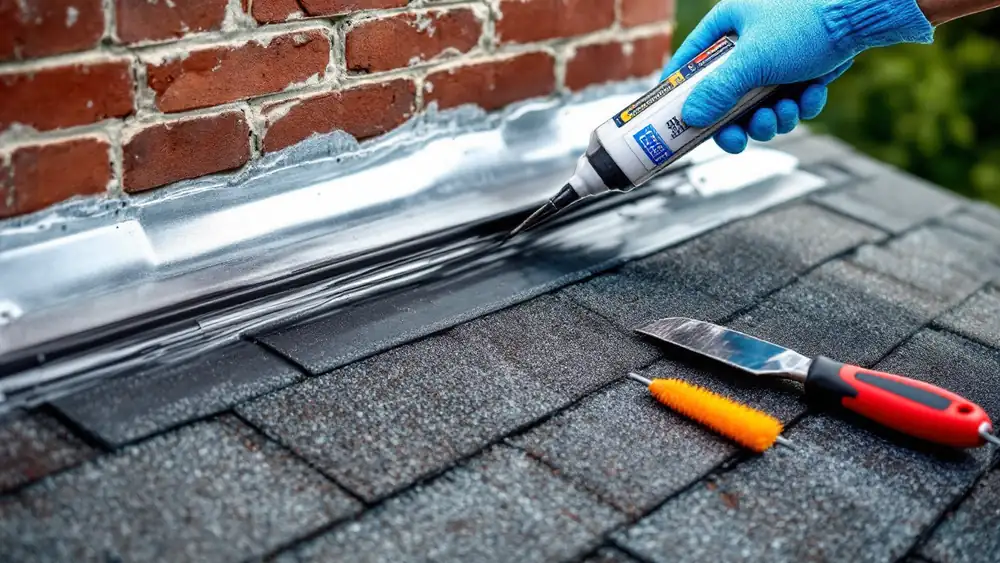
Re-caulking the counter flashing reglet with a gun-grade sealant
- Check the forecast and temperature. Loctite PL needs 40°F to 100°F; Sika says to warm NP 1 cartridges at room temperature for 24 hours in cold weather; Through the Roof! tolerates 0°F to 120°F surfaces and rain.
- Cut out every bit of old sealant. Use a utility knife or oscillating tool down to bare metal and mortar. The Sika NP 1 data sheet requires substrates free of “sealant residue,” and Sashco says to remove old silicone with a silicone remover.
- Clean the masonry and metal. The Sika data sheet specifies grinding or wire brushing masonry to a sound surface and removing scale and rust from metal to “a bright white surface.”
- Size the joint. Aim for a sealant depth about half the joint width, never under 1/4 in or over 1/2 in (Sika NP 1). Geocel caps its 2300 joint at 1/2 in wide by 3/8 in deep. If the reglet is deeper than 1/2 in, push in backer rod first, as Loctite and Sashco both direct.
- Prime where the sheet says to. Copper, galvanized steel and Kynar-coated flashing typically need a Sika primer under NP 1, and the NP 1 data sheet says priming and sealing must be done the same day.
- Gun the bead from the back of the joint. Hold the nozzle against the back of the reglet and fill toward the surface, then dry-tool it, which Sika recommends for bead shape and adhesion. A 1/4 by 1/4 in bead yields 24.3 ft per 10.1 oz cartridge of NP 1.
- Leave the bottom edge of the counter flashing open. Do not run a bead where the counter flashing laps over the step flashing; that joint is meant to move and drain, and the counter flashing should simply lap at least 2 in over the step flashing, per IKO.
- Let it cure before you test or paint. Loctite PL skins in 30 minutes and cures in about 7 days at 78°F and 50% humidity; Geocel 2300 cures in 4 days. Paint Geocel or Through the Roof! with latex after 24 hours; paint Loctite only after full cure.
Coating tarred or cracked flashing with a brush-on sealer
- Wait for 45°F and a dry 12-hour window. All three SaverSystems sheets say not to apply in cold, damp or rainy weather “or product may wash away.” MasonryDefender adds an upper limit of 95°F and no rain within 4 hours.
- Scrub the surface. Remove dust, dirt and loose debris with a stiff brush; MasonryDefender allows a stiff poly or wire brush.
- Cut the reinforcement fabric. FlashSeal’s 7-year warranty applies only with fabric and professional application; Lowe’s lists the ChimneySaver reinforcement fabric as a “6 x 150 ft” roll.
- Start on the lowest side of the chimney. Lap each piece of fabric over the one below “as you would shingles,” per the FlashSeal data sheet and work upward toward the cricket or back pan.
- Brush a first coat about 1/8 in thick. Fill every crack and hole, and run it about 1 in past the fabric edges.
- Embed the fabric, then topcoat. Press the fabric into the wet first coat with the brush and apply a liberal topcoat that covers it fully and extends about 1 in past the problem area.
- Work in 2 to 3 ft sections. The coating dries fast on hot days. Duct tape along the edges gives a clean line; pull it when you finish.
- Allow 6 to 12 hours to cure. It is dry to the touch in 30 to 60 minutes, but the sheets give 6 to 12 hours for a full cure depending on temperature and humidity.
How much chimney flashing sealant to buy: a worked example
Quantity comes from the length of the reglet, not the size of the chimney face. The example below is a Roofing Brief estimate using each maker’s published yield; swap in your own chimney dimensions.
| Step | Input | Result |
|---|---|---|
| Chimney size | 30 in wide (parallel to the ridge) by 20 in deep, on a 6:12 roof | Not over 30 in wide, so IRC R1003.20 does not require a cricket |
| Side run along the slope | 20 in x 1.118 (6:12 slope factor) | 22.4 in per side |
| Total reglet run | 30 + 30 + 22.4 + 22.4 in | 104.7 in, or 8.7 linear ft |
| Allowance for stepped reglet cuts and tooling waste (Roofing Brief assumption) | 8.7 ft x 1.25 | 10.9 linear ft |
| Sikaflex NP 1, 1/4 by 1/4 in bead | 308 linear ft per gallon; 10.1 oz cartridge = 24.3 ft | 1 cartridge (about 45% used) |
| Sikaflex NP 1, 1/2 in wide by 1/4 in deep bead | 154 linear ft per gallon; 12.2 ft per cartridge | 1 cartridge at 90%, so buy 2 |
| Loctite PL Roof and Flashing, 1/4 in bead | 30.9 ft per 10 oz cartridge | 1 cartridge |
| Geocel 2300, 1/4 by 1/4 in | 24.8 ft per 10.3 oz cartridge | 1 cartridge |
| FlashSeal with fabric | 28 linear ft per gallon | 0.39 gallon, so one 1-gallon can |
| MasonryDefender, 8 in wide band (Roofing Brief assumption: 6 in over the joint plus 1 in each side) | 14 sq ft per 1/2 gallon (2 coats); 10.9 ft x 0.67 ft = 7.3 sq ft | About 52% of one 1/2 gallon container |
The 25% allowance is an editorial assumption, not a maker figure. A stepped side reglet adds short vertical cuts at each brick course, so a chimney with tall exposed sides can need more than the slope length suggests.
What chimney flashing sealant costs at Home Depot, Lowe’s and chimney suppliers
Prices below are single-unit listings seen in Google Shopping results on October 29, 2026; they change often and may differ by store and region. The cost-per-foot column is Roofing Brief arithmetic: listed price divided by the maker’s published yield at a 1/4 in bead or an 8 in brush-on band.
| Product | Retailer and size | Listed price (Oct 2026) | Published yield | Cost per linear ft |
|---|---|---|---|---|
| Loctite PL Roof and Flashing | Home Depot, 10 oz | $8.98 | 30.9 ft | $0.29 |
| Sikaflex NP 1 | Lowe’s, 10.1 oz | $9.98 | 24.3 ft | $0.41 |
| Sashco Through the Roof! | Lowe’s, 10.5 oz | $13.48 | 30 ft | $0.45 |
| Geocel 2300 | Lowe’s, 10.3 oz | $20.28 | 24.8 ft | $0.82 |
| MasonryDefender Chimney Flashing Sealer | Lowe’s, 1/2 gallon | $49.32 | 14 sq ft, about 21 ft of 8 in band | $2.35 |
| Chimney RX Elastomeric Flashing Sealant | chimneyrx.com, 1/2 gallon (sold out when checked) | $56.12 | 14 sq ft, about 21 ft of 8 in band | $2.67 |
| ChimneySaver FlashSeal | Cheap Chimney and Lowe’s, 1 gallon | $94.99 to $129.36 | 28 linear ft | $3.39 to $4.62, plus fabric |
| Henry 208R Rubberized Wet Patch | Home Depot, 0.90 gallon | $27.97 | 12.5 sq ft per gallon at 1/8 in | Not comparable |
| Flex Seal Liquid | Walmart, 16 oz | $25.95 | No yield published | Not computable |
For the 30 by 20 in example chimney, the materials gap is about $9 for one cartridge of Loctite PL versus $95 to $129 for a gallon of FlashSeal before fabric. Labor, roof access and any reflashing dominate the real bill; see our chimney flashing replacement cost breakdown for contractor pricing.
Will Flex Seal work on chimney flashing?
Flex Seal can coat chimney flashing, but its maker does not position it as a permanent flashing repair. The Flex Seal roof-leak page says its products suit “temporary or quick fixes” and are “not a permanent fix for significant structural damage or full-roof repairs.” The Flex Seal Liquid FAQ gives a 32°F to 120°F application range but publishes no ASTM movement class, elongation or cure time.
The bigger cost comes later. A rubber film over the reglet is exactly the “membrane materials, and sealant residue” that the Sika NP 1 data sheet says must be removed before NP 1 will bond, so a roofer reflashing or re-caulking that chimney has to strip the coating first. If you need a same-day stopgap in wet weather, Through the Roof! carries a published wet-application rating and stays paintable.
Does chimney flashing need sealant?
Yes, but only at the counter flashing’s top edge and a few laps. The residential code text never mentions sealant: IRC R903.2.1 requires flashing “around roof openings” and, where the flashing is metal, corrosion-resistant sheet at least 0.019 inch thick, and IRC R1003.20 requires the cricket-to-chimney intersection to be “flashed and counter-flashed in the same manner as normal roof-chimney intersections.”
Sealant enters where the counter flashing meets the masonry. IKO’s guide tells installers to tuck counter flashing into a ground reglet, lap it at least 2 in over the base flashing and “seal the indent with roofing caulking.” A chimney where the only seal is a bead of caulk between the step flashing and the brick has no counter flashing at all, and no sealant fixes that.
When sealant is the wrong fix
A bead or a coating buys time only when the metal underneath is sound. Use these thresholds, from the 1/2 in maximum reglet depth to the 30 in cricket rule, to decide whether to buy sealant or call for a reflash.
| When you see… | Sealant alone? | What it needs instead | Reference |
|---|---|---|---|
| Step flashing turned up the brick with caulk on top and no counter flashing | No | Reglet cut and new counter flashing | Counter flashing guide |
| Reglet gap deeper than 1/2 in or mortar crumbling at the groove | No | Repoint or regrind the reglet, then seal | Sika NP 1 maximum depth 1/2 in |
| Chimney wider than 30 in with no cricket on the uphill side | No | Add a cricket sized by Table R1003.20 | IRC R1003.20; roofing cricket guide |
| Rusted-through or slipped step flashing | No | Replace the step flashing course by course | Bad chimney flashing signs |
| Dried, cracked or pulled-away bead at an intact reglet | Yes | Cut out and re-caulk with a Class 35 sealant | Steps above |
| Hairline cracks in old tarred flashing, metal still intact | Yes, as a stopgap | Brush-on with fabric | FlashSeal data sheet |
Frequently asked questions
What is the best sealant for flashing around a chimney?
For the counter flashing reglet, a gun-grade polyurethane rated ASTM C920 Class 35 with Use M and A, such as Sikaflex NP 1 or Loctite PL Roof and Flashing, both rated for plus or minus 35% movement. Over old tar, Geocel 2300 is listed as asphalt compatible. For cracked, previously tarred flashing, a fabric-reinforced brush-on such as ChimneySaver FlashSeal carries a 7-year warranty when the fabric is used.
How do you seal flashing around a chimney?
Cut out all old sealant, wire-brush the mortar and metal, and size the joint so the sealant depth is about half the width, between 1/4 and 1/2 inch. Prime copper or galvanized flashing if the sealant maker requires it, gun the bead into the reglet from the back, and dry-tool it. Leave the counter flashing bottom edge unsealed and allow 4 to 7 days of cure.
Will Flex Seal work on chimney flashing?
Flex Seal can coat chimney flashing as a short-term patch, but its maker describes its products as suited to temporary or quick fixes, not a permanent fix. Flex Seal Liquid lists a 32 to 120 degree F application range and no ASTM movement class. Polyurethanes such as Sikaflex NP 1 will not bond over the leftover rubber film, so it must be stripped before a proper repair.
Does flashing need sealant?
Chimney flashing is the barrier; sealant is the backup. IRC R903.2.1 requires flashing around roof openings, and metal flashing must be corrosion-resistant and at least 0.019 inch thick. Sealant is required only where the counter flashing tucks into the mortar reglet, plus dabs at corner laps and exposed nail heads. Step flashing under the shingles and the counter flashing bottom edge should not be glued together, because the two parts are meant to move separately.
What do roofers use to seal chimney flashing?
Roofers typically bed the counter flashing in a ground reglet and seal it with a gun-grade elastomeric sealant. Sikaflex NP 1 and Loctite PL Roof and Flashing are ASTM C920 Class 35 polyurethanes; Geocel 2300 is a tripolymer that bonds to brick, asphalt shingles and Kynar-coated steel. IKO also describes securing counter flashing with roofing cement and sealing the indent with roofing caulk.
Can you use silicone on chimney flashing?
Silicone can seal a reglet, but it creates problems for the next repair. Loctite says its roof and flashing polyurethane must not contact silicone sealants, cured or uncured, and Sashco says Through the Roof will not adhere to silicone and must have old silicone removed with a silicone remover. Sashco also notes paint does not stick to silicone, while Through the Roof takes latex paint after 24 hours.
How long does chimney flashing sealant last?
Makers publish warranties, not service lives. FlashSeal is warranted to stay intact for 7 years when used with reinforcement fabric and applied by a professional contractor, MasonryDefender for 5 years, and Through the Roof carries a limited lifetime warranty. Sika warrants NP 1 product for one year, and Henry replaces defective 208R within 12 months. Exposed beads on a sunny face should be checked every year.
Can I buy chimney flashing sealant at Home Depot or Lowe’s?
Yes. In October 2026 listings, Home Depot sold Loctite PL Roof and Flashing for $8.98 per 10 oz cartridge and Henry 208R for $27.97 per 0.90 gallon, while Lowe’s listed Sikaflex NP 1 at $9.98, Through the Roof at $13.48, MasonryDefender Chimney Flashing Sealer at $49.32 per half gallon and ChimneySaver FlashSeal at $129.36 per gallon. Prices change by store.
Related reading: chimney flashing kits and sizing and best roofing caulk by job.