
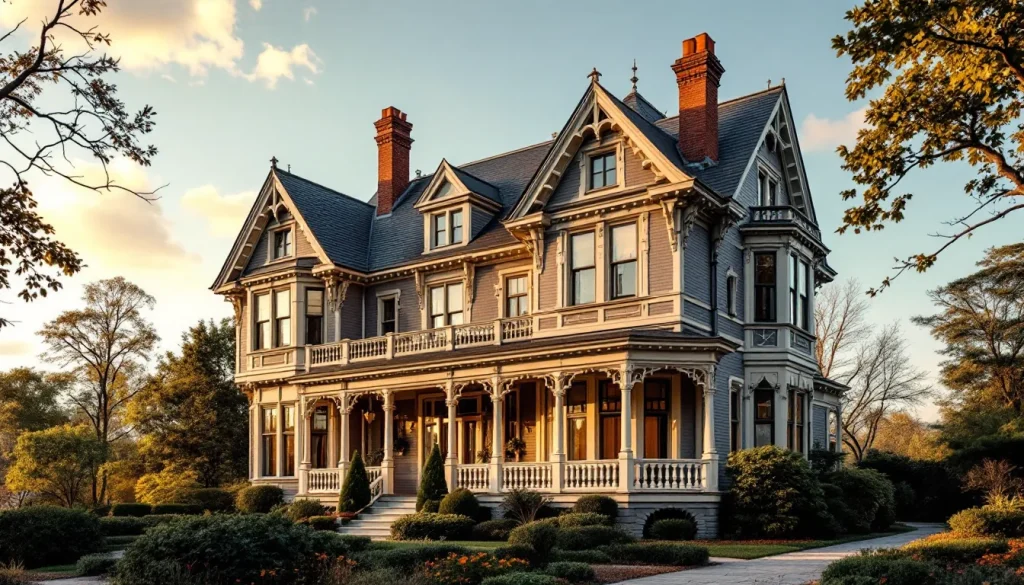
A mansard roof is the four-sided, double-pitched style invented by 17th-century French architect Francois Mansart and revived in the Napoleon III era as the dominant residential roof in French Second Empire architecture. In 2026, a mansard roof costs 25 to 60 percent more than a comparable gable installation but adds usable attic floor space and a premium architectural signature that almost no other style delivers. Here is when the math makes sense, what the install actually entails, and what owners should expect over the 30 to 50 year service life of the roof.
The short version
- Mansard roofs have four sides with two pitches each: a steep lower slope (often 70 degrees or more) and a nearly flat upper slope (often 10 degrees or less).
- 2026 installed cost runs $14 to $28 per square foot for asphalt, $22 to $45 for metal, and $35 to $80 for slate or copper.
- The full-height attic conversion is the real reason mansards exist: you get an entire usable floor without zoning your house as three stories.
- Wind performance is mixed: the steep lower slope sheds wind well, but the flat upper deck is vulnerable to uplift and ponding.
- Best modern applications: French-influenced custom homes, boutique hotels, urban infill where extra floor area is taxed differently than added stories.
- Insurance premiums often run 10 to 30 percent higher than for a hip or gable roof of the same square footage.
The Short Answer: What Mansard Means + 2026 Cost
A mansard roof has four sloped sides, and each side has two different pitches. The bottom pitch is steep, often vertical or near-vertical at 70 to 80 degrees. The top pitch is shallow, sometimes only 5 to 15 degrees, and is barely visible from the street. The shape is what allows a builder to put a true usable floor inside what would otherwise be attic space. It is the answer to a structural problem: how do you get a fourth story of usable space without the building code (or the historic tax assessment) calling it a fourth story.
In 2026, expect a turnkey mansard roof on a 2,500 square foot home to run $48,000 to $135,000 installed. The wide spread is real. A simple straight mansard with asphalt shingles on the lower slope and a TPO membrane on the upper deck can come in near the bottom. A copper-clad concave mansard with custom dormers and slate accents can blow past the top.
The Architecture: Steep Lower Slope + Nearly Flat Upper Slope
The defining feature of any mansard roof is the two-pitch geometry on each of the four sides. The lower pitch carries the visual weight of the building and contains the dormers. The upper pitch is functionally a low-slope or flat roof, hidden behind the steep lower face and the parapet edge where the two pitches meet. From the street, you mostly see the steep lower slope, which is why most mansard roofs look almost like a vertical wall punched with dormer windows.
The geometry creates two construction challenges. The first is the kick where the two pitches meet, which becomes the most flashing-intensive joint on the entire building. The second is the low-slope upper section, which behaves like a flat roof and needs to be detailed as one (membrane, tapered insulation, internal drains or scuppers).
History: From Francois Mansart to Second Empire
Francois Mansart (1598 to 1666) did not invent the double-pitched roof, but he was the first architect to use it as a defining feature of a building rather than a structural workaround. His work at the Chateau de Maisons (1642) and on additions to the Louvre established the form as a signature of high French architecture.
The style went global during the Second Empire under Napoleon III (1852 to 1870), when Baron Haussmann’s renovation of Paris standardized the mansard roof across thousands of new apartment buildings. The economic logic was clear: Parisian property taxes were based on building height measured to the eaves, not to the ridge. A mansard roof let you build a full additional floor and pay tax on it as roof space rather than as a story.
The Second Empire style crossed the Atlantic in the 1860s and became dominant in American urban architecture from 1865 to 1885. Boston, Philadelphia, and Washington D.C. have entire neighborhoods of brownstones and row houses with mansard roofs from this era. Many of these are now in National Register historic districts, which means restoration work has to match original materials and detailing under National Park Service guidelines.
The Attic-Conversion Advantage
The structural reason a mansard exists is to convert what would be unusable attic space into a full-height occupied floor. On a steep gable roof, the usable floor area inside the attic is limited by the headroom rule: most building codes require 7 feet of clear height over 50 percent of the floor area for the space to be counted as habitable.
A mansard delivers that headroom across nearly the entire footprint. The vertical lower slope creates straight side walls inside the attic. The dormers (which are almost always part of the mansard design) bring in light and bring up the ceiling at the edges. The result is that a 2,000 square foot ground floor under a mansard roof can yield 1,700 to 1,900 square feet of usable attic floor, where the same footprint under a gable would yield 600 to 1,000.
That extra floor is the economic argument for the mansard. At a 2026 build cost of $250 per square foot in most metros, an extra 800 usable square feet is worth roughly $200,000 in finished value, and the mansard premium over a gable is rarely more than $40,000 to $80,000. The math is why the style refuses to die.
Variants: Straight, Convex, Concave, S-Curved
There are four standard mansard profiles, and the choice affects both the cost and the building’s character.
| Variant | Lower slope shape | Cost premium vs straight mansard | Best application |
|---|---|---|---|
| Straight | Flat planar surface, 70 to 80 degrees | baseline | Most residential, easiest to roof |
| Convex | Bowed outward (bell shape) | +20 to 35% | Victorian and ornate revivalist |
| Concave | Bowed inward (curved like a flare) | +25 to 40% | French Second Empire signature |
| S-curved | Concave at top, convex at bottom | +40 to 70% | High-end custom, rare in new build |
Straight is by far the most common. Convex and concave require either curved sheathing or custom-bent metal panels, both of which are labor-intensive. S-curved roofs are almost exclusively found on historic restorations.
Cost Per Square Foot in 2026
Mansard pricing in 2026 reflects three cost drivers that gable and hip roofs do not have: more square footage of roof per square foot of floor area (because the lower slope is so steep), more flashing detail at the kick line, and the need to detail the upper deck as a low-slope roof.
| Roof type | Installed cost per square foot (2026) | Cost premium vs gable | Typical service life |
|---|---|---|---|
| Gable, asphalt shingles | $5.50 to $9.00 | baseline | 20 to 30 years |
| Hip, asphalt shingles | $6.50 to $10.50 | +10 to 20% | 20 to 30 years |
| Mansard, asphalt + low-slope membrane | $14.00 to $20.00 | +50 to 90% | 25 to 35 years |
| Mansard, slate + EPDM | $45.00 to $80.00 | +400 to 700% | 75 to 100 years |
| Mansard, standing seam metal | $22.00 to $35.00 | +150 to 240% | 50 to 70 years |
| Mansard, copper | $50.00 to $90.00 | +450 to 800% | 100+ years |
The cost premium is real, and any contractor who quotes a mansard at gable pricing is either missing scope or planning to subcontract the upper deck to a separate flat-roof crew without telling you. For a deeper look at residential pricing structure across all styles, see how much does a new roof cost.
Material Best-Pairings
The mansard’s geometry rewards certain materials and punishes others. The steep lower slope behaves like a steep gable for water-shedding purposes, but the upper deck has to be waterproofed like a flat roof. That means almost every mansard is a two-material system.
| Lower slope material | Upper deck pairing | 2026 cost per sq ft | Notes |
|---|---|---|---|
| Asphalt architectural shingles | TPO or EPDM membrane | $14 to $20 | Most common, easiest service |
| Slate | EPDM or built-up bitumen | $45 to $80 | Historic and high-end custom |
| Standing seam metal | Standing seam carried over | $22 to $35 | Best for snow climates |
| Wood shake (cedar) | EPDM with stone ballast | $20 to $30 | Restoration only, fire concerns |
| Copper | Copper carried over | $50 to $90 | Civic and luxury custom |
| Synthetic slate (composite) | TPO | $18 to $28 | Slate look without weight |
The two-material seam at the kick is where most mansards leak. Whatever the materials, the flashing at that joint should be a full step-and-counter detail with a separate underlayment lapped 12 inches in each direction. See roof flashing for the geometry of the detail.
Wind Performance: The Steep-Pitch Tradeoff
Steep slopes shed wind better than low slopes because the wind pressure is mostly compressive against a steep slope and mostly upward (uplift) against a low slope. The lower section of a mansard, at 70 degrees or steeper, is one of the best-performing geometries against horizontal wind loads. ASTM D7158 wind ratings for shingles on a mansard lower slope can hit Class H (190 mph design wind) more readily than the same shingle on a gable.
The upper deck is the weakness. At 10 to 15 degrees of slope, the upper section of a mansard sees the same uplift forces as any low-slope roof. Florida Building Code 1626 requires that any low-slope section in a high-velocity hurricane zone be designed and tested for the full design wind pressure, and the same membrane attachment standards (mechanical fastener spacing, perimeter bar attachment, corner enhancement) that apply to flat commercial roofs apply to the mansard upper deck.
Net effect: a mansard in a hurricane zone is buildable but expensive. The upper deck adds 15 to 25 percent to total roof cost just for the wind-rated membrane system.
Snow Load Considerations
Snow loading is a real issue on the mansard upper deck. The steep lower slope sheds snow rapidly. The upper deck does not, and it tends to accumulate the snow that the lower slope dumped before it (in the form of drift). Drift loads on the upper deck of a mansard can run 1.5 to 2.5 times the ground snow load specified in ASCE 7-22.
The practical implication: in any climate with a 40 psf or higher ground snow load (most of New England, the Great Lakes, and the Rocky Mountain interior), the upper deck framing has to be sized as a flat roof, not as a roof section that gets the snow-shedding credit of the steep slope below it. Most mansards in these climates use a steeper upper deck (15 to 25 degrees) to help shed accumulated snow.
Dormer Integration: Almost Always Part of the Design
Almost every mansard roof has dormers in the lower slope. The reason is functional, not aesthetic: without dormers, the rooms inside the converted attic have no windows and very low light. The standard mansard dormer is a small gable-roofed projection set into the steep lower slope.
Dormer count and detailing is the single largest cost variable for a mansard roof. A simple straight mansard with four dormers (one per face) on a 2,500 square foot home might add $8,000 to $15,000 to total cost. A heavily dormered mansard with 12 to 16 dormers can add $40,000 to $90,000.
The most leak-prone joint on the entire building is the dormer-to-mansard wall flashing. Every dormer adds four critical flashings (head, two sides, sill if a window). Sloppy work here is the single most common reason a mansard roof fails before its expected service life.
Modern Mansard: Where It Is Being Built in 2026
The mansard roof did not die with the Second Empire. In 2026, it shows up in five specific market segments.
Boutique hospitality. Hotel developers love the mansard for the floor-area math discussed above. Marriott’s Tribute Portfolio and several Hyatt boutique brands specify mansard or mansard-influenced massing for new urban infill properties because the extra floor of guest rooms more than pays for the roof premium.
French-influenced custom residential. The roof is the signature of a certain residential style: French country, French Provincial, and the urban French townhouse. Builders specializing in this segment (mostly in metros with strong French architectural traditions: New Orleans, Quebec adjacent New England, the Hudson Valley) build new mansards every year.
Urban infill with floor-area incentives. A few American cities still have building codes that count mansard floors as attic space rather than as a story for purposes of FAR (floor area ratio) calculations. This is a tax-advantaged design move in those jurisdictions.
Historic district reconstruction. Any building destroyed by fire or storm in a Second Empire historic district has to be rebuilt with a mansard under the historic preservation rules. Boston, Philadelphia, and Washington D.C. all have active reconstruction work that draws on traditional mansard detailing.
Civic and institutional. Courthouses, libraries, and college buildings still get mansards as a visual gesture toward institutional permanence.
Mansard vs Gambrel: The Quick Comparison
The mansard and the gambrel are both double-pitched roofs that maximize attic space, and they get confused constantly. The difference is geometric: a mansard has four sides (slopes on all four exterior walls), while a gambrel has two (slopes on two sides, vertical gable ends on the other two).
| Feature | Mansard | Gambrel |
|---|---|---|
| Number of sloped sides | 4 | 2 |
| End walls | Sloped (no gable) | Vertical gable |
| Cost premium vs gable | +50 to 90% | +10 to 25% |
| Architectural origin | French (17th century) | Dutch Colonial |
| Common modern application | Urban/civic | Farmhouse/barn revival |
| Attic floor area gained | 85 to 95% of footprint | 75 to 85% of footprint |
If you have walked through a Dutch Colonial home and seen the classic shape of the Brooklyn brownstone era barn, you are looking at a gambrel. If you have walked through a Boston Back Bay townhouse with dormers all around, that is a mansard. The full breakdown of the barn-style cousin is at gambrel roof.
Mansard Roof Insurance Considerations
Homeowner insurance carriers price mansard roofs 10 to 30 percent higher than equivalent gable or hip roofs for two reasons. First, the replacement cost is materially higher, so the insured value goes up. Second, the kick joint and dormer flashings are claim-prone, so loss frequency goes up.
In hurricane states, the insurance picture is more complicated. Florida and the Gulf states give wind mitigation credits for hip roofs but not for mansards. A homeowner with a mansard in Florida will not get the hip-roof credit on their wind premium, which can be a $400 to $1,200 annual penalty compared to a hip roof of the same square footage. See best roof for hurricane for the mitigation credit structure in detail.
Maintenance Realities
A mansard roof has more maintenance points than any other residential style. The annual maintenance items are: inspect the kick line flashing on every face (4 inspections), inspect every dormer’s four flashings, inspect the upper deck membrane for ponding or punctures, clear the internal scuppers or drains, and check the soffit ventilation behind the dormers.
Realistic annual maintenance budget: $500 to $1,200 for a single-family mansard, $1,500 to $4,000 for a larger building or one with heavy dormer counts. This is two to four times the maintenance cost of an equivalent gable.
The good news: when properly built and maintained, a mansard roof lasts a long time. The slate-and-copper mansards on Beacon Hill in Boston are 130+ years old and still original. A modern asphalt-and-membrane mansard, well-detailed, should hit 30 to 40 years. For comparable life expectancy across all styles, see how long does a roof last.
Should You Buy a Mansard-Roofed Home?
If you are looking at a home with a mansard roof, the buying decision turns on three questions.
Age of the roof. A mansard installed in the last 10 years and well-detailed is a fine purchase. A mansard that is 25+ years old, especially with asphalt shingles on the lower slope, is likely to need significant work within five years. Budget $30,000 to $80,000 for the replacement and price the home accordingly.
Quality of the original detailing. Hire a roof consultant (not just a general home inspector) to look at the kick joints, dormer flashings, and upper deck. A bad mansard can have $50,000 of latent leaks behind perfectly clean ceilings.
Insurance availability. In some Florida and Gulf state markets, mansards are now actively penalized by carriers. Confirm you can get a policy at a reasonable rate before you commit. For the contractor side of the inspection question, see how to choose a roofing contractor.
FAQs
What is the main advantage of a mansard roof?
The full-height usable attic floor. A mansard converts what would be unusable attic space into a true habitable floor, adding 700 to 1,200 square feet of usable living area to a typical 2,500 square foot home footprint.
How much does a mansard roof cost in 2026?
For a 2,500 square foot home, expect $48,000 to $135,000 installed depending on materials. Asphalt-and-membrane systems are at the low end. Slate-and-copper systems are at the high end.
Are mansard roofs still allowed in new construction?
Yes, in almost every U.S. jurisdiction. Some local zoning codes treat the mansard floor as a partial story for height calculations, but the roof type itself is universally permitted under the IRC.
Do mansard roofs hold up in hurricanes?
The steep lower slope performs well. The low-slope upper deck is the weakness and has to be detailed to Florida Building Code 1626 standards in any HVHZ county. A properly built mansard can pass wind code, but it costs more to do so than a hip roof of the same footprint.
Why are mansard roofs more expensive?
Three reasons: more roof surface area per floor area (because of the steep lower pitch), more flashing detail at the kick joint, and the upper deck has to be built as a low-slope membrane system. Net premium runs 25 to 60 percent over a comparable gable.
How long does a mansard roof last?
Asphalt-and-membrane mansards last 25 to 35 years with normal maintenance. Slate mansards last 75 to 100 years. Copper mansards last 100 years plus. The kick joint flashing and dormer flashings are the limiting factors, not the field material.
Can I add a mansard to an existing gable roof?
It is possible but rare. The framing has to be substantially rebuilt: new exterior walls extended up to the kick line, new floor framing for the converted attic, new dormers. The cost typically equals or exceeds new construction of the upper floor in conventional framing. Most owners who want extra space build a dormer or add a conventional story rather than converting to mansard.
Do mansard roofs need special ventilation?
Yes. The attic floor inside a mansard is conditioned space, not vented attic. The roof assembly itself has to be ventilated either with a continuous soffit-to-ridge path behind the lower slope or as an unvented assembly with continuous insulation per IRC R806. Most modern mansards are unvented assemblies because the geometry makes continuous ventilation difficult. See attic ventilation for the assembly options.