
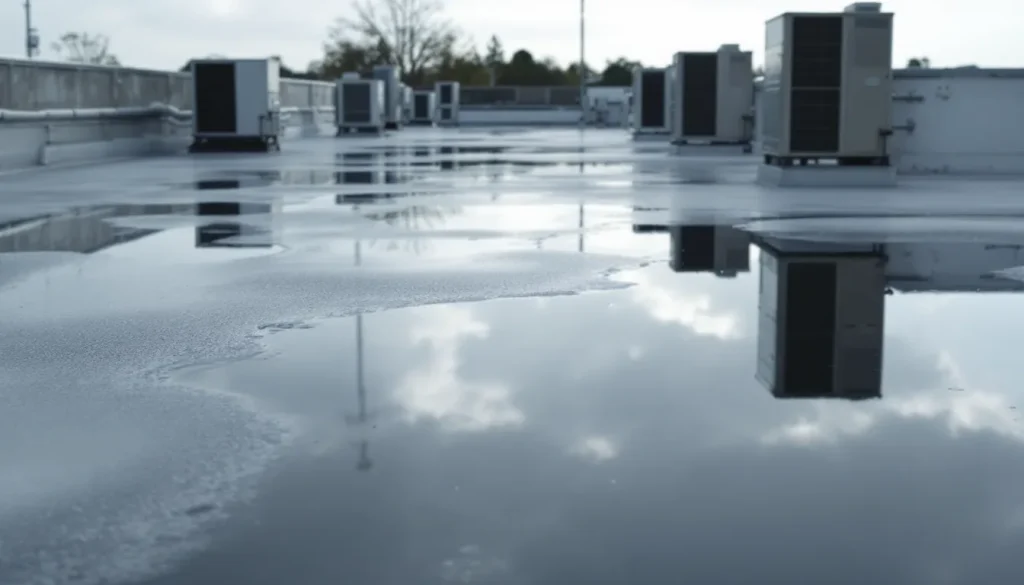
Ponding water on a flat roof in 2026 is defined by the NRCA as standing water that remains 48 hours after rain stops. The fix is tapered insulation, additional roof drains, or relocating existing drains, with cost ranging from $1,500 for a small drain addition to $14,000 plus for full tapered insulation retrofit on a 4,000 square foot roof. Ponding voids most major flat roof warranties (GAF, Carlisle, Firestone, Sika, Versico all exclude it), accelerates membrane failure by 50 to 70 percent based on NRCA membrane studies, and is the single largest cause of premature failure on TPO and EPDM systems. If your insurance carrier or warranty inspector documents ponding water and you do not act on it, you will likely lose coverage on the next claim.
The short version
- The 48 hour rule is the NRCA standard. Any standing water after 48 hours of dry weather counts as ponding, full stop.
- Ponding voids warranty coverage on essentially every major single ply system. GAF, Carlisle SynTec, Firestone (now Holcim), Sika Sarnafil, and Versico all carve it out.
- The three root causes are insufficient slope at design (less than 1/4 inch per foot), structural deflection that develops over time, and clogged or undersized drains.
- Tapered polyiso insulation is the permanent fix. Adding drains or crickets is the patch fix.
- Cost ranges from $1,500 for a single drain addition to $14,000 plus for full tapered retrofit on a 4,000 square foot roof.
- Silicone coatings are the only flat roof material with manufacturer endorsement for ponding water tolerance.
Short answer: the NRCA 48 hour standard
The National Roofing Contractors Association defines ponding water as water that remains on the roof surface 48 hours after the end of a rain event under conditions conducive to drying. This is the standard cited in essentially every commercial roofing warranty as the trigger for exclusion. It is not a code requirement (the International Building Code does not define ponding) but it is the de facto industry threshold.
Why 48 hours? Because the NRCA technical committee found that membrane degradation accelerates measurably once standing water sits longer than 48 hours, especially in heat. TPO and EPDM both exhibit accelerated UV degradation when wet, plasticizer migration on PVC roofs accelerates, and biological growth (algae, fungi) begins to colonize the surface within 72 to 96 hours.
The fix path is straightforward in concept. Find the low spots. Decide if the cause is design, deflection, or drainage. Then choose between tapered insulation (permanent fix), additional drains (patch), or a ponding tolerant coating (interim).
Why ponding voids most flat roof warranties
The major flat roof manufacturers all carve ponding out of their warranties because they have decades of claim data showing it causes premature failure. The specific language varies but the substance is identical. GAF’s EverGuard 20 year warranty excludes “damage caused by ponding water.” Carlisle SynTec’s Sure Weld TPO warranty excludes “deterioration caused by ponding water.” Firestone (now Holcim) RubberGard EPDM warranty excludes ponding. Sika Sarnafil PVC warranty excludes it. Versico VersiWeld TPO warranty excludes it.
What this means in practice. If you file a claim for membrane failure and the manufacturer’s inspector documents ponding on the roof during the site visit, the claim is denied. This includes minor 1/4 inch deep birdbath areas. The carriers are aggressive about this because ponding visibly shortens membrane life and they have decades of internal data to back the exclusion.
One useful nuance. Some carriers (Carlisle, Sika) offer a “ponding water waiver” upgrade for an additional premium, typically $0.04 to $0.08 per square foot of roof area added to the system cost. The waiver does not cover unlimited ponding but does cover ponding up to a stated depth and area. This is worth asking about during a new roof bid.
Three root causes
Ponding has three root causes that often combine. Insufficient slope at original design is the most common on roofs built before 2010, when 1/8 inch per foot was sometimes accepted as adequate. Modern IBC and IRC requirements call for minimum 1/4 inch per foot positive slope to drains. A 1/8 inch slope often produces ponding even when everything else works correctly.
Structural deflection is the second cause and shows up as ponding in the middle of bays away from drains. Steel joists, wood trusses, and concrete slabs all deflect under sustained load. As insulation gets heavier (or wetter), or as the roof accumulates HVAC and solar additions, deflection increases. A roof that drained properly in 1995 may pond in 2026 simply because the joists have sagged 1/2 inch over 30 years.
Clogged or undersized drains are the third cause. A roof designed for 4 inch drains on a 1995 rainfall intensity may pond during 2026 storms that exceed design intensity by 20 to 40 percent. Clogged scuppers and drains compound the problem. Every inspection should include a drain flow test and a leaf and debris removal.
Tapered insulation as the permanent fix
Tapered polyiso insulation is the permanent solution to ponding caused by insufficient slope. Tapered panels are factory cut to a fixed slope (typically 1/4 inch per foot or 1/2 inch per foot) and laid out across the roof in a planned pattern that directs water to drains. A tapered system can be installed under a new membrane (full tear off plus tapered) or over an existing membrane (recover with tapered, less common).
Cost for tapered polyiso runs $2.50 to $5.50 per square foot installed, depending on average thickness, complexity, and region. A 4,000 square foot roof with full tapered retrofit and new membrane runs $10,000 to $22,000 just for the tapered system and membrane, before any other work. This is the expensive option, but it is also the only fix that fully eliminates ponding rather than mitigating it.
Tapered insulation also improves the thermal performance of the roof, which is a useful side benefit. A 1.5 inch average tapered polyiso layer adds R 8 to R 10 to the assembly. On a commercial building, this can pay back the upgrade portion in HVAC savings within 6 to 10 years depending on climate zone.
Drain additions and crickets
Adding a drain or relocating an existing drain is the patch fix. A new internal drain through the deck and ceiling runs $1,500 to $4,000 installed including plumbing tie in. An additional scupper through the parapet runs $800 to $2,500. A cricket (a sloped insulation buildup behind a curb or wall to divert water around it) runs $400 to $1,500.
Drains and crickets are the right fix when ponding is localized to one or two specific spots, the cause is identifiable (a drain too far from the actual low point, a curb that blocks flow), and the budget does not support full tapered retrofit. They are not the right fix when ponding covers most of the roof, when slope is fundamentally inadequate (under 1/8 inch per foot), or when the existing membrane is at the end of its service life and will need replacement anyway.
How to identify low spots manually
You do not need fancy equipment to find ponding areas. After a rain event, walk the roof at 48 hours and mark every standing water area with chalk or a marker on the membrane. Use a straight edge (a 6 foot level works) to measure depth at each spot. Note the distance to the nearest drain and whether the drain has flow blockage.
For roofs already dry, look for residue rings. Ponding leaves a visible mineral deposit ring at the perimeter of each pond, often grayish or whitish on a white TPO surface. These rings persist between rain events and let you map ponding areas on a dry day. Note any biological growth (black algae, green moss) which is a strong indicator of long term standing water.
Document every spot with photos and a sketch tied to a drain and parapet reference. This documentation is what you give your contractor for a fix bid and what you save in case of a future warranty dispute.
Insurance implications
Commercial property insurance carriers (Travelers, FM Global, Chubb, Liberty Mutual) routinely inspect flat roofs as part of underwriting and renewal. FM Global in particular publishes detailed flat roof guidance and explicitly flags ponding as a hazard during their site visits. If their inspector documents ponding and you do not act, you can see premium increases of 15 to 30 percent at renewal, coverage limitations on the roof, or in extreme cases non renewal.
Residential carriers are less rigorous on flat roofs but still flag ponding as a risk during inspections, especially after a claim. A homeowner who files a roof claim and has documented ponding may face increased deductibles or coverage exclusions on subsequent renewal.
The right play is to document the ponding yourself, get a contractor bid for the fix, and complete the fix before your next renewal cycle. Then provide proof of repair to the carrier. This typically resets the risk rating and preserves coverage. See filing an insurance claim for roof damage for the claim path if you are dealing with active damage.
Cost by fix type
| Fix | Cost | Best for | Permanent? |
|---|---|---|---|
| Single drain addition | $1,500 to $4,000 | Localized ponding near a missing drain | If root cause is drainage only |
| Scupper addition through parapet | $800 to $2,500 | Perimeter ponding | If root cause is drainage only |
| Cricket behind curb or wall | $400 to $1,500 | Ponding behind a single obstruction | Yes for that location |
| Tapered polyiso, partial | $1,800 to $6,500 per area | Localized low spots | Yes |
| Tapered polyiso, full retrofit | $2.50 to $5.50 per sq ft | Whole roof inadequate slope | Yes |
| Silicone coating over existing | $2.50 to $5.00 per sq ft | Ponding tolerant interim fix | 10 to 15 years |
| Full tear off and new sloped roof | $8 to $16 per sq ft | Membrane at end of life and ponding present | Yes |
TPO ponding vs EPDM ponding
TPO and EPDM behave differently under ponding. TPO is more sensitive to standing water because the heat reflective white surface accelerates UV degradation of the membrane underneath when it is wet. Field studies by GAF, Carlisle, and Sika have all shown roughly 30 to 50 percent service life reduction on TPO under chronic ponding compared to the same membrane on a draining roof.
EPDM tolerates standing water somewhat better because the black membrane is already UV stable and ponding does not accelerate UV damage in the same way. However, EPDM ponding does cause seam degradation over time as water sits on seam tape and adhesives. EPDM service life under chronic ponding drops about 15 to 25 percent.
If you are choosing a new flat roof and you know your slope is borderline, EPDM is the more forgiving choice. See TPO vs EPDM roofing for the full comparison.
Silicone coating as a ponding tolerant alternative
Silicone roof coatings (GE, Dow Corning, Henry, Mule Hide) are the only flat roof material category with manufacturer endorsement for ponding water tolerance. The silicone polymer is chemically inert and does not degrade in standing water the way urethane, acrylic, or asphalt based coatings do. A silicone coating applied at 20 to 30 dry mils over an existing flat roof typically carries a 10 to 15 year warranty that explicitly includes ponding water coverage.
Cost runs $2.50 to $5.00 per square foot installed depending on existing roof condition and number of coats. This is roughly half the cost of a tear off and new membrane, and the warranty length is comparable. The catch is that silicone bonds well to itself and to most properly prepared substrates but not to anything (you cannot top coat silicone with anything except more silicone), so a future recoat or replacement requires careful planning. See silicone roof coating for the full system breakdown.
Code requirements for flat roof drainage
The International Building Code (IBC) and International Plumbing Code (IPC) both set requirements for flat roof drainage. IBC 1507.10 requires single ply membrane roofs to comply with manufacturer instructions, which always include positive slope. IBC 1611 sets the structural rain load requirements (typically 5 inches per hour design storm). IPC 1106 sets the secondary drainage requirement: every primary drain must have a secondary scupper or overflow drain at least 2 inches above the primary, to handle the case where the primary clogs. Roofs built before these requirements were adopted (typically pre 2000) often lack the redundant drainage that current code requires, and this is one of the most overlooked safety issues on older flat roof buildings. A clogged single primary drain on an older roof can pond enough water to exceed the structural live load capacity, leading to deck collapse. Two roof collapses per year in commercial buildings are attributable to this exact mode.
NRCA Quality Control Guidelines
The NRCA Quality Control Guidelines for the application of polymer modified bitumen roofing, single ply roofing, and built up roofing all reference positive drainage as a fundamental requirement. The guidelines specify minimum 1/4 inch per foot slope to drains and warn that any roof not meeting this slope is at increased risk of premature failure.
NRCA also publishes the Roofing Manual, which dedicates significant space to flat roof drainage design. The manual recommends two drains minimum per roof area regardless of roof size, primary drain plus overflow scupper on every drain, and tapered insulation when slope is inadequate. These are not code requirements but they are the industry standard of care, and they show up in expert witness testimony when a flat roof fails and ends up in court.
Commercial property warranty implications
For commercial property owners, the warranty stakes on ponding are high. A 20 year manufacturer warranty on a 50,000 square foot TPO roof is typically valued at $400,000 to $750,000 in deferred replacement cost. Letting that warranty lapse due to ponding is a major balance sheet event.
The right protocol for commercial owners. Inspect twice per year, after spring rain and before winter freeze. Document all ponding areas. Get contractor bids on the fix. Then either fix it or get written confirmation from the membrane manufacturer that the existing condition does not void coverage (rare). Self insuring the roof by letting the warranty lapse is occasionally rational for an old roof at end of life but almost never for a roof in the first 10 years of service.
Warranty position by major manufacturer
| Manufacturer | System | Ponding language | Waiver available? |
|---|---|---|---|
| GAF | EverGuard TPO | Excluded | No standard option |
| Carlisle SynTec | Sure Weld TPO | Excluded | Yes, ponding water waiver upgrade |
| Carlisle SynTec | Sure Seal EPDM | Excluded | Yes, ponding water waiver upgrade |
| Firestone (Holcim) | RubberGard EPDM | Excluded | Limited under Red Shield |
| Sika Sarnafil | S327 PVC | Excluded | Yes, ponding water option |
| Versico | VersiWeld TPO | Excluded | Yes, ponding water waiver upgrade |
| Johns Manville | JM TPO | Excluded | No standard option |
| Mule Hide | EPDM and TPO | Excluded | Limited |
Symptom checklist: ponding vs normal drainage
| Observation | Ponding (action required) | Normal (no action) |
|---|---|---|
| Water 48 hours after rain | Yes | No |
| Mineral residue rings on membrane | Yes | No |
| Black algae or biological growth | Yes | No |
| Standing water depth over 1/4 inch | Yes | Trace film only |
| Pattern repeats at every rain event | Yes | Random/event specific |
| Membrane discoloration under water area | Often yes | No |
| Visible deflection in deck | Often yes | No |
When to walk away from ponding fix and just replace
| Roof age | Ponding severity | Recommended action |
|---|---|---|
| 0 to 5 years | Any | Fix immediately (tapered or drains), preserve warranty |
| 5 to 12 years | Localized birdbaths | Add drains or crickets |
| 5 to 12 years | Widespread ponding | Silicone coating or partial tapered |
| 12 to 18 years | Any | Plan replacement, silicone coat as 5 to 7 year interim |
| 18 plus years | Any | Full tear off with tapered insulation |
If you are looking at a full replacement, see low slope roof systems and modified bitumen roof as alternative material choices. If you are unsure whether your roof is at end of life, see signs you need a new roof. For the broader replacement cost, see how much does a new roof cost and roofing cost per square.
FAQs
How long can a flat roof tolerate ponding water?
The NRCA threshold is 48 hours. Anything beyond that is documented ponding and a warranty exclusion. Membrane life starts to drop measurably above 96 hours of standing water.
Will a silicone roof coating fix ponding?
It will tolerate ponding rather than fix it. Silicone is the only coating category with manufacturer endorsement for standing water coverage. The water still sits there but the membrane underneath is protected.
How much does tapered insulation cost?
$2.50 to $5.50 per square foot installed, depending on average thickness, complexity, and region. A 4,000 square foot roof runs $10,000 to $22,000 for full tapered with new membrane.
Does the IBC require minimum slope on flat roofs?
Yes. International Building Code 1507.10 and 1507.11 require minimum 1/4 inch per foot positive slope to drains on most low slope assemblies. Roofs built before code adoption may legally have less slope and still need a fix to perform.
Why does ponding void warranty?
Manufacturers have decades of claim data showing standing water shortens membrane life by 30 to 70 percent depending on system. They exclude ponding because it is the most predictable failure path on the planet.
Can I just add another drain instead of replacing the roof?
Sometimes. If the ponding is localized to one area near a missing or undersized drain, adding a drain can solve the problem for $1,500 to $4,000. If the entire roof slopes wrong, no amount of drains will fix it.
Is ponding water covered by my property insurance?
The ponding itself is not. Damage to the building from a roof that fails because of ponding may or may not be, depending on whether the carrier classifies it as wear and tear (excluded) or storm damage (covered). Most ponding related failures get denied.
Related reading: all roofing guides | TPO vs EPDM roofing | modified bitumen roof | silicone roof coating | elastomeric roof coating | low slope roof | signs you need a new roof | filing an insurance claim for roof damage | how much does a new roof cost