
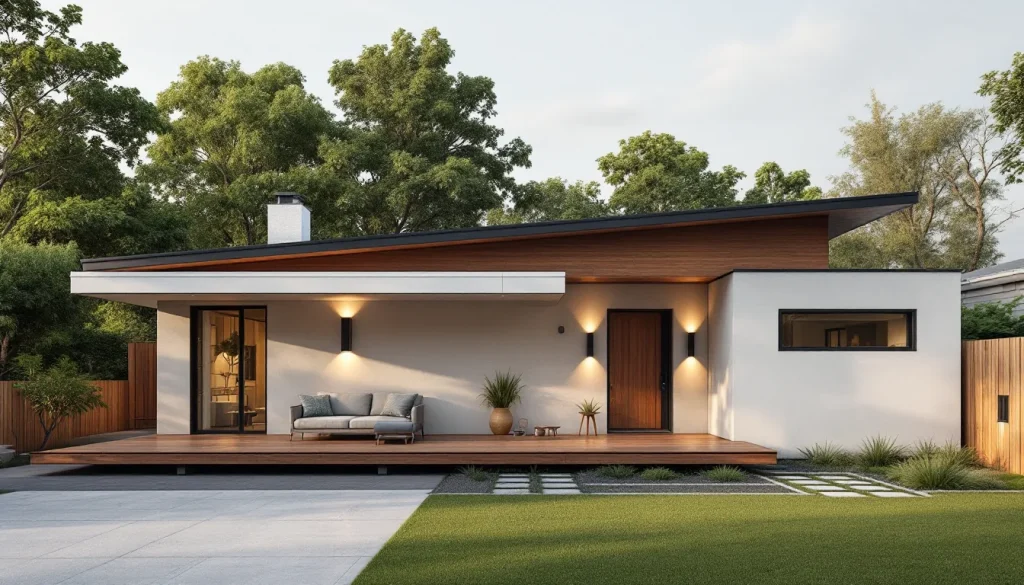
A low slope roof in 2026 is restricted to membrane systems (TPO, EPDM, modified bitumen) plus a few specific asphalt products designed for single-slope replacements on slopes between 2/12 and 4/12. The IRC R905 building code prohibits standard architectural shingles below 4/12 pitch (or 2/12 with double underlayment), which rules out asphalt for most truly flat or near-flat residential roofs. The right material choice depends on exact pitch: TPO and EPDM work down to 1/4 inch per foot (the 2 percent minimum slope required for drainage), modified bitumen and rolled asphalt handle 1/4 inch to 2/12, self-adhered low-slope shingles cover 2/12 to 4/12, and standing seam metal works at almost any slope including 1/4 inch per foot when properly detailed. Installed costs range from $5 to $9 per sq ft for membrane systems up to $14 to $22 per sq ft for standing seam metal on low slopes. Here is the full material decision tree by pitch with code references, manufacturer warranty rules, and installation complexity.
The short version
- Below 2/12 pitch you must use a membrane (TPO, EPDM, modified bitumen) or specially-designed asphalt product. Standard shingles are prohibited per IRC R905.2.2.
- 2/12 to 4/12 is the “low-slope shingle zone” where architectural shingles work with double underlayment. Many roofers prefer membrane even in this range for reliability.
- TPO and EPDM are the residential default for flat-ish roofs. Single-ply, machine-welded (TPO) or one-piece (EPDM), 20 to 30 year life.
- Modified bitumen is the asphalt-based membrane option. Torch-down or peel-and-stick. Handles ponding water better than TPO.
- Standing seam metal works at 1/4 inch per foot when detailed correctly. Premium cost but 50+ year life.
- Manufacturer warranties on low-slope products typically require certified installer and specific underlayment + accessories. Skip a step, void the warranty.
Short answer: the decision tree by pitch
Material choice on a low slope roof is dictated by slope. The IRC R905 sections enforce minimums for each material category. Below those minimums, the product fails (water blows uphill under laps, ponds at seams, sits on adhesives that degrade in standing water). Above the minimums, the product works as designed.
| Slope range | Available materials | IRC reference | Typical cost / sq ft installed |
|---|---|---|---|
| Below 1/4 inch per foot (under 2%) | None code-compliant. Reslope required. | R905 (drainage) | N/A |
| 1/4 inch per foot (2%) to 2/12 | TPO, EPDM, PVC, modified bitumen, built-up, standing seam metal, rolled asphalt | R905.10-14, R905.11, R905.12 | $5 to $14 |
| 2/12 to 4/12 | Above plus: asphalt shingles (with double underlayment), self-adhered low-slope shingles, corrugated metal, slate (rare) | R905.2.2 (special prep) | $4.50 to $14 |
| 4/12 and above | Standard asphalt shingles (single underlayment), all the above | R905.2.2 (standard install) | $4 to $22 |
The practical rule for homeowners with low-slope sections: identify your pitch first, then narrow the material list. See our roof pitch chart for measurement and slope conversion, and the roof pitch calculator method to convert rise and run to degrees. Anything below 2/12 in residential is membrane territory, which is exactly the trade-off behind a flat roof house.
Why pitch matters: how water sheds
Roofing materials function by shedding water down a slope fast enough to prevent infiltration. Asphalt shingles are lapped (each course overlaps the one below) so water can flow over the joint, not under it. At low slope this stops working: water flows slowly, capillary action and wind drive water uphill under the lap, and the lap line becomes a leak path.
Membrane materials solve this with continuous seam-welded or fully adhered surfaces. There is no horizontal joint between courses (TPO and PVC have heat-welded seams that become functionally continuous; EPDM ships in large sheets that minimize seams entirely). Water sits on or flows across the membrane without penetration paths.
The IRC slope minimums are calibrated to material physics:
- Asphalt shingles at 4/12: water flows fast enough that wind-driven backwash does not breach the lap
- Asphalt shingles at 2/12 with double underlayment: the backup underlayment catches any backwash
- Asphalt shingles below 2/12: no amount of underlayment can keep up with ponding
- Membrane at 1/4 inch per foot: minimum slope to drain water rather than pond it indefinitely
The 2 percent minimum (1/4 inch per foot) for all roof drainage is the lowest practical limit. Below that, water ponds; ponding water accelerates degradation of every membrane material and most metal coatings.
TPO membrane on low slope
TPO (thermoplastic polyolefin) is the most common single-ply membrane on residential and light commercial low-slope roofs. It is a flexible white or light gray plastic sheet, typically 0.045 to 0.060 inches thick, that gets seam-welded with hot air to form a continuous waterproof surface.
Why TPO has become the default:
- Reflective surface: white TPO reflects 75 to 80 percent of solar heat, reducing attic temperatures and HVAC loads
- Heat-welded seams: properly welded seams are as strong as the parent sheet
- Wide temperature range: handles -40 to 180 degrees F
- Reasonable cost: $5 to $9 per sq ft installed for residential applications
- Long warranty: most manufacturers offer 20 to 25 year warranties
TPO disadvantages:
- Requires heat-welding equipment (not DIY-friendly)
- Surface degrades faster than EPDM in chronic UV exposure
- Ponding water accelerates seam failure on poorly-installed jobs
- Membrane thickness matters: 0.045 inch is minimum spec, 0.060 inch is preferred
Installation involves laying the membrane over a substrate (insulation board, existing roof deck with insulation, or directly on plywood/OSB for residential), mechanically fastening or fully adhering with adhesive, then heat-welding the seams. Flashing details at parapets, penetrations, and edges use compatible TPO accessories.
For the side-by-side TPO vs. EPDM analysis see TPO vs EPDM roofing.
EPDM rubber membrane
EPDM (ethylene propylene diene monomer) is a black synthetic rubber membrane. It is the longest-tenured single-ply membrane in the residential market, with installations dating to the 1960s. EPDM ships in large sheets (typically 10×100 feet) that minimize seams.
EPDM characteristics:
- Color: traditionally black, increasingly available in white-coated or ballasted versions
- Thickness: 0.045, 0.060, or 0.090 inch. Thicker = longer life, higher cost.
- Seam method: tape-and-primer adhesive seams (older) or peel-and-stick seam tape (modern)
- Attachment: mechanically fastened, fully adhered, or ballasted
- Life expectancy: 20 to 30 years for properly installed mechanically-attached EPDM
- Cost: $5.50 to $9.50 per sq ft installed for residential
EPDM advantages over TPO:
- Better UV resistance over decades of exposure
- More flexible at low temperatures
- No heat-welding required (some DIY potential)
- Better track record (60+ years of installed history)
EPDM disadvantages:
- Black absorbs heat (worse for attic and HVAC load)
- Seam tape adhesive can fail before the membrane does
- Surface gets dusty / chalky over time
The right pick between TPO and EPDM depends on climate (TPO for hot, EPDM for cold), aesthetics (TPO white surface), and installer experience (some markets are TPO-dominant, others EPDM-dominant).
Modified bitumen on low slope
Modified bitumen is asphalt-based but engineered to handle low slope. Polymer modifiers (APP or SBS) give the asphalt elasticity and waterproofing performance well beyond standard shingles. The membrane ships in rolls (typically 36 inches wide by 33 feet long, 100 sq ft per roll) and installs by torch-down (APP-modified) or peel-and-stick (SBS-modified, cold-applied).
Modified bitumen advantages:
- Excellent ponding water resistance (better than TPO or EPDM)
- Multi-ply systems (base ply plus cap ply) add redundancy
- Granulated cap sheet hides the asphalt surface (better appearance)
- Long track record on residential and commercial
- Cost: $4.50 to $8.50 per sq ft installed
Disadvantages:
- Torch-down install requires open flame and skilled installer (fire risk on residential is real)
- Peel-and-stick install is safer but more expensive
- Cold-weather install difficult (asphalt does not bond well below 50 F)
- Heavier than single-ply membranes (matters on lightly-framed roofs)
Modified bitumen is the right call when ponding water is a known issue (poor drainage, no slope correction possible) or when you want the proven track record of an asphalt-based product. See modified bitumen roof for the full breakdown.
Rolled asphalt
Rolled asphalt (also called rolled roofing or roll roofing) is the cheapest legitimate low-slope roofing material. It is essentially a wider, longer version of an asphalt shingle: rolls 36 inches wide and 36 feet long (typically 100 sq ft per roll). The granulated surface looks like an asphalt shingle from a distance.
Rolled asphalt slope range: 1/12 (1 inch per foot) and above per IRC R905.5.2. Below that you need modified bitumen or membrane.
Where rolled asphalt makes sense:
- Sheds, detached garages, outbuildings where lifespan does not matter
- Temporary or sacrificial structures
- Hidden low-slope sections (a porch roof not visible from the street)
- Extreme budget constraint
Where rolled asphalt does not make sense:
- Primary residential roofs (lifespan too short)
- Roofs with ponding water (asphalt degrades fast)
- Roofs visible from the street (appearance is dated)
- Roofs with significant traffic or solar mounting
Cost: $1.50 to $3.50 per sq ft installed. Material is $30 to $80 per roll (100 sq ft). Lifespan: 5 to 12 years depending on quality and exposure.
Self-adhered low-slope shingles
A niche category: standard architectural shingles modified for self-adhesion across the entire shingle, not just the standard sealant strip. These are designed for the 2/12 to 4/12 slope range where you want shingle appearance but need extra adhesion to compensate for slow water shedding.
Products: GAF SealMate Roof System, CertainTeed Landmark with full ice-and-water shield underlayment, Owens Corning Duration FLEX with sealing technology.
Approach: install double underlayment per IRC R905.2.2, install a full ice-and-water shield over the entire roof (not just eave edges), install standard architectural shingles with adhesion across the full back.
Cost: $7 to $11 per sq ft installed. Lifespan: 22 to 28 years (same as the shingles themselves, provided the underlayment holds up).
This path makes sense when matching an adjacent house roof in shingles is more important than membrane reliability, and the slope is 2/12 to 4/12 (truly flat sections need membrane). For most low-slope porch and addition roofs that connect to a shingled main house, this is the visual continuity option.
Cost per square foot comparison
| Material | Cost / sq ft installed | Lifespan | Cost per year of life | Min slope |
|---|---|---|---|---|
| Rolled asphalt | $1.50 to $3.50 | 5 to 12 years | $0.20 to $0.45 | 1/12 |
| Modified bitumen (peel-and-stick) | $4.50 to $8.50 | 15 to 25 years | $0.25 to $0.40 | 1/4 per foot |
| EPDM 0.045 (mechanically attached) | $5.50 to $8.00 | 20 to 25 years | $0.25 to $0.35 | 1/4 per foot |
| EPDM 0.060 (fully adhered) | $7.00 to $9.50 | 25 to 30 years | $0.25 to $0.35 | 1/4 per foot |
| TPO 0.045 (mechanically attached) | $5.00 to $7.50 | 20 to 25 years | $0.25 to $0.35 | 1/4 per foot |
| TPO 0.060 (fully adhered) | $7.00 to $9.00 | 25 to 30 years | $0.25 to $0.35 | 1/4 per foot |
| PVC membrane | $8.00 to $12.00 | 25 to 35 years | $0.30 to $0.40 | 1/4 per foot |
| Self-adhered low-slope shingles | $7.00 to $11.00 | 22 to 28 years | $0.30 to $0.45 | 2/12 |
| Built-up roof (BUR, hot tar) | $5.50 to $9.50 | 20 to 30 years | $0.25 to $0.40 | 1/4 per foot |
| Standing seam metal | $14.00 to $22.00 | 50 to 70 years | $0.25 to $0.35 | 1/4 per foot (manufacturer spec) |
Per year of life, the materials cluster more tightly than the upfront prices suggest. TPO, EPDM, modified bitumen, and standing seam all land in the $0.25 to $0.40 per sq ft per year range. The differentiation comes from upfront cash flow constraint (cheaper materials win if budget is tight now), appearance preference (TPO white vs. EPDM black vs. shingle look), and climate match (modified bitumen for ponding, TPO for hot climates, EPDM for cold).
Manufacturer warranty requirements for low-slope
Low-slope manufacturer warranties are stricter than standard shingle warranties. Common requirements:
- Certified installer: many manufacturers offer “system warranty” coverage only on installs by certified contractors. Non-certified installers void the warranty regardless of work quality.
- System-spec accessories: the warranty covers the membrane plus all manufacturer-spec accessories (insulation, fasteners, primers, flashings). Mixing brands voids the warranty.
- Slope minimum: even within IRC code limits, the manufacturer warranty may exclude installations below specific slopes (e.g., warranty void below 1/2 inch per foot for ponding-prone designs).
- Annual inspection: extended warranties (20 to 30 years) often require documented annual inspections to maintain coverage.
- Repair restrictions: any repair must use manufacturer-spec materials applied by certified installers.
The practical impact: get the warranty paperwork in writing before signing the contract. Verify the contractor is certified by the manufacturer they are installing. Save all receipts, inspection reports, and product spec sheets in case of future claim.
For TPO specifically, the major manufacturer warranty levels:
- Material-only warranty (10 to 20 years): covers manufacturing defects in the membrane. No labor coverage.
- System warranty (20 to 30 years): covers material and labor on certified installs. Most common warranty type.
- NDL (no dollar limit) warranty (20 to 30 years): unlimited labor coverage. Premium tier. Often requires upgraded membrane thickness and full system install.
Installation complexity by material
| Material | DIY-friendly? | Specialty equipment needed? | Hours per square (100 sq ft) |
|---|---|---|---|
| Rolled asphalt | Yes | No (utility knife, hammer, roofing nails) | 1 to 2 hours |
| Modified bitumen (peel-and-stick) | Possible | No (utility knife, roller) | 2 to 4 hours |
| Modified bitumen (torch-down) | No | Yes (propane torch, fire safety) | 1.5 to 3 hours |
| EPDM (mechanically attached) | Possible | No (utility knife, hand seam roller, seam tape) | 2 to 4 hours |
| EPDM (fully adhered) | Possible but tricky | Adhesive applicator, rollers | 3 to 5 hours |
| TPO | No | Yes (hot-air welder, $1,500 to $5,000 equipment) | 2 to 4 hours |
| PVC | No | Yes (hot-air welder) | 2 to 4 hours |
| Built-up roof | No | Yes (hot tar kettle, multiple workers) | 3 to 5 hours |
| Standing seam metal | Specialty | Yes (seamer, panel cart) | 3 to 6 hours |
For homeowner DIY, modified bitumen peel-and-stick and EPDM mechanically attached are the realistic options. Both can be done with hand tools on a small low-slope roof (porch, shed, detached garage). TPO, PVC, BUR, and standing seam are pro-only because of equipment requirements.
When metal roofing works on low slope: standing seam
Standing seam metal panels with locked seams or mechanically-seamed joints work on slopes as low as 1/4 inch per foot, matching membrane minimums. The continuous seam (no exposed fasteners along the panel run, no horizontal lap) eliminates the leak paths that prohibit exposed-fastener corrugated metal at low slope.
Standing seam advantages on low slope:
- 50 to 70 year lifespan vs. 20 to 30 years for membrane
- Solar reflective with cool-roof coatings
- Fire resistant (Class A)
- Easy snow shedding (matters more on steeper variants, but the smooth surface helps even at low slope)
- Recyclable at end of life
Disadvantages on low slope:
- Highest upfront cost of any low-slope option ($14 to $22 per sq ft installed)
- Requires precise installation (panel layout, seamer pressure, flashing detail)
- Limited installer pool (not every metal roofer does low-slope standing seam)
- Penetrations (vents, skylights) need specialized flashings
The right candidates for standing seam on low slope: long-term ownership homes where the 50+ year life pays off, modern or contemporary architectural styles where the metal aesthetic fits, and commercial-leaning residential projects where the long warranty matters. See standing seam metal roof cost, metal roof installation, and metal roof cost for broader context.
Code requirements: IRC R905.10-12
The IRC sections that govern low-slope roof materials:
- R905.2.2: asphalt shingles. Minimum slope 4/12. Allows 2/12 with double underlayment per the section’s special conditions.
- R905.5: rolled roofing. Minimum slope 1/12. Specifies underlayment, lap requirements, and fastening.
- R905.10: metal roof panels. Standing seam works to 1/4 inch per foot. Exposed-fastener panels need 3/12.
- R905.11: modified bitumen. Minimum slope 1/4 inch per foot.
- R905.12: EPDM membrane. Minimum slope 1/4 inch per foot.
- R905.13: PVC membrane. Minimum slope 1/4 inch per foot.
- R905.14: TPO membrane. Minimum slope 1/4 inch per foot.
- R905.15: liquid-applied (coating systems).
- R905.1.2: ice and water shield requirements (depending on climate zone).
- R903.4: roof drainage. Requires either positive slope to drains or interior drainage system.
Local code amendments may be stricter. High-wind zones (per IRC R301.2.1) require enhanced fastening patterns and edge securement on all low-slope membranes. Hurricane zones require enhanced wind uplift testing certification (ASTM D7158 for asphalt, FM 4474 for membrane). Check your local AHJ.
Insulation under low-slope roofs
Low-slope roof installations on residential typically use one of two insulation strategies: above-deck rigid foam insulation, or below-deck (in the rafter bay) fiberglass or spray foam.
Above-deck (the commercial-style approach):
- Rigid foam (polyiso, EPS, or XPS) installed between the structural deck and the membrane
- Membrane goes over the insulation, not directly on the deck
- R-values of R-20 to R-40 are practical
- Improves the membrane’s thermal performance and ponding resistance
- Significantly increases roof assembly height (matters at parapet, edge, and penetration details)
Below-deck (the residential-style approach):
- Insulation in the rafter bay between joists
- Membrane goes directly on the deck
- R-values depend on rafter depth and insulation type
- Simpler install but ventilation more critical to prevent moisture issues
For a porch roof, addition, or low-slope outbuilding, below-deck insulation is the default. For a full residential low-slope roof or a retrofit where attic ceiling integrity is uncertain, above-deck is often the better long-term choice.
Ponding water: design and mitigation
Ponding water is the single biggest enemy of low-slope roofs. Even at 1/4 inch per foot (the 2 percent minimum), localized depressions hold water that does not drain within 48 hours of a rain event. Long-term ponding accelerates membrane breakdown, freezes and thaws against seams, and grows organic material that further holds water.
Design mitigations:
- Tapered insulation systems: rigid foam insulation cut at a slight slope to direct water toward drains or scuppers. Adds $1 to $3 per sq ft to insulation budget.
- Crickets and saddles: small triangular structures upslope of penetrations and behind parapets to deflect water around obstacles.
- Multiple drains: rather than a single drain, place drains every 30 to 50 feet so no point on the roof is too far from drainage.
- Overflow scuppers: in case the primary drain clogs, an overflow scupper at the parapet prevents structural collapse from accumulated water weight.
Material mitigations: modified bitumen and silicone coatings handle ponding better than TPO and EPDM. Silicone in particular is often used as a recoating system over existing TPO or EPDM that has developed ponding-related issues. See silicone roof coating and elastomeric roof coating.
Climate match for low-slope materials
| Climate | Best low-slope material | Avoid | Reasoning |
|---|---|---|---|
| Hot, sunny (Southwest, Florida) | White TPO, white PVC, cool-coated standing seam | Black EPDM | Reflective surface reduces attic heat and HVAC load |
| Cold, snowy (Northeast, Upper Midwest) | EPDM, modified bitumen, standing seam | Rolled asphalt | Freeze-thaw resilience matters more than UV resistance |
| Coastal (Pacific NW, Mid-Atlantic) | EPDM, TPO, standing seam (with marine-rated fasteners) | Cheap rolled asphalt | Salt air, UV, and rain combine; durability premium pays back |
| Hurricane zones (Gulf Coast, SE Atlantic) | Fully adhered TPO or EPDM, mechanically-seamed standing seam | Mechanically-attached membranes with exposed fasteners | Wind uplift resistance is the primary design driver |
| Arid (Desert SW) | White TPO, silicone-coated systems | EPDM if reflectivity matters | Solar heat reflection and UV resistance |
| Temperate (Midwest, Pacific NW) | Any properly installed system | Mismatched climate-specific products | Material choice driven by cost and aesthetic, not climate constraint |
Common low-slope roof mistakes
- Standard shingles below 4/12 with single underlayment. The most common code violation on residential additions. Leak appears in first heavy rain.
- Mismatched seam tape brand and membrane brand on EPDM. Most warranties require system components from the same manufacturer.
- Skipping the cover board on TPO over rigid foam insulation. Direct TPO over foam can puncture under foot traffic. Cover board (gypsum or wood fiber) is the puncture protection.
- Torch-down modified bitumen near combustibles. Real fire risk. NFPA and most state fire codes require fire watch for 30 to 60 minutes after torch-down install.
- No edge metal or wrong edge metal profile. The drip edge or perimeter metal must match the membrane manufacturer’s spec. See drip edge.
- Ignoring drainage during design. Building flat without drain placement leads to ponding within 5 years.
- Inadequate fastening pattern at edges. Wind uplift starts at the perimeter. IRC R905 and manufacturer specs require enhanced perimeter fastening.
- Roof penetrations (HVAC, vents, skylights) without proper flashing. Generic flashings rarely match the membrane manufacturer’s spec. Use system-spec flashings.
- Walking traffic without walk pads. Membrane wear at HVAC units and access points without protective walk pads creates premature failure zones.
How to evaluate a low-slope contractor
Standard residential roofing experience does not automatically translate to low-slope competency. Many residential roofers install asphalt shingles every day and have done one TPO job in their career. Vet contractors specifically for low-slope experience:
- Ask how many low-slope (TPO, EPDM, modified bitumen) installs they have done in the past 12 months
- Ask which manufacturer they are certified to install
- Ask for two references on low-slope jobs at least 3 years old (so you can confirm the install held up)
- Verify the manufacturer’s certified installer database online before contracting
- Confirm the bid specifies system-spec accessories (not generic substitutes)
- Get the warranty paperwork before signing
For general contractor vetting see how to choose a roofing contractor.
Recoat as an alternative to reroof
Existing low-slope roofs that are tired but structurally sound can sometimes be recoated rather than reroofed. A coating system (acrylic, silicone, or urethane) bonds to the existing membrane and adds 10 to 20 years of life at a fraction of reroof cost.
When recoating works:
- Existing membrane is intact (no widespread holes, no seam failures, no large patches)
- Substrate (decking, insulation) is dry and structurally sound
- Ponding water is minimal or has been corrected
- The remaining life of the existing membrane is short (5 years or less)
When recoating does not work:
- Existing membrane has structural failure (rot, large seam separations)
- Substrate is wet (recoating traps moisture and accelerates deterioration)
- The existing material is incompatible with the coating chemistry
Cost: $1.50 to $4.00 per sq ft installed for recoat, vs. $5 to $12 per sq ft for full reroof. See elastomeric roof coating and silicone roof coating.
Frequently asked questions
What is the cheapest low slope roofing material?
Rolled asphalt at $1.50 to $3.50 per sq ft installed. Shortest lifespan of any credible option (5 to 12 years). Used on sheds, outbuildings, and budget projects. Modified bitumen at $4.50 to $8.50 is the cheapest durable option with 15 to 25 year lifespan.
Can I put asphalt shingles on a low slope roof?
Only at 2/12 or steeper, and 2/12 to 4/12 requires double underlayment per IRC R905.2.2. Below 2/12, asphalt shingles are prohibited regardless of underlayment. Use membrane (TPO, EPDM, modified bitumen) on truly low-slope sections.
What is the difference between TPO and EPDM?
TPO is white plastic (thermoplastic polyolefin) with heat-welded seams. EPDM is black rubber (ethylene propylene diene monomer) with tape or adhesive seams. TPO is more reflective and runs cooler in hot climates. EPDM has better UV resistance over the long term and works better in cold climates. Both are 20 to 30 year systems at $5 to $9 per sq ft installed.
How long does a low slope roof last?
Depends on material. Rolled asphalt: 5 to 12 years. EPDM and TPO: 20 to 30 years. Modified bitumen: 15 to 25 years. Standing seam metal: 50 to 70 years. PVC membrane: 25 to 35 years. Built-up roof: 20 to 30 years. Lifespan in all cases depends on installation quality, ponding water, and UV exposure.
Can I DIY a low slope membrane roof?
EPDM mechanically attached and modified bitumen peel-and-stick are DIY-possible for an experienced builder on a small project (porch, shed, addition). TPO and PVC require hot-air welding equipment and are pro-only. Standing seam metal requires specialty seaming tools. Most homeowners hire pros for low-slope work because of the system-spec warranty requirements.
What is the minimum slope for a residential roof?
Per IRC R905, the minimum slope for any membrane roof (TPO, EPDM, modified bitumen, PVC) is 1/4 inch per foot (2 percent). Below that, drainage is inadequate and water ponds indefinitely. Roofs below 1/4 inch per foot require structural reslope, not a different material.
Why does standard shingle warranty not apply on low slope?
Standard shingle warranties assume water sheds fast enough at 4/12 slope and above to prevent backwash under shingle laps. At lower slopes, the manufacturer cannot guarantee the shingle will not leak even if installed correctly, so the warranty excludes installations below the manufacturer’s minimum (typically 2/12 with double underlayment, 4/12 without).
Should I tear off the old low-slope roof or coat over it?
Depends on substrate condition. If the existing membrane is intact and the deck below is dry, a recoat at $1.50 to $4 per sq ft adds 10 to 20 years for a fraction of reroof cost. If the membrane has structural failure (widespread holes, separated seams, wet substrate), tear off and reroof for the long-term solution.