
Last reviewed: September 2026.
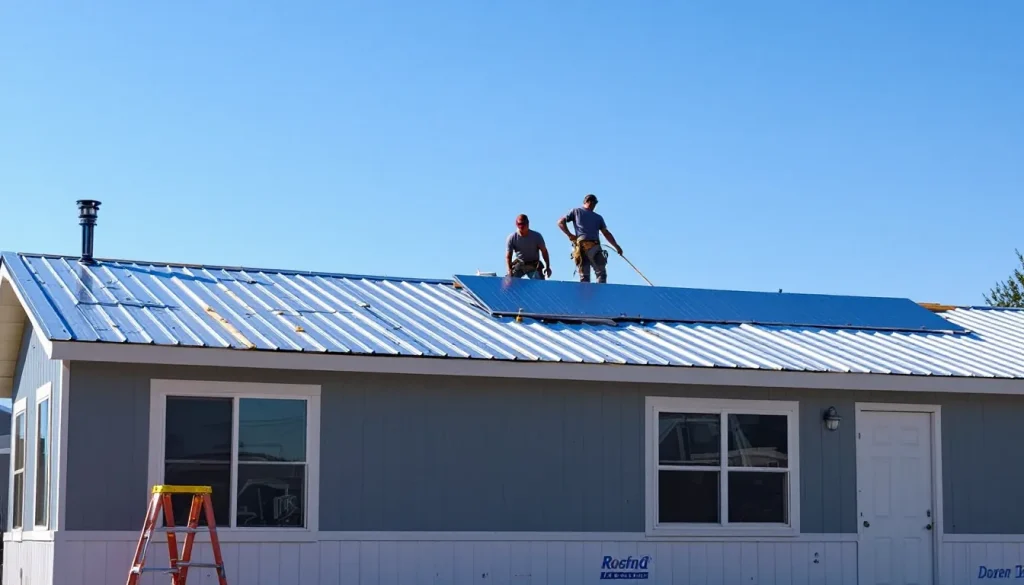
The mobile home roof replacement cost in 2026 ranges from $1,500 for a single-wide rubber-coating job to $14,000 for a full standing-seam metal roof-over on a double-wide. Three product paths drive that spread: liquid rubber roof coatings at $1.50 to $3.00 per square foot (see our cost per square foot guide), asphalt shingle overlays at $3.50 to $6.00 per square foot, and metal roof-overs (standing seam or screw-down) at $4.00 to $8.00 per square foot. A single-wide is typically 800 to 1,000 square feet of roof. A double-wide is 1,400 to 1,800 square feet. Insurance treats these differently than a stick-built house, lenders care about the roof age on a refinance, and the wrong product choice ages out in 5 years instead of 25. Below is the actual 2026 contractor-market pricing, the structural quirks that make mobile home roofs different from site-built homes, and the insurance gotchas that catch first-time mobile home buyers.
The short version
- Single-wide reroof in 2026: $1,500 (rubber coating) to $7,500 (full metal). Double-wide: $3,000 to $14,000.
- Rubber coating extends life 5 to 10 years and is the cheapest path, but it’s a maintenance layer, not a replacement.
- Metal roof-over (over the existing roof) is the most common full replacement in 2026 and runs $4 to $8 per square foot installed.
- Asphalt shingle replacement requires checking that the original framing can carry the weight (older single-wides often can’t).
- Insurance carriers in 2026 typically cap mobile home roof coverage at 15 to 20 years for shingles, 25 to 30 for metal.
- Permits are required in most jurisdictions even for coatings if structural roof-overs are involved.
- The DIY route exists for coatings ($300 to $800 in materials) but is a bad fit for shingle or metal replacement on raised mobile homes.
The short answer: cost by replacement type
Mobile home roof replacement breaks into four distinct product paths, each with its own cost (for the full data set, see our the full 2026 Roofing Cost Report) range, lifespan, and structural requirements. The table below shows 2026 contractor-market pricing for each, assuming a typical single-wide (about 900 sf of roof area) and double-wide (about 1,600 sf).
| Replacement type | Cost per sq ft installed | Single-wide total | Double-wide total | Realistic lifespan |
|---|---|---|---|---|
| Liquid rubber coating (over existing) | $1.50 to $3.00 | $1,400 to $2,700 | $2,400 to $4,800 | 5 to 10 years |
| TPO single-ply membrane (over existing) | $3.50 to $6.00 | $3,200 to $5,400 | $5,600 to $9,600 | 15 to 20 years |
| Asphalt shingle replacement (tear-off) | $4.00 to $7.00 | $3,600 to $6,300 | $6,400 to $11,200 | 20 to 25 years |
| Screw-down metal (corrugated/R-panel) | $4.00 to $6.50 | $3,600 to $5,900 | $6,400 to $10,400 | 25 to 35 years |
| Standing-seam metal roof-over | $5.50 to $8.00 | $5,000 to $7,200 | $8,800 to $12,800 | 30 to 50 years |
Pricing assumes a flat-to-low-slope original roof (most pre-1990 single-wides are nearly flat at 1:12 to 2:12). Higher pitch double-wides and modular homes that look more like stick-built houses cost more because they need conventional shingle or metal install rather than overlay methods.
Why mobile home roofs are different from stick-built
Mobile home roofs were not designed like residential roofs. Three things are different and they all matter for the replacement decision.
First, the original roof on pre-2000 single-wides was usually a single-ply rolled metal pan with low slope, designed for the factory to ship the home on a flatbed. The framing underneath was minimal: 2×2 or 2×3 roof joists at 24-inch or 16-inch on-center, sometimes with no rigid deck at all (the metal pan was the structural surface). Tearing off that original roof exposes joists that may not pass current code or carry shingle load.
Second, mobile homes are uplift-sensitive. The roof catches wind like a sail and the home is held to the ground by tie-down straps, not foundation walls. A heavier roof (shingles, especially) shifts the home’s center of gravity and changes the uplift behavior. HUD-code installation guidelines require tie-down inspection any time the roof load increases meaningfully.
Third, mobile home interiors typically have no attic. The ceiling is bonded directly to the underside of the roof framing, often with vinyl-on-gypsum or vinyl-faced ceiling panels. Any roof-over (rather than tear-off) is more attractive because tear-off risks damaging the ceiling below.
For broader context on mobile home roofing options, see our mobile home roof overview.
Rubber coating: cheapest, shortest-term path
Liquid rubber roof coatings (Henry, Black Jack, Liquid Roof EPDM, Heng’s) are applied as thick (60 to 100 mil dry film) elastomeric paints over the existing roof. They are the default mobile home roof repair for older single-wides with original metal roofs that are leaking at fastener heads and seams but are not structurally failing.
Material costs
- Acrylic elastomeric (Henry 587, Black Jack 5775): $40 to $60 per 5-gallon pail, covers ~400 sf at proper thickness. Most affordable.
- Silicone (GacoRoof, Henry HE587088): $90 to $140 per 5-gallon pail. Better UV resistance and longevity.
- Liquid Roof EPDM (Liquid Rubber): $200 to $260 per 5-gallon pail. Highest performance, can be applied to almost any substrate.
Labor costs
Contractors typically charge $1.00 to $2.00 per square foot for labor on a coating job, including pressure-wash, fabric reinforcement at seams, two coats, and basic prep. A typical 900 sf single-wide takes a 2-person crew about 1 day. Total contractor price: $1,500 to $2,700.
DIY route
Coatings are a legitimate DIY product. Material cost for a single-wide: $300 to $800 depending on product. The work is a pressure-wash, primer where required, seam tape over rust spots and seams, then two coats applied with a roller or airless sprayer. Plan a full weekend with good weather forecast.
Lifespan reality
Coatings are a maintenance layer, not a roof replacement. Manufacturers advertise 10 to 15 year warranties but realistic field life is 5 to 10 years before recoating is needed. Skipping recoats turns a $1,500 problem into a $7,000 problem when the underlying roof finally rots through.
TPO single-ply over existing roof
TPO (thermoplastic polyolefin) single-ply membrane has become a mid-priced mobile home replacement option in 2026. It’s the same product used on commercial flat roofs (Carlisle SynTec, GAF EverGuard, Versico, Holcim Elevate) but in a residential-thickness 45 to 60 mil version.
Install runs $3.50 to $6.00 per square foot for a roof-over installation: rigid foam insulation (1 to 2 inches) screwed through the existing roof into joists, then the TPO membrane hot-air-welded at seams. The end result is a continuous waterproof surface with no exposed fasteners.
TPO is a strong fit when the existing roof is functional but aged, and the home has another 15 to 20 years of expected life. Realistic lifespan is 15 to 20 years. Lower install cost than metal, higher lifespan than coatings.
Asphalt shingle replacement (full tear-off)
Shingle replacement on a mobile home requires (1) a steep enough pitch (4:12 minimum for standard shingles, 2:12 with double underlayment (see our best synthetic underlayment guide)), (2) structural framing that can carry the additional weight, and (3) plywood or OSB sheathing over the joists.
Most post-2000 double-wide modular homes meet all three. Most pre-1990 single-wides do not, which is why metal roof-overs dominate that market.
Cost breakdown for a 900 sf single-wide shingle replacement
- Tear-off and disposal: $0.80 to $1.40 per sq ft
- New 7/16 OSB sheathing (if needed): $0.90 to $1.40 per sq ft
- Synthetic underlayment + ice & water shield at eaves: $0.30 to $0.50 per sq ft
- Architectural shingles (GAF Timberline HDZ, Owens Corning Duration, CertainTeed Landmark): $1.50 to $2.50 per sq ft
- Drip edge, ridge cap, pipe boots, flashing: $0.40 to $0.70 per sq ft
- Labor: $1.10 to $1.80 per sq ft
Total: $5.00 to $8.30 per sq ft installed. Single-wide total typically $4,500 to $7,500. Double-wide: $8,000 to $13,500.
If you’re considering shingles, get a structural assessment first. Adding a shingle layer to a framing system designed for thin metal pans can overload joists and cause sag.
Metal roof replacement (the 2026 default for full replacement)
For homeowners committing to a full replacement, metal has become the dominant choice in 2026. Two product types matter: screw-down corrugated/R-panel (cheaper, shorter life, fastener gaskets to maintain) and standing-seam (more expensive, longer life, no exposed fasteners).
Screw-down metal (corrugated or R-panel)
Painted Galvalume corrugated and R-panel from MBCI, Drexel Metals, ABC Metal Roofing, or McElroy Metal runs $1.10 to $1.80 per square foot at the material level. Installed with underlayment and screw-down fasteners, total installed cost is $4.00 to $6.50 per square foot.
Lifespan is 25 to 35 years on the panel itself, but fastener gaskets typically need replacement at year 15 to 20. Color and panel quality matter (Kynar 500 paint systems vs cheaper SMP systems differ by about 10 years of fade resistance).
Standing-seam metal roof-over
Standing-seam (Englert S-2000, MBCI Lokseam, Berridge Tee-Lock, Drexel Metals 1-Inch Snap-Lock) runs $2.40 to $4.20 per square foot at the material level. Installed cost is $5.50 to $8.00 per square foot.
Standing seam can be installed directly over the existing metal roof with hat-channel furring strips, saving the tear-off cost. The seams are concealed and there are no exposed fasteners, so leak risk over time is much lower than screw-down. Realistic lifespan is 30 to 50 years.
For a typical single-wide, standing-seam roof-over is $5,000 to $7,200. For a double-wide, $8,800 to $12,800. This is the most common 2026 “do it once” choice on mobile homes that the owner plans to keep for 10+ years.
The structural assessment (don’t skip this)
Before any replacement that adds weight (shingles, metal-over-metal), get a structural assessment. The roof framing in an older mobile home was designed for one thin layer of metal, often with no rigid deck. Adding a heavier roof can overload the joists.
What the assessment covers
- Joist size, spacing, and condition (rot, splits, sagging)
- Sheathing presence and condition (some mobile homes have no sheathing under the metal pan)
- Tie-down strap condition and adequacy for the new roof weight
- Existing roof slope and drainage
- Wall plate connection (where the roof rests on the wall framing)
Cost is $200 to $500 for an inspection by a structural engineer or experienced mobile home contractor. Most reputable replacement contractors include this as part of their estimate (see our roofing estimate breakdown guide).
Insurance carrier roof age cutoffs
Mobile home insurance treats roof age more aggressively than site-built home insurance. The 2026 patterns:
| Roof type and age | Typical carrier action |
|---|---|
| Original metal pan, any age | Often non-renew if home is over 25 years old |
| Coating only, 0-5 years | Coverage continues but at higher premium |
| Shingles, 0-10 years | Full RCV coverage available |
| Shingles, 10-15 years | Shifts to ACV at most carriers |
| Shingles, 15+ years | Often non-renew or requires replacement |
| Metal roof-over, 0-20 years | Full RCV coverage available |
| Metal roof-over, 20-30 years | RCV with inspection requirement |
This is the underwriting story that pushes homeowners toward metal: insurance treats it as a “real” roof for 20 to 30 years. Coatings get treated like patches and shingles age out of full coverage at year 15. Verify with your specific carrier (Foremost, American Modern, Farmers Specialty, and Assurant write most of the mobile home market in 2026).
Permits and code
Coating-only jobs typically do not require permits. Structural roof-overs (metal, shingles, TPO with rigid insulation) do require permits in most jurisdictions because they modify the existing structure and affect the home’s overall weight and wind profile.
Permit cost runs $50 to $300 depending on jurisdiction. Skipping the permit voids most insurance claims tied to roof damage and can flag at any future home sale or refinance. If your home sits in a park, the park may have its own roof replacement rules layered on top of municipal code.
DIY: what’s realistic and what isn’t
Liquid rubber coatings are a legitimate DIY product. Pressure-wash, prep, seam reinforcement, two coats. Materials run $300 to $800 for a single-wide. Time investment is a full weekend.
Metal panel replacement (especially screw-down corrugated) is technically DIY-able but practically very hard on a raised mobile home because of height, panel handling, and the need for an air compressor or impact driver capable of seating hundreds of screws cleanly. Mistakes (over-driven screws, gasket compression issues, missed underlayment seams) cause leaks. Most contractors charge $1.50 to $2.50 per square foot for labor, which puts a single-wide labor total at $1,400 to $2,300. The DIY savings are real but the failure cost is also real.
Shingle replacement and standing-seam installation are not realistic DIY projects on a mobile home in 2026. Pay a contractor.
For broader DIY repair guidance, see our how to fix a roof leak guide.
Hidden cost adders
- Soft spots and deck replacement: $80 to $200 per soft spot found during tear-off
- Vent stack replacement: $80 to $180 per vent (most mobile homes have 3 to 5 vents)
- Skylight repair or removal: $200 to $800 per skylight
- New tie-down straps (if weight increases significantly): $500 to $1,500
- Gutter replacement: $4 to $10 per linear foot
- Park or HOA inspection fees: $0 to $200
Get itemized estimates that name these line items. The most common scam in mobile home roofing is a low headline quote that triples when the contractor “finds” decking damage during the work.
Choosing the right product for your situation
Three scenarios cover most homeowners:
Scenario 1: You’re keeping the home 3 to 7 years, original metal roof is leaking. Get a quality silicone or EPDM coating. Cost: $1,500 to $3,000. Buys you time until sale.
Scenario 2: You’re keeping the home 8 to 20 years, structure is sound. Standing-seam metal roof-over. Cost: $5,000 to $13,000. Eliminates the roof from your worry list for 30+ years.
Scenario 3: You’re keeping the home indefinitely, double-wide with conventional pitch. Either standing-seam metal or premium architectural shingles. The choice depends on aesthetics and your local climate. Both run $7,000 to $14,000 installed.
FAQ
Is it cheaper to coat or replace a mobile home roof?
Coating is dramatically cheaper upfront ($1,500 to $3,000 vs $5,000 to $14,000 for replacement) but only buys 5 to 10 years. If you’re keeping the home long-term, full metal replacement is cheaper over a 20 year horizon because you avoid two or three coating cycles.
Can I put shingles over my mobile home metal roof?
Sometimes, but it requires a structural assessment first. Most pre-1990 single-wides cannot carry shingle weight without joist reinforcement. Metal-over-metal roof-over is the more common solution for that vintage.
How long does a rubber-coated mobile home roof actually last?
5 to 10 years before recoating is needed. Silicone coatings (GacoRoof, Henry HE587088) typically outlast acrylic by 2 to 4 years. EPDM products like Liquid Roof typically outlast acrylic by 3 to 5 years. None of them are permanent.
Will insurance cover my mobile home roof replacement?
Only if the damage is from a covered peril (wind, hail, falling object) and the roof was under the carrier’s age cutoff at the time of loss. Wear-and-tear or age-related deterioration is not covered. File a claim quickly after any storm event and document with photos.
Do I need a permit to coat my mobile home roof?
Usually no for coatings alone. Yes for any structural roof-over (metal, shingles, TPO). Park-owned communities may have additional rules. Check with the city and the park before you start.
Bottom line
Mobile home roof replacement in 2026 ranges from $1,500 for a single-wide rubber coating to $14,000 for a double-wide standing-seam metal install. The right choice depends on how long you’re keeping the home and what your existing structure can carry. Coatings are a maintenance layer, not a replacement, and they need redoing every 5 to 10 years. Metal roof-over is the dominant full-replacement choice in 2026 because it adds 25 to 40 years of life without tearing off the original deck. Shingles work on conventional-pitch double-wides and modular homes but require a structural assessment first. Get itemized estimates, verify insurance treatment of the chosen product, and pull a permit on any structural roof-over. The contractors who handle mobile homes well are a different specialty from stick-built roofers, so ask for mobile home references specifically.