
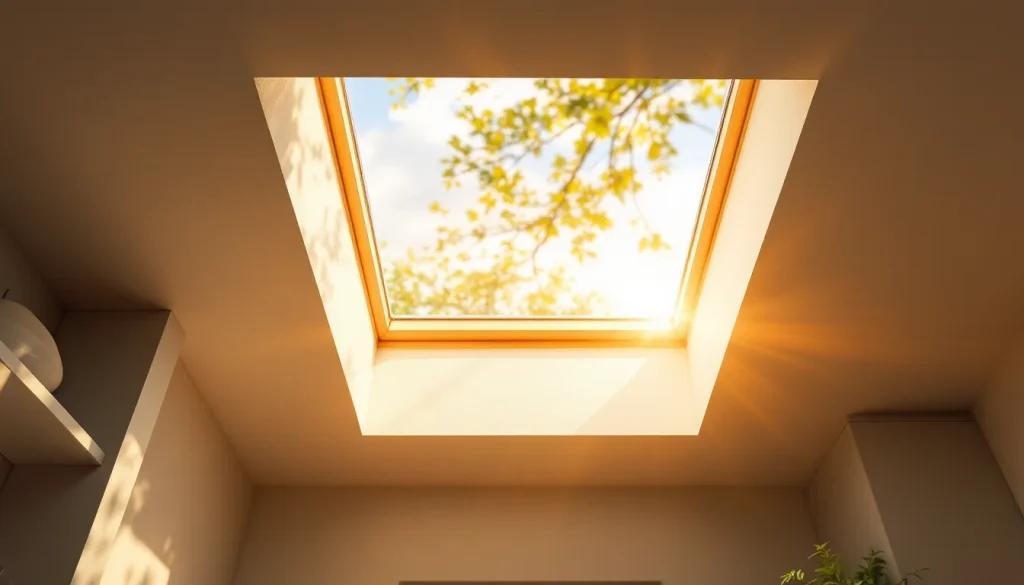
Skylight (see our skylight replacement cost) installation cost in 2026 ranges from $400 for a basic fixed tubular skylight to $4,000+ for a vented motorized skylight, with most homeowners paying $1,000 to $2,500 fully installed. The cost depends on the skylight type (fixed, vented, tubular), brand (VELUX, Sun-Tek, Kennedy Skylights, Wasco), structural complexity of cutting through the existing roof, and the drywall and interior finishing work that follows. A simple fixed skylight retrofit in an existing rafter bay takes a 2-person crew about 6 hours. A vented motorized install with a shaft cut and a finished interior box can take 2 to 3 days. The math below covers all of it.
The short version
- Fixed skylight: $400 to $1,500 installed. The 50% case.
- Manual vented: $700 to $2,000 installed. Adds operable window functionality.
- Motorized vented (VELUX with rain sensor): $1,500 to $4,000 installed.
- Tubular (“solar tube”): $400 to $1,200. Light only, no view, lowest install complexity.
- Federal solar tax credit (30% through 2032) applies to solar-powered VELUX models, including the motor and blackout shades.
- Skylight leaks are 95% installation defects (flashing). Pick an installer who has done 100+ of the specific brand.
The short answer: skylight cost by type
Skylights split into four product categories, each with a different installation method and cost profile. The table below covers product cost (the skylight itself) and installed cost (product, labor, flashing kit, interior finishing). All figures are for a single skylight in a 2026 retrofit (existing asphalt shingle roof).
| Type | Product cost | Installed cost | Install time | Use case |
|---|---|---|---|---|
| Fixed | $150-700 | $400-1,500 | 4-8 hours | Daylight in dark rooms |
| Manual vented | $300-1,200 | $700-2,000 | 6-10 hours | Bathroom, kitchen ventilation |
| Motorized vented | $800-2,500 | $1,500-4,000 | 1-2 days | Hard-to-reach high ceilings |
| Solar-powered vented (VELUX) | $1,200-3,000 | $2,000-4,500 | 1-2 days | 30% federal tax credit eligible |
| Tubular (“solar tube”) | $200-600 | $400-1,200 | 2-4 hours | Hallways, closets, small dark spaces |
Fixed skylight ($400 to $1,500)
Fixed skylights don’t open. They’re a sealed glazed window installed in the roof plane. The advantage is simplicity: lowest cost, fewest failure modes, longest service life. The disadvantage is no ventilation, which matters in bathrooms and kitchens.
Fixed skylight cost breakdown
- Skylight unit: $150 to $700 depending on size and glazing. A standard 22 x 46 inch VELUX FS runs about $350 to $500 retail.
- Flashing kit: $75 to $200. Brand-matched to the skylight. Never substitute generic flashing.
- Labor: $300 to $700. A 2-person crew at $80 to $120 per hour for 4 to 8 hours.
- Interior drywall finish: $100 to $300 typically (more for vaulted ceilings).
- Permit: $50 to $200 depending on jurisdiction.
Vented (manual) skylight ($700 to $2,000)
Vented skylights open and close, either via a crank handle (manual) or a motor. Manual vented runs the lowest installed cost of the operable family because there’s no electrical work. The catch is reachability: at a typical 9 to 12 foot ceiling, the crank is operated by a telescoping rod, which works fine but isn’t elegant.
When manual vented makes sense
- Bathrooms (ventilation for moisture)
- Kitchens (steam and cooking heat)
- Bedrooms with 8 to 9 foot ceilings (still reachable)
- Anywhere a 30% federal tax credit isn’t applicable
Manual vented adds about $300 to $600 over an equivalent fixed unit, mostly in the mechanism and slightly more labor.
Vented motorized skylight ($1,500 to $4,000)
Motorized vented skylights add an electric motor, typically with a wireless wall control and (on the premium VELUX and Sun-Tek lines) a rain sensor that auto-closes the skylight when precipitation starts. Motorized is the right answer for tall ceilings, vaulted spaces, and any installation where the homeowner won’t realistically reach the manual mechanism.
The VELUX VSE (electric) and VELUX VSS (solar) lines
- VELUX VSE: hardwired electric. $1,000 to $2,000 product cost, $1,800 to $3,500 installed.
- VELUX VSS: solar-powered (battery + photovoltaic). $1,200 to $2,500 product cost, $2,000 to $4,500 installed. Eligible for the 30% federal solar tax credit through 2032.
The VSS solar model is the most-installed motorized skylight in 2026 because the tax credit effectively closes the price gap to the hardwired VSE. After the 30% credit, a $4,000 VSS install nets to $2,800, which is right at the VSE installed cost.
Tubular skylight ($400 to $1,200, the budget option)
Tubular skylights (often called “solar tubes” or “sun tunnels”) are a different category. Instead of cutting a large opening through the roof, they pipe daylight through a 10 to 14 inch diameter reflective tube from a small roof-mounted dome down to a diffuser in the ceiling below. They deliver daylight to interior rooms (hallways, closets, bathrooms) that can’t accommodate a traditional skylight.
Tubular advantages
- Lowest install cost: $400 to $1,200 installed.
- Fastest install: 2 to 4 hours for a single tube.
- No drywall work through joists in most cases (tube routes through attic space).
- High light output: a 14-inch tube delivers roughly equivalent light to a 40-square-foot fixed skylight.
- Lower leak risk: smaller opening, simpler flashing.
Tubular tradeoffs
- No view of the sky
- No ventilation option
- Limited daylight in deep overcast (less reflection)
- Aesthetic: round ceiling diffuser, less architectural impact
Brand comparison: VELUX, Sun-Tek, Kennedy, Wasco
Four brands dominate the U.S. residential skylight market in 2026: VELUX (market leader), Sun-Tek (Florida-based, strong in hurricane markets), Kennedy Skylights (Pacific Northwest specialty), and Wasco (now owned by VELUX since 2018 but still sold separately in some markets).
| Brand | Market share | Strengths | Pricing | Warranty |
|---|---|---|---|---|
| VELUX | ~60% | Full product line, Energy Star, rain sensor, solar option, distribution everywhere | Mid to premium | 10-year glass, 5-year frame, 2-year electrical |
| Sun-Tek | ~15% | Hurricane-rated for FL/coastal markets, glass and acrylic options | Mid | 10-year glass, 10-year acrylic |
| Kennedy | ~5% | Custom sizes, Pacific NW dealer network, snow-rated glazing | Premium | 10-year unit, 20-year glass seal |
| Wasco | ~10% | Commercial heritage, large openings, custom configurations | Mid to premium | 10-year glass, 5-year unit |
| Other (CrystaLite, Solatube, etc.) | ~10% | Specialty tubular and architectural product | Varies | Varies |
For most residential installs in 2026, VELUX is the default recommendation. The product line is comprehensive, the flashing kits are the most refined in the industry, and the dealer/installer network is broadest.
Installation labor ($600 to $1,500 typical)
Skylight installation labor varies by complexity. A simple fixed skylight in an existing single-story home with attic access runs at the low end. A motorized vented unit in a vaulted ceiling on a two-story home runs at the high end.
| Job complexity | Labor range | What’s included |
|---|---|---|
| Tubular skylight | $200-500 | Roof opening, tube assembly, ceiling diffuser |
| Fixed skylight, attic access | $300-700 | Cut opening, install flashing, basic drywall return |
| Fixed skylight, vaulted ceiling | $500-1,000 | Above + custom shaft framing, drywall finish |
| Vented manual | $400-900 | Fixed skylight scope + operable mechanism |
| Vented motorized hardwired | $800-1,500 | Above + electrical run, wall control install |
| Vented solar (VELUX VSS) | $700-1,200 | Vented manual scope (no electrical needed) |
Roof penetration and flashing (where it gets technical)
The flashing system is the most important part of any skylight install. Skylight leaks are almost never product defects. They’re almost always flashing defects. The brand-matched flashing kit (VELUX EDL, Sun-Tek FK, Kennedy FK) is engineered to integrate with the specific skylight curb and the surrounding roofing material.
Flashing kit components
- Head flashing: the upslope piece that diverts water around the upper edge.
- Side step flashing: interlaced with shingle courses on both sides.
- Apron flashing: the downslope piece that diverts water away from the lower edge.
- Underlayment integration: typically self-adhered ice and water shield extending 6 to 12 inches around the skylight on all sides.
The four most common skylight flashing mistakes
- Using generic step flashing instead of the brand-matched kit
- Skipping the ice and water shield around the curb
- Caulking the head flashing to the shingles instead of integrating with the upper shingle course
- Installing the skylight too close to the ridge or eave (manufacturer minimums apply)
If you suspect a skylight leak, see our roof leak repair and how to fix a roof leak guides.
Energy code implications (Energy Star and low-E coating)
The 2024 and 2025 versions of the Energy Star skylight specification raised the bar for U-factor and Solar Heat Gain Coefficient (SHGC). To qualify as Energy Star in 2026, a skylight needs:
- U-factor of 0.50 or lower in northern climate zones
- SHGC of 0.40 or lower in southern climate zones
- Low-E glass coating (typically tin oxide or silver)
- Argon gas fill (not air) between glass panes
The cost premium for Energy Star versus baseline is $100 to $300 per unit. The energy savings range from $40 to $120 per year per skylight depending on climate, which means payback inside 3 to 7 years. Energy Star qualification is also a precondition for the federal Energy Efficient Home Improvement Credit (separate from the solar tax credit).
Skylight leak repair
The most common skylight leak is at the flashing, not the glazing. Symptoms typically include a damp ceiling around the skylight shaft or staining in the drywall return. The repair process is:
- Identify the source. Water can travel several feet along the roof deck before showing inside. Hose test from below.
- Lift the upslope shingles to inspect the head flashing and ice and water shield.
- Re-flash if needed. Often this means removing and re-installing the brand-matched flashing kit with new ice and water shield.
- Re-seal the curb-to-flashing junction with NP1 or manufacturer-spec sealant.
- Document the repair. Photos before/after, materials used. Critical for warranty.
Cost for skylight leak repair runs $400 to $1,500 depending on accessibility and flashing condition. Catastrophic flashing failure on a 10+ year skylight is often best fixed by replacing the entire unit while the shingles are lifted.
Glazing options: glass vs acrylic vs polycarbonate
The skylight glazing (the transparent panel itself) comes in three materials, each with different cost, performance, and maintenance profiles.
| Glazing | Cost premium | Lifespan | Best for |
|---|---|---|---|
| Tempered glass (single) | Baseline | 20-30 years | Most residential applications |
| Tempered + laminated glass | +15% to +30% | 25-40 years | Hurricane zones, child safety priority |
| Low-E glass (argon-filled IGU) | +20% to +40% | 20-30 years (seal-limited) | Energy Star, all-climate |
| Acrylic dome | -30% to -50% | 10-15 years | Budget, outbuildings, garages |
| Polycarbonate | -10% to +10% | 15-25 years | Impact resistance, hurricane zones |
VELUX, Kennedy, and Wasco default to tempered+laminated glass on residential installs. Sun-Tek offers both glass and acrylic dome options, with acrylic dominant in Florida and Gulf Coast markets where hurricane impact ratings matter and cost sensitivity is high.
Why laminated glass matters
Laminated glass has a plastic interlayer between two glass panes. If the glass breaks (impact, falling branch, hail), the interlayer holds the fragments together rather than letting them fall into the room below. This is the same construction used in car windshields. On any skylight directly above a living space, laminated glass is the recommended specification.
Blinds and shading options
Most skylight installations include blinds, shades, or solar control films. The options vary widely in cost and functionality:
Manual blinds
$50 to $300 per skylight. Roller shade or pleated blind, operated by a telescoping pole. Simple, reliable, no electricity required. Good for bathrooms and easy-reach locations.
Electric blinds
$200 to $600 per skylight. Wall-controlled motorized roller shade. Useful in tall ceilings and master bedrooms where remote operation matters.
Solar-powered blinds (VELUX FSC, FMC)
$400 to $800 per skylight. Photovoltaic cell on the blind cassette powers the motor. No wiring needed. Eligible for the 30% federal solar tax credit when paired with a solar-powered skylight. The most popular choice on premium installs.
Blackout vs light-filtering
Bedroom installs typically pair blackout blinds with the skylight. Living spaces typically pair light-filtering (allowing diffused daylight through). VELUX offers blackout, light-filtering, room-darkening, and Venetian blind options for nearly every product in their line.
Skylight wells and shaft design
The skylight shaft (also called the well) is the boxed-out space between the roof opening and the ceiling opening. Shaft design matters for light delivery, not just construction cost. The three primary shaft styles each deliver different light patterns:
- Straight shaft: walls perpendicular to the ceiling. Throws a focused beam directly below the skylight. Lowest cost, narrowest light spread.
- Splayed shaft (4-sided flare): walls angle outward in all four directions as they descend. Light spreads broadly. Higher cost, much better light distribution.
- Asymmetric splay: one or two walls angle outward, the others stay straight. Used to direct light toward a specific area (a work surface, a reading nook).
For most residential installs in conditioned spaces, a 30 to 45 degree splay delivers significantly more useful daylight than a straight shaft and is worth the additional drywall and finishing cost. The splay also makes the skylight feel architecturally intentional rather than utilitarian.
Skylight cleaning and maintenance
Skylights need routine maintenance to maintain light transmission and to catch flashing issues before they become leaks. The maintenance cadence:
- Annual exterior glass cleaning ($75 to $200 if pro, free if DIY with extension wand): removes airborne dust, pollen, and bird droppings that reduce light transmission by 10% to 30% per year on neglected skylights.
- Annual interior glass cleaning: cobwebs and dust on the indoor side.
- Annual flashing inspection: visible cracking, lifted edges, sealant condition.
- Every 5 to 7 years: sealant refresh on the curb-to-flashing junction. NP1 polyurethane or manufacturer-spec product.
- Every 10 to 15 years: full flashing kit review. By this point, most kits need either resealing or replacement.
Tie this into the seasonal roof maintenance schedule and the spring inspection routine.
Curb-mounted vs deck-mounted
Skylights mount two ways to the roof structure. Deck-mounted skylights sit directly on the roof deck (low-profile, modern aesthetic). Curb-mounted skylights sit on a raised wood curb (older style, also used in flat-roof commercial applications).
| Feature | Deck-mounted | Curb-mounted |
|---|---|---|
| Profile above roof | 2-4 inches | 6-10 inches |
| Look | Sleek, modern | Traditional, prominent |
| Leak risk | Slightly lower (lower water exposure) | Slightly higher (more flashing perimeter) |
| Cost | Baseline | ~10% more (curb construction) |
| Best for | Most residential pitched-roof installs | Flat roofs, ventilation routing, replacements |
Drywall and interior finishing cost
The interior box (called the skylight shaft) is where many homeowners get blindsided on cost. The roof and ceiling are typically not at the same elevation, so the skylight opening at the ceiling level needs framing, drywall, paint, and finishing.
Shaft styles
- Straight shaft: walls perpendicular to ceiling. Cheapest. Less light.
- Splayed shaft: walls angled outward to ceiling. More light, more drywall work, more cost.
- Angled shaft: walls angled toward one side. Common in vaulted ceilings, complex framing.
Interior finishing cost
| Shaft type | Material cost | Labor cost | Total |
|---|---|---|---|
| None (vaulted ceiling, drywall to skylight) | $0 | $0 | $0 |
| Short straight shaft (under 24″) | $50-100 | $150-400 | $200-500 |
| Standard splayed shaft (24-48″) | $100-200 | $400-900 | $500-1,100 |
| Long shaft / angled (48″+) | $200-400 | $700-1,500 | $900-1,900 |
Federal solar tax credit (for solar-powered VELUX)
The Residential Clean Energy Credit (Section 25D) extends the 30% federal tax credit for solar-powered equipment through 2032, with phased reductions beginning in 2033. Solar-powered skylight products qualify, specifically:
- VELUX VSS (solar venting skylight) unit cost
- VELUX VSS installation labor
- Solar-powered blackout and light-filtering blinds
- Solar-powered window opening operators
The credit is non-refundable but can be carried forward to future tax years. On a typical $4,000 VELUX VSS install with $400 in solar blinds, the credit comes to $1,320 (30% of $4,400), netting the installed cost to about $3,080. This is why the VSS is the most-recommended motorized skylight in 2026.
Replacement skylight (vs new install)
Replacing an existing skylight (typically a 20+ year old unit at end of life) is cheaper and faster than a new install because the structural opening already exists. Plan on $800 to $2,500 for a like-for-like replacement, depending on the new product tier.
What’s different about replacement
- No structural framing changes (usually)
- No new drywall shaft
- Existing electrical run (for motorized replacement)
- Full flashing kit replacement required (do not reuse old flashing)
- Often coordinated with a reroof for best flashing integration
If you’re replacing the entire roof anyway, the skylight is the time to upgrade. Adding a new skylight during a reroof costs $700 to $1,500 less than adding it as a standalone job because the flashing work is happening anyway.
Skylight frequency: where in the roof
Skylight placement matters for both light distribution and structural impact. The guidelines below are NRCA + VELUX recommendations:
- Minimum 12 inches from any ridge, eave, valley, or hip.
- Centered between rafters when possible (avoids structural cutting).
- South-facing rooflines: best winter heat gain but require shading in summer.
- North-facing rooflines: consistent diffuse light, no heat gain spike.
- East-facing: morning light, good for bedrooms.
- West-facing: afternoon glare, often the worst orientation for living spaces.
Multiple skylights
If installing two or more skylights on the same roof plane, manufacturers recommend at least 24 inches of horizontal space between units to allow proper flashing. Most installers recommend matching unit sizes for visual balance.
Frequently asked questions
How much does it cost to install a skylight?
Most residential skylight installs in 2026 run $1,000 to $2,500 fully installed. Fixed skylights start around $400. Motorized solar VELUX units run $2,000 to $4,500 installed (before the 30% federal tax credit).
How long does a skylight installation take?
A simple fixed skylight retrofit takes a 2-person crew 4 to 8 hours. A motorized vented install in a vaulted ceiling can take 1 to 2 days. Tubular skylights are the fastest at 2 to 4 hours.
Will a skylight leak?
Properly installed skylights with brand-matched flashing kits and ice and water shield around the curb rarely leak in the first 15 years. Almost all skylight leaks are installation defects (skipped flashing components, generic step flashing instead of brand-matched, incorrect shingle integration).
Are skylights worth it?
For dark interior rooms (bathrooms, hallways, kitchens with limited window walls), skylights deliver 2 to 5 times more daylight per square foot than vertical windows. The energy savings, plus the daylight quality, justify the cost for most homeowners. The 30% federal tax credit on solar VELUX products tips the math further.
Can I install a skylight myself?
For most homeowners, no. The flashing integration with shingles is where leaks happen, and it requires specific brand-matched kits and shingle technique. Tubular skylights are the closest to a DIY job and even those benefit from a pro install in most cases.
What’s the federal tax credit on skylights in 2026?
30% of total installed cost (product plus labor) for solar-powered skylights and blinds, under the Residential Clean Energy Credit (Section 25D). The credit runs through 2032 at 30%, then phases down. Hardwired electric and manual skylights don’t qualify; only solar-powered models do.
How long do skylights last?
Modern asphalt-shingle-compatible skylights last 20 to 25 years. The glass seal typically fails first, fogging up between panes. VELUX, Sun-Tek, and Kennedy all warranty their glass seals for 10 to 20 years. Flashing kits should be replaced with the skylight when it reaches end of life.
What size skylight should I install?
Skylight sizing follows the 5% rule: total skylight area should equal roughly 5% of the room’s floor area for good daylight without overheating. For a 200-square-foot room, that’s about 10 square feet of skylight. Most residential skylights are 22 inches wide by 38 to 70 inches tall, putting one unit at 5 to 10 square feet. For larger rooms or vaulted spaces, two smaller skylights spread the light more evenly than one large one.
Where in the roof should the skylight go?
North-facing rooflines give consistent diffuse light without heat gain or summer glare. South-facing rooflines maximize winter heat gain but require shading in summer. East-facing works well for bedrooms (morning light). West-facing is usually the worst orientation because of afternoon glare. All units need at least 12 inches of clearance from any ridge, eave, valley, or hip to allow proper flashing.
What about ice and snow on skylights in cold climates?
Snow accumulation on skylights is normal and isn’t a structural concern on properly-installed units. Snow rated to 50 to 80 pounds per square foot is standard on VELUX, Sun-Tek, and Kennedy products. Ice dam formation around skylights is more concerning: the heat loss around the skylight curb can melt nearby snow, then refreeze at the cold edge. Proper attic attic ventilation and ice and water shield extending at least 12 inches around the curb prevent this.
Should I add a skylight during a reroof?
Yes, if you’ve ever considered adding one. The flashing labor is already happening during a reroof, so the marginal install cost for the skylight is $700 to $1,500 less than a standalone install. The same applies to replacing an existing aging skylight while the shingles are off.