
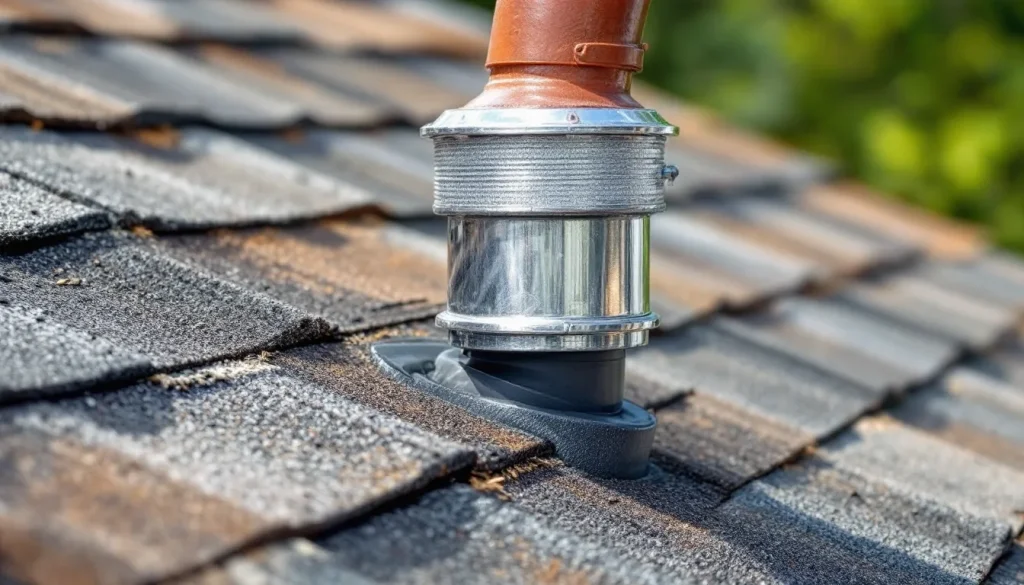
A perma-boot vent boot (see our vent pipe boot guide guide) repair is a retrofit fix for a failed plumbing vent pipe boot: a slip-on polymer collar slides over the existing rusted-out or sun-cracked rubber boot, locks down to the shingle field, and restores a watertight seal around the vent pipe without tearing off shingles or removing the existing boot. The Perma-Boot system (made by Lifetime Tool, the patented original) takes 15 to 30 minutes per vent and costs $25 to $40 per unit in materials versus $150 to $400 for a full vent boot replacement done by a roofer. The catch: it only works when the existing shingle field around the boot is sound, the pipe is the right diameter (1.5, 2, 3, or 4 inch standard), and the underlying flashing isn’t already compromised. Get those three things right and Perma-Boot is a 20-year fix. Get them wrong and you’ve buried a leak under a new collar.
The short version
- Perma-Boot is a slip-on polymer collar that retrofits over a failed vent pipe boot. No shingle removal, no boot tear-out.
- Fits standard 1.5, 2, 3, and 4 inch ABS or PVC vent pipes. Sizes are color-coded.
- Install time: 15 to 30 minutes per vent. Tools: caulk gun, utility knife, screwdriver.
- Material cost: $25 to $40 per unit. Total install cost including roofer labor: $75 to $150 per vent.
- Works only when shingle field around boot is intact and underlying flashing isn’t leaking elsewhere.
- Full boot replacement still beats Perma-Boot in three cases: badly degraded shingles around boot, multiple leaks indicating a flashing problem, or roof close to end of life.
Why vent pipe boots fail in the first place
A standard plumbing vent boot is a galvanized or aluminum base plate with a molded EPDM (rubber) collar that seals around the vent stack. The base plate slips under the shingles above and over the shingles below, weaving into the field like step flashing (see our step flashing guide). The rubber collar wraps the pipe and is what actually keeps water out at the pipe-to-base junction.
The rubber collar is the failure point. UV exposure breaks down EPDM over 8 to 15 years depending on climate. In Phoenix, Las Vegas, and Tucson, EPDM collars routinely crack at year 7 to 10. In the Pacific Northwest they last 15 to 20 years. The base plate is fine. The shingles around it are fine. The collar is just cooked.
Once the collar cracks, water runs down the pipe, behind the failed rubber, and through the gap between the pipe and the base plate. The leak (see our water stains on a ceiling guide) shows up as a ceiling stain or a wet attic spot directly below the vent. Homeowners often assume the entire boot needs replacement. In most cases, it doesn’t.
How the Perma-Boot retrofit works
The Perma-Boot (see our vent pipe flashing replacement) is a one-piece polymer collar that slides over the failed boot from above. The bottom flange of the Perma-Boot sits on top of the existing shingles around the boot. The top of the collar wraps tightly around the vent pipe. The polymer is UV-stable (not EPDM rubber), so it’s rated for 25+ years of direct sun exposure.
The install in eight steps
- Identify the pipe diameter (1.5, 2, 3, or 4 inch). Bring the right size Perma-Boot up the ladder. Sizes are color-coded.
- Clean the area around the existing failed boot. Wire-brush rust, scrape old caulk, remove any moss or debris.
- Slide the Perma-Boot collar down over the vent pipe until the bottom flange rests on the existing boot’s flashing flange.
- Run a continuous bead of polyurethane or 100% silicone caulk around the perimeter of the bottom flange where it meets the shingles. Tube goods only, not the plastic cartridge dome.
- Press the Perma-Boot down into the caulk bead. Use moderate pressure to seat.
- Drive the supplied stainless or hot-dipped screws through the pre-drilled holes in the bottom flange into the deck below. Three to four screws around the perimeter.
- Run a second bead of caulk around the top of the collar where it meets the pipe. This is the secondary seal against wind-driven rain.
- Wipe excess caulk. Inspect from below in the attic for daylight or staining.
Total time per vent: 15 to 30 minutes once you’ve done one. The first install on a roof takes longer because you’re learning the product. By the third vent on the same house, it’s a 15-minute job.
When Perma-Boot is the right fix (and when it isn’t)
Perma-Boot is a retrofit, not a magic fix. Three conditions need to be met for it to work as a 20+ year repair.
Condition 1: shingles around the boot are sound
The Perma-Boot bottom flange seats on the shingle field around the vent boot. If those shingles are curled, cracked, brittle, or missing granules in the immediate area, the caulk seal at the bottom flange won’t hold for long. On a roof in the last 3 to 5 years of life, the Perma-Boot may only buy you a year or two before the shingle field itself starts leaking around it.
Condition 2: the leak is at the boot, not somewhere else
Ceiling stains near a vent pipe sometimes trace to other sources: a nearby chimney (see our chimney flashing leak repair guide) flashing, a roof-to-wall junction uphill, or a backed-up gutter. If you install a Perma-Boot and the stain returns, the leak was never at the boot. The 15-minute fix turns into a hunt for the actual source. Diagnose first.
Condition 3: the underlying base plate isn’t lifted or torn
If the original boot’s metal base plate is lifted off the deck, torn, or improperly woven into the shingles, sealing the rubber collar with a Perma-Boot doesn’t fix the base plate problem. Water can still get in below the base plate. In that case, full boot replacement is the only durable fix.
For deeper diagnosis of which type of leak you’re looking at, see our roof leak repair and how to fix a roof leak guides.
Perma-Boot vs full boot replacement
The decision tree usually comes down to cost, roof age, and how comfortable the homeowner is with a “patch” versus a “real fix.” The table below summarizes the tradeoffs.
| Factor | Perma-Boot retrofit | Full boot replacement |
|---|---|---|
| Material cost per vent | $25 to $40 | $15 to $30 (boot only) |
| Labor time per vent | 15 to 30 minutes | 45 to 90 minutes |
| Total cost (with roofer) | $75 to $150 | $150 to $400 |
| Shingle removal required | No | Yes (3 to 6 shingles above the boot) |
| Expected service life | 20 to 25 years | 15 to 25 years (depends on new collar material) |
| UV resistance | Polymer (excellent) | EPDM (8 to 15 years typical) |
| Best application | Sound roof, 5 to 20 years old | Reroof project, badly compromised base plate |
The cost math
A homeowner with three failed vent boots is looking at $450 to $1,200 for full replacements by a contractor. The same three vents fixed with Perma-Boot run $225 to $450. The difference is material savings (slip-on versus shingle tear-and-replace) and labor time (15 minutes versus an hour per vent).
For roofers, Perma-Boot is the fix that lets them squeeze in three vent repairs in the time a single full replacement would take. The margin is similar on a per-hour basis.
Sizing: getting the diameter right
Perma-Boot comes in four standard sizes that match the four most common US plumbing vent pipe diameters. Pick the wrong size and the collar either won’t slide over the pipe or won’t seal tightly against it.
| Pipe diameter | Common location | Perma-Boot SKU color |
|---|---|---|
| 1.5 inch | Lavatory, single fixture vent | Green |
| 2 inch | Kitchen sink, washer standpipe, most secondary vents | Tan |
| 3 inch | Main soil stack (most common residential) | Black |
| 4 inch | Large main stack, commercial | Brown |
Measure the actual pipe diameter, not the inside of the existing boot. A 3-inch pipe in a partially failed 3-inch boot looks identical to a 2-inch pipe in a 2-inch boot from a distance. Bring a tape measure or pipe gauge up the ladder before driving to the home center.
Common Perma-Boot install mistakes
Not cleaning the surface
The most common failure cause. Caulk does not bond to dirty, mossy, or rust-flecked shingles. The bottom flange seal lasts months instead of decades. Wire-brush, scrape, and wipe with denatured alcohol before laying the bead.
Using the wrong caulk
Acrylic latex caulk fails in 2 to 3 years on a roof. Use polyurethane (Sikaflex, Loctite PL) or 100% silicone (Geocel 2300, Dow 795). Both will hold for 20+ years if applied to a clean, dry surface.
Driving screws through cracked shingles
If the shingles directly below the bottom flange are cracked or brittle, screws can fracture them further. The fracture becomes a leak path under the Perma-Boot. Pre-inspect and, if necessary, lay a strip of self-adhered membrane (ice and water shield) under the flange before installing.
Skipping the secondary seal at the pipe
Some installers run only the bottom flange caulk and skip the top bead around the pipe. The Perma-Boot’s polymer collar grips the pipe pretty well on its own, but wind-driven rain in a strong storm can still drive water down the seam. The secondary seal at the pipe takes 30 seconds and prevents that.
Mixing it with a damaged base plate
If you can see the boot’s metal base plate is lifted, torn, or improperly flashed under the shingles above, a Perma-Boot on top won’t stop the underlying problem. Full replacement is the only durable answer.
Comparable products: lead boots, retrofit options
Perma-Boot isn’t the only retrofit product on the market. The two main alternatives are lead pipe flashing (the traditional pre-rubber-boot solution that’s making a comeback) and other slip-on retrofit collars from competitor brands.
Lead pipe flashing
Lead boots have been around since the 1800s. The base plate is lead, and the collar is hammer-formed around the pipe, then folded down into the pipe top. No rubber, nothing to fail to UV. Service life is essentially the life of the roof. The downside: lead is regulated in some jurisdictions, more expensive ($50 to $80 per boot in material), and not a retrofit product (requires full replacement of the existing boot).
Other slip-on retrofit collars
UltimateBoot, BoosterBoot, and a handful of other slip-on retrofit products compete with Perma-Boot. They work on similar principles. The original Perma-Boot has the longest track record (since 2008) and the broadest distribution. Functionally the products are similar. Price and availability often drive the choice.
How long does a Perma-Boot actually last
The manufacturer rates the polymer collar at 25 years. Field reports from roofers who’ve been installing them since the late 2000s suggest 20 to 25 years is realistic when installed correctly on a sound roof. The failure modes after that point are usually not the polymer itself (which holds up well) but the caulk seal at the bottom flange (which may need refreshing at year 15 to 20) or the shingle field around the boot reaching end of life.
For homeowners doing a Perma-Boot fix on a roof that’s 10 years into a 25-year asphalt shingle lifespan (see our asphalt shingle roof lifespan guide), the Perma-Boot will outlast the rest of the roof. When the full reroof comes, the Perma-Boot gets removed with the old shingles and a new boot goes in with the new roof.
When to call a roofer instead of DIYing it
The Perma-Boot is one of the most DIY-friendly roof repairs on the market. The tool requirements are minimal (caulk gun, screwdriver, utility knife, ladder), the install is forgiving, and the failure modes are mostly cosmetic when something goes wrong. That said, three situations push the job to a roofer.
- Roof pitch above 8:12. Steep roofs need fall protection equipment (harness, anchor, lanyard) most homeowners don’t have. The cost of a roofer is less than the cost of a fall.
- Multiple leak locations. If you have leaks at multiple vents plus other locations (chimney, valleys, skylights), the problem is bigger than a vent boot retrofit. Get a full roof inspection.
- Existing boot is badly damaged. If the base plate is torn or lifted, a Perma-Boot is the wrong fix. A roofer can do a full boot replacement properly.
For the broader question of when DIY makes sense versus calling a pro, see our roof flashing repair guide.
Real-world cost example
A 1,800-square-foot ranch home in suburban Atlanta has three vent stacks on the back slope: a 2-inch kitchen vent, a 3-inch main soil stack, and a 1.5-inch lavatory vent. All three boots have UV-cracked EPDM collars after 11 years of full southern exposure. The homeowner is seeing two ceiling stains: one in the master bathroom (under the 1.5-inch vent) and one in the kitchen (under the 2-inch vent).
Option A: Perma-Boot retrofit (three units)
- Materials: 3 Perma-Boots at $30 each = $90
- Polyurethane caulk: $12
- Labor (roofer, 1.5 hours total at $85/hr): $128
- Total: $230
Option B: full boot replacement (three units)
- Materials: 3 EPDM boots at $20 each = $60
- Replacement shingles: $25
- Roofing nails, sealant: $15
- Labor (roofer, 3.5 hours total at $85/hr): $298
- Total: $398
The Perma-Boot path saves $168 on this job and produces a longer-lasting fix (polymer vs new EPDM rubber). The full-replacement path is only worth it if the existing boots have base plate damage that the Perma-Boot can’t address.
FAQ
Does Perma-Boot actually work, or is it a homeowner gimmick?
It works. The polymer is UV-stable, the slip-on geometry seats correctly on a sound shingle field, and the caulk seal at the bottom flange holds for 20+ years if installed on a clean surface with the right adhesive. Roofers who initially dismissed it have largely come around because it’s a faster, cheaper fix than full boot replacement for the same long service life.
How much does Perma-Boot cost?
$25 to $40 per unit in materials. Total install cost with a roofer runs $75 to $150 per vent. DIY install drops the cost to materials only, around $35 with caulk and a tube of sealant.
What size Perma-Boot do I need?
Measure the actual pipe diameter. The four standard sizes are 1.5 inch (green), 2 inch (tan), 3 inch (black), and 4 inch (brown). A 3-inch main soil stack is the most common residential vent. Lavatory vents are typically 1.5 inch. Kitchen and washer vents are typically 2 inch.
Can I install Perma-Boot myself?
Yes, if the roof pitch is reasonable (under 8:12) and you have basic ladder safety equipment. The install takes 15 to 30 minutes per vent and requires only a caulk gun, screwdriver, and utility knife. Watch the manufacturer’s install video before starting.
How long does Perma-Boot last?
20 to 25 years when installed correctly on a sound roof. The polymer collar is rated for 25 years. The caulk seal at the bottom flange may need refreshing at year 15 to 20 if the original caulk dried out.
When should I not use Perma-Boot?
Three situations: when the shingles around the existing boot are cracked or curled (the caulk seal won’t hold), when the existing boot’s base plate is torn or lifted (the underlying problem won’t be fixed), or when the roof is within 3 to 5 years of full replacement (you’re better off waiting and doing new boots with the new roof).
Bottom line
Perma-Boot is the right repair for the vast majority of failed vent pipe boots on residential asphalt shingle roofs. The cost is one-third to one-half of a full boot replacement, the install takes a quarter of the time, and the polymer collar outlasts a new EPDM rubber boot. On a sound roof with a UV-cracked collar and an intact base plate, it’s the obvious choice.
The places it fails are where the underlying conditions aren’t met: brittle shingles around the boot, damaged base plate, or a leak that isn’t actually at the vent. Diagnose first, install carefully, and the Perma-Boot is a 20-year fix for a $30 part.