
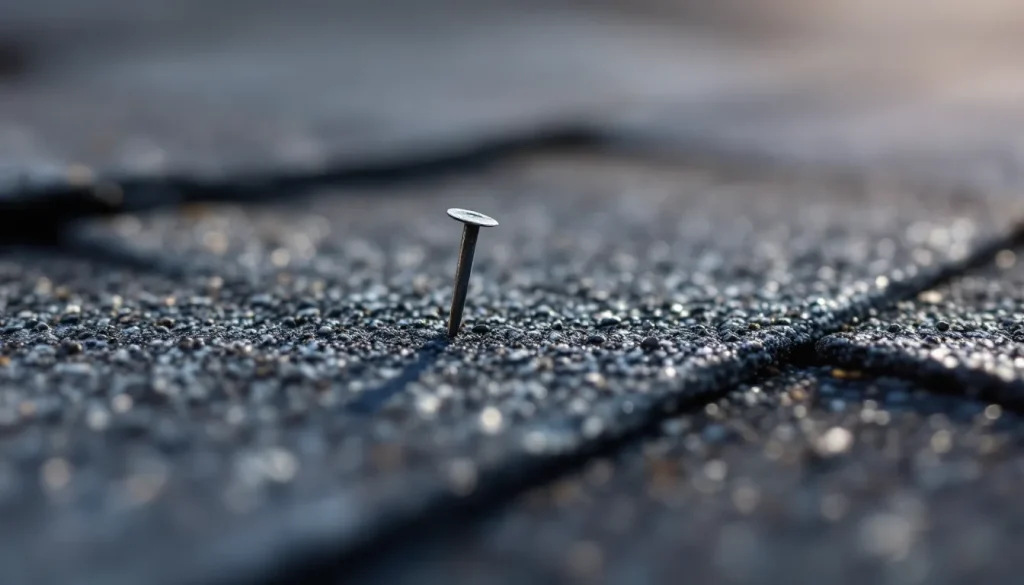
The nail pops on shingles you are seeing are nails that have backed out of the roof deck and pushed the shingle above them upward, creating a visible bump or a lifted tab. Three things cause it: thermal cycling that walks the nail back out of the wood, decking shrinkage in homes built with green lumber, or the wrong nail length used at original install. Most nail pops are an easy two-step repair: pull the popped nail, drive a new ring-shank nail an inch or two to the side, seal the old hole. The repair runs $50 to $200 for a handful, or $250 to $600 to do the whole roof. When nail pops appear in clusters across many slopes, that is a different problem: the decking is failing and you are looking at a partial reroof.
Last reviewed: August 2026.
The short version
- A nail pop is a fastener that has backed out of the decking and pushed the shingle above it upward.
- Three causes: thermal cycling, decking shrinkage, or wrong nail used at install (too short, smooth-shank instead of ring-shank).
- Fix one or two: pull the popped nail, drive a new ring-shank nail nearby, seal the old hole with asphalt cement. About $50 to $200 by a roofer.
- Fix many: full roof nail re-strike with replacement of any failed shingles. $250 to $800.
- If pops appear across multiple slopes in a coordinated pattern, the decking is failing. Pull a shingle and inspect for rot. See rotted roof decking.
- Left alone, a nail pop becomes a leak when wind lifts the shingle and water gets under the next course.
What it actually is
A roofing nail is driven through three layers: the asphalt shingle, the underlayment, and a half-inch or thicker layer of roof decking (usually OSB or plywood). The nail head sits flush against the shingle, the shank passes through to the decking, and the point bites into the wood. A correctly driven 1.25 to 1.75 inch ring-shank galvanized roofing nail holds essentially forever in dry, sound decking, whether the covering is 3-tab or laminate shingles.
A nail pop is what happens when the wood holding the shank loses its grip. The nail backs out, slowly, in micrometers per cycle, until the head pushes the overlapping shingle upward. You see this as a small dome, a lifted tab, or in late-stage cases a nail head poking through the shingle.
The reason it walks backward and not forward: every freeze-thaw cycle and every hot-to-cold daily cycle expands and contracts the decking wood and the asphalt shingle at different rates. The nail acts as a wedge. Each cycle nudges it out by a tiny amount. Over 10 to 20 years, that adds up to a quarter inch or more, which is enough to lift the shingle visibly.
How to tell which case you have
To tell which nail pop problem you have, count the pops and read their pattern. Walk the roof or use binoculars from the ground. One to five scattered pops are normal random fastener failure. A dozen or more along one slope points to undersized or hand-nailed fasteners. Pops in lines or clusters across slopes mean the decking is moving. The pattern, not the count alone, tells you the fix.
- One to five pops scattered. Normal. Random fastener failure. Easy repair.
- A dozen or more pops along one slope. Pattern suggests undersized nails or hand-nailed slope with the wrong technique. Repair affected nails, then audit the rest.
- Pops in lines or clusters across slopes. Decking is moving. Look for delamination, sagging between rafters, or visible bowing on the surface. This is a partial reroof, not a nail repair.
- Pops only on south-facing slopes. Thermal cycling. South slope gets the most temperature swing. Repair the visible ones, expect more.
- Pops within 3 to 5 years of a new roof. Installation problem. Call the installer under workmanship warranty.
Cost to fix: what a repair runs in 2026
Nail pop repair in 2026 typically costs $150 to $300 for one to three pops, $200 to $500 for four to ten, and $800 to $1,800 for a full roof re-strike. Most roofers price it three ways: per-pop on small jobs, hourly on medium jobs, or as part of a roof inspection or maintenance call. A service-call minimum usually applies to the smallest jobs.
| Job size | Typical cost | Notes |
|---|---|---|
| 1-3 pops | $150-300 minimum | Most roofers have a service-call minimum |
| 4-10 pops | $200-500 | Usually a 1 to 2 hour visit |
| 10-30 pops | $400-900 | Half-day, often paired with inspection |
| Full roof re-strike | $800-1,800 | Every visible nail audited, popped nails reset |
| Pops + decking repair | $1,500-5,000 | Pulled shingles, replaced sheathing, new shingles. See roof deck repair cost. |
The standard nail pop repair, step by step
The standard nail pop repair follows six steps and takes a competent roofer about five minutes per nail in good conditions. You lift the shingle, pull the popped nail, seal the old hole, drive a fresh ring-shank nail one to two inches away in the nail zone, seal the new head, and press the shingle back down. The steps below walk through each one.
- Lift the shingle gently. A roofing bar or a flat pry bar slides under the tab. Warm shingles bend, cold shingles crack, so the job is done on a 50 to 80 degree day.
- Remove the popped nail. Pull it straight out with the bar. Do not try to drive it back down. The hole the shank made is already enlarged and it will pop again within months.
- Seal the old hole. A dab of asphalt roof cement (Henry 208, Black Jack, or similar) into the hole. This stops water entry through the old fastener path.
- Drive a new nail 1 to 2 inches away. Use a 1.25 or 1.5 inch galvanized ring-shank roofing nail. Drive it through fresh shingle material into fresh decking. The new nail must be in the shingle’s nail zone (the manufacturer’s strip line, not random shingle area).
- Seal the new nail head. Optional but standard. A dab of asphalt cement over the head locks it down and prevents water entry.
- Press the shingle down. Reseat the sealant strip on warm days by pressing firmly. On cool days, a heat gun helps.
The whole process per nail costs the contractor about 10 minutes of labor and 50 cents of materials. The price you pay reflects the minimum service charge, drive time, and the inspection that should come with it.
DIY nail pop repair: when it makes sense
DIY nail pop repair makes sense when the pops are reachable, the pitch is under 6/12, and you have the tools and safety gear. The procedure matches the professional version: lift, pull, seal, renail with ring-shank, seal again. Pick a 60 to 75 degree day with no wind. If the roof is steep or the pops sit high off the ground, hire it out. Here is the shopping list:
- Flat pry bar or roofing bar
- Box of 1.25 inch galvanized ring-shank roofing nails (a 5 lb box is way more than you need)
- Tube of asphalt roof cement
- Caulking gun
- Hammer (or a roofing hatchet)
- Heat gun (helpful on cool days)
Pick a 60 to 75 degree day with no wind. Use proper roof safety. If the pitch is over 6/12, hire it out. The full procedure is the same as the pro version above. The biggest DIY mistake is using a smooth-shank common nail instead of a ring-shank roofing nail. Smooth-shank nails pop again. Ring-shanks have circular barbs around the shaft that lock into the wood fiber and resist back-out.
Why nails pop in the first place
Nails pop for three root causes, listed here in order of frequency. Thermal cycling expands and contracts the shingle and the decking at different rates, walking the nail out over years. Decking shrinkage releases nail grip as green lumber dries. And the wrong nail at install, too short or smooth-shank instead of ring-shank, never held well to begin with. Each is covered below.
1. Thermal cycling
Asphalt shingles get hot in the sun. Surface temperatures hit 150 to 180 degrees F on a 90 degree day. Overnight, the same shingle drops to ambient. The shingle and the underlying decking expand and contract at different rates. Every cycle nudges the nail incrementally outward. Over a 15 to 25 year roof life, accumulated cycling can back a nail out by a quarter inch or more. Roofs finished in lighter, more reflective materials run cooler under the same sun, which is one reason hot-climate homeowners consider solar reflective shingles.
2. Decking shrinkage
Homes built between roughly 1995 and 2010 sometimes used OSB decking that was milled and installed with high moisture content. As that wood dried over the first 5 to 10 years, it shrank. Shrinkage releases nail grip. This is why nail pops are common on homes 10 to 20 years old, and rarer on much older or much newer homes.
3. Wrong nail at install
The IRC requires at least 12 gauge ring-shank galvanized roofing nails of sufficient length to penetrate at least 3/4 inch into the decking or fully through. A short nail (the 1 inch nails some discount installers use to save fractions of a penny each) has less grip and pops sooner. A smooth-shank nail (sometimes used in pneumatic nailers loaded with the wrong coil) pops at a much higher rate. If your roof was installed by the cheapest bidder in town, this is a likely cause.
What happens if you ignore nail pops
A nail pop is not an emergency, but it is a slow-developing problem that worsens on a predictable timeline. The lifted shingle catches wind, the sealant strip below breaks, the nail head eventually wears through the shingle, and water starts entering in wind-driven rain. Left long enough, that water rots the decking and forces a partial reroof. The progression, year by year:
- Month 0: Nail pops. Shingle above is lifted but the sealant strip below is still intact. No leak.
- Months 1 to 6: Lifted shingle catches wind. Sealant strip below partially breaks. Shingle flutters in storms.
- Year 1 to 2: The nail head wears through the shingle above. Now there is a hole at the nail location. Water enters in heavy wind-driven rain.
- Year 2 to 5: Persistent water entry rots the decking around the nail. Adjacent nails lose grip. Stain appears on the ceiling below. See water stain on ceiling roof leak.
- Year 5+: Localized decking failure. Multiple shingles lift in wind. Partial reroof becomes necessary.
The point: fixing a $200 nail-pop problem early prevents a $3,000 decking-repair problem later.
When nail pops mean the decking is failing
Nail pops mean the decking is failing when they appear in coordinated patterns rather than scattered randomly. Pops spaced every 8 to 12 inches along an OSB seam signal delamination. Pops following the rafter lines signal twisting or separation. Pops paired with visible sagging or waviness mean the decking is bowing between rafters. In each case the wood, not the fasteners, is the real problem. The patterns to look for:
- Pops every 8 to 12 inches along an OSB sheet seam. The sheet has delaminated and lost grip.
- Pops along the rafter lines. The rafters have twisted or the decking has separated.
- Pops associated with visible sagging or waviness. The decking is bowing between rafters.
- Pops on the underside of an unvented roof. Moisture has been condensing in the decking. Almost always tied to bathroom or kitchen exhaust dumped in the attic. See attic ventilation.
In these cases, fixing the popped nails individually does not solve anything. The decking needs to be inspected from above (pulling shingles in suspect areas) and below (in the attic). If decking is delaminated, rotted, or moisture-soaked, it must be replaced before any new fasteners hold.
Nail pops on a new roof: who pays
If nail pops appear within the first 5 years of a new roof, that is a workmanship failure and the installer eats the cost. Most manufacturers’ enhanced warranties (GAF Golden Pledge, OC Platinum Preferred, CertainTeed SureStart Plus) cover workmanship issues like nail pops for 10 to 25 years if your roof was installed by a certified contractor.
The standard manufacturer product warranty does NOT cover nail pops. It covers the shingle, not the installation. Workmanship is on the contractor or on the enhanced warranty.
If you are inside the workmanship window, call the installer in writing (email is fine, text is not), describe the pops, and attach photos. A reputable installer will come out and fix it. If they refuse, escalate to the manufacturer if you have an enhanced warranty, or to small claims court.
Can you just hammer the nail back down?
Tempting, common, and wrong. The hole the nail backed out of is enlarged and damp. Driving the same nail back into the same hole gives you maybe 6 to 12 months before it pops again. The shingle above also now has the original nail-head impression worn into it, so the seal you thought you got is not actually a seal.
The correct fix is always: pull the popped nail, drive a new ring-shank nail in fresh wood and fresh shingle material, seal the old hole. Yes, it is more work. No, the shortcut does not work.
How to prevent nail pops on a new roof
Preventing nail pops starts at installation. Specify ring-shank galvanized roofing nails at least 1.25 inches long, driven flush and inside the manufacturer’s nail zone, at six nails per shingle rather than four. The same fastening discipline applies across the whole roof, from field shingles to starter shingles at the eaves and ridge cap shingles at the peak. Spec the following with your contractor:
- 1.25 inch minimum ring-shank galvanized roofing nails. 1.75 inch is even better and only costs pennies more.
- 6 nails per shingle, not 4. Manufacturer high-wind nailing pattern. Reduces per-nail load.
- Coil nail check. Inspect the nailer coils used. They should be ring-shank, not smooth.
- Nail head flush, not over-driven or under-driven. Over-driven nails cut through shingles. Under-driven nails (the head sitting above the shingle) are nail pops on day one.
- Compressor pressure tuned to the deck. Pressure too high over-drives. Too low under-drives.
If you are watching the install happen, look at the first few shingles laid. Pull one back and check the nail. If it is set proud (above the shingle), the crew needs to adjust their pneumatic gun. If half the nails are set proud, stop the install and have the conversation.
Common mistakes that make it worse
The mistakes that make nail pops worse all share one theme: shortcuts that skip the real fix. Hammering the old nail back down, using smooth-shank common nails, lifting cold shingles too hard, skipping the asphalt cement, ignoring adjacent shingles, and misreading a patterned decking failure as random pops. Each one turns a small repair into a callback or a leak. The list:
- Hammering the nail back down without replacement. Repeats the same failure.
- Using common smooth-shank nails for the repair. Pops again in 2 to 4 years.
- Lifting cold shingles aggressively. Cracks the shingle, creates a worse leak path.
- Skipping the asphalt cement on the old hole. Leaves a direct water path.
- Repairing the visible pops without checking adjacent shingles. Most pops have neighbors developing.
- Ignoring the pattern. Random pops are nothing. Patterned pops are decking.
FAQ
Are nail pops covered by homeowners insurance?
No. Nail pops are wear and tear, which all policies exclude. Insurance pays for sudden damage from a covered peril (wind, hail, fire). A nail walking out of the decking over 15 years is not sudden.
How long do nail pop repairs last?
A correctly done repair (new ring-shank in fresh wood, old hole sealed) lasts the remaining life of the roof. The original failure mode (thermal cycling, decking shrinkage) does not affect the new nail in any significant way because it is in fresh wood.
Do nail pops show up on a home inspection?
Yes. Any inspector with binoculars sees them from the ground. They will write up the number and recommend repair. Buyers sometimes negotiate a credit. The repair cost is small relative to most other roof issues.
Can I just put a dab of caulk over the popped nail?
You can, but it is a 12 to 18 month band-aid. The caulk will fail and the nail underneath has not been fixed. The shingle above is still lifted and still catches wind. Use it as a stopgap until you can do the proper repair.
Should I repair pops before selling the house?
Yes. Cost is low and the inspection report reads better. Buyers calibrate roof anxiety based on what shows up in the report. A clean report with no nail pops calls for a happier appraisal than a report with a dozen.
Bottom line
Nail pops are common, easy to fix, and rarely a major issue on their own. Pull the popped nail, drive a new ring-shank in fresh wood, seal the old hole. $50 to $200 for a handful, $250 to $800 for a roof re-strike. The exceptions: pops within 5 years of new construction (call the installer under workmanship warranty), pops in coordinated patterns (decking is failing, see rotted roof decking), or pops accompanied by interior water staining (this has moved from cosmetic to active leak, see how to fix a roof leak). Most nail pops cost less to fix than the call-out fee suggests. Get them done.